






Photographs by Scot Facer Proctor
Christmas Eve made me breathless when I was a little girl, with almost too much emotion to contain. It wasn’t just that Santa was coming that night, though it did make the world seem inexpressibly lovely to think that someone invisible to me should know my heart and secret desires, even the ones I hadn’t told anyone.
How could Santa know I wanted doll clothes? I asked my mother, holding up a miniature coat. “Santa just knows,” she smiled. What a wonder to be known from the in side out without even having to reveal yourself.
But Christmas Eve was more to me than even that, something I never told anybody. It ignited a yearning in me, a longing that was beautiful in itself. I could feel its beauty spread through my system and expand every part. It was a sense of holiness like a memory. What I wanted was the Lord, and it seemed to me that on that night we were all as close as we ever got to having him again.
I had seen nativity scenes acted out, children with crooked halos, shepherds in bathrobes, a mother holding this year’s newest infant—but in my child’s eye view, I hoped for something more. I thought that on Christmas Eve, somewhere, in some magical way, he must be born again. Maybe it was in Bethlehem a half a world away, where reality might be counted differently than at home. Maybe if you just rounded a corner, like in the movie Brigadoon, your eyes would clear for a moment, and there he’d be, all glowing in his mother’s arms.
The whole scene would be complete, donkeys and lambs, sweet-smelling straw, shepherds and wise men—and me. He was a little infant, tender and fragile, and I was a little child, tender and fragile, too, so we’d have an understanding. I could come right up to him with nobody noticing and say how I felt and not be at all embarrassed: “I love you Jesus. I miss not seeing you.”
Then enough days passed and I grew up, largely forgetting that I had once thought it possible to visit him at the manger.
Photographing Bethlehem on April 6
“You call that work?” our friends would say whenever we were preparing to go on another journey. “We’ll volunteer to come along and just carry the camera bag.” These were familiar sentiments to Scot and me as a husband-and wife creative team who have gone with a camera to the most holy sights of the world to create books about things sacred to us.
We have slept at Adam-ondi-Ahman waiting for the first streaks of light across the morning sky, scrambled up Mt. Sinai with a tripod, and tramped through the jungles of Guatemala searching for the best candidate for Zarahemla. But one spring day in Israel stands out above all the rest.
We had wanted our photographs to capture not only the places where significant sacred events had transpired, but also the time and season, bringing the viewer right to the holy place, a participant in the scene. With this in mind, Hill Cumorah had been shot in the fall, memories of young Joseph Smith coming to get plates still lingering in the landscape. We would soon be photographing the Kidron Valley on the night of Passover, the moon casting long shadows across the place where Jesus and his apostles had walked to Gethsemane. But today was April 6, Christ’s birthday, and we were on our way to Shepherd’s Hill.
“Merry Christmas,” we said to each other through tired eyes. It was four o’clock in the morning and still dark outside. When we are on a shoot, we get up morning after morning early enough to beat the sun to the place we are planning to photograph, but we never entirely get used to it. “Anything for a picture,” we tell ourselves. “First light is worth it.”
On this occasion we awakened my mother to come with us and the three of us drove through Jerusalem’s empty streets, then south of the city to the place where shepherds had once watched their flocks by night and had been awed by a multitude of the heavenly host.
Morning was closer as we pulled our car to the top of the hill, yanked our gear out, and began picking our way across the stony field looking for just the right place to set the camera. Across a little valley about a mile wide, on a hill just opposite where we stood, was Bethlehem, still dark at this early hour. “No one knows this is the real Christmas,” we said to each other. “It’s like a secret. Everyone is sleeping and they just don’t know.”
We began to sing, “O little town of Bethlehem, how still we see thee lie.” The three of us made a small chorus on the hill and wondered how it was that we should be so blessed to know. Where were all the others who could be here celebrating a day of such importance?
Our voices were the only sound we heard. “Above thy deep and dreamless sleep the silent stars go by.” We ran through our repertoire of carols until we heard the first crowing of the roosters, signaling that dawn was near—and then the hurry, the scramble to have the right lens, the right angle, to be perfectly in focus for the light before it broke across the landscape.
As we were on a northern hill, with Bethlehem on the southwest, the village was the first to catch the light, which then crept slowly toward us. Bit by bit, the scene which had been painted in hues of gray and blue became illuminated. Then we could see ambling stone walls, the caves that pocked the hillsides. The colors changed, the rock houses of Bethlehem becoming amber in the sun, the hills brushed with dusty olive. Bright red poppies, which had been closed in the cool night, now stretched open to the light.

God Reveals Himself in Symbols
Of course, it would have been like this we though—of course his birth would be in the spring, a season of new life. He had told us that “all things are created and made to bear record” of him (Moses 6:63). So no other season would do. The image of a snowy Christmas where your breath hangs like a cloud in the air before you and the ground is thick with snow was quickly slipping away. The shepherds had been out watching their flocks by night because it was the season of new lambs that needed their special protection. The earth was green and growing again after its little season of death to symbolize him who came to give life more abundantly. Of course his birth was in the spring.
God reveals himself to us not just in words, but also through the earth itself and the very shape our experience takes. It is as if all things, including the events in our lives, are constantly pushing on our spirits, saying, “See. See. Here is a type of Christ—but only if you have eyes to see.” Here we were in Bethlehem where the very land echoes with his presence, where his image is in every rock and tree, and we could see the witnesses everywhere.
The word Bethlehem itself means “House of Bread” in Hebrew, and he came to be the bread of life. Bread is the perfect symbol to speak to us needy mortals, who get our fill of bread only to need it once again. Then, too, Bethlehem was the home of David, the shepherd who was also a king. From Bethlehem flowed the waters that quenched the thirst of all Jerusalem, and Christ was the living water. Even the fields crusted by stones were a symbol of him and celebrated his coming. “Wherefore, I am in your midst, and I am the good shepherd, and the stone of Israel” (D&C 50:44). We saw him on the left and on the right, before us and behind us.
Rural Sounds
With the light came the early morning sounds. His newborn cry must have carried on the air with noises just like these. Sheep were bleating on the hillsides, birds sang, dogs barked, and somewhere across the way a stubborn donkey, who didn’t want to start a day of work, was braying his complaint.
These were rural sounds, village noises, sounds of life spilling into the air that hadn’t changed in two thousand years. “It was like this,” we thought, “just like this.” No hush for his coming. No pause in the routine. People went on about their work, unnoticing. He added his baby cry to a thousand sounds to join us in life. If we listened hard enough even now, we could probably hear a baby cry.
We took our pictures, moved the camera to a different angle and snapped again, but the images printed on our souls were the most vivid—a scene bearing record of him. It would have been gift enough had the day ended there, but there was more.
Same Spot, Later that Day
Photographers don’t usually take pictures during the flat light of day. Scot’s work is accomplished in the first light of morning and the last light of night. Noon offers no shadows or plays of light, no nuances that make a picture sing. So that late afternoon we came back to the same spot to complete our shot list.
We needed to get a photograph of a flock of sheep; we hoped to snap a picture of a little lamb—a picture we had been trying to get for weeks. Lambs don’t cooperate, fleeing in terror before the camera. Finally, we hoped to get a night shot of Bethlehem, nestled on the hill under starry skies.
The sheep were first on the list. The sun was low in the sky as we scrambled over one stone wall with our gear and then sat on another, watching a family of Bedouins tending their flocks. Suddenly we heard an explosion, felt the ground rumble, and quickly turned to the east to see smoke rising from the trees.
Our mother and our daughter Laura, who were resting in the car, had heard the sound too. “That must have been a sonic boom,” they said almost simultaneously, each hoping the other would be comforted by the bad guess. It hadn’t been.
A mortar shell had landed a few hundred yards away, and though it may have been just a military maneuver. It was a grim reminder that this place where the Prince of Peace had been born was in turmoil, a land divided, where even teachers of schoolchildren carry machine guns to guard the students, and the military is a constant presence. Was it safe to stay for our pictures? Should we go? But this was April 6 and we had pictures yet to take. A little shaken, we turned back to the sheep, who grazed in friendly clusters before us.

We took several pictures of the sheep, the wooly silhouette of their bodies outlined in flame in the setting sun. One little lamb pulled away from the flock, scampered up a rocky ledge and turned back long enough for a photograph.
Sheep are helpless creatures, without defenses, unable to protect themselves against roaming solves or nighttime predators. God gave porcupines quills and cheetahs speed, but sheep he left vulnerable. They are perfect symbols for humanity without the Lord. That is why they need a good shepherd who will stay with them in all kinds of weather and at nighttime lead them into a fold and sleep across its only gate.
Burned by the sun and parched in the wind, the shepherd has a job that isn’t glamorous or picturesque, but the sheep cannot survive without him. To them, he is good. He is constant. His sheep know his voice when he calls them forth from their fold again in the morning. Even if several flocks are tended together in one fold, the sheep will respond only to the voice of their master.
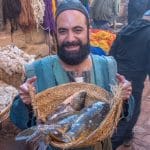
So our eyes scanned the hills for a shepherd to see what we could learn, finally fixing on a bearded man in a flowing robe carrying a lamb tenderly close to his chest, his arms wrapped around the little creature. We watched the lamb with some affection and wondered: Had this lamb strayed, been lost? The man picked his way with sandaled feet carefully across the stony hillside, down a slope and back up again, past the tent of his family to the wall where we sat.

Then in an instant the image changed. Now we were no longer being taught about the Good shepherd. He was gone. Instead we were shown why Christ was the Lamb. The Bedouin brought the submissive lamb, laid it gently on a rock, and then with a swift stroke, he slit its throat.
Tonight was their holy feast, and a lamb was needed. It was a shocking moment, completely unexpected, the reality of sacrifice suddenly vivid and graphic before us, no longer comfortably removed in to a clean and sterile abstraction. The lamb’s blood spurted and splattered and then flowed freely. Then when the little creature had squealed and struggled its last, the Bedouin tied the body to the stone wall just a few hundred feet from us. Poor little lamb. We were drawn both to look and to turn away, but turning away conquered as the wall became flooded and stained red.
Here was a lamb that had gone willingly to the slaughter. For us, it had become more than a creature of the earth. It had become the Lamb who had also gone willingly, who had suffered for our sins, “which suffering caused myself, even God, the greatest of all, to tremble because of pain, and to bleed at every pore, and to suffer both body and spirit—and would that I might not drink the bitter cup, and shrink” (D&C 19:18).
Would we ever be able to thin about the atonement the same way again? Could we comfortably distance ourselves from it? We couldn’t take a picture of the scene before us. Something about it seemed much too sacred.
By now the sun had fallen behind the western horizon. Hearing a hollow boom, we turned toward Bethlehem, whose lights now made it glow on the hillside. And there above the city, the most visible thing in the nighttime sky was a new star. It was glistening there like every Christmas picture we’d ever seen of it, lighting the way to the manger.
Since we were alone on Shepherd’s Hill, it couldn’t have seemed more personal, more designed for our own wonder on this April 6. “It’s the star. It’s the star,” we cried. “For we have seen his star in the east, and are come to worship him” (Matthew 2:2). We felt loved and noticed by the heavens, invited to the manger, not just for this evening, but for always. We had always loved the French nativity sets where more than just the shepherds and wise men have come to the stable. In them, all the townsfolk are invited, the cripple with his crutch, the newlyweds, the elderly, the merchant and stone mason. Tonight we were invited by our own star.
Though our bright star was only a military flare, to have it shot into the sky that night seemed more than coincidental. It completed our picture as it hovered over Bethlehem for some time. Had we paid a special effects team to create the picture for us, it couldn’t have more perfectly fir our imagined picture of the event. We could have hardly been more taken if we had seen the actual star two thousand years ago.
We took a photograph of it, but the film could not capture the wonder of the moment. Being a long time exposure, it revealed what our eyes couldn’t see—that the “star” was imperceptibly drifting down, leaving a trail of light behind it. We live in a weary world where sometimes stars don’t stay.
But I wanted the star to stay, wanted all the symbols that had been pressed upon my soul that day to stay like an engraving. Then I knew that sometimes children know more than adults, that all those years ago I had been right on Christmas Eve when I had thought that somewhere, somehow Christ was born again on that night. For in a way I couldn’t explain, the nativity and the atonement both happened again for me that day. I had been there. I had seen it all enacted again, felt it in my bones and sinews. And I felt to exclaim, “Shine for me, star of Bethlehem. Always shine for me.”





Elizabeth SnowDecember 16, 2014
A tour group of us, including my daughter and her parents stood on that same spot and sang, "Oh Little Town of Bethlehem". It is a moment I will never forget. Thank you for this wonderful narration. I love Meridian and read it faithfully.
Susan D'AndreaDecember 16, 2014
This is the most beautiful and most meaningful writing you have ever written. Yes, please, make it into a video next Christmas.