







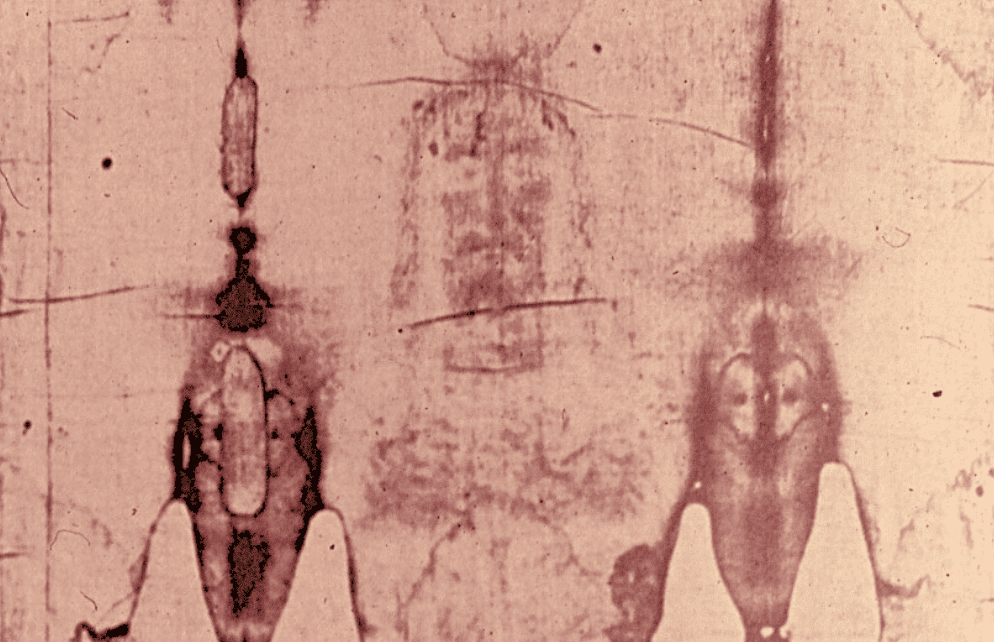


In 1978 I had a singular experience that strengthened my testimony of the truthfulness of the Book of Mormon as a sacred ancient witness of Christ. Curiously, it came from the study of a piece of cloth that is claimed by some to be a two-thousand-year-old relic. Like the Book of Mormon, others consider it merely a clever hoax.
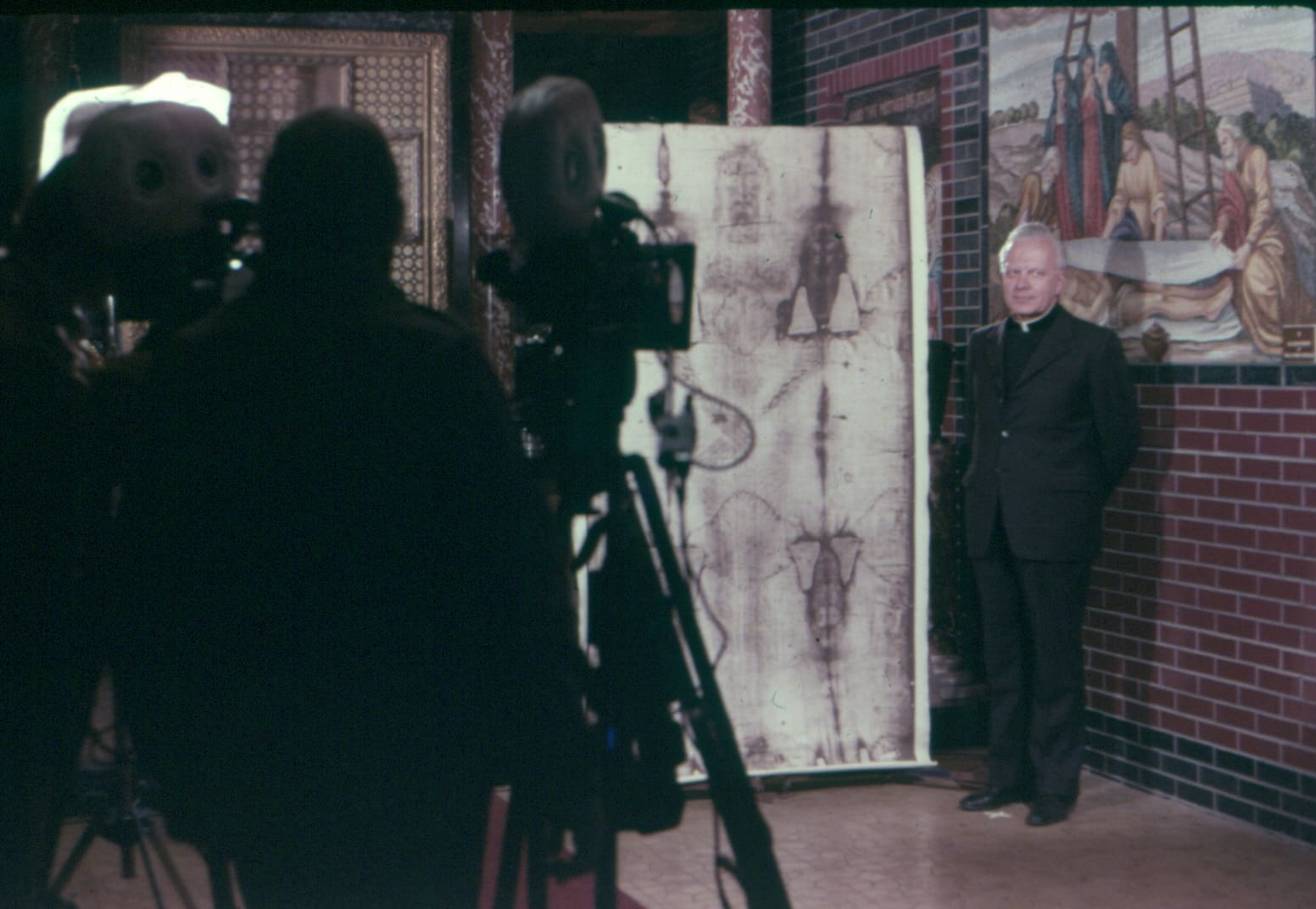
I traveled in that year to Torino (AKA Turin), Italy to film a piece of linen cloth for a documentary movie called “In Search of Historic Jesus”. The Shroud of Turin is believed by many to be the fabric that was used to cover the body of Christ when it was laid in his tomb. Others consider it to be a Medieval hoax, similar to the many “splinters of the true cross” or the dozens of fraudulent “crucifixion nails” that were foisted upon gullible believers as objects of veneration in the Dark Ages.
The modern documented history of the Shroud begins in 1354, when it was reported to have been first displayed in a cathedral in Lirey, France. Prior to that, there are legends that trace the relic from Jerusalem to Edessa, Turkey, where it was hidden in a cavity of a stone wall for centuries. It was eventually re-discovered, and was taken by conquering Christian Crusaders to Europe.
What distinguishes the Shroud from other relics, is that it bears the complete front and back full-length image of a crucified man. This faint image is not painted on the 14×4-foot cloth by any known method, but appears to have been singed or “toasted” onto the outer layer of fibers by a brief-but-powerful burst of light or radiation, a process that some scientists have described as “flash photolysis”. Scientists at Los Alamos Scientific Laboratory and elsewhere have theorized that the re-animation or resurrection of a dead human body might require a massive burst of energy such as that which could have burnt the image onto the shroud.
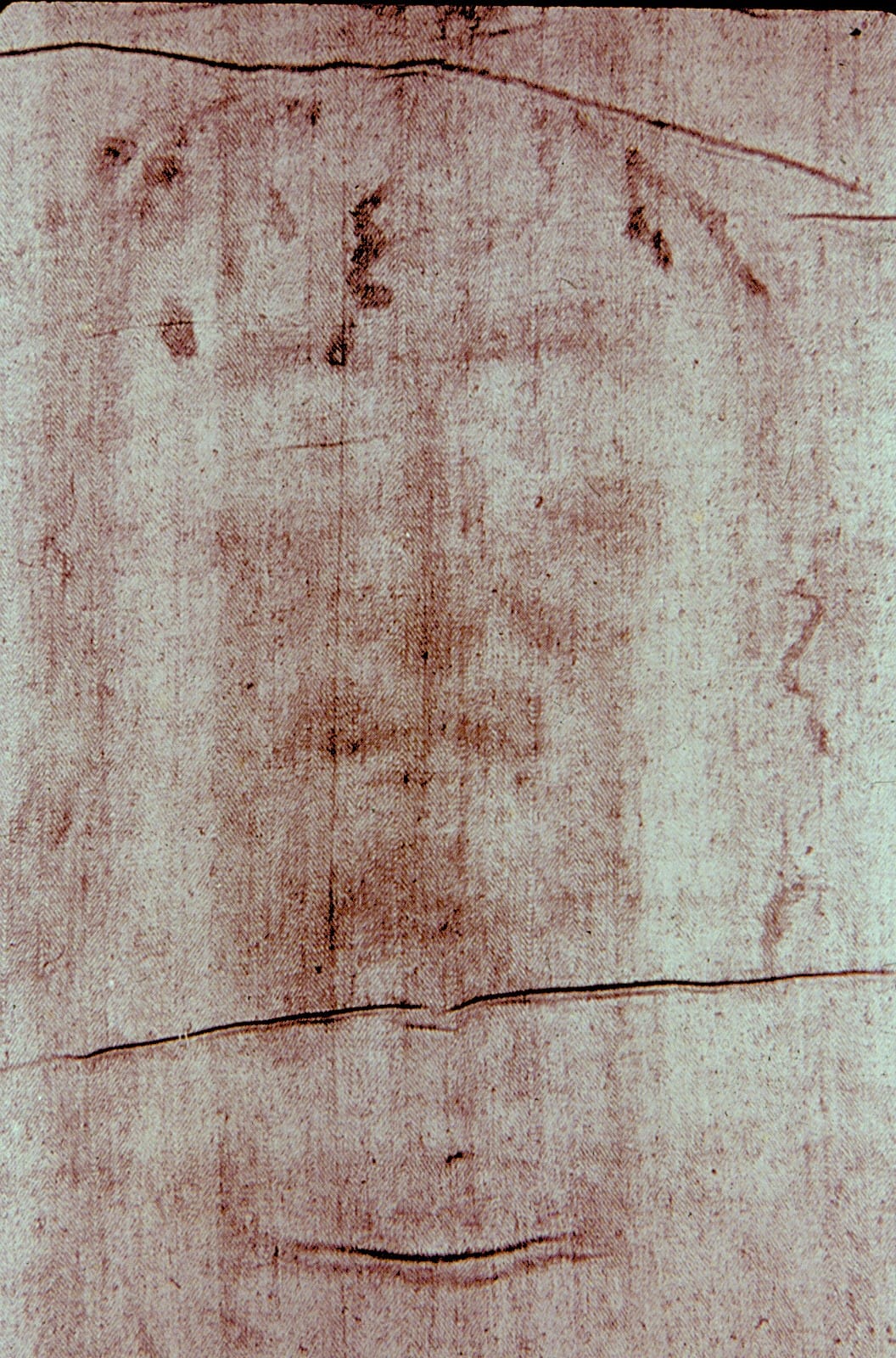
Another distinguishing element is that the Shroud depiction is a NEGATIVE image. This was discovered in 1898 when the first photograph of it was taken by Secondo Pia, an attorney and amateur photographer in Turin. He was astounded when he removed his large photographic film from the developing chemicals and held it up to the light. What he saw on the negative film was a POSITIVE photo of what he believed to be the face of Jesus. Of course the photographic process was totally unknown when the modern history of the Shroud began in 1354, and would have been impossible to depict by a forger in that era.
Although there are other examples of textiles that have survived for thousands of years, this cloth with a complete anatomically correct image of a crucified man is unique in all the world. I filmed an interview for the documentary with Professor James Cameron, a crime scene investigator (CIS) with Scotland Yard who had spent years in study of the artifact. He explained that while marks of the scourging and crucifixion depicted in the image on the Shroud matched perfectly the Biblical accounts, there were anatomical details shown that would not have been known by a 14th-century forger. And while carbon-14 dating results from the fibers have so far been inconclusive and controversial, other evidences such as the type of fiber, the weaving style, sizing chemicals, and pollen grains imbedded in the cloth seem to place its origin authentically in a First Century Middle Eastern context.
Of course the crucifixion of Christ was not unique. The Romans crucified thousands of victims. But his supernatural resurrection to an immortal state definitely was without precedent. If the Shroud of Turin is what many scientific scholars believe it to be, it would seem to certainly qualify as “another testament of Jesus Christ” physically, and more importantly, of his divinity.
The gold plates from which the Book of Mormon were translated are reported to have been buried for centuries in a stone box, to come forth at a later date. The Book of Mormon, like the Shroud, gives testimony that Jesus Christ was crucified and then supernaturally resurrected.
It states that the risen Christ appeared to thousands of his “other sheep” who lived on the American continent and elsewhere. The historicity of that claim is supported by many Native American oral histories that speak of a “white and bearded god” who visited many different peoples and cultures throughout the Americas around 33 A.D. This supernatural being was known by various names, but as he healed the sick and the lame, raised the dead, and taught a kinder, gentler way of life, the comparisons with Jesus are unmistakable. He even told some of them that he had been crucified in a distant land, and that he had risen after three days in a tomb.
The methods we might use to test the validity of the Shroud of Turin and the Book of Mormon are different. Various physical forensic tests have told us much about the Shroud, and they continue to reveal its secrets as time goes on and as scientific methods improve. We do not have access to the gold plates, but we have the sworn affidavits of multiple well-qualified and respected witnesses as to their existence. And we have the text itself of the translation, which has been credibly examined and tested for almost 200 years using tools of linguistics, archaeology, history, geography, and computer wordprint analysis. Hundreds of alleged “anachronisms” or difficulties that many thought to be evidences of a hoax when it was published in 1830 have been resolved by further study and modern discoveries and scholarship.
In 1982, the publishing title of the Book of Mormon was revised to include the phrase, “Another Testament of Jesus Christ”. We believe that when the Ten Lost Tribes of Israel return, their records will also bear witness of the Savior. When Jesus departed from the Americas, he said that he had still more “other sheep” to visit, and perhaps their records will soon come forth as more testaments to his divinity.
Is it possible that the shroud that wrapped his body in the tomb has ALSO been preserved to be physical evidence – a witness of his divinity and his supernatural resurrection? As Jesus himself said, “in the mouths of two or three witnesses every word may be established”. (Matthew 18:16)
END
Note: For more information, watch the YouTube video, “A Latter-day Saint Explains the Shroud of Turin”. https://youtu.be/Vm3QcAu23P0
Robert Starling has been a writer and producer for the NBC Television Network, and has worked at Schick Sunn Classic Pictures, Osmond Productions, and the media production department of The Church of Jesus Christ of Latter-day Saints. He has served in various writing and producing capacities on feature films such as: “Jack Weyland’s Charly”, “In Search of Historic Jesus”, “Tears of a King”, “Scout Camp: The Movie”, and “Abandoned Mine”. His book “A Case for Latter-day Christianity” is available in many bookstores, on Barnes and Noble, and on Amazon.com in printed and e-book versions. A free .pdf version is available upon request at [email protected] . He lives in Riverton, Utah with his wife Sharon. They have four adult children and eleven grandchildren.







Particle ManNovember 13, 2024
The following more recent discussions, which feature much of the same material as the 1985 talk, address subsequent technological advances and provide further insights. "Is the Shroud of Turin authentic? (Yes, here's why)" https://www.youtube.com/watch?v=oM9a45ANjiI "The Shroud Reveals New Insights on Jesus" https://www.youtube.com/watch?v=cEl9KyZBA4g
Richard EastwoodNovember 12, 2024
According to John 20: 5-7, there was not one pice of fabric in which the Savior was wrapped, but several. Verse 7: "And the napkin, that was about his head, not lying with the linen clothes but wrapped together in a place by itself."