







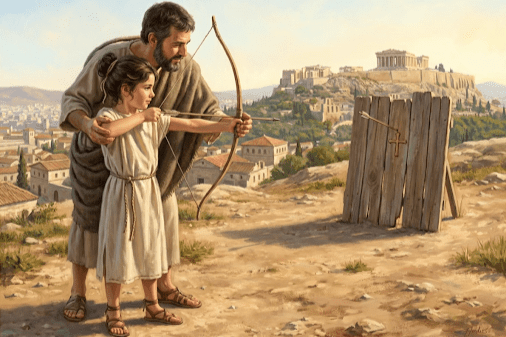


The hill above Athens smelled of sun-baked dust and crushed thyme. It was a place for boys with spears, but this afternoon the trampled earth held only a small girl, her toes gripping the dry ground through worn sandals.
Iris was eight. The bow was nearly as tall as she was.
“Hold it so,” her father said. His hands, rough from shaping clay, wrapped around hers. He turned her wrists and straightened her elbows with a potter’s gentle precision. “Lift your eyes. Do you see the mark?”
She squinted at a charcoal circle painted on a battered board. “I see it.”
“Good. Breathe in. Draw back. When you breathe out, let go.”
The string bit into her fingers. Her arms trembled under the tension. She released.
The arrow jumped sideways, fell short, and stuck in the dirt.
“Hamartan,” Theo said. “You missed.”
Iris scowled. “You say it like the arrow did something wrong.”
He walked with her to retrieve it. “Before the apostles used that word for our souls, it belonged here. A stone that flies crooked, an arrow that sinks into the dirt—that is hamartia. Missing the mark.”
“Then I am very… hamartia,” Iris muttered.
“You missed,” he corrected. “That is not the same as being a mistake.”
He handed her the shaft. She groaned but took her stance. This time the arrow flew high, sailing over the target to vanish in the weeds.
“Hamartan,” she said quickly. “I missed again. It is the wind’s fault.”
“Is it?”
“And my arms are too small. And the bow is too big.”
He smiled. “Come, my Iris.”
They hunted through the dry grass until they found the arrow. Back at the top of the hill, Theo sat on a stone and Iris climbed onto his knee. Below them, the city flashed white in the sunlight. The theater lay like a half-bowl scooped out of the hill.
“You see the theater?” Theo asked. “That is where men wear the great masks. From here they look like heroes. Up close, you see the cracks in the clay.”
He grew quiet. “You say the wind made you miss. If that were all hamartia meant, God would not weep. A rock rolls downhill because it must. A lion kills because it is a lion. We do not call the rock wicked or the lion cruel.”
“So… we are not rocks?”
“No.” He tapped her chest. “We are archers. We can choose where to aim. Our hearts were made like bows—to send our love toward God, the One who builds us. That is the true target. When we aim at other things, and pretend we have done well—that is hamartia in the dark way the apostles speak of it.”
She twisted the arrow in her hands. “But I didn’t want to miss.”
“Today, no. But often men miss and do not care. Or they choose an easier mark. They spend their strength shooting at money, or praise, or being important. Then they put on a mask so the world will clap.”
“Like the actors,” Iris said. “Pretending to be kings.”
“Just so. Sin is missing the true mark, and hiding behind a painted face.”
Iris was quiet. “Then… hamartia is lying too?”
“It is a lie told to the sky,” Theo said. “But come. I will show you.”
He moved the target board closer, then produced a tiny pot of black paint and a reed brush.
“Stand where you like,” he said. “Do not look at the circle. Just shoot.”
She giggled, hopped back, and let the arrow fly without aiming. It thudded into the far corner of the wood.
“Ugh!,” she admitted.
“Wait.” Theo set the board down, the arrow still quivering in the corner. He handed her the brush.
“Paint me a target.”
“Around this?” She stared. “But the real circle is over there.”
“Never mind the real circle. Draw a new one. Make this arrow the middle.”
She blinked, then grinned. Carefully, she painted rings around the shaft.
“There,” she said. “A bull’s-eye!”
“Did your arrow fly straight?”
She hesitated. “No.”
“But now it looks perfect. You have turned a miss into a victory with a pot of paint.”
Her smile faded.
“This is the trick of pride,” Theo said. “We fire where we please. Then, instead of saying, ‘I missed the true mark,’ we draw a new circle around what we have done and call it good. We say, ‘This is just how I am. This is natural.’ We move the target instead of the aim.”
A breeze from the sea lifted the edge of his cloak.
“So,” she whispered, “when you tell me I missed, you are glad I didn’t also lie?”
“Yes.” His voice was firm. “Better a thousand honest misses toward the true mark than one clever lie that says the wrong mark is right.”
Iris looked from the painted board to the blazing Acropolis. She imagined the whole city doing it—everyone wearing masks, everyone drawing targets around their own arrows.
“Is that why you follow the Christ?” she asked. “Because you were painting circles?”
“When Paul came to the hill of Ares,” Theo said, “he spoke of a Man whom God raised from the dead. I saw then that He is the true center. The only arrow that ever flew straight. And I realized I had spent years drawing circles in the dust around my own choices.”
He walked to the board and scraped away the wet paint. In its place, very small, he scratched a cross—two lines cutting deep into the wood.
“This is the mark now. Not praise, not being a clever potter. Christ Himself. To be healed of pride is not just for God to say, ‘I will forget your misses.’ That would leave you facing the wrong way. It is for Him to turn you around. To take your hands and teach you to aim at Him.”
“But I am only eight,” Iris whispered. “My hands shake.”
He knelt, leveling his eyes with hers. “The city will tell you that you are only your feelings. That when you are angry, you were bothered; when you are greedy, it is only fair. It sounds kind, but it is a prison. It says, ‘You are a rock; you cannot help where you roll.’”
“That is not kind,” she said.
“No. The Christ speaks more highly of you. He says you are a creature who can choose. You can miss—because you can aim. That is why He calls you to repent. To turn. You are not a stone; you are an archer who can hand Him the bow.”
“And if I give it to Him, will I hit the mark?”
He smiled. “Not always. Not yet. Your arrows may still tremble. But they will face the right way. And when you miss, you will not paint circles to pretend otherwise. You will say, ‘Lord, I missed. Teach me to shoot again.’”
He pressed the bow back into her hands and stood behind her, his arms enclosing hers.
“Now,” he said softly. “Once more. No tricks. No painted circles. Just the true mark.”
She nocked the arrow, feeling his steady breath at her back. Together they drew the string. Her small fingers ached, but his large hands held the weight.
“Look,” he whispered. “Do you see the cross?”
“I see it.”
“Then aim there.”
They loosed. The arrow flew—not perfect, but true—striking the board a finger’s width below the cross.
“I still missed,” she said.
“Yes,” Theo answered. “But you missed while aiming at the Light. That is the beginning.”





Brad BFebruary 26, 2026
This is an inspired parable that will teach the true meaning of "missing the mark." Thank you for sharing. And I thank you for my grandchildren.
Douglas K ThompsonFebruary 26, 2026
Looking at the full tale, she missed blaming her weakness, and was counseled. The next attempt she missed blaming the wind, and was counseled. Another attempt hit the target but not the right mark, more lessons and counsel. Another mark (cross) drawn, another miss but much closer (a fingers bredth away). This tale does not end here - it's open to pondering. Perhaps through humble repentance, continued study, application of lessons learned, perseverance in honing our abilities . . . we will hit the mark someday. Until then, strive to improve every day...