







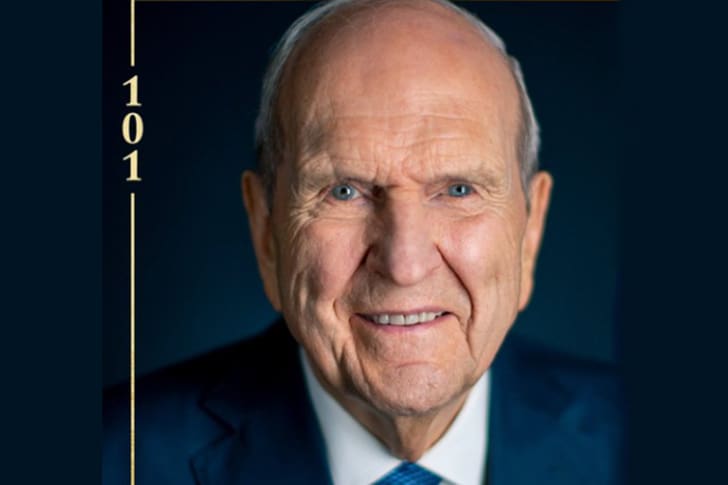


In a 700-word Idea piece written for Time Magazine to celebrate his 101 birthday, President Nelson hit just the right note. As the oldest-living religious leader in the world, he said he’s witnessed changes “from the telegram to the Instagram” and seen wars and peace, and the Great Depression. Through it all he affirms, “What I have learned is that some truths do not change. These enduring truths are what anchor us in turbulent times.”
This is a bold statement in a “my truth/your truth” culture, where subjectivity claims that there is not universal right or wrong—only what’s right for you. It is reassuring and affirming in a time when what was once considered universally wrong is now justified if it serves personal happiness. People pick and choose values like items in a shopping cart. Truth has been reframed as social construct, dependent on power, culture, or language. The result is a world that has lost its anchor.
When President Nelson speaks about the enduring nature of truth, it is not only from age, but from the power of spending forty years on the cutting edge of medical science and another 40 years as an apostle and then a prophet.
In heart surgery, it had been conventional wisdom that a heart should not be touched or it would stop, but, Dr. Nelson and his colleagues learned that by carefully balancing sodium and potassium “the heart could be stopped, repaired, and revived.”
“I still remember a professor asking me years later, ’But what if it doesn’t work?’ My answer was simple: It always works. This is one example—despite longstanding beliefs—or an irrefutable truth.”
What President Nelson proclaimed in his article to the whole world essentially is that truth is truth. We can attempt to twist it, smash it, rationalize it, abolish it, cancel it, but it is there, not only in science but as it pertains to humanity.
He said, “Later, as a faith leader, I came to understand that the human spirit flourishes when nourished by divine truth as well.”
Now, much of what President Nelson wrote was drawn from talks the faithful have heard from him in the past, when he has spoken like King Benjamin and we have pitched our tents around the tower to hear. We’ve heard these sentiments in General Conference.
In a magazine like Time, however, which has shaped American’s perceptions for more than hundred years, he is speaking more like Paul in the marketplace at Athens. to the world. Time’s circulation is 1 million copies (combining print and digital), with the probability of 10-15 million readers. Some claim that with all platforms combined they have a much larger global reach.
In addition to proclaiming that truth is and endures, President Nelson has two more messages particularly meant for our time. The first is that “Each of us has inherent worth and dignity,” and the second is “Love your neighbor and treat them with compassion and respect.”
Thus he makes a plea to our dizzying and divided world where the snarkiest comments win the most attention and the loudest voices gain the most power. This anger which explodes in politics and media, and also diffuses to the most personal level can be changed.
President Nelson says, “Imagine how different our world could be if more of us were peacemakers—building bridges of understanding rather than walls of prejudice—especially with those who may see the world differently than we do. I have seen bitter divisions soften when neighbors chose to listen to one another with respect rather than suspicion. Even small acts—like reaching out across lines of faith, culture, or politics—can open doors to healing. There is power in affording others the human dignity that all of God’s children deserve.”
In this time when “loneliness and isolation are rising around the world, families—though never perfect—remain one of life’s strongest sources of stability and meaning.” How telling that the prophet should mention this when the U.S. Surgeons General issued a 2023 advisory saying that loneliness has reached “epidemic” levels.
So in a very few words, President Nelson addressed the major ills of our time. He said what a prophet would say—with love and ended with testimony.
“My faith teaches me that over two millennia ago, Jesus Christ preached these same laws of happiness.”







Carol AnnSeptember 8, 2025
Profound!!