









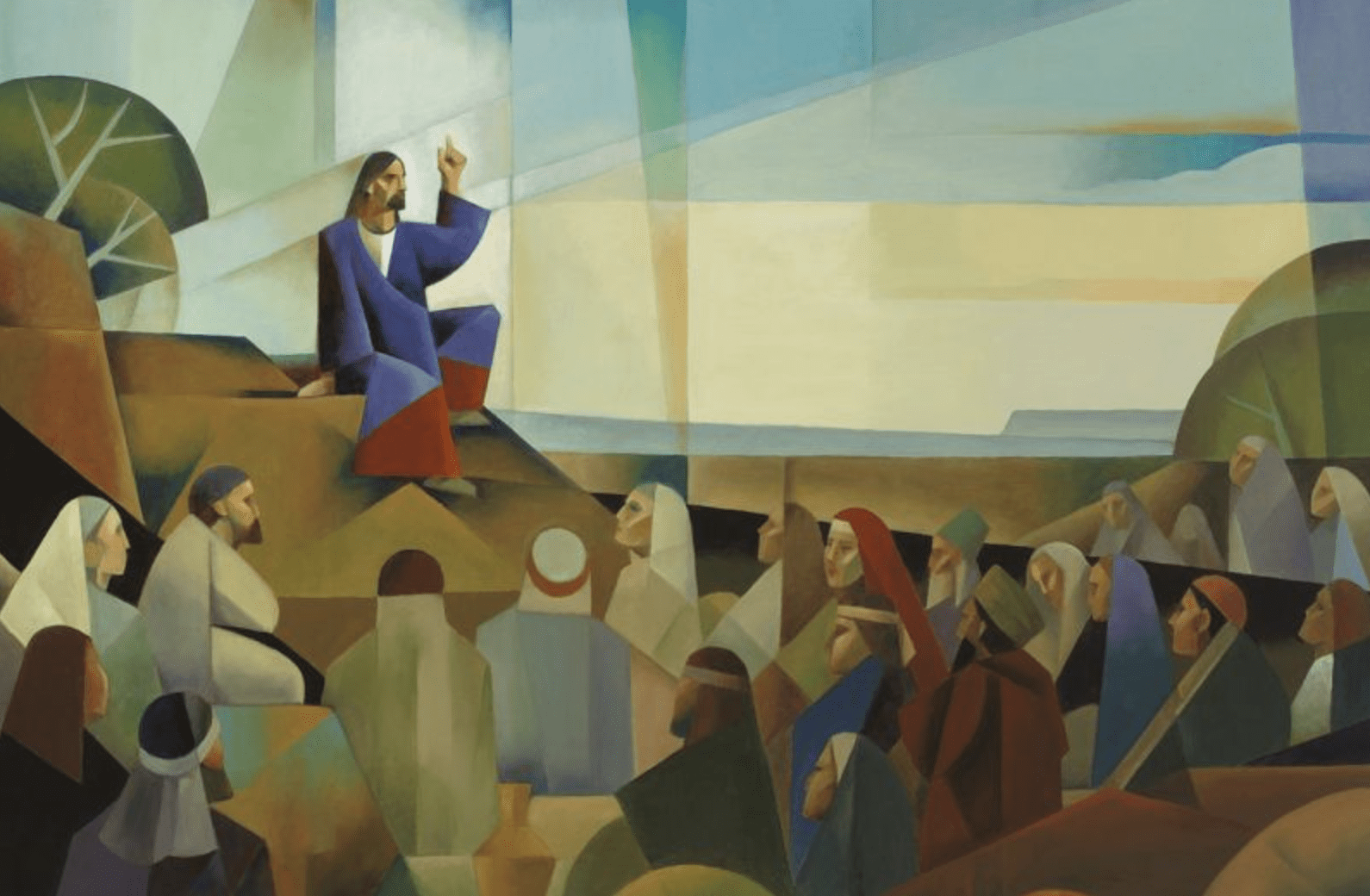


Cover image: The Sermon on the Mount by Jorge Cocco Santángelo via ChurchofJesusChrist.org.
Some who think Joseph Smith wrote the Book of Mormon use the Sermon at the Temple in 3 Nephi 12-18, as evidence of plagiarism. They claim these chapters are too similar to the Sermon on the Mount in Matthew 5-7.
Three points:
- It is logical that the teachings of Jesus would be similar wherever He spoke, which does not indicate plagiarism but revealed truth.
- Since the King James Version of the Bible was familiar to Joseph, it seems logical that the words on the Urim and Thummim he read aloud to his scribes would be in the scriptural language with which he was familiar.
- This is discussed at length in a KnoWhy article at Scripture Central:
-
-
- Joseph Smith’s ordinary language likely included some biblical expressions that were common in the early 1800s. Under the theory that he was responsible to express the ideas on the plates using his own words and phrases, it is possible that some of the biblical phrases could have appeared in the translation without his thinking about (maybe not even being aware of) where they appeared in the New Testament (as perhaps Galatians 5:1/Mosiah 23:13; Ephesians 6:4/Enos 1:1; Philippians 2:12/Mormon 9:27).
- Joseph Smith may have memorized or learned by heart some common New Testament passages which the Spirit then called up from his mind as they were then woven into the translation because they made good translational sense appropriate in that context.
- The idea that Joseph Smith opened a Bible, located, and read from the Bible as he went along seems completely unlikely, for several reasons: (1) There is no evidence that he had his own Bible before the end of 1829; (2) eye-witnesses, such as Emma, said that he used no books, notes, or Bible in dictating the English words of the Book of Mormon; (3) no witness or close associate involved in any way in the coming forth of the Book of Mormon ever claimed that Joseph had or used a Bible; (4) no hostile observers ever report or suggest that Joseph had a Bible while translating; (5) if Joseph were using a King James Bible, he would have to have done extensive study and alteration of the text before dictating, due to the complex composite quotations, blending of texts, and sometimes extensive but precise modifications made to the quoted biblical texts.10
- Various lines of scriptural, linguistic, and historical evidence suggest that Joseph Smith was not responsible for the English language of the translation, and that it was instead revealed to him word for word.11 In this scenario, it is possible that whatever divine process was responsible for producing the English translation was also responsible for extensively integrating relevant New Testament phrasing into the text. This “revealed words” approach accounts well for the fact that not only are there short phrases from the New Testament found in the Book of Mormon but also long verbatim quotes. The complexity of how these longer quotes are sometimes woven in and adapted to the Book of Mormon narrative makes the idea that they were coming from Joseph Smith’s memory seem inadequate. Keeping in mind that Joseph Smith was most likely not using a Bible during the translation (as discussed above), the presence and nature of these biblical quotations can be seen to support this theory.
-
3. Though very similar, the two sermons have significant differences. Before doing a verse-by-verse comparison of the two sermons to uncover any evidence of plagiarism, I would like to call Emma Smith as a witness.
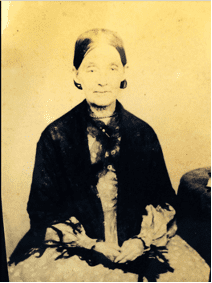
(Photo of Emma Smith, mid-1870s.)
Emma was one of Joseph’s scribes as he dictated the text of the Book of Mormon. In an interview with her son Joseph Smith III, she testified of how the text of the Book of Mormon came to be. When the interview took place, it had been thirty-five years since Carthage, and she was married to Lewis Bidamon. The date of the interview is early 1879. She passed away April 30, 1879. The transcript was published in “The Saints Herald,” October 1, 1879.
Joseph III: What of the truth of Mormonism?
Emma: I know Mormonism to be the truth; and believe the Church to have been established by divine direction. I have complete faith in it. In writing for your father, I frequently wrote day after day, often sitting at the table close by him, he sitting with his face buried in his hat, with the stone in it, and dictating hour after hour with nothing between us.
Joseph III: Had he not a book or manuscript from which he read, or dictated to you?
Emma: He had neither manuscript nor book to read from.
Joseph III: Could he not have had, and you not know it?
Emma: If he had had anything of the kind, he could not have concealed it from me.
Thank you, Emma and Joseph Smith III. Now let’s set the stage for the two sermons.
Where did the sermons take place?
The Sermon on the Mount took place on a hillside overlooking the Sea of Galilee.
The Sermon at the Temple took place at or near the temple in Bountiful, in ancient America. The temple likely resembled Solomon’s temple following the pattern established. “And I, Nephi, did build a temple; and I did construct it after the manner of the temple of Solomon save it were not built of so many precious things; for they were not to be found upon the land, wherefore, it could not be built like unto Solomon’s temple. But the manner of the construction was like unto the temple of Solomon; and the workmanship thereof was exceedingly fine” (2 Nephi 5:16).
How many people attended the sermons?
Sermon on the Mount: more than 5,000
Sermon at the Temple: about 2,500
Who attended the sermons?
Sermon on the Mount: Jews, Gentiles, believers, non-believers, friends and foes
Sermon at the Temple: In Bountiful, Jesus spoke to a more prepared and spiritual audience. Many wicked Nephites/Lamanites had died in the natural disasters, and the survivors had been significantly humbled by the devastation. Most importantly, the previous day, at the Savior’s invitation, the people gathered at the temple had felt the nail prints in his hands and feet and had thrust their hands in his side. The people were ready to receive higher doctrine. Their testimonies were sure. They knew.
Why are the verse numbers the same in Matthew 5 and 3 Nephi 12?
The original manuscripts for both accounts had no chapters or verses. These were added later. According to Wikipedia, Archbishop Stephen Langton in the early 13th century devised the numbering system still used in the Bible today. The Book of Mormon numbering system was created in 1879 by Elder Orson Pratt, which he patterned after the King James Bible for easier reference (https://www.churchofjesuschrist.org/study/manual/about-the-scriptures/history?lang=eng#title19).
Differences in Matthew 5:3 and 3 Nephi 12:3
Bible: “Blessed are the poor in spirit: for theirs is the kingdom of heaven.”
Book of Mormon: “Yea, blessed are the poor in spirit who come unto me, for theirs is the kingdom of heaven.”
Differences in Matthew 5:6 and 3 Nephi 12:6
Bible: “Blessed are they which do hunger and thirst after righteousness: for they shall be filled.”
Book of Mormon: “And blessed are all they who do hunger and thirst after righteousness, for they shall be filled with the Holy Ghost.” (The people assembled on the hillside in Galilee didn’t know with what they would be filled or for what they were hungering and thirsting. The Nephites did and were promised the Holy Ghost.)
Differences in Matthew 5:10 and 3 Nephi 12:10
Bible: “Blessed are they which are persecuted for righteousness’ sake: for theirs is the kingdom of heaven.”
Book of Mormon: “And blessed are all they who are persecuted for my name’s sake, for theirs is the kingdom of heaven.” (The two references would be more similar if the New Testament version read: “Righteousness’ sake,” capitalizing Righteousness to specify for Jesus’ sake.)
Differences in Matthew 5:14, 16 and 3 Nephi 12:14,16
Bible: “Ye are the light of the world. A city that is set on an hill cannot be hid…. Let your light so shine before men, that they may see your good works, and glorify your Father which is in heaven.”
Book of Mormon: “Verily, verily, I say unto you, I give unto you to be the light of this people. A city that is set on a hill cannot be hid…. Therefore let your light so shine before this people, that they may see your good works and glorify your Father who is in heaven.”
(Jesus Christ, the Light of the World, promised light to the Nephites. His pronouncement, “I give unto you” is an endowment of power. “This people” may have a double meaning: the people within your sphere of influence with whom you interact often and people of the House of Israel.)
Differences in Matthew 5:19 and 3 Nephi 12:19
Bible: “Whosoever therefore shall break one of these least commandments, and shall teach men so, he shall be called the least in the kingdom of heaven: but whosoever shall do and teach them, the same shall be called great in the kingdom of heaven.”
Book of Mormon: “And behold, I have given you the law and the commandments of my Father, that ye shall believe in me, and that ye shall repent of your sins, and come unto me with a broken heart and a contrite spirit. Behold, ye have the commandments before you, and the law is fulfilled. (Jesus taught the Nephites the law and the commandments are His Father’s. Also, He used “a broken heart and a contrite spirit,” which is found seven times in all scripture: six times in the Book of Mormon and one time in the Doctrine and Covenants 59:8.)
Differences in Matthew 5:20 and 3 Nephi 12:20
Bible: “For I say unto you, that except your righteousness shall exceed the righteousness of the scribes and Pharisees, ye shall in no case enter into the kingdom of heaven.” (No more is required of you except that you be better than the scribes and Pharisees.)
Book of Mormon: “Therefore come unto me and be ye saved; for verily I say unto you, that except ye shall keep my commandments, which I have commanded you at this time, ye shall in no case enter into the kingdom of heaven.” (Jesus set requirements above and beyond the “righteousness” of the scribes and Pharisees: The command is personal. Keep the commandments and come unto Jesus.)
Differences in Matthew 5:21 and 3 Nephi 12:21
Bible: “Ye have heard that it was said by them of old time” is one of six examples in which Jesus referred to hearing the word of God” (Matthew 5: 21, 27, 31, 33, 38, 43).
Book of Mormon: “Ye have heard that it hath been said by them of old time, and it is also written before you.” Jesus referred to reading the word of God in 3 Nephi 12:21, 27, 33, 38, 43. (The people of Jerusalem at this time must have heard more than they read.)
Differences in Matthew 5:22 and 3 Nephi 12:22
Bible: “But I say unto you, that whosoever is angry with his brother without a cause shall be in danger of the judgment.”
Book of Mormon: “But I say unto you, that whosoever is angry with his brother shall be in danger of his judgment.” (“Without a cause” is missing in the Nephite account. “Without a cause” is also not in the oldest known manuscript of the Bible. “Jerome, a fourth-century Catholic priest, scholar, and translator of the Latin Vulgate Bible, stated: “In some codices [manuscripts] ‘without cause’ is added; however in the authentic codices the statement is unqualified and anger is completely forbidden, for if we are commanded to pray for those who persecute us, every occasion for anger is eliminated. ‘Without cause’ then should be deleted, since the anger of man does not work the justice of God” (https://rsc.byu.edu/how-new-testament-came-be/adding-taking-away-without-cause-matthew-522). We believe the Bible to be the word of God as far as it is translated correctly. [Article of Faith 1:8]).
Differences in Matthew 5:26 and 3 Nephi 12:26
Bible: “Verily I say unto thee, thou shalt by no means come out thence, till thou hast paid the uttermost farthing.” (The coinage used in Palestine.)
Book of Mormon: “Verily, verily, I say unto thee, thou shalt by no means come out thence until thou hast paid the uttermost senine.” (A weight of gold or silver used by the Nephites.)
Differences in Matthew 5:29-30 and 3 Nephi 12:29-30
Bible: “And if thy right eye offend thee, pluck it out, and cast it from thee: for it is profitable for thee that one of thy members should perish, and not that thy whole body should be cast into hell. And if thy right hand offend thee, cut it off, and cast it from thee: for it is profitable for thee that one of thy members should perish, and not that thy whole body should be cast into hell.”
Book of Mormon: “Behold, I give unto you a commandment, that ye suffer none of these things to enter into your heart; For it is better that ye should deny yourselves of these things, wherein ye will take up your cross, than that ye should be cast into hell.” (No bodily harm is indicated.)
Differences in Matthew 5:46-47 and 3 Nephi 12:46-47
Bible: “For if ye love them which love you, what reward have ye? do not even the publicans the same? And if ye salute your brethren only, what do ye more than others? do not even the publicans so?
Book of Mormon: “Therefore those things which were of old time, which were under the law, in me are all fulfilled. Old things are done away, and all things have become new.”
Differences in Matthew 5 and 3 Nephi 12:
Bible: “Come unto me” is found 0 times in this chapter.
Book of Mormon: “Come unto me” is found 6 times in this chapter:
3 Yea, blessed are the poor in spirit who come unto me, for theirs is the kingdom of heaven.
19 Ye shall repent of your sins, and come unto me with a broken heart and a contrite spirit.
20 Therefore come unto me and be ye saved;
23 Therefore, if ye shall come unto me, or shall desire to come unto me, and rememberest that thy brother hath aught against thee—
24 Go thy way unto thy brother, and first be reconciled to thy brother, and then come unto me with full purpose of heart, and I will receive you.
Differences in Parables in the Sermon on the Mount and Sermon at the Temple
Bible: Jesus taught the parables of the Sower: Matthew 13:1-23; the Wheat and the Tares: Matthew 13:24-30, 36-43; the Mustard Seed and the Hidden Leaven: Matthew 13:31-33; the Hidden Treasure and the Pearl of Great Price: Matthew 13:44-46; and the Gospel Net: Matthew 13:47-50.
Book of Mormon: There no parables in the Sermon at the Temple in chapter 13. Why? Jesus’ disciples in Palestine asked Him why He spoke to the people in parables. Jesus answered: “I teach them in parables: because they seeing see not; and hearing they hear not, neither do they understand” (Matthew 13:13). Jesus could speak more openly and clearly to the Nephites because of their spiritual preparation. Also, the parables Jesus taught in Palestine applied to the culture of Palestine.
I’ll end here not because there are no more evidences but because there are too many more. No plagiarism here. Rather the fulfillment of Ezekiel’s prophecy that the stick of Judah—the Bible and the stick of Ephraim—The Book of Mormon will “join one to another into one stick; and they shall become one in thine hand” (Ezekiel 37:16-17).







Heber FrankAugust 23, 2023
Excellent,. However, to be more accurate about the last point made, consider this: : “...to whom I have committed the keys of the ***RECORD*** of the stick of Ephraim;” --D&C 27:5 The Book of Mormon is NOT the Stick of Ephraim according to this verse. It is the RECORD of the stick of Ephraim. So the stick is Ephraim and those tribes that went with Ephraim at the time of the division. Likewise, the stick of Judah is the tribes of Judah and Benjamin and many of Levi,. And the Bible is the RECORD of the stick of Judah. The prophecy in Ezekiel 37:15-22 is talking about the unification of the tribes again. But when the tribes are united the sacred RECORDS they kept will also be united. So the unification of the Book of Mormon and the Bible is implicated in this prophecy just as Mormons have been saying.