









Perhaps as we begin another Book of Mormon year in Gospel Doctrine, you are saying to yourself, “Haven’t we been here before?” After all, 1 Nephi is one of the most frequently read books in all of scripture. But I have a suggestion that may help to enrich your understanding of the Book of Mormon: read the book of Deuteronomy first. What you find there will have been uppermost in the minds of Lehi and his family as they fled from Jerusalem and then tried to make sense of their long journey to a new promised land. If you want to see the world as the earliest Nephites saw it, read Deuteronomy.
How do we know what Lehi was thinking? Here a bit of historical inference is required. In the first year of the reign of Zedekiah (597 BC), Lehi had four unmarried sons and probably at least two daughters who would have married the sons of Ishmael (Nephi’s sisters are mentioned at 2 Nephi 5:6). It would be reasonable to think of Lehi as being in his thirties when the Lord first spoke to him. This means that he would have been a child or a young man in 621 BC, when one of the most dramatic events in the religious history of Judah occurred.
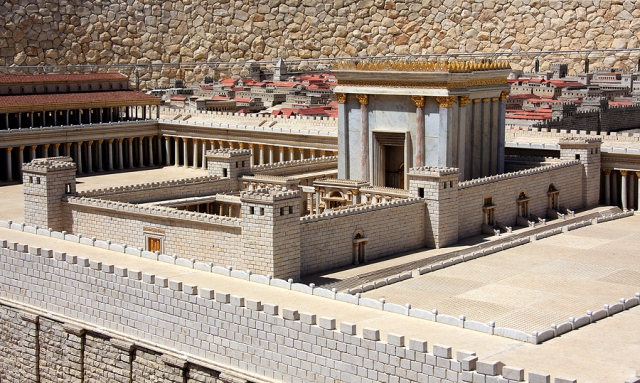
According to 2 Kings 22-23, King Josiah ordered workmen to repair and restore the temple in Jerusalem. Sometime during the renovation, the High Priest Hilkiah reported that he had found a long lost “book of the law.” When the book (actually, a scroll) was read aloud to the king, he tore his clothes in grief because he realized that the curses contained therein would fall upon his people for their disobedience. Consequently, he gathered his people for a covenant renewal ceremony:
And the king went up into the house of the Lord, and all the men of Judah and all the inhabitants of Jerusalem with him, and the priests, and the prophets, and all the people, both small and great: and he read in their ears all the words of the book of the covenant which was found in the house of the Lord. And the king stood by a pillar, and made a covenant before the Lord, to walk after the Lord, and to keep his commandments and his testimonies and his statutes with all their heart and all their soul, to perform the words of this covenant that were written in his book. And all the people stood to the covenant [which means that they all joined in the covenant]. (2 Ki. 23:2-3).
Was Lehi, who had “dwelt in Jerusalem in all this days” (1 Ne. 1:4) part of that crowd? Maybe, maybe not, but in any case, he certainly would have been aware of what came next. King Josiah launched a massive reform program throughout the land in which he destroyed and desecrated unauthorized shrines, deposed idolatrous priests, expelled temple prostitutes (!), and expunged the pagan images and vessels that had been introduced into the temple by a succession of wicked kings. And then Josiah called for a nationwide Passover celebration, something that had not been done since the time of the judges.
Scholars have long identified the mysterious “book of the law” or “book of the covenant” as Deuteronomy, or at least its central portions (verses 1:1-4:43 and chapters 31-34 may have been added later). What would it meant to a young Lehi to have been alive at a time when a key scriptural text was rediscovered? Perhaps his response would be similar to how you would feel if the Church announced that the lost 116 pages had been found and a new, expanded version of the Book of Mormon was about to be published. Assuming that he had been religiously inclined throughout his life, Lehi would have eagerly sought out all the information he could, and he would have passed those precious teachings on to his children. In fact, Deuteronomy 4:9 specifically commands parents to teach its words to their offspring. Unfortunately, at that time the scriptures were not as readily available as they are today. You can see how excited Lehi is to receive that Brass Plates in 1 Ne. 5; it seems as if he has never had his own copy before.
Now before you actually open Deuteronomy, I should warn you that there’s not much of a narrative there. The book is organized as a set of three farewell discourses delivered by Moses to his people shortly before his death and their entry into the promised land. In the first discourse (1:1-4:43), Moses reminds the people of the Exodus and their wanderings in the wilderness, and then exhorts them to obey his words. The second discourse (4:44-26:28) is a long repetition of the law of Moses as found in Exodus, Leviticus, and Numbers (with a few significant changes). This is why the book is called Deuteronomy, which means “the second law.” And the third discourse (29:1-30:20) is a covenant renewal ceremony on the plains of Moab, where the blessings for obedience are spelled out, along with the much longer list of curses for disobedience.
As the young Lehi read or heard the “book of the law” from the temple, he would have reflected on its teachings concerning idolatry, clean and unclean foods, tithes, debts, slavery, various feasts and festivals, sacrifices, proper judicial procedures, regulations for kings, the privileges of priests, cities of refuge, behavior in warfare, murder, inheritance, sexual relations, and marriage and divorce, along with the ten commandments.
These were the basic rules for organizing a society that would be dedicated to the Lord, and Lehi must have felt considerable distress as he compared the Deuteronomic commandments with the behavior of his fellow citizens in the years leading up to his prayer on their behalf that was answered by a “pillar of fire” (1 Ne. 1:6). When his own prophesying was rejected and his flight into the wilderness looked like it would turn into a journey to a new promised land, Lehi, like the ancient Israelites on the plains of Moab, would have wanted a guidebook for establishing a society virtually from scratch in a new homeland. No wonder he was so eager for his sons to acquire a copy of the Brass Plates.
Scholars have noticed a distinctive writing style in Deuteronomy, which Michael Coogan, in his Old Testament: A Historical and Literary Introduction (Oxford University Press, 2006), describes in this way:
It is intended to persuade, and it does so by repeated use of the same phrases and concepts, which are italicized in the following summary: The law that Moses proclaims consists of commandments, statutes, ordinances, decrees, and in it the Israelites are urged to love God with all their heart and all their soul. He chose them from all the nations, rescued them from Egypt with his mighty hand and outstretched arm, because he loved them.
Therefore Israelites are to worship him alone, and not other gods, so that he will bless them and their days will be long in the land which he is giving them, which they are entering to possess.For it is in this land that he will also choose a place for his name to dwell, and it is there that they are to assemble regularly for specific festivals at which this law will be read. (p. 174, emphasis in the original)
Does any of this sound the Book of Mormon? Nephi and his successors were keenly aware of their identity as a branch of Israel, and their responsibility to be faithful to the covenant and to live by the Mosaic Law (conveniently summarized in Deuteronomy) for generations to come.
Throughout First and Second Nephi, we can see Lehi’s family looking back to key themes in Deuteronomy. Some of the admonitions in that book would have required difficult re-evaluations or adaptations. For instance, one of the book’s main points is the centralization of the all sacrificial worship in the temple at Jerusalem-a temple that Lehi had left behind. Similarly, the role of the priests and Levites was emphasized in Deuteronomy, though the Nephites had no Levites with them. Another crucial concept was an affirmation of strict monotheism, and Nephi and his father would have had to undertake significant theological inquiry to figure out how the coming Messiah that had been revealed to Lehi, whom Nephi calls “the son of God” (1 Ne. 10:17), would have been connected to the traditional God of Israel. And in 2 Nephi 25, Nephi directly address the question of whether or not the Law of Moses is eternally binding, and how it relates to Christian salvation.
There were also passages that the Lehites would have found particularly meaningful. Deuteronomy 18 gives the signs by which true prophets can be distinguished from false ones (authorized prophets speak only what the Lord has commanded them and their predictions come to pass-which may be why Lehi is anxious to affirm at 2 Ne. 1:4 that Jerusalem had indeed been destroyed). That same chapter also included a messianic prophecy which Nephi quoted to his brothers: “And the Lord will surely prepare a way for his people, unto the fulfilling of the words of Moses, which he spake, saying, A prophet shall the Lord your God raise up unto you, like unto me; him shall ye hear in all things whatsoever he shall say unto you. And it shall come to pass that all those who will not hear that prophet shall be cut off from among the people” (1 Ne. 22:20 = Deut. 18:15, 18-19, though the wording follows the more familiar version at Acts 3:22-23).
So also the continuing emphasis in Deuteronomy on the importance of scripture and being faithful to the covenant would have resonated with Lehi as he led his family through the desert and on to a new promised land. Indeed, when he heard the famous injunction “Inasmuch as ye shall keep my commandments ye shall prosper in the land; but inasmuch as ye will not keep my commandments ye shall be cut off from my presence” (2 Ne. 1:20), he would have remembered hearing long passages of specific blessings and curses in the impressionable years of his youth (see Deut. 28:1-14 for blessings and 28:15-68 for horrendous curses like “the Lord shall smite thee with a consumption, and with a fever, and with an inflammation, and with an extreme burning, and with the sword, and with blasting, and with mildew; and they shall pursue thee until thou perish” [v. 22]). The fact that Lehi’s promise (obedience = prosper in the land) is repeated some twenty times in the Book of Mormon shows how thoroughly Deuteronomistic the Nephite record is.
After leading his family through the wilderness for many years, Lehi, unlike Moses, was able to bring them into the promised land himself. But he seems not to have lived much longer, and shortly before his death he too gave a farewell address. As he urged his children and grandchildren to remain true to the covenant in the land the Lord had given them, Lehi surely recognized that he was reenacting sacred history, yet rather than reciting long list of laws or enumerating specific blessings and curses like Moses on the plains of Moab, he instead clearly alludes to Moses’ final plea.
The climax of Moses’ last discourse was an offer of life or death:
See, I have set before thee this day life and good, and death and evil; in that I command thee this day to love the Lord thy God, to walk in his ways, and to keep his commandments and his statues and his judgments that thou mayest live and multiply: and the Lord thy God shall bless thee in the land which thou goest to possess it . . . I call heaven and earth to record this day against you, that I have set before you life and death, blessing and cursing: therefore choose life, that both thou and thy seed may live” (Deut. 30:15-16, 19).
Here is Lehi’s version:
Wherefore, men are free according to the flesh; and all things are given them which are expedient unto man. and they are free to choose liberty and eternal life, through that great Mediator of all men, or to choose captivity and death, according to the captivity and power of the devil; for he seeketh that all men might be miserable like unto himself. And now, my sons, I would that ye should look to the great Mediator, and hearken unto his great commandments; and be faithful unto his words, and choose eternal life, according to the will of his Holy Spirit, and not choose eternal death, according to the will of the flesh and the evil which is therein. (2 Ne. 2:27-28)
How often have we quoted the line about Satan wanting everyone to be miserable like himself, without remembering its origins in Deuteronomy, with its stirring appeal to “choose life.” When Lehi urges his sons to “choose eternal life,” he is elaborating on treasured teachings that would have thrilled his soul many decades earlier, when as a young man he first heard about the recovery of a lost book of scripture.
Grant Hardy is the editor of The Book of Mormon: A Reader’s Edition (University of Illinois Press, 2003) and the author of Understanding the Book of Mormon: A Reader’s Guide (Oxford University Press, 2010). His most recent publications include the Oxford History of Historical Writing, Vol. 1 and Great Minds of the Eastern Intellectual Tradition, a 36-lecture cd/dvd course produced by the Great Courses. Hardy is a professor of History and Religious Studies at the University of North Carolina-Asheville.







BrianFebruary 28, 2013
Excellent - thank you very much!