






In June of 1844, as the events at Carthage Jail drew closer and as premonitions of his own martyrdom became ever more prevalent, the Prophet Joseph Smith turned to his brother Hyrum and said: “Hyrum, take your family on the next boat to Cincinnati. I want you to live to avenge me.” To which, Hyrum replied: “Joseph, I will not leave you.” (Cannon, George Q., The Life of Joseph Smith, the Prophet, 435)
If Hyrum had stayed in Nauvoo, it is clear that he would have assumed the Presidency of the Church (Doctrines of Salvation 1:221; Times and Seasons 5:683) but Hyrum would not leave his brother Joseph.
As brothers, they faced an angry mob of over 100 men at Carthage Jail. And as brothers, they died as martyrs for the cause of Christ.
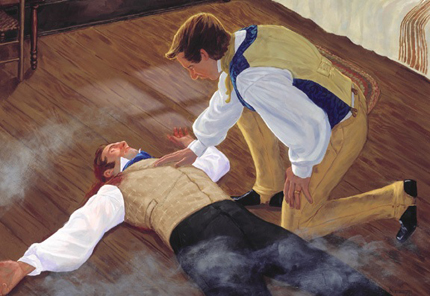
“The Death of the Patriarch” A New Painting
After extensive research, artist Andrew Knaupp attempted to recreate, on canvas, the events at Carthage Jail. In painting Hyrum Smith’s final moment, Knaupp said that there was one quote by John Taylor that inspired what he wanted to accomplish:
“I shall never forget the deep feeling of sympathy and regard manifested in the countenance of Brother Joseph as he drew nigh to Hyrum, and, leaning over him, exclaimed, ‘Oh! my poor, dear brother Hyrum!'” (John Taylor, Witness to the Martyrdom, pg. 88-90.)
Andrew Knaupp explained that the martyrdom at Carthage Jail lasted only a few minutes. “Joseph didn’t have a lot of time to grieve for Hyrum. But he leans over him to mark the moment as dangerous as it was to be in the line of fire. It was really hard for the mob to angle the guns, sufficiently, to get someone that’s against the wall. But Hyrum was dead between the door and the window which is where all the shots were going. So for Joseph to lean over him, in the line of fire, was dangerous to do at all. But he did it. We know that Joseph knew that he would die…I’m guessing that he probably thought that he would die first…I’m not sure he thought Hyrum would be the first to be killed.”
Andrew Knaupp goes on, “I felt that the sadness expressed by the Prophet Joseph at seeing his faithful brother fall would be a mixture of grief, brotherly love, and respect, which is a difficult emotion to capture. This of course was all happening in a matter of seconds, so the Prophet would have had to be quick in his grief, for their was still death coming from the door and the window. A quick one knee down with the hand of a loving brother saying farewell seemed fitting.
Painted next to Hyrum’s body is light from the Carthage Jail window that forms a ‘T’ shape, “To symbolize a cross, a Christian symbol,” Knaupp said. “to show that these men were dying for their testimony of Jesus Christ.”