





‘Tis the season…for a whirlwind of shopping, baking, entertaining, purchasing, and trying not to let the meaning of Christmas get completely buried under an avalanche of to-do lists, wreaths, wrapping paper and bows. Help is at hand! Each of the three selections today provides a different approach to celebrating Christmas. Maybe some of their suggestions will help you spruce up, simplify or just shift your Yuletide perspectives a bit.
“In those days, ‘Jingle Bells’ was not only a song, it was a thrilling experience”
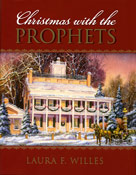
Christmas with the Prophets
By Laura F. Willes
These snapshots from the lives of the sixteen men who have led the Church of Jesus Christ of Latter-day Saints in this dispensation focus on what is most important during the Christmas season. Each chapter highlights a different prophet and contains a handful of vignettes from notable Christmases in his life, closing with a Christmas message he delivered. Themes of family, service, gifts of love and time, and Christ-centered celebrations crop up over and over. After reading Christmas with the Prophets, I’m newly inspired to purposefully incorporate more meaningful activities into our family’s Christmas festivities.
Because of their commitment to the Lord, several prophets found themselves occasionally separated from loved ones during the Christmas season. On December 25, 1839, John Taylor was being tossed to and fro during rough weather somewhere on the Atlantic Ocean on his way to serve a mission in England. Joseph Smith and Lorenzo Snow each spent a Christmas in jail. As a young apostle, David O. McKay was assigned by President Grant to tour all the missions of the world, leaving in early December of 1920 and returning on Christmas Eve the next year. He observed Christmas of 1920 in Japan, serenaded by a few Japanese Saints singing “Jesus Wants Me for a Sunbeam.” An unorthodox song selection, perhaps, but how appropriate for a celebration of Jesus’ birth!
Other stories show how prophets spent the day doing temple work or serving the poor. Wilford Woodruff recorded attending services at the Kirtland temple on Christmas in 1836 and, as temple president of the St. George temple, working all Christmas Day in 1876 to get the temple ready for its dedication on January 1, 1877. Then again in 1883, he reported in his journal that he oversaw 316 baptisms at the temple “today which is Called Christmas.” Harold B. Lee, while a stake president in Salt Lake City, felt chagrined at not doing enough for the poor one Christmas during the Great Depression. The following year he created a stake welfare program and prepared far ahead of time to ensure that everyone would have their needs met, including a Christmas dinner and toys for the children. This successful prototype eventually evolved into the Church’s current welfare system.
And I never knew how many of our prophets loved to dance! Joseph Fielding Smith’s daughter Amelia reported that on Christmas Day her father would put a record on their old Victrola and dance to the music, “whether a march or a lively folk dance” and then the family would sing Christmas carols and hymns before sending the kids to bed. Once ensconced in Salt Lake City, Brigham Young held an annual Christmas party that was the highlight of the winter social season – dancing was the main event. As the leader of the Saints, he said, “I have the whole people’s burdens, and I get rid of them by kicking them off my toes.” Ms. Willes sums up by saying, “What better way to celebrate Christ’s birth than to praise the Lord with joyful heart, music, and dance?”
Counsel from our current prophet, President Thomas S. Monson, closes the book: “Before we can successfully undertake a personal search for Jesus, we must first prepare time for him in our lives and room for him in our hearts.” A perfect reminder to recommit ourselves to the essential foundation of our faith as we commemorate His birth.

“People are not perfect decision makers”
Scroogenomics: Why You Shouldn’t Buy Presents for the Holidays
By Joel Waldfogel
Americans spend approximately $66 billion on Christmas every year and an additional 2.8 billion hours shopping (about 80% of which is done by women). And what do we get for all that money and time? Less than we should, according to Mr. Waldfogel. On average, recipients of gifts during the holiday season generally value their presents at only eighty-six cents on the dollar, with even lower values for gifts given by relatives or friends seen very infrequently. In other words, for every dollar Aunt Mildred spends on a gift for you, you get at most 86c worth of pleasure out of it, and quite possibly much less (remember that orange and purple reindeer sweater?).
Mr. Waldfogel discusses the holiday season in terms of opportunity cost, wasteful spending, marginal utility, personal consumer debt and deadweight loss (I bet your eyes are glazing over already, aren’t they?). But he does it using real life examples and humorous anecdotes to get his point across without sounding like an economics textbook. Yes, Mr. Waldfogel makes macro- and micro-economics interesting!
Especially intriguing to me was the chapter on the costs of Christmas around the world. For example, per capita, Russia spends more on Christmas than the United States does. So do Norway, Italy, and France. In fact, the U.S. comes in 12th on a list of 26 nations for which Mr. Waldfogel could gather consistent data on December expenditures. When the data is adjusted for income levels, Portugal, South Africa and Mexico shoot to the top of the list and the U.S. drops to 22nd out of 26. Mr. Waldfogel concludes, “American Christmas may be overly commercial and materialistic. But we are not alone.” For that matter, the United States is average, even a little below average, in its Christmas spending habits. Who would have thought?!
Another compelling comparison Mr. Waldfogel does is across time. We tend to see the past through a haze of nostalgia, imagining that previous generations had a simpler, purer and more meaningful way of celebrating the season. However, examining the “December bump” in retail sales back to 1919, he shows that holiday spending in the United States actually took a larger share of the gross domestic product back then than it does today – almost double, in fact. Consequently, he opines that “contemporary holiday spending is neither unique nor excessive compared to that of the past century.”
Mr. Waldfogel makes several suggestions to improve the efficiency of our Christmas giving. I won’t give them all away, but an obvious option, though fraught with possible social or familial penalties, is to simply pare down the gift list, leaving off the more distant relatives and acquaintances that we’re not likely to select well for anyway. If that’s not possible, he urges readers to consider gift cards, including a relatively new development: charity gift cards. He also proposes focusing on consumable gifts or gifts of spending time with the person, instead of more clutter that stays on our credit card bills for months and in landfills even longer.
Scroogenomics is a refreshing and even liberating read, despite the grinchy-sounding title.
This slim treatise is full of fascinating statistics, insightful analysis and suggestions for improving the quality of our gift giving and its effect on the general economy as well as our personal bottom lines.
“Every decision you make supports something”
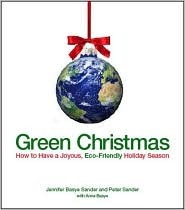
Green Christmas
By Jennifer Basye Sander and Peter Sander with Anne Basye
Like Scroogenomics, this book chronicles a spike that occurs every December – during the annual holiday season, Americans create 25 million extra tons of garbage! That may seem like an overwhelming number, but the authors offer encouragement: lots of people making little changes adds up to a significant difference.
The Sanders and Ms. Basye propose a myriad of options for folks from all walks of life. There are small changes like reusing bows and wrapping paper, selecting gifts with little or no packaging, or giving presents that don’t require wrapping at all. For the more intrepid or environmentally committed, they suggest more drastic Christmas overhauls like going tree-less or skipping gift-giving altogether in favor of one large donation to charity.
While some of the suggestions made are common “green” lifestyle choices (i.e., avoid using bottled water, purchase eco-friendly cleaners, spend money on locally produced items and services), this little book includes lots of great holiday-specific ideas as well. And most of them help by simplifying celebrations and decreasing costs as well as being environmentally responsible. For example, don’t buy Christmas cards with glitter on them. Not only does the glitter fall off and make a mess, but the glitter is not recyclable and makes the cards unable to be recycled as well. Better yet, instead of sending out dozens of Christmas cards that will probably get tossed in the trash, consider sending e-cards or postcards instead. As an added benefit, you’ll also save money on stamps. Or a simple switch to LED Christmas lights will lower your electric bill (and I like their deeper, richer colors better than the standard incandescent bulbs anyway). They also compare the environmental impacts of using a real Christmas tree versus an artificial tree and come down firmly on the side I wasn’t expecting.
The one chapter I found rather ironic was on “Green Holiday Getaways.” After pointing out the staggering emissions that accompany any mode of travel and strongly recommending travel by foot, bicycle, hybrid car or train as the most eco-friendly, the authors highlight a particular environmentally responsible hotel in Hawaii. Once you arrive in the Islands, that may be a great “green” lodging choice, but since none of their low-carbon-footprint travel options work across the ocean, getting to Hawaii is anything but cheap, easy, and “green” for most of us!
The authors include many, many website addresses for general environmental information, “green” holiday options and some specific products and services they mention, so you can delve further into the topic at your leisure. Of the many ideas they share, I’m confident you can find at least one or two to incorporate into your winter festivities to be kinder to the earth while celebrating the holiday season.
**************************
On My Bedside Table…
Just finished: Lunch Walks Among Us by Jim Benton
Now reading: Aftershock by Robert B. Reich
On deck: The Unbearable Lightness of Scones by Alexander McCall Smith
**************************
In two weeks we’ll take a look at the history of Christmas: the holiday itself, its traditions, and celebrations. Come find me on goodreads.com or email suggestions, comments, and feedback to egeddesbooks (at) gmail (dot) com.