




Since August I’ve read seven books and started three others, some non-fiction, but mostly fiction, mostly Chaim Potok — and all Jewish.
My husband is waiting for some big announcement along the lines of, “Honey, I’m turning Jewish!” My kids are wondering when they’ll get their mother back. This has been one of my longest reading fits in a good while. I’m thinking I could be a Christ-loving Mormon and Jewish, couldn’t I? But then again, I have enough drama in my life running a household with a nonmember hubby. Further duality would surely send me over the top!
Besides, who am I kidding? I’m barely organized enough to cook a real dinner a few times a week, incorporating food storage and a few organics from time to time. Making sure it is kosher, too? Oy! Yes, that would be my break point.
So, alas, me and my disordered mind will stay where we are and just admire the Children of Israel from afar…
The Jew Store: A Family Memoir, Stella Suberman
“An Absolute Pleasure,” proclaims the Booklist blurb on the front cover of Stella Suberman’s The Jew Store. I always take such high praise with the proverbial grain of salt. Talent, art, beauty, pleasures — they are, after all, entirely subjective (just like my reviews).
Nevertheless, I launched into Suberman’s story with reckless abandon. It was only my second “fun” read after finishing up a recent college class for which I did copious amounts of not-entirely-exciting type reading for research purposes. Much as I learned, I have never been so thankful for a light, yet enlightening book in many years! The Jew Store was the perfect book for which to cleanse my palate and my brain; it truly was an absolute pleasure.
In her sixth decade of life, author Stella Suberman decides to return to the small Tennessee town of her birth and delve into the story of how her family of Russian immigrants from Brooklyn came to reside in the isolated greenness of rural Tennessee.
Lovingly, Suberman traces the history of her parents: who they were as individuals, the Russia of their childhoods, the New York of their youth, and what motivated the move to the tiny town of Concordia.
Her father, Avram Plotchinikoff, eventually renamed Aaron Bronson by a judge in Savanna, Georgia, was a driven “sal-es-man.” Bright and hard working, Aaron knew that his life was designed to be more than eking out a meager subsistence among the black-clothed, fully kosher Jews of Brooklyn. He wanted to be something big, someone in charge of his own destiny; and he didn’t care if he had to go out among the gentiles to do it.
Suberman’s mother, the diminutive dark-haired Reba, had to be almost pried out of her family’s tight-knit Brooklyn enclave. Aaron’s dreams alone couldn’t overcome Reba’s fears of the unknown, yet her grandmother’s admonition that Reba should stop her complaining. “Go with your husband,” she said. “Be a warm stone in his pocket on a cold day.”1 This unexpected advice set Reba on her heels, then eventually set her heels on a train bound for the South.
So, in 1920, with Reba’s grandfather financing the trip, Aaron packed up the family and headed out in search of his American Dream. The pathway the family trod took them through Nashville, where a small but thriving Jewish community took them in for a time. The businessmen in Nashville were impressed with Aaron’s fortitude, and shortly after their arrival, the Bronsons were sent on their way to Concordia, letters of credit for the St. Louis wholesalers in hand. The Jews were taking over the South, one small town dry goods store at a time!
The Jew Store, which reads like a well-stitched patchwork of family memories, Suberman herself being quite young during the years covered, is stirring and sweetly sentimental, and, of course, educational. I’m finding that books about Judaism, whether they be fiction or nonfiction, are always an education. Lost in Yiddish as readers may have been in Asher Lev, Suberman explains any foreign vocabulary or religious customs as she goes along, which proves to be extremely helpful.
Despite the overarching joys of family life Suberman relates in her story, the difficulties, and especially the prejudices of the day, are not glossed over or minimized. There is tension in Concordia created by the likes of the Ku Klux Klan and various less savory members of the town. Raising a family far away from any sort of Jewish culture and worship proves to be a hardship on Reba, who is markedly more orthodox than Aaron and unused to living outside of the well structured and predictable world of New York.
In learning to live among the Gentiles of Concordia, Reba must face her own prejudices and Aaron learns just what kind of a salesman is required to flourish among “country folk.” What both the Bronsons and their neighbors receive by way of an education about one another is worthy of reflection.
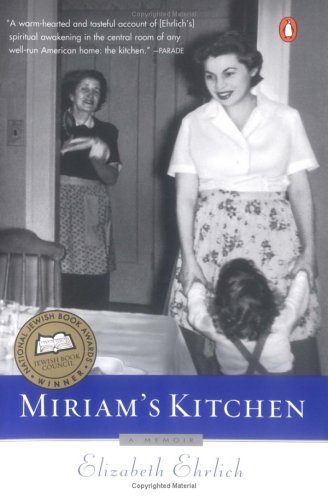
Miriam’s Kitchen: A Memoir, Elizabeth Ehrlich
Exploring kashrut (kosher living) is my way of bundling up all the broken twigs that belong
together. I can tie up my past, and transmit to my children something that, if not unbroken, is patched and coherent. They will receive the tradition. It is something to leave behind,
perhaps — that will be their choice, later — but also something on which to build.2
More like unto A Year of Living Biblically, than The Jew Store, Miriam’s Kitchen is a story of conversion and discovery, obeisance and examination. Author Elizabeth Ehrlich, raised in the “Kosher Style” of Detroit by a leftist atheist father and an agnostic mother, chronicles her introduction to true kosher living at the table of her mother-in-law, the indefatigable Miriam.
Though bonded by blood to multiple Holocaust survivors, Jewish immigrants from lost villages in Europe, Ehrlich’s parents separate themselves from the greater part of their Jewishness by virtue of a move from New York to Detroit. The distance between the two cities, which only allows for biannual visits to observant grandparents and great-grandparents, coupled with the generally nonobservant lifestyle of her parents, left Ehrlich with only a glancing understanding of her heritage as she begins her adult journey into marriage and motherhood.
Watching her husband’s mother work miracles in her kosher kitchen brings to mind Passover meals dutifully prepared by her own grandmother, and Ehrlich realizes she is not just observing a woman laboring within the bounds of narrow religious rules, she is seeing the beauty and devotion of a life well lived by serving others. Under Miriam’s tutelage, Ehrlich begins to understand the purpose of Kashrut. Likewise, she feels within herself a blooming sense of wonder at the faith of her elders, and it is a faith that she desires to truly understand. Finally. And perhaps even live.
In prose that is often something closer to poetry, Elizabeth Erlich sets before readers not only her own journey into Judaism, both as a child and as an adult, but also the bold tapestry of life woven by her grandparents, parents, and in-laws. The lives she describes, every one of them bespeaks a richness of living, and sometimes just surviving. Of the immigrant, Holocaust touched as they were, a sense of the sacred is found in everything.
The younger generation displays the desire to separate from the religious worship of their predecessors, but so too is the inexplicable draw to the traditional.
As a lifelong church member who wasn’t raised in a very “observant” home, a home of divorce and discord, where the Sabbath was just the day we went to church and Family Home Evening was just another night when we were all home, I was particularly touched by Ehrlich’s observations of faith, of coming into her own as a Jewish woman, of understanding the importance of ancestral ways. She makes comments that few who are raised in a religion make, but comments that are reverential and cogent, questions that require deep contemplation.
End Notes
1. Stella Suberman. The Jew Store. (Algonquin Books of Chapel Hill: USA, 2001) 43.
2. Elixabeth Ehrlich, Miriam’s Kitchen. (Penguin Books: New York, 1997) 261.
Next Month: Wrapping up Judaica in Fiction: Delving Further into Chaim Potok’s World
I’d love to know what books you’re reading and whether or not you’ve enjoyed my recommendations. Please, add me to your friends’ list at GoodReads.com or contact me via email at [email protected]