





 I am a bit fascinated with the Jewish faith and have been for many years.
As near as I can recall, my interest started in junior high then gained intensity in high school. Studying the harrowing stories of Anne Frank, Corrie Ten Boom, and the Holocaust made me wonder about the advent of and the fanatical intensity of anti-Semitism in Europe. How could God’s chosen people have garnered so much hatred that one villainous man was able to create a movement bent on eradicating them? I was dumbfounded…and curious.
Currently, a portion of my interest comes from world politics. I enjoy the debate and discussion that is given broad quarter on Dennis Prager’s and Michael Medved’s radio programs. Bedsides the requisite political banter, each man speaks often of both Judaism, their shared faith, and their love and concern for modern-day Israel. The talk surrounding religion can be particularly interesting on Fridays though, when they are preparing for the Sabbath. I am always touched by their unapologetic esteem and preparation for the coming holy day. In a gentle way, they remind me of the emphasis we should all place on the Lord’s day-regardless of the day on which it is celebrated.
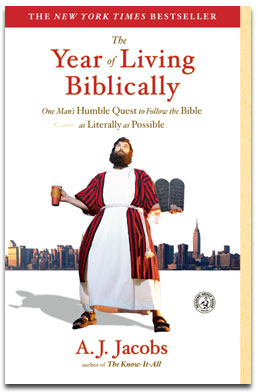
Surprisingly, however, it was the research of Esquire editor, A.J. Jacobs (published as his 2007 book The Year of Living Biblically: One Man’s Humble Quest to Follow the Bible as Literally as Possible), that really taught me something about the breadth of modern Judaism and the depth of some of Judaism’s historical practices.
I will comment here that between the title, the cover image, and the author’s bio, The Year of Living Biblically could have been one big sacrilegious mess! But it wasn’t.
Instead, Jacobs turned out a pleasantly reflective and often unexpectedly reverential story of a secular Jew exploring his roots and ending a year of intense effort with a more profound understanding and respect for both his ancestry and his innate “Jewishness.” Jacob’s writing is meant to be accessible, a goal he cannot help but achieve. His voice is witty and acerbic, and highly personal-all of which worked very well for me, as I love to laugh while I learn. Apparently, so does Mr. Jacobs.
Reading Jacobs’ book prepared me for this month’s column because of the many intricacies of Hassidic Judaism he explored. While I’ll not do a full review of The Year of Living Biblically, I will recommend you read it before this month’s selection. You will find the task of understanding the world of Asher Lev much easier if you do!
My Name is Asher Lev, Chaim Potok
As a matter of fact, observant Jews did not paint at all–in the way that I am painting. So strong words are being written and spoken about me, myths are being generated: I am a traitor, an apostate, a self-hater, an inflicter of shame upon my family, my friends, my people; also, I am a mocker of ideas sacred to Christians, a blasphemous manipulator of modes and forms revered by Gentiles for two thousand years. Well, I am none of those things. And yet, in all honesty […] I am, in deed, in some way, all of those things.1
 It is always poor judgment to compare your own God given gifts to those of others. We are each so valuable and unique, yet too often we want talents we don’t have or fail to appreciate those we do. We are so…human, aren’t we?
Recently, while doing some small scale mural work for a local charity, a man asked me, “Are you an artist?” I shrugged and smiled self-deprecatingly, “I try to be,” was my only response. If I’d wanted to elaborate, I could have said, “On a talent scale of one-to-ten, I’d give myself a three-and-a-half.” Reading My Name is Asher Lev made me want to take off that extra “half.” Maybe even a full point.
Chaim Potok penned a masterpiece of beauty, joy, sadness, and complex family relationships when he created both Asher Lev, the character and Asher Lev, the book. A semi-autobiographical story, My Name is Asher Lev transports readers to a strict Hassidic community in Brooklyn, circa 1950. Potok’s primary characters are Asher, a remarkably talented young artist, his mother and father, an uncle, and a Russian refugee who befriends Asher. In the background is the Rebbe, the community’s spiritual leader, and the ever present, ever looming threat of Stalin’s Russia, the fear of which drives a great deal of Asher’s community and family life.
We are introduced to Asher Lev as our narrator.
At the book’s opening, Asher is seeking to defend himself from slanderous rumors which are circulating about him and his art. In formulating his defense, the young man attempts to explain who he is, what circumstances brought him to his current state of infamy, and in no small part, why he is not guilty. In deed, he was only doing what he must, which is to speak the truth of the world through art. He did not mean to hurt anyone, but he couldn’t help himself, he asserts. Truly, he couldn’t.
In order to fully acquit himself to the readers, Asher lays bare his entire life, so that we might judge him ourselves. He recounts his earliest memories, memories of ancestors; memories of responsibility and expectations; memories of an unimaginable gift; and memories of unfathomable pain and disappointment. In a society as small and cloistered as his family’s Hassidic community, which understood and valued only scholarship and service in the name of the “Master of the Universe,” a talent for artistic vision and expression as immense as Asher’s was never seen as a heavenly gift. Non-academic pursuits were, at their most benign, considered a waste of time; at their worst, they were a devilment meant to take youth away from their studies and separate them from God and family.
For years young Asher struggles to find peace with his talent and his father, who laments more than once that his son had even been born. Remarkably, when Asher reaches the age of thirteen, the Rebbe, as the only one who could hold any sway over Asher’s father, intervenes on his behalf.
A life should be lived for the sake of heaven. One man is not better than another because he is a doctor while the other is a shoemaker. One man is not better than another because he is a lawyer while the other is a painter. A life is measured by how it is lived for the sake of heaven. Do you understand me Asher Lev? There are those you love and who love you who do not accept this. 2
The Rebbe’s connections outside of the Brooklyn Hassidic community brings Asher under the tutelage of the famous artist Jacob Kahn. Because of the Rebbe’s blessing, Asher has the opportunity to expand and develop his talent without fear of losing his soul. Nevertheless, his father resents the intervention and continues to brood. The chasm that had developed years before between the boy and his father only widens during this time of tremendous growth and exploration for Asher. And after several years of intense study, Asher finally creates a masterpiece which fully explains his inner turmoil: how to be both the Jew he was raised to be and the artist he has to be. The only question remaining is can he also be the son his father desires?
The last book I finished that left me filled with the same sense of awe was Markus Zusak’s The Book Thief. The feelings I have about both books are grounded in the weight of their stories, the lessons taught by their prose, the fragility and strength of their characters, and, perhaps most importantly-their authors’ skill.
I know The Book Thief was a lightly personal story for Zusak, whose parents grew up under Hilter’s reign. Likewise, Potok is said to have related to Asher Lev more than any of his other characters. Anyone with a modicum of artistic ability, and in that I include writers, actors, painters, vocalists, musicians, and the like, will tell you they simply must create, there is no choice in the matter. That feeling, that intensity of drive vibrates throughout Asher Lev and made it all the more piercing for me. The visions of the world Potok expresses through the eyes of young Asher were stunning and engaging, and achingly realistic, leaving me almost frustrated that I could not see the world with Asher’s eyes!
Aside from the artistic fervor emanating from Potok’s words, the most haunting aspect of Asher Lev is the pain and disappointment expressed by Asher’s father, and to a lesser degree his teachers and other community members. Potok touched a nerve in the development of Mr. Lev, for I’m sure more than a few of us can relate to dashing our parents’ hopes and dreams at one time or another. And what child doesn’t yearn for his parent’s love and approval? Poor Asher recounts being spurned by his parents from a very young age and Potok captures Asher’s pain, relating it to readers as if it were their own.
As for Potok’s writing style, I can only say there was nothing poorly placed in Asher Lev. The narrative flow was easy and consistent, moving readers smoothly forward throughout Asher’s brief story. The content is imaginative, and despite the Hassidic language, Asher Lev is a book that will likely resonate with the artists out there, as well as those with children they are struggling to understand.
Next Month: More Oy! from a Goy: The Jew Store
End Notes:
1. Potok, Chaim. My Name is Asher Lev. (Fawcett Crest: New York, 1972) 3.
2. Ibid, 176.
I’d love to know what books you’re reading and whether or not you’ve enjoyed my recommendations. Please, add me to your friends’ list at GoodReads.com or contact me via email at [email protected]