




Continuing on from last column’s theme of accessible non-fiction, today’s triumvirate includes a “liquid” look at history, some of the latest scientific findings on childhood development, and an economist’s view of, well, everything.
“History…amid its swirling depths”
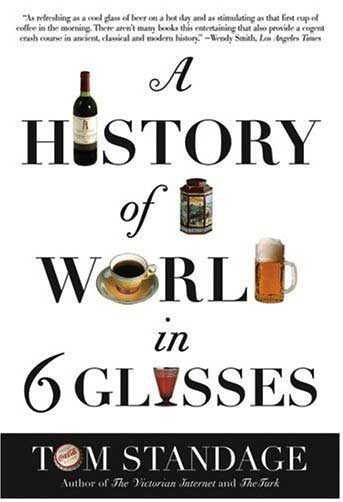
A History of the World in Six Glasses
By Tom Standage
 History as a whole can be overwhelming. Not only does it stretch on and on and on across hundreds of cultures and locations for thousands and thousands of years, but depending on whom you ask you’ll get dozens of widely divergent perspectives of the exact same events. So it’s always nice to find a book that breaks history down into a straightforward narrative, hung on a simple, easy-to-follow scaffolding.
In A History of the World in Six Glasses, Mr. Standage uses six beverages (beer, wine, spirits, coffee, tea, and Coca-Cola) to outline an overview of the past several thousand years of human history, including the rise of empires and dominant cultures from the Middle East, Europe, Asia, and the Americas. Growing up in an active LDS family, I freely admit to having very little knowledge of the drinks selected, but I figure I’m in good company; Ken Jennings reportedly drilled with homemade flashcards to improve his “Potent Potables” showing on Jeopardy, after all.
Each of the six drinks serves as a cause, an effect, and a backdrop for different historical happenings in geographically diverse locations. As Mr. Standage asserts, “Understanding the ramifications of who drank what, and why, and where they got if from, requires the traversal of many disparate and otherwise unrelated fields: the histories of agriculture, philosophy, religion, medicine, technology, and commerce.” Complex interactions between nations and cultures, social class structure, politics, and economics are distilled into each section. But to provide relief from the grand scope of human civilization, Mr. Standage sprinkles the book with humorous asides and interesting little tidbits (I know what grog is now! And the difference between green and black tea, and how to make rum – theoretically, of course). While it seems a bit oversimplified at times, that’s probably a necessity for a fairly short book covering such a huge span of time and space. On the whole, it’s an engaging look at the progress of civilization from a unique angle.
“All it takes is a new way of looking”
Superfreakonomics
By Steven D. Levitt & Stephen J. Dubner
 In 2005 Freakonomics, Levitt and Dubner’s first collaboration, topped bestseller lists and sparked many conversations about the role of economics, and specifically incentives, in every aspect of life. In Superfreakonomics, the authors have once again provided food for thought in the form of odd but illuminating juxtapositions and intentionally provocative questions. It’s refreshing to know that there isn’t just one way of looking at the world; the “common knowledge” that is so pervasive it’s not even questioned anymore can be not just wrong, but spectacularly so.
But it’s also a bit unsettling.
For example, I learned about the “bystander effect” in my entry-level under-grad psychology course; it was a fact, a given, in my study of basic group dynamics. And, according to Levitt and Dubner, it’s a complete fallacy. So does it follow that I should question absolutely everything I “know” to be true? Some level of taking things on faith is necessary to function in the world, but it certainly makes me more skeptical of those who purport to have the single correct scientific interpretation of any set of data or events.
The runaway success of Freakonomics set off a trend of similar books, with the result that this book doesn’t have the sparkle of originality found in the first (though it certainly still goes for the shock value – just take a look at the subtitle). The structure of each chapter occasionally makes it hard to follow because Steven and Stephen like to set up all of their seemingly unrelated examples first before pulling them together and drawing the conclusion that links them all. But in spite of all of the copycats and the sometimes disorienting randomness of examples used, the book is a compelling reminder that not all is as it seems and that multiple perspectives are valuable if only because they serve to force my mind out of its rut.
“Walking contradictions”
NurtureShock: New Thinking about Children
By Po Bronson & Ashley Merryman
 I rarely “gush” about a book, but brace yourselves, because here it comes.
Hospitals and adoption agencies should send every new parent home with a copy of this book. Pediatricians should hand out copies to parents of all new patients. Anyone who has ever thought about interacting with a child on any level should have this on his/her bookshelf. It is phenomenal.
I love books like this, full of hard science AND practical applications for the average person. Literally every chapter has some new insight into parenting and child development that I will put into practice with my own children.
Among the eye-opening conclusions presented are the significant impact of even 15-minute increments of sleep on children’s neurological functioning, the important of verbally addressing racial differences because children are developmentally prone to in-group favoritism, and that many common children’s books specifically designed to teach positive relationship skills actually have a negative effect on sibling interactions.
Exhaustively researched (the “Selected Sources and References” at the end is over 60 pages), this book is an incredible resource for parents and educators. Speech development, learning self-control and interpersonal skills, teen rebellion, how to respond to lying, and the right way to praise are just a sampling of the topics covered. And Bronson & Merryman never talk down to their readers, even while guiding us step-by-step through scientific experiments and complex sociological and psychological theories.
Seriously, if you have anything to do with children, run – don’t walk – to your nearest bookstore or library for a copy of this one. Here’s hoping Bronson & Merryman are at work on a sequel!
*********
Next column we’ll start with some biographies and memoirs, including a study of Mother Teresa’s letters documenting her spiritual struggles, a children’s look at John Smith, and a memoir of a boy soldier from Sierra Leone.
Is there a theme you’d like me to cover? I’d love to hear your suggestions, comments, or feedback. Please email me at [email protected].