






Slavery and Redemption on Every Family Tree
By Sherlene Hall Bartholomew
My genealogist mother, Ida-Rose Langford Hall, died almost a year ago. Since then, I have sensed that she and her restless clan are tending a glorious harvest that has ripened on our Langford family tree. We have been blessed, thanks to other-world nudging, to glean some of this tantalizing fruit, but so far lack the facility to safely “can it.” The Rockcastle County, Kentucky courthouse burned down in 1873, so that all local records – marriage, estate, court, and land – were destroyed. We have faith that the Father of us all knew we would still be searching, so has provided other evidence that we just need to find. We have recently found some of that, though documenting family connections is a continuing challenge. I am not the only Langford who has lost sleep over this dilemma. Shiron Wordsworth, an adopted, if not yet confirmed cousin on the line, recently conveyed worrisome news from a relative in Cincinnati. This woman claims that Stephen Langford – the pioneer who in 1790 led first settlers into Rockcastle County, Kentucky, had a descendant named Liberty who, as Shi tells it, “fathered two daughters (at least) by a slave named Fanny. They migrated to western Ohio somewhere between the years 1855 and 1860… The girls were named Nancy (b. 1852) and Ann (b. 7 Nov 1853).” This information flies in face of our tradition that Kentucky Langfords were principled, independent thinkers with Republican sympathies, who ran an Underground Railroad stop called “Langford Station.” We know for sure that several fought as Union soldiers in the Civil War. For this they paid dearly, in subsequent years. “You may recall,” Shi writes, “that Liberty’s son, James H. Langford, was killed by the KKK. James’ oldest son Liberty, named after his grandfather, was also murdered in the County, though we don’t know if the Klan’s responsible for that one.” Though pioneer Stephen owned much land and the proverbial southern white mansion, he only had nine slaves in 1810, before he died the next year. As Shi explains, “Rockcastle County never was a plantation society. Its hills don’t prosper such cash crops as cotton and tobacco that required much slave labor. The Langfords farmed, and they did have substantial land holdings. But they prospered from enterprises such as milling, horse trading, timbering, and quarrying. Photo in collection of Ida-Rose L. Hall, labeled as the “Old Stephen Langford House,” on the Wilderness Road, in Mt. Vernon, Rockcastle, Kentucky. Two-Way Escapes Writes Shiron, “In the book Rockcastle County, Kentucky and its People, 1992, Langford Station is pictured. It’s obviously the same house as the one in the photo your mother took” (pictured above). Shi’s grandmother knew Ruth McFerron Leach, who by account featured in this book, “bought the house in later years… had the house taken down… and discovered that it had been used as part of the Underground Railroad. The house had many secret trap doors throughout” and… “a big cellar used to hide the slaves.” Shi frets: “There are some missing pieces of the puzzle concerning the Langfords and their relationship with their personal slaves, in particular, and the institution of slavery, in general. Is it possible that as their attitudes about slavery changed, our Langfords only kept slaves as a front for their illegal activities, moving slaves North?” Family history further complicates the riddle. Pioneer Stephen’s descendant James H. Langford’s life was saved (before the Klan finally got him) by a former slave called “Uncle Alf.” As Shi tells it, “One dark night in Rockcastle County, long after the Civil War was over, the Klan was hot on the trail of that Langford, but this vulnerable ex-slave refused to disclose James’ hiding place. Uncle Alf was roughed up because of his pretended ignorance as to where James had gone to ground. I have to wonder what precipitated such courage and loyalty on the part of Uncle Alf. There’s something more to this story. I just haven’t found it yet.” The Lost are Found! Thinking on all this, I felt Mom urging from beyond, as I lay awake, worried about how we might find slave Fanny and her two Langford daughters. Then I remembered that I could do a first-name-only search. Using HeritageQuest on-line indexed census images, I typed spelling variations of “Fanny” in the first-name field for all of Ohio. It took several hours to check the family of every one who came up in the census index. For all that, I found nothing – what a disappointment! Then it occurred to me that maybe Fanny kept her Langford name, after she was freed. I did a search for all Langfords in the Ohio 1860 Census (just typed “Langford” in the surname field). As the alphabetized list came up, I found her as “Frances,” at first click on “Craig Langford.” What a thrill! (You might have seen me levitate at this point, with help from deceased Langfords!) Sensing the Census I learned that Frances was then living in Wayne, Butler, Ohio. She was age thirty-one, “keeping house” for head of the family, Craig Langford, who was eleven years her senior. (In two subsequent censuses, she is named as “Fanny” and “Fannie.”) Eight children are listed in quite regular succession, in their 1860 household, including Nancy and Ann, of ages to match the dates Shiron got from her cousin. A William Langford is listed last and is the right age to be Craig’s brother, though he could have been another slave from the plantation (Rockcastle County slaves, like many others, carried their masters’ names). A four-year break in ages of the last two children, Isaac (age five, born in Kentucky, and Stephen, age one, in Ohio) sent us looking for another child who might have been left in Kentucky. We may have found him in the 1870 Census, where Liberty Langford and his legal, white wife Sallie are listed, both at age sixty. In their household is a black child named Peter, age 14 (so b. abt. 1856), along with Robert, a mulatto, age 7. Robert must have been born of a different slave mother, since Fanny moved to Ohio by 1860. As usual, there is much to sort, trailing censuses, in such a hunt. Sometimes we uncover information we weren’t looking to find. Since there’s no proof about siring of slaves in his household, we decided not to focus on Liberty’s liberties. Every person in the 1860 Ohio household of Craig and Frances Langford was listed as black, with no ‘M’ to indicate ‘mulatto’, though white clerks often listed “B” for any person of mixed racial identity. We can’t discern which children, if any, were born of Craig, since they carried prominent Langford first names, instead of the usual tags, like “Mingo.” Shi and I feel there has to be a reason why Craig and Fanny gave the name “Stephen,” to their son who was born in Ohio, shortly after their escape. It would hardly make sense that slaves who hated their white master would give their first “free” child an important name in their master’s Langford line. Then again, maybe they took Langford names so Peter could some day find them. Scheduling Slaves While I worked the censuses, Shi looked up slave schedules and forwarded that fascinating information. In 1850, it looks to us like Liberty’s female slave and her three children have ages close enough to those of Fanny and her first three children, listed in Ohio, in 1860. Where, though, were Craig and Walter, in 1850? Shiron did an additional search and found comps for a Robert Langford, who may well have been Liberty’s father (she forwarded good evidence for that, though Shi as usual insists that we must find that coveted “paper trail documentation”). As Shi suggests, slave schedules open the possibility that Robert could have fathered Fanny’s children, despite the report that it was Liberty. Compounded Complexities There is, of course, the chance that Fanny’s children, as listed in the 1860 Census, had more than one white father. It is also possible that they were born in Kentucky to more than one slave mother. Since all the Craig Langfords in Ohio are listed as “black,” we might also learn that Craig, while working as a Langford slave in Kentucky, fathered them all (except, perhaps, Nancy and Ann). Further, it is possible that not all of Craig’s children were born of the same mother – especially after their master claimed Fanny as his mistress. The complexities, trying to compile family group records for former slaves, boggle the mind! There is, however, a grain of truth in most family legends. Shi and I resolved to find all the documentation we can to either strengthen or dismiss this family tale about a white Langford’s slave children. DNA Dilemma I began to hope that DNA testing might with certainty place Fanny’s children with their father(s). This hope was fortified by Part II of the PBS special, “African American Life” that traced the DNA of famous black persons like Oprah to specific locales! Then a cousin told me about the article, “In Our Blood,” in the Feb. 6, 2006 Newsweek that cautions about DNA test limitations. An insert on page 54 asks: “Did Thomas Jefferson father as many as six children with his slave Sally Hemings? In 1998, scientists tracing the Y chromosome from father to son said, ‘Yes, Jefferson was the most likely candidate – at least for one of Hemings’s children.’ But the controversy continues because DNA evidence can’t absolutely prove it; another male Jefferson could have been the culprit.” We may never prove who fathered Fanny’s children. For now, I have placed them all in my Craig Langford family group, with accompanying notes about potential biological white blood. In some cases all we can do is take a combination of facts, common sense, and DNA evidence, while continuing the search for better documentation. PART II – My Father’s Folk Intervene After all the excitement, finding Fanny in Ohio, I tried to learn all I could about life in Rockcastle County, just before the 1860 Census. At BYU’s Harold B. Lee Library, I found the history of a bordering county: Madison County: 200 Years in Retrospect,” by William E. Ellis, H. E. Everman, and Richard D. Sears (published by the Madison County Historical Society). This volume brought alive the rioting, threats of violence, and arson perpetrated by area pro-slavery factions (see pp. 123-153). For a while there in Rockcastle, communicants at churches with abolitionist ministers were mainly women, while their men stood in surrounding woods, guns aimed at would-be arsonists, who did succeed in turning one Rockcastle church to ashes. On another occasion, they burned down the home of an abolitionist whose young family narrowly escaped the flames. In one case, John G. Fee, an abolitionist minister, was forcibly removed from his pulpit and marched more than ten miles, from Rockcastle County to nearby Crab Orchard (where my ancestor Fielding Langford was born in 1804, but left long before). Jesse Keeps the Peace In 1860, a pro-slavery Kentucky legislature passed a law that any citizen freeing slaves had to get them out of the state. Also, no freed slaves could enter the state. Perhaps provisions in this law convinced the Langfords to free and transport their slaves. But how, we wondered, did they accomplish that? I googled “Craig Langford,” without expecting to find much. Up came the link to a page about abolitionist activities of Levi Coffin (https://www.waynet.org/nonprofit/coffin.htm), a member of the Society of Friends (“Quakers”) and reputed president of the Underground Railroad. His home had a hidden door behind a bed and a covered inside well. With the support of his wife Catharine, he helped more than 2,000 slaves find their way to freedom! Levi and I both descend from Tristram Coffin, my father’s ancestor, who was born in 1609, in Plymouth, England, but left his native country to become a founding father of Nantucket. Levi’s journal (https://www.geocities.com/Heartland/Plains/2064/undrgrd.htm) tells of his visits with the Stubbs family in West Elkton, Indiana, in their joint endeavors to free slaves. The “Squire Stubbs” he stayed with on one stop was probably Jesse Stubbs, then Justice of the Peace. This site tells how Jesse advanced most of the $5,062 needed to free an entire slave family. Then he traveled, in 1858, to Rockcastle County, Kentucky to redeem the Craig Langfords! (More levitation, this time with spirit from my father’s side.) I reviewed my extract of the 1870 Census that lists Craig and Fanny and children, in Ohio. Look at the name of their last child: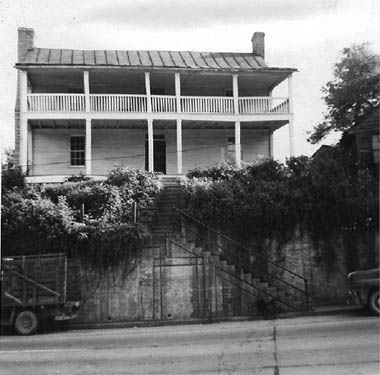
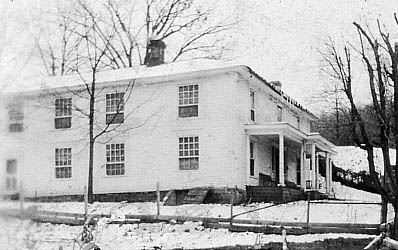
Side view, home of James Steven or “Tip” Langford, also in Mt. Vernon, Rock Castle‘s county seat. Tip was sheriff of Rockcastle County, Kentucky, in the 1920s. He was the son of James H. and Liberty Langford’s grandson. Report is that his home was a stone’s throw from settler Stephen Langford’s original mansion. Neither home survives. (Photo courtesy of Shiron Wordsworth.)60/60 Langford, Craig 52M B Farmer 1100 Kentucky , Fanny 43F B Keep House Kentucky , Robert 22M B Farm Laborer Kentucky , Walter 20M B Farm Laborer Kentucky , Annie 16F B At Home Kentucky , Isaac 15M B At Home Kentucky , Stephen 11M B At Home Kentucky [Ohio, 1860] , Jesse S. 9M B Kentucky
(Source: HeritageQuest on-line image: P.O. Jacksonsborough, Wayne Township, Butler County, Ohio – Series M593, Roll 1177, Page 490, taken 4 June 1870.)
I learned from additional reading that Craig and family prospered in Ohio and managed to pay back most of what Jesse Stubbs and his neighbors raised to free them. In the 1900 Census, I find Jesse Langford at age 39, with his wife and son, living near two brothers and between two white families. Two houses up live Joseph Stubbs, age 65, and wife Esther, 62. They have to have been connected to the Jesse Stubbs who freed the Langfords. I like to think that Jesse shoveled their snow for them, from time to time, there in Gratis, Preble, Ohio.
Better than Fiction
Shi and I have quite a challenge, trying to find documentation, so we can sort fact from fiction, in this family story. For now, it’s fun to think that my father’s relatives helped redeem a family owned by my mother’s! History sometimes reads better than fiction.
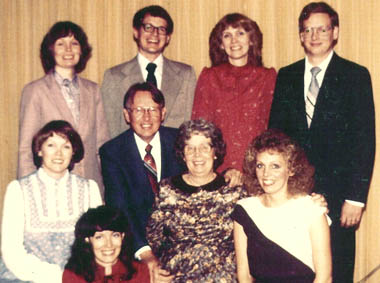
The author’s family in 1976: Back L-R Sherlene, H. Tracy, Jr., Elizabeth, David R; Front L-R Virginia, Charlotte, H. Tracy, Sr. (sustained that day as an LDS bishop), Ida-Rose (Langford), and Nancy Hall.
Since learning about Quaker participation, freeing the Craig Langfords, I have written letters, hoping to learn how these Indiana abolitionists learned about and decided to free this particular slave family. Are there receipts, I ask, telling who accepted the $5,062 redemption for this family? How did Jesse Stubbs travel to Rockcastle, and how did he get these slaves out? Did he perhaps make use of the Langford Station Underground Railroad stop? Is it possible that Jesse knew the money would go to strengthen the abolitionist cause in Kentucky? (I know we’re optimistic, but we can always hope, can’t we?) Is there a record of how the Craig Langfords paid off their freedom debt and to whom? Has correspondence from descendants of Craig and Fanny been preserved?
Anguish at “The Tree”
There are those who never ask questions about their family history, for fear of what they might learn. To remain in such ignorance is itself a form of self-enslavement. Others very well know the facts, but prefer to sweep them under that already-bulging rug, caring little how their children might fall, tripping over what they cannot see.
We all need to overcome insecurities that make us afraid to know who we really are. Nothing we ever find can override the fact that we are all created in the image of our Savior, who said: “… If ye continue in my word, then are ye my disciples, indeed. And ye shall know the truth, and the truth shall make you free.” [John 8:31-32] Then He went on to explain what His fellow Jews might have learned from their Abrahamic genealogy (and what we might also learn from ours).
Abolitionist Langfords in Nauvoo
I descend from Walker Lankford who married Mary or “Polly” Warren, of Lincoln County, Kentucky and Clay County, Indiana. In 1830, his son Fielding married Sarah, who was born in 1809, in Rockcastle County, to David P. and Margaret (Kincaid) Bethurem. The young couple soon moved to Indiana, where they converted to the “Mormon” faith in 1843. With other “saints,” they gathered to Nauvoo, Illinois, in time to join the trek across Iowa to Council Bluffs. In 1850, they were living in Platte County, Missouri, but in 1852 migrated to the Salt Lake Valley.
After surviving all that, Sarah died in 1863 from the bite of a black widow spider. I yearn to find a picture of my Sarah, but perhaps she died too soon. We do have one of Fielding in his old age, posing with children by his next wife, Carolyn Christina Bocker, whom he married in 1865, in Salt Lake City. She, however, is not in the picture. By then she had divorced him, purportedly for his whiskey habit. It probably also did not help that Fielding was Swedish-born Carolyn’s senior by forty-three years!
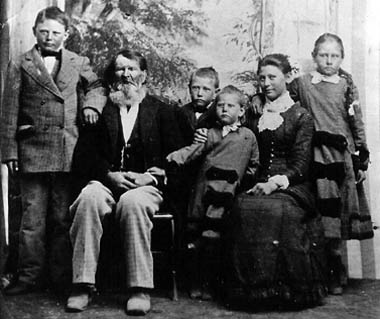
Fielding Langford (1804-1882) and his children by 2nd wife, Carolyn Christina Bocker (from an old tin-type taken about 1880-82). L-R: Joseph, Fielding, Wm. Henry, Anna Caroline, Cynthia Elizabeth, and Malinda Melvina Langford.
Whatever his faults, I love Fielding for having the courage to join a new and different religion that has so blessed my life. I admire his thrifty, hard-working stamina, pioneering the West, drawing on skills he saw his colonizing fathers in the US South apply. Learning to creatively adapt, as they faced new, trying situations, he and Sarah managed to raise a healthy clan that gave me a phenomenal Langford mother.
Fielding and his family missed all the civil rights excitement in Kentucky, but saw plenty of their own in the form of persecution against the concentrated “Mormon” population in Nauvoo. Such trials did not seem to dampen their hope for that better future they did carve out for us, their descendants.
Find an Ancestor – Find yourself!
I am also inspired, learning more about my paternal-line Quakers who, as noted on the above-mentioned site, did not wink at injustice that for many had become a way of life. They did more about it than complain or write a letter to the editor. Taking action, they slowly changed opinions and altered custom – often at significant personal cost.
I also have empathy for slaveholders who found themselves entrenched in what had been a way of life for generations. How difficult it must have been to have all that household and field help and then be forced, either by conscience or circumstance, to give it up.
Before then, it must have been perplexing for children of slaveholders to see how different life was for half brothers and sisters. In situations where slave masters were abusive, studies show those tendencies carried down for generations, within families. Again, I admire the fortitude of Langford families who apparently tried to leave the system. Local pressure on those with Union sympathies was not exactly life-promoting.
Some of us don’t like learning that our ancestors were alcoholics or had slaves, much less that they bred additional “property” with them. On the other hand, knowing more about family history helps us better comprehend why we feel and act the way we do and to better guard against what may be inherited blind spots.
Speaking for myself, these family discoveries fortify my resolve to look at my environment with less complacency – to do what I can to not only change evils in society, but also to adjust attitudes and practices I better recognize as part of my own personal legacy.
We all might hope, as well, to build on accompanying virtues evident in every family line. God seems inclined to reveal a fair share of both the negative and positive in each of us, both to keep us humble and extend encouragement.
Magnificent Wonder!
At varying times, some branches on our family tree seem more straight and true than others. All, however, produce good fruit that, unless tended well, attracts spoil and canker. We stretch to pick the best and try to ignore the bad. Finding soft spots in the past, we excise them for our future, with help from the Master Chef. The result is a fresh pie so divinely aromatic, vibrantly colorful and flavorful that we who taste of it can hardly wait to prepare tables and share it.
The magnificent wonder is that our Father in Heaven, in His great love, invites us, His children all, into His vineyard to with faith cultivate our inheritance. There each of us not only finds vital root, but by virtue of our Lord’s tender mercies, becomes more strong, resilient, and trusting, as we reap His redeeming bounty.
2006 Meridian Magazine. All Rights Reserved.