





By Cynthia J. Rieben
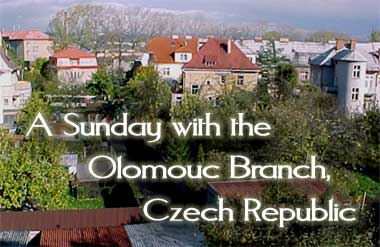
I take a last look out the window of my second-floor flat, over the red tiled roofs toward the rising sun and the hills that surround Olomouc, Czech Republic. The sky is clearing. I don’t think I’ll need my umbrella. Its 8:20 a.m. on a Sunday, and if I walk quickly, I will be at the chapel with time to put out the hymnbooks and post the page numbers.
I walk out the back through the garden and down the little lane, past the large block and plaster buildings, home to many families. Then I pass the impressive villas built at the turn of the 19th century and during the prosperous days of the First Republic. Some have been restored to their former elegance, but many are crumbling away due to 40 years of neglect under communism. Fenced yards contain gardens and many a dwarf apple or pear tree, often espaliered to maximize space. Red geraniums and white petunias spill out of window boxes. I walk on past the modern sports complex, another more positive legacy of communism, on to the main thoroughfare of the old section of the city, the Star Mesto, all cobblestone streets here. Nothing is opened on Sundays, and the buses and trams are running on the weekend schedule.
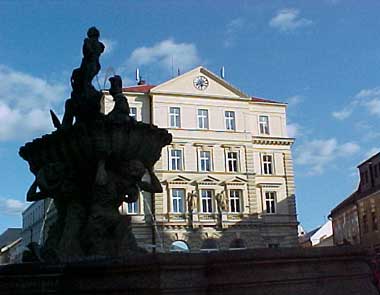
Our branch meets in tastefully remodeled rooms above a boutique on the smaller of the two main market squares in the historic center of this Moravian city of 100,000. Sitting on the Morava River, it has a history as old as that of Prague, the capitol city lying in eastern Bohemia. On the walk to the chapel this morning, I first cross through the larger of the two squares, Horn Nmest or Upper Square, past the imposing Trinity Column, easily the largest plague column in the Czech Republic, and the beautifully restored city hall, with its astronomical clock done to socialist realism tastes during the communist era. And then into Doln Nmest, Lower Square, with its smaller plague column and fountains of Jupiter and Neptune. I step through a carved archway, walk down a corridor with a low gothic ceiling.
When I entered this corridor for the first time, I paused at the large Plexiglas-covered plaque recording the building’s history. The earliest date is 1250 AD, early medieval, when the first wooden walls and gothic architectural details appeared. Fire and later renaissance rebuilding changed the faade. Ownership and uses for this building have changed over the centuries, revealing the changing sources of political power: feudalism under the Premyslids, the Holy Roman Empire, the Czech Reformation, the Counter-Reformation and the Austro-Hungarian Empire, the Czech National Revival, World War I, the First Republic, annexation by Nazi Germany and World War II, finally absorption into the Warsaw Pact nations under Soviet domination, until the Velvet Revolution of 1989. Democracy has returned to Czech and Slovak lands. How welcomed is a political structure guaranteeing religious freedom at last.
I climb the stairs to the first floor and our chapel. The branch used to meet in a hotel room, but three years ago was able to rent this sunny and spacious real estate. Our chapel consists of three large carpeted meeting rooms, an office, restrooms and a very small kitchen Doors and molding are done in lightly stained pine, except for the original dark wooden beams overhead. The clean lines of finely crafted solid pine furniture can also be found in the sacrament table, pulpit, book and storage cabinets in the Relief Society and Primary rooms and in the branch president’s office. Large, healthy plants sit in all the broad windowsills, and up front in the chapel is the ubiquitous electronic keyboard.
As I enter our floor, I hear reverent music. Someone has put on a CD of Mormon Tabernacle Choir music. President Josef Slezr and his Executive Secretary, Jan Dvorak, are there. They greet me with broad smiles, warm, firm handshakes. A convert of 6 years and branch president for three, President Slezr will start the meeting exactly at 9 even if his counselors haven’t yet arrived. Jana Galickova warms up on the keyboard for the opening hymn as members, investigators, missionaries and visitors take their seats.
President Slezr stands and looks out over the small group of us, smiling. Peace and contentment emanate from him now. Yet, he had spent much of his adult life very unhappy. He was a successful businessman, but still he had been unhappy and he hadn’t understood why. He had tried to talk to his friends about his deepest feelings, and they thought he was crazy. Plenty of money, women, beer, a good business. Weren’t these the things that made a Czech man happy? They weren’t making him happy. In fact, he hadn’t even wanted to find a woman or get married because he said that then his wife and his children would be unhappy, too. A psychiatrist had told him, “The way you feel, most people feel that way. It is normal.” This had been very depressing news.
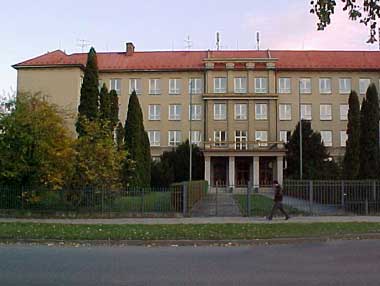
Gymnazium Hejcin where I work
He had examined the religions around him, but he hadn’t found any whose followers seemed genuinely happy. When he went to Sydney, Australia, to study English and to learn the history of aborigines, he had met the missionaries. We know what happened, and we understand why he radiates happiness now. Often in his talks to the branch, he will share his experiences in the business world, among his friends, to show how the Lord is preparing people to hear the gospel. When he works with the missionaries on Doln Nmest on Saturday, people tell him that they feel unhappiness in their lives, and he understands.
First counselor Rostislav Galic has joined President Slezr on the stand. Rost joined the church in 1993 and shortly after served a mission in Washington state, USA, and so his fluent English is a great boon to me with my limited Czech. His wife, a professional classical guitar instructor and graduate music student, was one of many young people who found the gospel 12 years ago through yoga classes. These classes represented a remarkable missionary effort begun by Otakar Vojkuvka in Brno under communism and later by Olga Kovarova Campora and others. (Read more about this fascinating chapter of Czech-Slovak church history in Olga Campora’s book, Saints Behind Enemy Lines, Deseret Books, 1997.)
The other counselor, Petr Hires, was brought into the church by his wife Blanka, who also joined the church through the Brno yoga classes and then served in the Moscow Russia Mission. Her loving spirit touched me several months ago. We were walking home from church together in the bitter cold one Sunday, pushing the stroller in which was tightly swaddled her 1 year old son Honzie. With intensity of feeling, she turned to me and said, “You are alone here. What can I do to help you? Is there anything you need?” I was speechless. She, who had so little in the way of any material goods, who struggled with a husband whose habits had kept them from a temple sealing, she was concerned about me? I had mulled over Blanka’s beautiful offer. I simply said, “Well, since I’m your new visiting teacher, just let me come visit you.”
Blanka now sits holding Honzie on her lap as I begin leading the sacrament hymn. I used to just mush through the pronunciation of all the Czech words to familiar hymns, but my sight-reading and pronunciation have improved. I even recognize key words like “love,” “Heavenly Father,” and “grateful. ”
Vlastik Holik kneels and says the sacrament pray. An energetic young man, he became interested in the gospel while attending the missionaries’ English language classes taught weekly here in our chapel. He dotes on the missionaries now who are helping him learn his priesthood duties and prepare for his own mission within the next year or two.
Radmila Honcov, another recent convert, has been assigned to talk about happiness, pleasure and the difference. She says that her friends don’t understand why she won’t go out and drink with them any more. When her young husband, who is still learning about the gospel, came to the branch Christmas party AND to sacrament meeting the next day, we could all see how very happy she was. She is the first counselor in the Relief Society and has been conducting meetings recently while the Relief Society president, Josef’s wife Dana, overcomes the early months of nausea and fatigue of her first pregnancy.
Elder Taylor Prince, one of the four missionaries serving in our branch, gives another talk on the importance of families. In fluent Czech he bears his testimony of the blessing of having the love and support of his mother and father. He tells us that in his later teen years, he had drifted into a kind of spiritual inactivity. He continued to attend church, but other things filled his free time: a lively social life, his girl friend, soccer, hockey, snowboarding and, most of all, 4-wheeling. A mission was pushed onto the back burner.
Although his parents had separated, both had served missions. His mom remained very active, and although she didn’t lecture him, she subtly let him know that he should think about a mission. When his bishop asked him about it, he said, “No way.” In his later teens he began living with his father, but he moved back in with his mother, brother and sisters when his mother was first diagnosed with cancer. He began attending church more regularly with his sisters and with his mom when she was able to go. Sometimes when he walked through the house, his mom would begin singing “I hope they call me on a mission . . . ” and he’d say, “Ah, Mom, give it a rest.”
However, as he passed his 21st birthday, he began regretting his decision. It was uncertain how well his mother would handle the increasingly harsh therapies she underwent, she still encouraged him to put in his papers. She got well long enough to speak at his farewell and see him off at the airport after he had completed his two months at the Missionary Training Center. “‘Focus on your mission,’ she told me, recalls Elder Prince. On the day she died three and a half months later, Elder Prince and his companion were helping to conduct an Open House in a branch in Slovakia. In one of the many phone calls he was given permission to make during this very painful time, his little 8-year old sister, whom he had baptized earlier that year, said to him, “You aren’t going to come home are you?” No, he did not go home.
After Jana Galickova’s thought provoking Sunday School lesson (with her husband interpreting in my ear) we separate for our auxiliary meetings.
Another story that grips the heart is found in the words of an older sister who today teaches our Relief Society lesson. Kvet Kopecka.joined the church with her mother and sister when she was nine years old, back in 1949. Note the date. This same story could be told of many members of the church who found themselves stranded for years without active priesthood guidance once communist regimes tightened their grip throughout Eastern Europe. To openly practice any religion had meant ostracism and unpleasant repercussions for the family. Even having grandparents who were religious was a black mark forever on one’s records. One’s children would be denied admission to university; one’s employment advancement would come to an abrupt halt. And at times it was worse than that as Sister Kopecka’s mother found out when she was called to the police station and accused of being a spy for foreign powers. In spite of the harassment, her mother would lead them in a little Sunday School once a week. They had had the standard works but little else to guide them in their worship. Tears flooded Sister Kopecka’s eyes as she recalled all those years, all those years.
Sister Kopecka had thought it would always be like that, that they would be a little island of testimony cut off forever from the body of the church. On rare occasions and in secret, they had met with the few other members of the church in the area. One has to imagine going without all the familiar support — priesthood leadership and priesthood blessings, partaking of the sacrament, member teaching, weekly worship together, home and visiting teachers — to have any sense of what it must have been like.
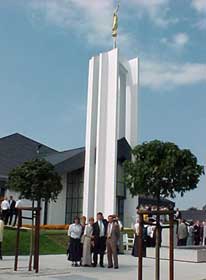 Now I understand why she said she had almost fainted for joy at the rededication of the Freiberg Temple last September and the sight of the prophet, President Gordon B. Hinckley, just a handshake away. She had all but given up hope of ever seeing a temple much less a prophet of God.
In contrast to Sister Kopecka’s deeply rooted testimony are the fragile but keen testimonies of the twins Blanka and Sarka Dorazilova, who were baptized in the fall, and Sister Dana Lichtblauova and her son David, who have been members not quite three months. The sisters listen attentively to Sister Kopecka’s lesson, which is about promoting an atmosphere of peace and love in our homes. Blanka, who has just been called to be the Relief Society secretary, has often come to church very upset over family quarrels. However, today she acknowledges to the class that there definitely seems to be a better atmosphere in their home since their missionary lessons and baptism. Their parents won’t allow any members to visit the home, but the girls were thrilled when their mother attended the recent Open House.
The meetings come to an end. President Slezar walks through the rooms shaking hands and chatting with everyone. The missionaries set up appointments to continue their visits with investigators and invite them to the Tuesday evening English language classes. Dana and I look at our calendars to see when we might be able to do visiting teaching, and she interprets for me as I ask Radka if I could come and visit her this week. Although she speaks very little English and I speak very little Czech, Radka and I have been able to have fun visits even when Dana, who speaks English fluently, has been unable to join us. So we set something up, and then Blanka and I put Honzie in his stroller and with Petr’s help carry it down the steps and out onto the square. All spring chill is gone from the morning air. It is noon, and the square is quiet as we stroll along together up into the Upper Square, past the majestic Trinity Column, and along toward our homes.
Click here to sign up for Meridian’s FREE email updates.
2001 Meridian Magazine. All Rights Reserved.