






The Vern Marrott Story
by Terry Bohle Montague
All rights reserved
Portions of this article have been excerpted from Mine Angels Round About by Terry Bohle Montague.
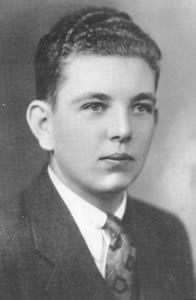
Elder Vern Marrott, the young missionary.
I remember standing on the doorstep of the white clapboard bungalow in Orem, Utah on a fall day in 1984. I had pressed the bell and was watching the front door through the porch screen.
The door opened and an elderly man came out. He was older-looking than I thought he would be. I’d met many of the evacuated West German Missionaries, all in their sixties by then, but this man looked older. I recognized him from the mission photos, though – the reticent smile, the wavy hair.
He pushed open the screen door. Against the door, his right hand was pale and swollen.
I asked, “Are you Vern Marrott?”
“Yes,” he replied. “Are you Terry Montague?” he asked and put out his hand.
His hand felt unnaturally soft and cold in mine. ‘Uh, oh,’ I thought. ‘He’s sick.’
He said, “I knew you would come. I waited for you for 45 years and I didn’t tell anyone. But I always knew you would come.”
After the missionary evacuation from Germany in 1939, the Church was concerned about the safety of missionaries serving in foreign countries who had not been evacuated. The leaders asked the evacuees not to discuss their experiences in order to protect missionaries and members in other countries. So Vern had waited – quietly, obediently, patiently, and with faith – knowing, someday, someone would come, at last, to hear his story.
His reserve, obedience, patience, and faith were the same traits that made it possible for him to take his missionary companions, both elderly and ill, out of Germany during the crisis just before the Nazi invasion of Poland.
I had read President M. Douglas Wood’s account of the evacuation in an April 1940 conference report. President Wood made reference to the difficulties an unnamed missionary, companioned with an elderly couple, had in getting out of Germany.
In the West German Mission Journal, kept in the LDS archives, I found a list of the missionaries and where they were assigned in August 1939. On the list, Mainz was assigned to an elderly, married couple, Katharina and Nikolaus Riegler and an elder. Vern Marrott.

Katharina and Nikolaus Riegler. An obviously ill Katharina Riegler was only 74 when this photo was taken in 1939.
I found Vern in Orem, Utah and wrote, asking if he’d be willing to talk to me about his experiences in Nazi Germany. His return letter questioned me about my membership in the church. I wrote back with my Stake President’s name and phone number. Later, Vern said my Idaho return address had made him wonder if I was connected to the Aryan Nations, a neo-Nazi group in northern Idaho.
Vern’s 60- minute tape followed almost immediately.
The story touched me. I told my husband, Quinn, “We need to go to Orem and talk to Brother Marrott.”
There, Brother Marrott invited me into his living room and I heard the story again. In September 1938, the Czechoslovakian, East, and West German Missions were evacuated during a crisis created by Nazi Germany’s demand for a strip of land along the German-Czech border known as the Sudetenland. The missionaries waited out the crisis in Rotterdam, Holland. Then, with the signing of the Munich Agreement in October, the missionaries returned to their assigned areas.
The evening of November 9, 1938, members of the SS, disguised as civilians, broke into, looted, and burned synagogues, Jewish hospitals, shops, and homes. Missionaries across Germany watched in horror. Some Jews, including women and children, were slain as they tried to escape being burned to death. Several missionaries witnessed the stoning of Jewish businessmen in front of their shops and stores.
“This is terrible. This is terrible,” muttered one elderly man who stood next to a pair of missionaries in a crowd outside a synagogue in flames. “If they do this to the Jews, who will be next? Who will stop them from doing this to anyone else?”
The Nazis kept a cautious eye on the religious activities of the German people. Hitler declared, “We want no God but Germany!”
Though numerically insignificant, the LDS Church did not escape the notice of the Nazi officials. “You blunt the intellects of the people!” a Nazi official told one Branch President.
Although the winter of 1938-39 passed quietly, tension in the West German Mission grew.
The Nazi government ordered the missionaries to sign statements agreeing they would not go from house to house, or be involved in any group discussions in any park or on the streets. Only Sunday meetings were allowed and those were often interrupted by the arrival of SS officers who sat at the back of the room and observed the gathered Saints. Any other meetings had to be approved by the local police.
Government interference was obvious in almost every aspect of the missionaries’ daily lives. Their letters from home were opened and read by censors. Portions of the letters, judged inappropriate by Nazi officials, were cut from the pages. Many missionaries were watched and, sometimes, followed through the streets. One pair of elders had their apartment thoroughly searched. The police even probed their straw tick mattresses with long, metal prongs and dumped out the missionaries’ salt and pepper shakers.
Despite those conditions, the missionaries persevered. They joined clubs and groups, even organizations connected with Hitler’s Youth, to meet people and introduce them to the gospel. They participated in sports events, gave athletic exhibitions, taught classes and formed musical groups. They also relied on cottage meetings in the homes of church members.
In the spring of 1939, Germany demanded Poland turn over a narrow strip of territory called the Danzig Corridor. Poland refused the demands and resisted Hitler’s threats. Great Britain and France declared they would lend Poland all the support in their power.
Missionary work stalled. Conversations about the possibility of war overshadowed all gospel discussions. The Mission Office cautioned the missionaries to be ready to evacuate at any time.
With concern, the missionaries watched the more and more obvious signs of a coming crisis – ships and airplanes were built, automobile manufacturing plants turned out military vehicles instead of cars. Draft notices were delivered and long columns of troops moved across the countryside at night. Farmers were told the wheat must be harvested by the end of August. Fruit, vegetables and meat became increasingly scarce. Bakeries produced bread made with a poor grade of flour extended with sawdust.
In mid-July 1939, Vern Marrott had been assigned not one new companion, but two. The Rieglers were German converts to the Church who had immigrated to the United States and raised their family in Utah. Then, in their retirement years, they received a mission call to Germany with the specific assignment to return to their hometown of Mannheim and contact family and friends about the Church.
The Rieglers were happy serving in Mannheim, but when the transfer came, they were shocked and saddened. The did not want to leave Mannheim, yet they desired to be obedient. They transferred.
But Mainz was not Mannheim. The couple grew more and more homesick and talked about returning to Mannheim. Brother Riegler was so unhappy in Mainz, one day he broke down and went into his room sobbing.
Vern did his best to smooth the situation, talking to them about how the Lord needed them in Mainz, commending them for their desire to serve a mission and be obedient. He took special care with his companions, trying his best to make them comfortable, realizing it took real courage for them to serve a mission in an unfamiliar place. They told him, if it wasn’t for him, they’d have returned to Mannheim. It was not until several months later, that any of the three missionaries realized the Rieglers’ transfer to Mainz was solidly based on inspiration.
Sister Riegler became ill. She suffered from a chronic stomach ailment that seemed to be relieved only by a daily diet of six fresh eggs and a quarter pound of butter. Of all the rationed food in Germany, eggs and butter were the most scarce. Since butter was rationed to one-eighth pound per person per week, Vern asked the members in Mainz to sacrifice their rations to help Sister Riegler.
The problems did not end there. In her discomfort, Sister Riegler complained about the food their landlady, Frau Burkehardt, prepared for them. Frau Burkehardt reacted by flatly refusing to do any further cooking and cleaning for the missionaries. Those tasks were left for Vern, which he did without complaint, not wanting to be the cause of any more discontent.
Even more discouraging for the young missionary was that all their proselytizing efforts in Mainz had come to a standstill. No one wanted to discuss the gospel. All the talk was of Poland and the possibility of war. With every new political rumor, the Rieglers threatened to leave Germany and go back to the United States.
On August 14, one of the sisters in the Mainz branch invited Elder Marrott and the Rieglers to come over and pick pears from her tree. Fresh fruit was a rare treat in Germany at that time, almost impossible to find in the markets. The missionaries were thrilled to have the pears, but the Rieglers, perhaps because they were not used to eating fresh fruit, became very ill and Brother Riegler fainted dead away.

The West German Mission held a conference at The Romberg in Frankfurt in May 1939. These flags were displayed to welcome the missionaries.
These companions were a grave concern for the young elder. One evening, weighted down by the responsibilities of caring for them while they were ill, cooking, cleaning, and trying to teach the gospel in an environment of constant tension and fear, Vern went to a quiet little park near their apartment and sat on a bench near the Rhine River. Watching the peaceful water flow, he tried to study out what he should do.
Also in the park were a pair of elderly Mainzers, discussing the latest rumors. Japan attacking Russia, Germany colonizing America, and food shortages. Overwhelmed, Vern got up and found his way home.
On Friday, August 25, Vern and the Rieglers attended a cottage meeting. Since it was still light when they returned to their apartment near the big dome, Vern suggested they sit in the little park for a while. At first, the Rieglers declined. Brother Riegler had been ill a few days earlier and still did not feel well. Sister Riegler just wanted to go to bed.
“It may be our last chance,” Vern said, thinking the fresh air would do the Rieglers good. On the way there, Walter, the fourteen-year-old son of their landlady, came running toward them with a message from the telephone operator at the post office. It read,
“Call office, 61967, immediately. Wood” The three missionaries knew what it meant.
Walter said, “Well, I guess this is it.”
Vern told the Rieglers to return to their rooms and pack. Then, he and Walter ran to the post office where there were public telephones and called the Mission Office in Frankfurt.. After several unsuccessful attempts, the telephone operator broke in and told Vern there was no point in continuing his efforts. The lines were jammed with priority military calls. Vern decided the only way to find out the details of President Wood’s message was to catch a train from Mainz to the Mission Office in Frankfurt, a distance of about forty miles.
The Frankfurt railway depot was in chaos. Soldiers, headed east to Poland, crowded onto the platforms while Jews and foreigners formed long lines at the ticket offices. Baggage handlers, frenzied under the pressure of the added work load, shouted obscenities as they threw trunks, suitcases, crates and boxes onto the train.
In the Mission Office, open, half-packed trunks and suitcases lined the hallways. The desks stood with their drawers gaping as the staff frantically rushed between desks and trunks.
One of the office missionaries, Sister Kraemer, took Vern directly to President Wood who gave him instructions about leaving Mainz. He asked if the Rieglers were able to leave. Not anticipating any problems, Vern thought they’d be all right. President Wood told Vern to return to Mainz, pack as quickly as possible, and head to Holland.
Vern said, “The train was thirty minutes late because of the increased traffic, so I had quite a wait in the station.
“Soldiers were steadily streaming toward different platforms. I noticed the foreigners were making arrangements to get train tickets to go across the border. They had fear in their eyes. They knew something serious was facing them.”
It was after midnight when Vern’s return train pulled into Mainz. He found the wild scene from the Frankfurt station reenacted there. Everywhere soldiers milled, paced, and checked and rechecked train schedules. Some stood in silent, solemn groups, smoking cigarettes. Another group formed a ring around two soldiers in a bloody fight.
Vern went to the railway ticket office to buy three tickets for Rotterdam. As in Frankfurt, the office was besieged by foreigners and German Jews attempting to leave Germany. Vern waited in a 30- minute line to make his purchase
Since the missionaries needed a baggage handler to come to their apartment for their trunks, Vern approached the baggage master. Vern said, “The baggage master was literally howling and barking to his helpers, even at that time of night. Finally, I made him understand that I wanted him to get our trunks from the flat.
When I got home, the Rieglers had their stuff scattered all over everywhere. When I told them the news, they went to packing with new zeal.”
Vern gathered his own belongings and crammed them into his trunk. Dawn was just streaking the sky when he finished packing. He would not be able to take his rain coat, hat, or his typewriter. The Rieglers had finished by that time, too, and went to bed.
Vern sat down and wrote letters and cards of farewell to the members of the Mainz Branch. It was 5:30 a.m. on Saturday, August 26, when he crawled into bed for an hour and a half sleep.
“It was a tough night,” he said.
Although most of the packing had been completed, Vern still had to pick up their laundry, which was done every week by a Sister Berg who lived across the Rhine River.
That morning, columns of soldiers and military vehicles filled the Mainz Streets. Vern found it necessary to dodge and weave through the long lines of traffic to reach the streetcar stop. He noticed a woman was standing by the street car operator, learning his job so she could take over for him. Vern saw Albert Berg’s fiancee also waiting at the stop.
“When she saw me there with my suitcase, she looked as if a charge of electricity had gone through her,” Vern wrote in his journal.
The two spoke for a moment. She, like many other Latter-day Saints in Germany, believed while the missionaries were there, everything would be all right. There would be no war.
She and Albert had been engaged for a year, she told Vern. They had planned and saved for the time they could be married. Now, it looked like their plans would have to be abandoned.
The Bergs hoped Vern would not come that morning, but they expected him just the same. With the German army mobilizing on the Polish border, the Prophet would know it was too dangerous to allow the missionaries to stay in Germany.
Sister Berg wept as she folded his laundry and put it in the suitcase. Vern wept as he said goodbye. With the missionaries’ departure, Mainz would be without priesthood.
Back at his apartment, Vern did not finish eating before the railway baggage handler arrived to pick up their trunks. Then, he and the Rieglers walked with the handler to the depot.
It seemed that everywhere – in the streets and in the shops – there were soldiers. Their jackboots shining, the officers swaggered with self-importance. The new recruits, dressed in heavy woolen uniforms and boots, looked uncomfortable that sultry summer day.
The depot was also crowded with foreigners and Jews, all trying to get out of Germany. Vern wrote, “The train was about 25 minutes late and when it came, it was so full of people they were almost hanging out the windows. Those to get on at Mainz were mostly recruits and they were half drunk.”
Vern managed to get Sister Riegler into a car. As Brother Riegler attempted to board, the conductor refused to allow him on the train. “There are too many people already!” he shouted above the confusion.
Determined, Vern pushed and shoved until he cleared a small space for Brother Rielger. Then, he struggled to squeeze the older man on. The train was so crowded no one could sit down. The three missionaries stood during the one hundred miles to Cologne. The Rieglers were not strong and the long uncomfortable ride on that sweltry day physically taxed them.
In the Cologne station, the passengers thinned out, leaving only foreigners and Jews aboard the train. To Vern’s great relief, the Rieglers were, at last, able to sit down. Just across the Dutch border, in the Zevenaar railway station, the officials checked everyone’s credentials.
“A Dutch officer asked if we had any money to live in Holland. We didn’t.”
By German law, anyone leaving the country could take no more than 10 Reichmarks with them, about $2.50. The missionaries had left any money beyond that behind.
“Then, they asked how we expected to live in Holland without any money and without anybody to sponsor us.”
The missionaries had no answer. The missionaries, as well as several Jews and a Czechoslovakian, were taken aside and asked to wait in a small room in the depot. The Czechoslovakian had a pass from a country that no longer existed and the Jews were doing what they could to find a way into Holland.
Vern wrote, “The Jews were phoning friends and relatives, anyone who would take them in and sponsor them. One of the women was worrying about pooling the money so she could make a phone call to someone she knew. And I noticed one old fellow circulating around the group, talking to all the Jewish refugees and apparently making arrangements to sponsor them.”
Vern heard their train engine start and looked out the window. In alarm, he watched as their train, with their trunks aboard, pulled out of the station bound for Rotterdam. It disappeared down the tracks. Then, a Dutch officer appeared and instructed the group to follow him. He took them to a platform where guards herded them into a dilapidated passenger train. Within minutes, they were headed back to the German border.

Map of Germany
There had been no problem the year before. But this year, Dutch officials, in an effort to curb the number of refugees coming into Holland, decided to turn back anyone who did not have sufficient money to support themselves in Holland or tickets to destinations in England.
Vern and the Rieglers got off the train in Emmerich. Not knowing what else to do, they waited in the depot for other missionaries who would be headed in that direction. At last, a station agent informed them they must leave the border area. The three discussed their dilemma. There was nothing to do but move farther inland. In a larger city they might have a better chance of meeting other evacuating missionaries and getting help.
It was after 1 a.m., Sunday, August 27, when their train pulled into the Cologne depot. They tried to telephone the Frankfurt Mission Office but all the lines were being used for priority calls. They couldn’t leave the platform because they didn’t have the money to get back in. They found a vacant bench on the platform and sat down, totally exhausted. With no solution to their dilemma, they realized they were completely dependent on the Lord.
“We were all so worn out. The Rieglers were about done in. They were physically weak to begin with and with all the pressure and anxiety that they felt they finally said, ‘Let’s go back to Mainz. Even if there’s a war, at least we’ll have a comfortable bed.'”
They dozed into a restless sleep. About 4:30 a.m., another train rumbled into the station and Vern felt prompted to go to the other platform to see if he could find someone he knew. As he walked into the tunnel between platforms, Vern heard the whistled sound of the first four notes of the hymn, “Do What Is Right.” It was the mission call and he knew what it meant. It was an answer to his prayers.
Vern hurried to the platform and found Norman Seibold along with Dean Griner and William Manning. Norm told Vern that President Wood had sent him with money and tickets for those missionaries who were stranded along the Dutch border.
Seibold handed him an envelope and said, “I’m not going to take the time to explain because there is none. Just get on the train and then open the envelope. There are instructions inside.”
Vern raced back for the Rieglers and got them settled on the train. Fellow missionaries Dean Griner, William Manning, Norman Seibold, and Ferryle McOmber joined them. When Vern opened the envelope, he found tickets to London by the way of The Hague, Holland.
They reached the Emmerich train station at 9 a.m. and found Elders Grant Baker, Owen Ken Earl, Charles Jenkins Jr., and Alfred Alder waiting there. A train was to leave immediately for Zevenaar, Holland.
Because Vern, the Rieglers, Griner, and Manning had already received their through tickets, they boarded the train. Seibold and Manning remained behind to brief the other elders.
As Vern helped the frail Rieglers aboard, Ken Earl heard Vern mutter to himself, “Wir muss gehen! Wir muss gehen! (We must get through! We must get through!)
In the Dutch station at Zevenaar, Vern, the Rieglers, Manning, and Griner waited in the customs line. Soberly, they watched their fellow passengers being denied entrance into Holland.
“No refugees,” the officials told each sternly.
The Rieglers had slumped onto a nearby bench, their faces ashen.
Vern turned to Elders Griner and Manning. “We must get through,” he said. “Those old people are not going to make it if we don’t.”
When their turn came, Vern shepherded his companions through customs. The officials checked their passports, their tickets, and waved them onto the train bound for The Hague. No questions, no problems. In relief, Vern helped the Rieglers back into the train.
As the three were getting settled, Vern glanced out the window. Griner and Manning were arguing with the border agents who refused to let them re-board the train.
Vern heard the roar of the train’s engine. The wheels began to turn. Griner and Manning were still on the platform in heated conversation with the agents. It was Vern’s last glimpse of them as the train pulled out of the station.
Neither Vern Marrott or William Manning could explain what happened in the Zevenaar station. All five missionaries had the same amount of money and all had through tickets to London. Griner and Manning were told no refugees were being admitted and they were turned back, but Vern and the Rieglers were allowed to enter the country.
When Norm Seibold caught up with Griner and Manning in Zevenaar, he asked Manning what had happened. Elder Manning was bewildered. He could only say that Vern and the Rieglers had passed through without a hitch. Through the morning of Monday, August 28, Vern and the Rieglers rode to the safety of The Hague, Holland. The Rieglers were able to rest on the train.
Franklin J. Murdock, President of the Dutch Mission, greeted them warmly in the Mission Office. After the missionaries had cleaned up the best they could, they were treated to a meal of beans and bread. Vern noted with delight the bread was white bread that had not been extended with sawdust as had the bread typically sold in Germany. Best of all, was ice cream with real pineapple for dessert. After they had eaten, President Murdock instructed them to travel to nearby Rotterdam where an orientation was being held for all refugee missionaries in the branch meeting house.

1st row, John Wesche, Clark Hillam, George Peter Kuhn, and Fred (Fritz) Duehlmeier.
2nd row, Clarence Buehner, Reed Oldroyd, William George Goold, Vern Marrott, and Vern’s cousin, Dutch Mission Elder John Robert Kest.
3rd row, Robert Kunkel, Dwayne Ward, Erma Rosenhan, George Wimmer, John Wells, and Walter Welti. (Click image for enlargement.)
When Vern and the Rieglers had been turned back at the Dutch border the day before, their trunks stayed on the train and were sent into Holland without their owners. The missionaries decided, since they would be in Rotterdam for the orientation, they would pick up their luggage at the station.
There was a problem with that plan, however. Because their tickets were through tickets by way of The Hague, they did not have the necessary stamps on their passports to be in Rotterdam. They did not have permission to be there. Vern cautioned the Rieglers if there should be any difficulty, he would be the spokesman because the couple’s obvious German accents would surely attract suspicion.
In the Rotterdam depot, they discovered their trunks had been sent to another railway station in the city. On the way there, the three became lost. Forgetting herself in her anxiety, Sister Riegler approached a Dutch policeman and, in German, asked for directions.
Immediately, the officer arrested the three as German spies and took them to the police station. The officers there separated the missionaries and interrogated each of them. Then, the police brought the three together again. They reminded Vern and the Rieglers they were being charged with espionage and conducted the trio to the office of Rotterdam’s Chief of Police. The missionaries were convinced they were about to receive a prison sentence or worse.
The policeman asked, “Do you know a Mr. So-and-so in Salt Lake City?”
The missionaries replied that they did not know him.
“He was on the police force here in Rotterdam,” the chief said. “He joined your Church several years ago and now lives in Salt Lake City. I thought you might know him.”
Again, the missionaries replied that they did not know the man.
“I’ve known many Mormons in the city over the years,” he continued. “I know the branch president here. I’ll telephone him and have him come and get you.”
Surprised, but nonetheless relieved, the missionaries thanked the police chief and were released into the custody of the Dutch branch president. Seventeen of the 85 evacuated West German missionaries made it into Holland. Six evacuated to Switzerland and the remainder went to Denmark.
The group of missionaries who evacuated with Norm Seibold, including Dean Griner and William Manning, arrived in Denmark after traveling three days across Germany in hot, overcrowded railway cars, rarely having the comfort of a seat. They slept only minutes at a time on benches, tables, and floors in various railway stations. And they had almost nothing to eat.
Many times they boarded trains by running after them and vaulting aboard and, once, climbing from the windows of one train to another. They had been arrested, interrogated, and threatened on several occasions and put off trains more than a dozen times.
In Norm Seibold’s missionary journal, he wrote of the Rieglers, “That those old people got through shall be a testimony to me for as long as I live. What we went through, those old people could not have stood.”
Even though the Rieglers’ were safe in Holland, because of their poor physical health, they were sent home immediately. The rest of the West German Mission, along with the missionaries of the East German and Czechoslovakian Missions waited in Europe, hoping to be able to return to their Missions.
On September 5, 1939, Apostle Joseph Fielding Smith, who was in Europe at the time and was caught in the evacuation, announced the missionaries would all be going home to the United States. The missionaries who had evacuated to Holland caught a train on September 26 to Antwerp, Belgium and sailed from there aboard SS Pennland, a Dutch steamer bearing 500 passengers, 300 more than it was equipped to carry. One of the other passengers, an American tourist, had already tried to cross the channel but his ship had been sunk by a German U-boat.
To avoid mines, the Pennland zigzagged across the English Channel. Along the coast of England, the sky was full of barrage balloons. After that, the trip across the Atlantic was uneventful and the Pennland landed in New York City on October 6, 1939. Katharina Riegler died five months after the evacuation in February, 1940. Vern finished his mission in Cernac Lake, New York.

The SS Pennland docked in New York on October 6, 1939. These evacuated missionaries smiled and waved for newspaper photographers. Vern Marrott is on the left end of the second row. He’s wearing a particularly bright and relieved smile. (Click image for enlargement.)
Vern Marrott went into the service at the beginning of World War II. Because he spoke fluent German, he was placed in the Counter Intelligence Corps where he became an interrogator. Vern worked for Geneva Steel, in Provo, Utah, retiring in 1980 because of ill health. Vern and his wife Norma, had four children, three of whom served missions, one in Germany. All have married in the temple.
In June of 1989, Vern had not been feeling well for several days, but did not complain. One afternoon, when Norma went in to wake him from an afternoon nap, she found he had quietly passed away in his sleep.
To read more about the 1939 West German Mission evacuation go to www.meridianmagazine.com/missionaryjourn/020401whistle.html or www.mineangelsroundabout.com.
Mine Angels Round About, the story of the West German Mission evacuation of 1939, by Terry Bohle Montague, is available at any LDS bookstore or through Granite Publishing and Distributing.
Sources:
Grant Baker interview, August 1984
Written account, Owen Ken Earl, February 1985
Written account, Charles Jenkins Jr., November 1984
William Manning letter, January 1985
Vern Marrott tape and interview, September and October 1984
Ferryle McOmber letter, February 1985
Norman Seibold journal, September 1939
Linda Shelley Whiting research, July 2002
The Lord Stood At Our Side, conference talk by M. Douglas Wood, Deseret News Church Section, (15 June 1940)
West German Mission Journal, LDS Church Historical Department Archives
2001 Meridian Magazine. All Rights Reserved.