






REXBURG, Idaho — Some 2,000 youth took the floor in the Hart Auditorium Saturday evening in a colorful, tuneful, high-energy celebration of the area’s heritage as a prelude to the dedication of the new Rexburg Temple that followed on Sunday.
The event, broadcast live via satellite to other BYU-Idaho campus locations as well as stake centers in the temple’s district, involved youth from 17 stakes in telling the story of how Rexburg came to have a temple. Gerald Griffin’s script took the audience through key events, including early pioneer trials, the founding of Ricks Academy (now BYU-Idaho), and the role of agriculture and water in the area.
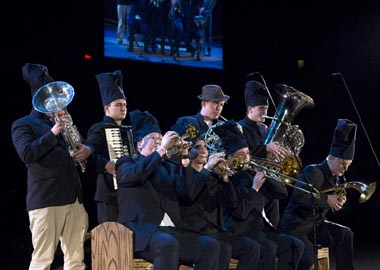
The program was an excellently executed balance of serious reflection and pure entertainment, blending video technology and live performance, cohesively strung together by excellent musical arrangements performed by choir and orchestra.
Among the key events outlined in Rexburg’s history was the Wagon Box Prophecy, wherein Wilford Woodruff stood atop a makeshift pulpit — a wagon box — during a visit in 1884, and prophesied to the Snake River Valley’s settlers of fertile fields, green valleys, a university, and temples dotting the land.
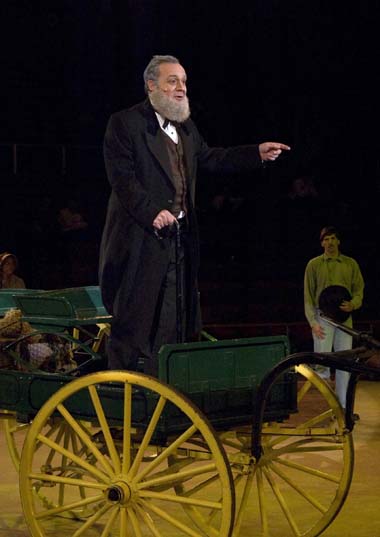
“We believe the Rexburg Temple to be fulfillment of that prophecy,” said Greg Moeller, chair of the cultural celebration, an event which has become a standard part of temple dedications in recent years.
The program also highlighted two other community-building events: the breaking of the Teton Dam and the widespread destruction from flooding in 1976, and how volunteers laid 16 miles of sprinkler pipe in just two days when the Yellowstone fires threatened eastern Idaho in 1988.
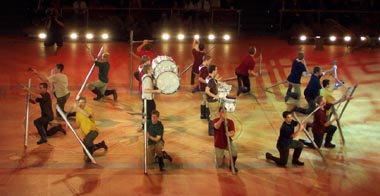
About one-third of the cast were students in dance and music at BYU-Idaho, adjacent to the temple site, while other participants were drawn from the community and temple district. Unfortunately, participants from Driggs, Idaho, were not able to be in the final production because of unseasonably heavy snowstorms that had closed mountain passes and prevented their attendance at dress rehearsals.

But for those who did make it, it was well worth the time they spent preparing. Alexis Sellers, 17, said it was exciting to be a part of it as well as to learn how to square dance. They were part of the exuberant opening numbers featuring the Virginia Reel and “Black-eyed Joe.”
She and Chris David, 17, both from the Rexburg East Stake, said that although they attend school with many of the other participants from their stake, “It was a good opportunity to meet people you don’t ordinarily associate with or know very well.” David had a similar experience a few months ago when he was living in the Sacramento Temple district in California and participated in that temple’s cultural celebration.

The Rexburg celebration’s planning committee and stake leaders displayed an amazing amount of organization in the way the 90-minute show went off — no small task when you consider the field house below the Hart Auditorium strewn with blankets, pillows, backpacks, bottled water and shoes, not to mention nearly 2,000 young people waiting their turn to go onstage.

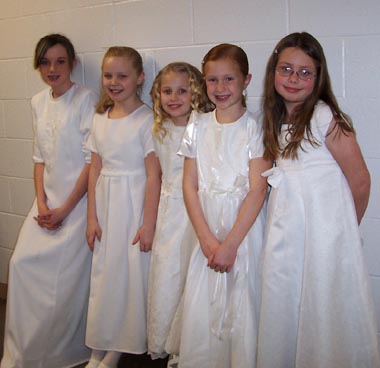
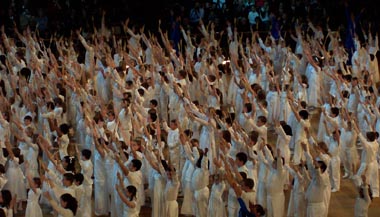
And those young people — including 600 Primary-aged children who flowed onto the floor in white clothing, carrying stalks of wheat in the finale — were amazingly under control and soaking up the experience.
Brittney Joost, BYU-Idaho student from Santa Clarita, Calif., dressed in a deep blue gown and performed with others a lyrical dance to a choir/orchestra arrangement of “The Spirit of God” to close the production.
“It went above and beyond my expectations,” she said afterward. “It was an awesome experience and probably something I’ll never do again.”
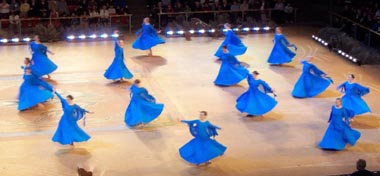
The program was designed as a multi-media production that would have equal appeal to those attending the live performance or watching it on a screen at another location, noted Moeller. In addition to live singing and dancing, there were pre-recorded sections and narrated quotes from pioneer journals, giving the show a semi-documentary feel.
Gentry Childers, a BYU-Idaho student from Vancouver, Washington, was waiting in the hall with friends before the show for standby seats in the 4,000-seat auditorium. As part of a theater tech class, all four had helped with technical aspects, props, costumes, and “crowd control” during rehearsals and had come to see how it all turned out. They weren’t disappointed.
“When you’re watching, you can really catch the spirit of it — everything working together,” Childers said.

Explained celebration chair Moeller a few days before, “The day the temple is dedicated will be a sweet, solemn occasion. But there’s so much joy in our hearts, and the night before that will be an opportunity to celebrate.”
He reiterated that thought as he greeted the audience Saturday night. Elder Russell M. Nelson presided and also spoke briefly. Elder David A. Bednar, former president of Ricks College/BYU-Idaho, urged the youth in the production to pray for a special memory of the dedication as they participated Sunday.

The committee chose the theme for the celebration from D&C 101: 64 and 65:
That the work of the gathering together of my saints may continue, that I may build them up unto my name upon my holy places; for the time of harvest is come, and my word must needs be fulfilled.
Therefore, I must gather together my people, according to the parable of the wheat and the tares, that the wheat may be secured in the garners to possess eternal life, and be crowned with celestial glory when I shall come in the kingdom of my Father to reward every man according as his work shall be…
Moeller noted that the youth were involved not only in rehearsals, but in firesides and devotionals where the theme could be discussed.
“We understand that garners refers to temples, places where we should gather,” said Moeller. “This celebration gives youths the opportunity to be part of the dedication and feel the spirit of temple-building.”
It’s a bit ironic that this stake president, who as a 13-year-old boy was happy to see the Teton Dam burst and cancel the only dance festival he’d ever been scheduled to be in, was now in charge of the entire youth cultural event in conjunction with the temple dedication. He assured, though, “My attitude was much better this time.”
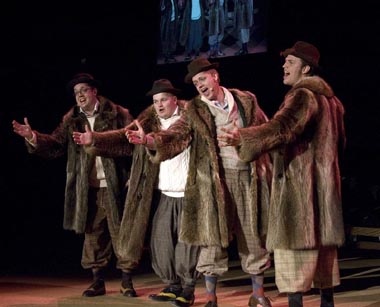
Three BYU-Idaho dancers who portrayed students in costume, makeup and energetic dance styles of the 1940s commented after the show on how organized it was, despite the large number of participants. “I could see it was totally in the hands of the Lord,” said Mandy Devey, from Murietta, Calif.

Canadian Mallory Klain, from Cardston, Alberta, knew as they were learning the dances that general authorities would be in the audience. “You could see it on the dancers’ faces,” she said when it was all over. “They love doing it, and they love the reason they’re doing it.”
Annmarie Hawkes of Twin Falls, where another temple is nearing completion, said, “The most special part for me is being able to show my feelings about the temple through dance.”
Whether they were in the audience or in the show, one thing’s certain: As 8- and 9-year-old siblings Justin and Alison Anderson of the Ashton Stake, who wore white and came onstage at the end, said, “We’ll always remember it.”