




 The original Liberty Jail
Liberty Jail is a sacred place where the faith of the Prophet Joseph Smith was tested and found sufficient. The fall of 2013 marks both the 175th anniversary of the Prophet’s incarceration at this site as well as the 50th anniversary of the dedication of Historic Liberty Jail by Elder Joseph Fielding Smith. He was then a member of the Quorum of the Twelve and also the grandson of Hyrum Smith, who was imprisoned with the Prophet along with Sidney Rigdon, Alexander McRae, Caleb Baldwin and Lyman Wight.
The four and a half months Joseph spent confined in the Liberty Jail were a painful and refining time for the Prophet. He suffered not only because of miserable living conditions but also knowing that his own family and other Church members were being driven from western Missouri into Illinois. During his confinement, thousands of men, women, and children were forced from their homes in the Far West region. Joseph’s feeling of anguish and frustration led him to plead with the Lord on behalf of the suffering Saints. In response, he received divine direction, comfort, and instruction as recorded in sections 121, 122, and 123 of the Doctrine and Covenants. As mentioned in the presentation at Historic Liberty Jail, “What could have been a time of despair became a season of faith.”
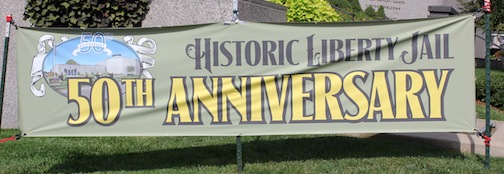 In remembrance of these past events, a commemorative symposium and a reception were held during the weekend of October 12-13. Speakers on Saturday included Alexander Baugh and Susan Easton Black Durrant, both BYU professors of Church History and Doctrine and Daniel C. Peterson, BYU professor of Islamic studies.
Describing the conditions of the Mormon prisoners, Brother Baugh spoke of the sickness, fevers, nausea, diarrhea, body aches and fatigue that plagued them. “Picture yourself, brothers and sisters, being confined in close quarters with just a few individuals and you don’t have your human liberty or freedom.” The Prophet Joseph also described their living conditions in a letter he wrote to Isaac Galland, “We are kept under a strong guard, night and day, in a prison of double walls and doors …Our food is scant, uniform, and coarse; we have not the privilege of cooking for ourselves; we have been compelled to sleep on the floor with straw, and not blankets sufficient to keep us warm; and when we have a fire, we are obliged to have almost a constant smoke.”
Brother Baugh explained that a total of eight letters by Joseph written from Liberty Jail have survived. This includes the twenty-nine page letter from Joseph to Emma, written in March 1839 in the handwriting of Alexander McRae and Caleb Baldwin, from which excerpts are taken from for D&C 121, 122, and 123. Brother Baugh also shared excerpts from some of the other surviving letters including, “Trials will only give us that knowledge to understand the minds of the Ancients. For my part I think I never could have felt as I now do if I had not suffered the wrongs that I have suffered. All things shall work together for good to them that love God.”
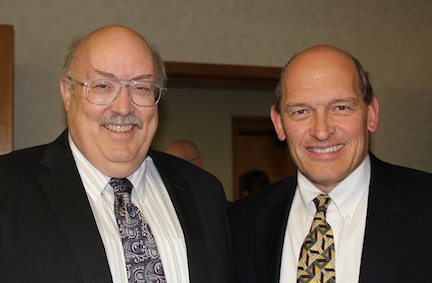 Daniel C. Peterson and Alex Baugh
Summarizing the experience of the Prophet, Elder Baugh said, “Liberty Jail changed Joseph, there’s no question…He became more compassionate, more kind and more determined to do what the Lord asked.”
Sister Durrant gave a brief life sketch of Alexander Doniphan, including some his many accomplishments. Many honors were bestowed upon him both during his life and in the years since. But for Latter-day Saints, General Doniphan is remembered because he defended the Saints at a time when it was not popular to do so. His defiance of the order given him by Major Gen. Samuel Lucas was even included by John F. Kennedy in a television series called “Profiles in Courage.” Sister Durrant expressed her own appreciation saying, “I am very grateful for Alexander Doniphan …I am particularly grateful that he had enough integrity to know who he was and what he stood for and that he would not, despite going against military orders, that he would not kill Joseph and fellow prisoners.”
Elder M. Russell Ballard of the Quorum on the Twelve was a special guest at a reception held at Historic Liberty Jail on Sunday afternoon. In attendance at the reception were local community leaders, religious leaders and descendants of the five men who were imprisoned with the Prophet Joseph Smith.
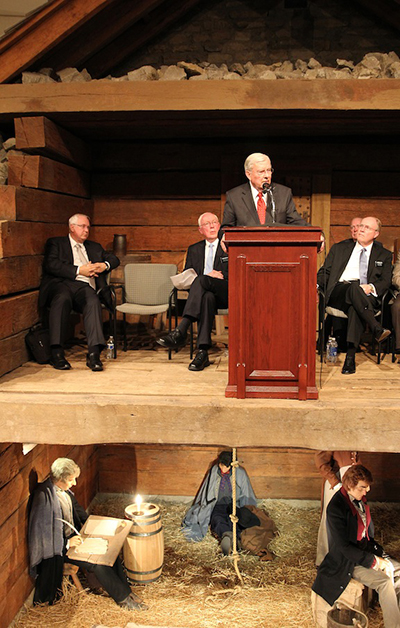 Elder M. Russell Ballard addresses those gathered at the Historic Liberty Jail
Elder Ballard had been in Kirtland Ohio that morning participating in commemorative events there. Accompanying Elder Ballard was his wife Barbara as well as Elder Robert C. Gay of the Seventy, President Donald Keyes of the Missouri Independence Mission and Karl Ricks Anderson, Patriarch of the Kirtland Stake and well-known historian.
Speaking from a podium on the upper floor of the cut-away jail inside the visitors’ center, Elder Ballard extended a warm welcome to those in attendance who were not members of the Church and expressed his desire to say a few words about who the Prophet Joseph Smith is and why he was called to restore the fullness of the gospel of Jesus Christ to the earth. “The gospel had to be restored – that is our message to the world. That was Joseph’s message; that was Hyrum’s message.”
Speaking of Joseph’s imprisonment in Liberty Jail, Elder Ballard expressed, “I believe that while they were incarcerated here, as difficult as it was in the winter…they learned something that was very precious – they learned of the Atonement of Jesus Christ…They also learned to stand firm under the most vicious attacks.” Elder Ballard also referred to the jail as a prison temple “because Heaven was very close to these men as they went through this incarcerated period.”
Elder Ballard also made reference to Carthage Jail in Illinois where both the Prophet and his brother Hyrum were martyred. “Joseph was only 38 years old when he was betrayed again and put into a jail unjustly.
Only this time, with his brother, they were gunned down in cold blood and became martyrs to the witness and testimony that they had brought to the world – that the gospel of Jesus Christ is once again upon the earth… I think if Joseph were here today, he would say, No unhallowed hand will destroy this work.'”
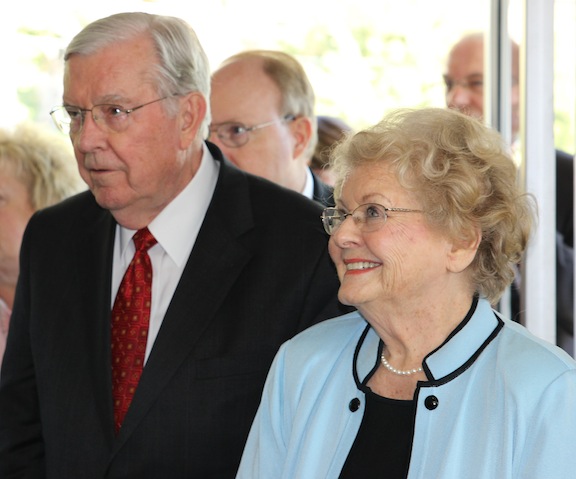 Elder M. Russell Ballard with his wife Sister Barbara Bowen Ballard
Closing his remarks, Elder Ballard explained that being here was very tender for him, “My mother is the great granddaughter of Hyrum Smith…I sense and feel the great strength of Hyrum…and pray that I may maintain my courage to declare what I know to be true; that which I have shared with you tonight.”
Elder Ballard also invited Elder Robert C. Gay, President Keyes and Karl Ricks Anderson to speak. Brother Gay spoke of Alexander Doniphan and his refusal to execute the Prophet and the lesson learned at Liberty to “Stand up for what’s right.” Brother Anderson related that he had been in the Kirtland Temple that morning with Elder Ballard and the youth of the Kirtland Stake. He spoke of the Prophet Joseph’s glorious experience in the temple when the Savior appeared. In contrast, Brother Anderson was now standing that afternoon in the jail where Joseph spent some of his darkest hours and yet this was also referred to as a temple.
That evening, Elder M. Russell Ballard spoke in the stake center located next to the newly dedicated Kansas City Missouri Temple. Speaking to those gathered, he spoke about the need to share the gospel. “What would Joseph and Hyrum say to you tonight if they were here: ‘Please, please, do not be apathetic…let other people know what we know.'” He spoke of the current wave of full-time missionaries, now over 80,000, and expressed his belief that the Lord was hastening His work. Referring again to the Prophet Joseph he said, “What would Joseph say – ‘We did everything we could, we fought a good fight …we established the Kingdom of God once again on the earth.'” “You hold on to that” Elder Ballard said referring to the gospel “You study it and then you do your part to help others understand it.”
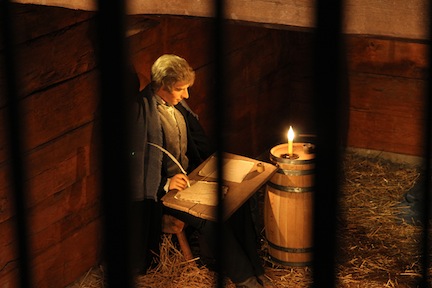 Artistic representation of Joseph Smith in the Liberty Jail
Elder Ballard encouraged all to be anxiously engaged in the work and to hold firm to our faith. He concluded by saying, “May the roots of your testimony be deep in the doctrine of Jesus Christ so that when the winds of trials come, you may lose leaves but you will not blow over.”