








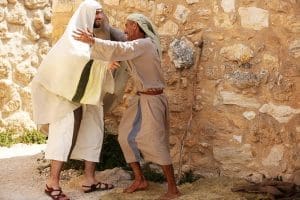



The law of consecration as practiced at different times in the history of the Church both anciently and in this dispensation is typified by having “all things in common.” (Acts 2:44-45, 4 Nephi 1:3, Moses 7:18, D&C 49:20)
Many modern saints parse the writings about the law of consecration, arguing about nuances in the language to better understand the mechanics of the law. Stephen Harper of Brigham Young University has suggested that such parsing largely misses the point. The law of consecration doesn’t prescribe specific practices in terms of how property is shared, rather its point is that resources must be shared to lift the poor and build the kingdom. In the early days of the modern Church, leaders, especially Joseph Smith, sought guidance and inspiration as to the procedures that might be used to implement the law of consecration.
Ultimately, the Church has determined not to broadly implement a program of having the saints share all of their assets and income in common. For now, in that sense of its meaning, it is fair to say that the saints are not expected to live the law of consecration.
That said, in the temple, we make a covenant to live the law of consecration. We who have made this covenant often assume that our pledge is essentially contingent upon a church-wide implementation of the law of consecration. To the extent that we are not now called upon to give all of our assets and income to the Church in exchange for an assigned “stewardship” (an assignment of resources from the Church) it is true that our pledge is contingent.
The broader doctrinal import of the law of consecration is that the saints are to use their resources to provide for the poor among them and to build up the kingdom. There are many ways in which we actively do this in fulfillment of modern Church practices.
First and most notably, we give 10 percent of our income to the Church in the form of tithing. Latter-day Saints are remarkable in their devotion to this principle. While not all members of the Church are faithful, full tithe payers, millions of members are.
Add to tithing, the duty to pay a generous fast offering. Latter-day Saints fast once each month for two meals and donate the value of those meals-or much more if they can-to the Church specifically to help members-and even friends of other faiths who may approach a Bishop for help-with their temporal needs.
In addition to our tithes and offerings, we are expected to contribute to the Church’s humanitarian aid program, the general and ward mission funds, the perpetual education fund and other charitable and philanthropic activities of the Church.
Furthermore, we send our young men-and increasingly our young women-to serve missions. Often, they pay for themselves from their own savings. When they cannot, parents generally provide the needed resources. In cases when that is not possible, wards and branches pool their resources to pay for the missionaries to serve. In the developing world, general missionary funds from the Church are used to support missionaries who can’t afford to serve otherwise.
But the story doesn’t end there. Really, we’re just beginning. We are expected to serve missions as seniors. Thousands of seniors serve full-time missions every year. In addition, many thousands more devote substantial service in the form of Church service missions, ranging from serving in inner-city wards to doing family history or working at a Bishop’s Storehouse. We are the Lord’s army, his foot soldiers in a noble work.
The Church also teaches us to put our families first. We are expected to fulfill the Lord’s command that we multiply and replenish the earth. Because we take that admonition seriously, our families are larger than the families of our friends of other faiths.
On top of all of that, we are encouraged as Latter-day Saints to be active in our communities, to give money to and to volunteer time with good causes. As it says in the Doctrine and Covenants, “…men should be anxiously engaged in a good cause, and do many things of their own free will…” (D&C 58:27)
For most members of the Church, our incomes our sufficiently limited that if we do all that we are expected to do-to tithe, to generously give offerings, to contribute to the ward mission fund, the humanitarian fund, the perpetual education fund and then to send our children on missions, to serve missions ourselves, to devote ourselves to Church service as home and visiting teachers and in whatever other calling our ward and stake leaders may choose to give us, there would be no practical difference between living the law of consecration and the Church’s current practice of collecting tithes and offerings.
For some whose resources are particularly modest, a stewardship from the Church might well represent an economic step up. Certainly, for the most affluent saints, a step down would seem to be required of any model where all things are held in common.
President Henry B. Eyring observed that the law of tithing prepares us well for living the law of consecration. It is clear to me that this is so. Most faithful members of the Church have little surplus after doing all that they are required and expected to do.
For those of us who find ourselves on the more affluent end of the spectrum, however, it might well be said that we could do more in the spirit of living the law of consecration we’ve covenanted to obey by generously giving more of our resources to the poor.
As the law of consecration is set forth in the Doctrine and Covenants, the context for the law is set forward: “And behold, thou wilt remember the poor, and consecrate of thy properties for their support.” (D&C 42:30)
My book, Building Wealth for Building the Kingdom addresses these and other financial topics; you can connect with me on my blog at BuildingWealthForBuildingTheKingdom.com, on Twitter or Facebook. Be sure to share your experiences in the comments below.






Lisa TozierMarch 12, 2013
Lisa I have tried this before and it did not work. let me know if it does.
MariaMarch 11, 2013
For Leah, I have been blessed with more than I need so I give a very generous fast offering. I would be happy to help all in my ward enjoy "some relief". I am sure those in your ward do to. Talk to your bishop so that you may be blessed by our offerings.