





I love questions. They often spur pondering on difficult topics that help me to articulate, refine, and elucidate my beliefs and thoughts on everything ranging from political hot topics like immigration or same-sex marriage to personal opinions like the best Pixar movie or preferred parenting techniques. The two books in today’s column both pose and attempt to answer difficult questions about justice, mercy, and “the right thing to do.”
“Conformity…is the enemy of the best way to live”
Justice: What’s the Right Thing to Do?
By Michael J. Sandel
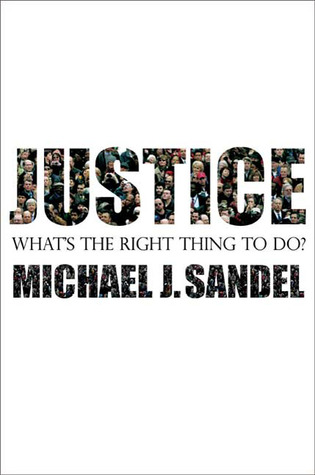 Dr. Michael Sandel teaches a popular course at Harvard simply called “Justice.” (You can actually watch videos of his lectures – twelve comprise the entire course – on his website here.) This book, Justice: What’s the Right Thing to Do?, is a summation of the major points of the Harvard course, and an accessible introduction to several major schools of philosophy and philosophers including utilitarianism, libertarianism, Immanuel Kant, John Rawls, and Aristotle, among others.
Dr. Sandel methodically and thoroughly discusses each approach to the concept of justice, defining it, elucidating with examples, pointing out the strengths and weaknesses of each argument, and comparing each philosophy to others. Utilitarianism, for example, defines the “right thing to do” as “whatever will maximize the happiness of the community as a whole.” Dr. Sandel points out that this approach can lead to trampling on the rights of individuals and minorities and that “happiness” can have a slippery and evolving definition for each person. And according to strict libertarians, self-ownership is supreme; each individual has “a fundamental right to liberty-the right to do whatever we want with the things we own.” But libertarianism assumes truly free will for all with no coercion, which, while appealing in theory, is simply not the case in practice. Immanuel Kant, on the other hand, “insist[ed] that we do not own ourselves.” Instead, morality “is about respecting persons as ends in themselves,” which to him meant “that we treat ourselves with respect, and not objectify ourselves.” Aristotle’s philosophy adds the dimension of telos, or purpose, to the discussion of morality and justice.
Justice: What’s the Right Thing to Do? does an excellent job of using current issues big and small to highlight the different definitions and perspectives on justice. In this wide-ranging book, Dr. Sandel draws on real-life examples that extract the salient points of differing philosophical schools. From abortion to affirmative action, from jury duty to consensual cannibalism, and from Casey Martin using a golf cart during the PGA tour to an unethical contractor charging an elderly woman $50,000 to fix a leaky toilet, case studies abound on almost every page and make the theoretical discussion much more concrete. It was fascinating to me to be able to see the threads of each of these schools of thought alive and well in today’s debates on contemporary political issues.
Finally, Dr. Sandel sums up the three major approaches to justice:
“One says justice means maximizing utility or welfare-the greatest happiness for the greatest number. The second says justice means respecting freedom of choice-either the actual choices people make in a free market (the libertarian view) or the hypothetical choices people would make in an original position of equality (the liberal egalitarian view). The third says justice involves cultivating virtue and reasoning about the common good.”
Dr. Sandel, not surprisingly, comes down in this third camp. In the last ten pages, he describes what a new approach he calls “politics of the common good” would look like. Citizenship, sacrifice and service would be re-enthroned as important virtues. Market-oriented reasoning would be limited to appropriate spheres instead of encroaching on social practices that should be valued in ways other than supply and demand. Inequality would be a serious topic of discussion because of its effect on both solidarity and civic virtue. And instead of a “politics of avoidance,” we should aim for a “politics of moral engagement” to provide a “stronger…basis for mutual respect.”
Early on in Justice: What’s the Right Thing to Do?, Dr. Sandel spells out his goal in writing this book: “to invite readers to subject their own views about justice to critical examination-to figure out what they think, and why.” I’d say he reached his goal with me, or at least started me on that path, and I encourage you to do the same.
“If we genuinely view criminals and sinners as the scum of the earth,’ then we are certainly failing in our duty as disciples of Christ”
Sinner’s Advocate: An LDS Perspective on the Morality of Criminal Defense
By Taylor Hartley
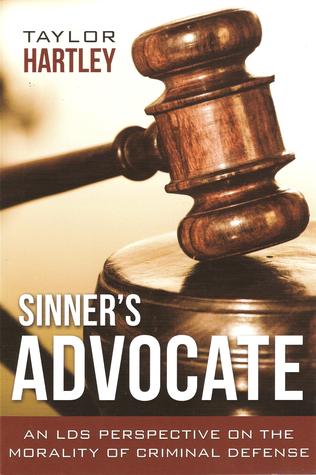 Mr. Hartley, a criminal defense attorney, has had some difficult questions lobbed at him during his career. When he taught criminology at a local college, the head of the criminal justice program asked him, “Taylor, how do you justify defending criminals if you’re a dedicated member of The Church of Jesus Christ of Latter-day Saints?” Another time, at a social gathering, the host asked “as she wrinkled her nose, How do you like working with the scum of the earth?‘”
Sinner’s Advocate is Mr. Hartley’s response to these questions. Explicitly written for an LDS audience, Sinner’s Advocate describes Mr. Hartley’s approach to his practice of defending those accused of crimes, including those who are undeniably guilty. He explains his role as a criminal defense lawyer is “threefold: (1) protect the innocent who are wrongly accused of crime(s); (2) insure that the guilty are treated fairly and not penalized more than they deserve…; and (3) keep the good guys’ good” (i.e., ensure that police and prosecutors use proper means to achieve their ends).
Seamlessly weaving back and forth between spiritual and legal insights, Mr. Hartley draws fascinating parallels and takes lessons from each sphere that apply to the other. For example, comparing legal certainty levels (quantified as percentages) to Alma’s sermon on faith recorded in Alma 32:18-34 yields the following “Seven Degrees of Certainty” in both the legal and spiritual realms:
|
Degree |
Legal Certainties |
|
|
100% |
Absolute Knowledge |
Perfect Knowledge |
|
95% |
Beyond a Reasonable Doubt |
Knowledge |
|
70% |
Clear and Convincing Evidence |
Strong Faith |
|
51% |
Preponderance of the Evidence |
Faith |
|
40% |
Probable Cause |
Belief |
|
25% |
Reasonable Articulable Suspicion |
Cause to Believe |
|
0% |
Hunch |
Desire to Believe |
In spite of the similarities, there is an important difference between our use of levels of certainty in spiritual matters and legal matters. Mr. Hartley explains:
“In our spiritual and religious lives, it is completely okay to say, I have faith in Christ,’ or I believe the Church is true.’ These are expressions of hope mixed with some level of uncertainty. We follow, or should follow, as if we’re 100 percent sure. Because in our spiritual and religious lives this devotion is acceptable, and even laudable, we tend to think it is also okay to say, I believe he or she is truly guilty’ and then treat the person as if he or she is, in fact guilty. There is uncertainty, though, and yet we use gap-fillers, such as reason and logic to make up for the missing amounts of certainty so we can feel justified in treating the person as guilty.”
Mr. Hartley is skeptical of “reason.” After all, he states, “reasonable minds can differ” and “honest mistakes can be made” in the process of trying to discover truth. “The strongest powers of reason can do nothing more than discover that which is more likely’ or most likely’ true because reason is what you use when you don’t have knowledge. By itself, reason can never determine with total certainty that which is true.” Therefore, reason alone is simply not sufficient basis for a criminal conviction – it doesn’t reach the standard of “beyond a reasonable doubt.” On the spiritual side, he concludes, “reason and its logical conclusions about absolute truths end up giving people a false sense of security in the accuracy of their beliefs or faith.” The only infallible source for spiritual truth is God. I’ll quibble with Mr. Hartley’s complete dismissal of reason as a vehicle for discovering truth just a bit; I believe that there is a place for reason at the very least in determining which truths to “plant” as a seed in Alma’s analogy or “desire to believe” in the chart above. And I believe that the Spirit can work with our mind as well as our heart to communicate truth and that this influence is often manifest as “reason.”
Using Jesus Christ as a pattern, Mr. Hartley makes specific suggestions on how we should treat both the accused and convicted. As Christ “did not come to condemn an evil world [but] to deliver and save it,” we should refrain from personally condemning others. Although Christ did criticize and rebuke some individuals and groups of people while on the earth, “we [unlike Christ] are not omniscient and we need to be careful about trying to criticize like Christ did because those criticisms require knowledge of what the others knew.” Our default rule should be, as Christ’s was, to “focus on remedies more than penalties-remedies that have the power to reform.” Finally, we need to follow the command to “love one another” without any exceptions.
One final insight from Sinner’s Advocate that struck me as profound: “All of us have the spiritual career of making the lifelong effort to find, accept, and live by what is actually true.” In order to fulfill our spiritual careers, “we need our own experiences with the Divine on some level, whether direct or indirect.” It’s only in that personal experience with the ultimate Source of truth that we can gain the perfect, absolute knowledge we seek.
** I received a review copy of Sinner’s Advocate from the author, who happens to be my sister’s brother-in-law.
**************************
On My Bedside Table…
Just finished: Unearthly and Hallowed by Cynthia Hand
Now reading: As I Lay Dying by William Faulkner
On deck: A Wizard of Earthsea by Ursula K. Le Guin
**************************
Come find me on goodreads.com or email suggestions, comments, and feedback to egeddesbooks (at) gmail (dot) com.