





We all make mistakes. A lot of mistakes. Big ones, small ones, some that have long-reaching effects and others that we forget two minutes later. And not just us “little” people – everyone makes mistakes, including those we view as leading experts in their fields. Here are two fascinating books that approach this experience, so fundamental to being human.
“Wrongness is a vital part of how we learn and change.
Being Wrong: Adventures in the Margin of Error
By Kathryn Schulz
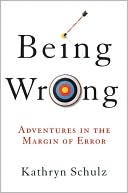 Within the first two paragraphs of Being Wrong: Adventures in the Margin of Error, Ms. Schulz lays out a startling, thought-provoking assertion: “As absurd as it sounds when we stop to think about it, our steady state seems to be one of unconsciously assuming that we are very close to omniscient.
When I got to that point, I had to stop reading for a minute. Was she right? Do I, as she suggests most of us do, “go through life assuming that [I am] basically right, basically all the time, about basically everything”? In many ways, a truthful answer would have to be “yes.” Otherwise, I’d try to change. I wouldn’t deliberately hold positions I thought were “off” or “mistaken” or “wrong.” Would I? Simply by virtue of the opinions being mine, it’s obvious that I believe they must have merit – or be “right” – and that does seem to be assuming I’m “very close to omniscient.”
Except for all those times I’m not…
In general, having our “rightness” confirmed feels good, while discovering that we’re wrong feels bad. But there’s far more to it than that. Ms. Schulz delves deeply into the psychology of being right and being wrong, along with how our errors “edge us incrementally toward” truth. Our unconscious or intentional biases, the difficulty so many of us have uttering those three special words: “I don’t know”, the peer pressure of groupthink. All of these very human tendencies illuminate how prone we are to not only err, but to be pretty sure that we aren’t erring.
A woman, violently raped and beaten, confidently identifies her attacker first in a photo and then in a line-up, only to discover 16 years later, through DNA evidence, that she was wrong and the real perpetrator is behind bars, serving time for another assault. Hundreds of thousands of followers of a popular preacher fervently believe that October 22, 1844, will mark the end of the world, only to watch the sun rise on October 23. An Exalted Cyclops (head of a local klavern) in the Ku Klux Klan reluctantly agrees to work with an African-American leader in his North Carolina town to implement desegregation and they become fast friends. Being wrong can be humiliating, frustrating, devastating; but it can also open us to wild new and exciting possibilities.
Instead of focusing on the negative aspects of making mistakes, throughout Being Wrong, Ms. Schulz reframes many mistakes in a positive light, in terms of the benefits we reap not only from our errors, but from our basic, mortal ability to err. Being mistaken allows us the opportunity to change and to grow, to recognize that we are not omniscient, nor do we have through our limited perspective, a corner on Truth. “Acknowledging our mistakes,” she mentions, “is an intellectual and (especially) an emotional skill.” We demonstrate humility when we are able to recognize our errors – and lack of omniscience – and accept them with grace. Additionally, she states that “error in general startles, troubles and sometimes delights us by showing us that the world isn’t as we imagined it to be.” In this way, being wrong is linked to creativity. Because human beings can be wrong, or see the world the way it isn’t, we are able to create great imaginative works of art and powerfully rich fictional novels.
Ms. Schulz offers several suggestions towards how to take advantage of our mistakes and ability to err. She notes that “awareness of one’s own qualms, attention to contradiction, [and] acceptance of the possibility of error,” rather than indications of weakness, are signs of “sophisticated thinking.” She reiterates that “listening is one of the best ways we can make room in our lives for our own fallibility” and is a skill that, while difficult to do well, can be learned and improved upon. Finally, she says, “all wrongness is optimism. We err because we believe, above all, in ourselves.” Being Wrong is going on my list of “books to re-read more slowly the second time” so I can glean more wisdom from its pages and learn how to turn my mistakes into progressive steps forward.
“The sorts of questions that experts tackle…[have] far more possible wrong answers than right answers.”
Wrong: Why Experts Keep Failing Us and How to Know When Not to Trust Them
By David H. Freedman
 My oldest, Will, was born a month early (surprise!), and though small, was judged healthy enough to come home after only two days in the hospital. A few days later, he turned blue in my arms – twice – prompting a frantic 9-1-1 call and rush back to the hospital. It was a scary, emotional, and disorienting time. He outgrew the issue, a result of his prematurity, and is healthy today, but what I remember as some of the most frustrating moments during our additional time in the hospital, were doctors’ rounds when we were presented with a myriad of divergent medical opinions. We saw no less than eight physicians during that week and it seemed that every single one had a different approach to Will’s care. This one wanted one certain test; that one thought these other two tests would provide better information. The third suggested one sleeping arrangement while the fourth expressed her opinion that that was completely unnecessary. Another one convinced us that his recommendation of a particular medication was best, only to have a different physician dismiss that idea as ineffective. As brand new, sleep-deprived, and frankly terrified parents, it was maddening and terrifying to us that all these “experts” not only weren’t on the same page, but actively contradicted each other. If they, with all their medical training and knowledge, couldn’t come to a consensus on the best course of treatment, how on earth were we, with little medical experience, supposed to make intelligent, informed decisions for our son?
In Wrong: Why Experts Keep Failing Us and How to Know When Not to Trust Them, Mr. Freedman discusses this phenomenon, along with many similar situations in which “experts” in many different fields find themselves. To open the book with a bang, Mr. Freedman interviews Dr. John Ioannidis, a physician whose specialty is “calculating the chances that studies’ results are false.” Dr. Ioannidis reveals that “most medical treatment simply isn’t backed up by good, quantitative evidence,” and that even when a study is published in a reputable, peer-reviewed journal, “often it [is] only a matter of months, and at most a few years, before other studies [come] out to either fully refute the findings or declare that the results were ‘exaggerated.'” In fact, he states, even in the top echelons of published medical research, “results that held up were outweighed two-to-one by results destined to be labeled ‘never mind.
‘” That’s not particularly reassuring, but it certainly provides some insights into why those eight pediatricians we dealt with in the hospital weren’t all singing the same tune.
So why are “experts” – and Mr. Freedman defines an expert as “someone whom the mass media might quote as a credible authority of some topic” as well as, for example, scientists and others who “gain some public recognition for their experience and insight” – so often wrong? Well, there are an impressive number of reasons, so many that by the end of the book you may be more surprised that “experts” ever get anything right than that they are so often wrong! Setting aside egregious faults like the deliberate falsification of data, it turns out that “experts” are just as susceptible to human errors as the rest of us, such as lacking good data (or ignoring data that doesn’t fit pre-conceived notions), using indirect or “surrogate” measurements that don’t really measure what you want to measure (but are, for whatever reason, easier or more accessible), or trying to force simple answers onto complex questions (like homing in on one or two factors as the “key” for reducing obesity).
Mr. Freedman also confronts the myth that teamwork and collaboration are effective ways to battle individual error. While I could certainly point to some anecdotal evidence of that from my college days and working life, it was affirming to read that “crowds, far from being reliably wise, turn out to be at least as good at discouraging and suppressing the production and dissemination of excellent work as highlighting it, and tend to bring some of the worst work to the top.” Group settings actually present additional opportunities for error including “social loafing” – in which people in groups don’t work as hard as people working alone – and “groupthink” – where there is pressure to conform to the majority opinion.
Finally, Mr. Freedman closes with a few suggestions regarding how we as laypeople or non-experts can judge wisely among all the “expert advice” with which we are bombarded on a daily basis. After listing typical characteristics of less trustworthy expert advice and characteristics that should be ignored, he provides traits of more trustworthy expert advice, including:
- It’s heavy on qualifying statements
- It’s candid about refutational (or conflicting) evidence
- It provides some context for the research
- It provides perspective
With “an appropriate level of wariness with regard to any expert pronouncement,” and a bit more education about just what “expert advice” entails, which Mr. Freedman provides here, we can be better prepared to judge which advice to follow and which to ignore amongst the cacophony of opinions, viewpoints, and theories.
**************************
On My Bedside Table…
Just finished: Northanger Abbey by Jane Austen
Now reading: Mansfield Park by Jane Austen (I recently decided to re-read all of Ms. Austen’s novels…fun!!)
On deck: Searching for Dragons by Patricia Wrede
**************************
More on being wrong, making mistakes, and screwing up next time! What have you learned from your mistakes? Come find me on goodreads.com or email suggestions, comments, and feedback to egeddesbooks (at) gmail (dot) com.