







To sign up for Meridian’s Free Newsletter, please CLICK HERE.
The following begins a serialization of the novel, Abinadi by H.B. Moore, originally published in 2008 by Covenant Communications. Abinadi is a Whitney Award Winner for Best Historical Novel and a Best of State Winner in Fiction. H.B. Moore is the USA Today bestselling author of more than a dozen thrillers and historicals. More information about H.B. Moore can be found: www.hbmoore.com
Prologue
Till I die I will not remove mine integrity from me.
(Job 27:5)
128 bc
A rat scurried across Abinadi’s legs, and he tucked his feet beneath him, wrapping his arms around his knees. The air inside the prison cell had blossomed into ripe humidity, sending rivulets of perspiration down Abinadi’s back. Gazing with effort at his dim surroundings, he wondered about those who had been in this cell before. He’d spent only three days here, but he’d heard of those who had been imprisoned for years.
A thin beam of muffled light filtered through the corridor beyond. The absolute dark was softening with the morning. Anxiety pulsed through Abinadi as he anticipated the guard’s arrival. He should be here any moment with the next instructions.
The previous night had proved sleepless as Abinadi crouched on the earthen floor, his back against the cold stone wall. There was nothing to lie upon, nowhere to sit except the dank ground. Standing was too exhausting and lying would have made him bait for the two rather large rats occupying his cell—the hard round of bread thrown in the night before had immediately become the varmints’ property. Despite his protesting stomach, Abinadi did not care about the food or the spilled vessel of water that darkened the dirt near his feet—courtesy of the rats. His thoughts left his physical environment as they replayed the day, little more than two years earlier, when he’d received the call to be a prophet.
He had been only twenty-five years old when the Lord asked him to preach repentance to His people. Abinadi’s entire life had changed in that instant. And now, here he was, caged like an animal, awaiting his final sentence. The sounds of his not-so-distant past seemed to fill the prison cell—his son’s bubbly laughter, his wife’s comforting whispers during restless nights, the voices praising God during Sabbath services in his home. Closing his eyes, Abinadi reveled in the sweet memories and let the salty tears fall.
From the Lord’s first instruction, Abinadi’s wife had understood that he had to preach the Lord’s words. But would she understand this—that she might have to raise their son alone?
In his heart, Abinadi had already made his choice. He would finish the Lord’s errand with the same determination with which he’d begun it.
The echoes from his memory blended with new sounds. Chanting. It seemed to fill the entire cavern. Abinadi listened as the rhythmic words grew louder. Somewhere . . . outside . . . people were condemning him. His pulse quickened, and he took a deep breath.
“O God,” he prayed through cracked lips, “with Thy strength I will pass through the valley of death.”
The low chants seemed to envelop him. The heavy door of the cell opened, and Abinadi lifted his head, ready to face the guard. But two men entered instead, their finely woven cotton capes thrown on haphazardly. They were high priests from the king’s court—some of those who had accused him. Abinadi smelled stale wine on their clothing, undoubtedly from a night of indulgence.
“Have you had enough time to reconsider?” one of the priests asked. Abinadi knew him as Amulon. The man was tall; his physical presence alone made him powerful. He wore a coat of jaguar skin and a belt of fine, beaded cloth. In one jeweled hand he gripped a long obsidian dagger.
“I am not afraid of death,” Abinadi said, gazing up into the man’s eyes. “Christ will break the bands of death, and the grave will have no victory.”
Amulon blinked, his face unresponsive.
But the priest next to him laughed. “Everyone knows that if you die you go to the underworld.” He guffawed and slapped Amulon’s shoulder.
“Enough,” Amulon growled at the other priest, then he narrowed his eyes at Abinadi. “You are foolish to speak against the king.” He took a step closer, but Abinadi didn’t move. “He asks for your presence once more. If you value your life, you’ll recant your words and ask for his forgiveness.”
When Abinadi didn’t respond, the unnamed priest reached down and grabbed him by the arm, sneering. “I say you’ve had your chance.”
Abinadi stumbled as the men jerked him to his feet then pushed him into the corridor, steering him along the narrow underground passage. The darkness had lifted, signaling that dawn had come and gone. But that didn’t keep the damp from settling beneath his skin. He had been here once before, on another mission . . . but that seemed so long ago, another lifetime. As they ascended the stone steps, morning light pierced through the eastern prison entrance. Abinadi blinked against the brightness, and when he emerged above ground, two guards immediately seized him, relieving the priests.
Abinadi’s skin tingled in the warmth of the sun while they walked. It was a beautiful day. The stoic trees that lined that pathway to the main temple were reverent somehow, as if something tragic were about to occur.
Abinadi and the guards arrived at the central plaza, where the revered ceiba tree stood—some thought it was the center of the universe. It shaded the surrounding area with its leafy, long-reaching branches. Several smaller temples with altars were spread out from the plaza—which created a lively scene on the Sabbath when the priests gathered to make sacrifices. Abinadi nearly tripped as one of the guards prodded him with a staff. Amulon and the other priests followed behind, laughing intermittently. Every step brought Abinadi closer to the judgment of the king. According to the laws that King Noah had established, Abinadi was guilty of blasphemy, and now he would meet his punishment.
Protect my family, O God, Abinadi prayed, for I know what I must do.
He looked about him at the surreal beauty of the early morning, expecting a hollow void of helplessness to consume him. But it did not. His soul was quiet, his mind at peace. The Lord had wrapped His arms around him.
They came to the temple grounds, where Abinadi was surprised to see a crowd waiting. It silently and fluidly parted as the guards shoved him along. Abinadi recognized some of them—men he’d worked alongside in the fields or purchased goods from in the market.
He’d spent his youth as nothing more than a simple farmer, paying his one-fifth taxes to the king and trying to provide for his ailing mother. Life had been trouble-free, although filled with hard labor. But he’d been content to move through the days, unobtrusive, unassuming. Until he met the Teacher, a man who led a group of elders in the old ways of their Fathers—Lehi, Nephi, Jacob, Enos . . . It was then that Abinadi started to question the teachings of King Noah’s priests. He started to desire more—happiness, freedom, equality.
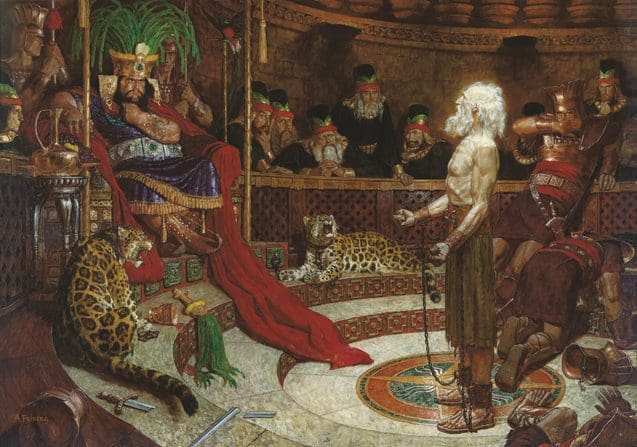
Abinadi left the sullen crowd and climbed the steps to the temple, sorrowing at the way King Noah had allowed it to be desecrated. Stone idols of nature gods lined the stairs and stood sentry at the entrance. Stepping into the cool interior, Abinadi caught a glimpse of the bright-colored idolatrous murals on the walls as his eyes tried to adjust to the semi-light. He soon came face-to-face with the raised platform of judgment seats. The king and his priests lounged upon them—as if a common thief were being brought before them instead of a prophet.
Abinadi stood for several uncomfortable moments, guards on both sides, as Amulon took his place on the right side of the king. The two men leaned their heads together to speak. Amulon was clearly older than the king, but Noah looked haggard from much indulgent living. His skin glistened with oil, and his beaded cowl looked too tight upon his neck. His feathered cape didn’t quite cover his girth, and as he tipped his head closer to Amulon, his elaborate headdress slipped. With one hand, Noah righted it, but the perspiration on his forehead caused it to slip again.
The king was so elaborately adorned that he looked like a moving pageant. At least a dozen jade bracelets pinched the flesh of his arms, while the rings on his fingers, alternating between gold and jade, made his gestures cumbersome. The cape over his shoulders had intricately sewn feathers, and his kilt was dyed in the popular turquoise. Two young women stood on either side of him, waving reed fans, although it didn’t seem to be helping much.
Finally, King Noah struggled to stand and gazed at his prisoner. “Abinadi,” the king said in a loud voice, his smile twisted. “How was your visit with the rats?”
The priests’ laughter roared through the room.
The king’s eyes glinted with delight, but his voice was harsh. “We have deliberated your case for three days. Because of your blasphemous words against me and my people, you have been found guilty. Your crime is worthy of death.”
Although Abinadi expected as much, his body shivered at the words.
Noah rubbed his meaty hands together, his face pulled into a stern glower. “And, unless you retract your destructive words, we will have no choice but to follow through with your punishment. This is your last chance.”
Abinadi stared at the king until the monarch glanced uncomfortably away. Then Abinadi looked at every priest, saying, “I will not recall the words which I have spoken, for they are true. I have come here, knowing that I would be punished. I accept death if that is your demand.” He knew he was willing to die in the name of the Lord. With every part of his soul he believed that true salvation came through the Lord. It was true. All of it. His mortal life had no great significance in the realm of eternal life with God.
His gaze found the king’s again. Noah’s face had darkened, and Abinadi’s voice rose almost as a clap of thunder. “But know this: if you slay me, you will be shedding innocent blood.” Warmth now surged through him as he felt the sure presence of the Lord in the room. He spread his arms wide, pulling from the guards who clasped them. “Your deed—my execution—will stand as a testimony against you at the last day.” Abinadi’s gaze bore into each person on the platform. “Against all of you!”
The guards recoiled, and the priests fell quiet as if they, too, could feel the sudden power pulsing through Abinadi. No one spoke. No one moved.
Noah shrank back a half step, his expression one of mixed astonishment and fear. For an instant, he appeared bewildered. He turned toward Amulon, who rose and deferentially whispered in the king’s ear. The priest on Noah’s other side, rising energetically to his feet, also bowed slightly and whispered to the king.
A spark of hope ignited in Abinadi’s chest where none had burned before. Maybe Noah would recant his sentence and Abinadi would see his wife and son again. Perhaps this was a test—like Abraham’s of old.
At the far end, two of the priests broke from their trance and stood from their chairs, one shouting, “He has reviled our king!” The other lifted a fist and yelled, “Kill him!”
The horrible words pierced Abinadi’s heart, but he kept his gaze on the king. Noah nodded to the two priests at his side, his eye growing bold again. Amulon moved away from the king, his arms crossed, a sneer on his face. One by one each of the priests stood and joined the chanting. “Kill him! Kill him!” Their voices thundered in the temple, reverberating against the walls.
After what seemed an eternity of jeering chants, Noah lifted his arms for silence. In the sudden quiet, it seemed as though even the once-holy walls held their breath.
King Noah’s voice was calm, clear, and full of authority. “Let it be done.”






Kirsten SchwendimanApril 18, 2016
Thank you! This has always been one of my favorite stories in the BoM, and this makes it even better...thanks again.
Don LaMontagneApril 18, 2016
Thank you for this great entry into the trial of this great prophet