








Failure of imagination
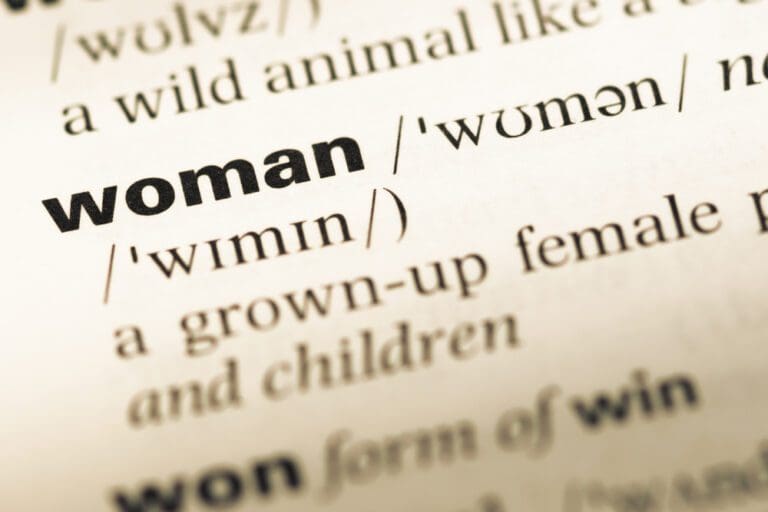
At a time when people give less authority to reality and more to inner thoughts and feelings, dictionaries are no longer reliable. Recently, Cambridge Dictionary has updated its definition of “woman” to “an adult who lives and identifies as female though they may have been said to have a different sex at birth”. Following this logic, “professional soccer player” would be anyone who wants to be a “professional soccer player” though they may not have the skill to be one.
And if dictionaries are confusing, it is not strange that people are confused as well. Nowadays “sex” and “gender” are frequently used interchangeably, not only in everyday speech, but also in academic, legal, and official writing.
It used to be a basic, fundamental feminist idea that, while sex referred to what is biological, gender referred to how society believes a man and woman act and feel (thus male and female). However, this implies a binary caste system, so now the aim is to abolish gender altogether or say that it is a spectrum.
We’ve reached a moment in time where man, women, sex, and gender are concepts so open-ended that they are actually empty. In 2024, it is enough “to feel to be” and forcing the rest of the people to act according to what is subjective and changeable seems to be the goal of those who are promoting this use of language.
International pressure
Few of us realized, years ago, that as we quietly acquiesced to using the words “gender” and “sex” interchangeably, we were opening the door to the total redefinition of sex-based words such as “man,” “woman,” “mother, “father” – even the word “sex” itself. Using the word “gender” simply seemed like a polite substitute for the word “sex.” But “gender” has been a hotly contested term in the international arena for decades. In fact, the definition of “gender” has been a source of contention since at least the mid-90’s.
There are only a couple of places in all international documents where the word “gender” is defined. One is the 1995 Fourth World Conference on Women (otherwise known as “Beijing”) where a protracted battle during negotiations yielded the word “gender” to be understood:
“as commonly used and understood in its ordinary, generally accepted usage.” (meaning man and woman).
Then the 1998 Rome Statute of the International Court (ICC) added more clarity:
“For the purpose of this Declaration and programme of Action, it is understood that the term ‘gender’ refers to the two sexes, male and female, within the context of society.”
Similar phrasing to the ICC was included in the 2001 World Conference against Racism. But all of these definitions are aggressively being attacked with an orchestrated effort to have the definition of “gender” rescinded from the ICC.
Why would it be so important to anti-family forces to get rid of that clarifying definition?
Eliminating a clear definition of the word “gender” (male and female in the law) would facilitate efforts to elevate “sexual orientation” and “gender identity” to protected categories of international law and thus provide all the “rights” associated with this new understanding.
Currently, United Families International has a team working on the negotiated draft for the “Agreed Conclusions” document that is part of the Commission on the Status of Women (CSW). In the current CSW compilation draft, there are 372 references to “gender” in a 66-page document (gender perspective, gender equality, gender responsive, gender transformative, gender identity, etc.). Imagine if every one of those references could be construed, not as the long-standing definition of sex which is the binary: man and woman, but to mean any number of the various 100+ “genders” along the non-binary spectrum.
There are currently many organizations and individuals pushing for words such as gender and sex to be interpreted as broadly as possible in treaties, since many of these treaties and documents do not contain definitions. As a matter of fact, not even the Convention on the Elimination of All Forms of Discrimination Against Women (CEDAW) provides a definition for the term “woman”.
Therefore, countries would be obliged to have a “trans friendly” interpretation in international and national legislation and policies, so that in all those cases where the word “sex” is referred to, it would be replaced by the concept of gender. The word “sex” as it has been understood for millennia would be gone. And, we no longer have the proper context or understanding of who qualifies as a “rights holder” within the framework of “sex.”
Problems incoming
But the lack of definitions not only brings legal trouble, it also opens the door to many issues involving religious freedom, families and especially children as it is becoming increasingly difficult to talk about basic biological reality in a common language.
What’s more, the true meaning of “woman” is being destroyed. “People who menstruate”, “pregnant people”, “parents 1 or 2”, “women in all their diversity” are euphemisms that seek to include but end up excluding real females. The violation of women in their privacy, safety and opportunity rights is a serious threat. Allowing biological men in women’s private spaces, dressing rooms, shelters, prisons and sports, is not helping anyone but men.
Let’s be clear
There are a couple of things to bear in mind before we start to take action. First, we cannot sacrifice women’s rights or sideline their interests amid social changes that promote greater inclusivity or gender equality, however well-intentioned. Second, to let people continue to believe that they are something they are not implies lying and being irresponsible. Who we are is not determined on how we feel, gender dysphoria is real and should be properly treated in each case.
Thirdly, women have XX chromosomes, while men have XY chromosomes. People born with atypical genetics or biology represent variations within the sexual binary categories of male and female. If a person is born without a leg, that wouldn’t declassify humans as bipedal (walking on two legs). It just means that an individual person was born with an anomaly—one leg instead of two.
What can be done?
To avoid future problems, enacting legislation that provides clear and scientific definitions should be a priority. In the U.S., states like Kansas, Tennessee and Oklahoma have already approved their own “Women’s Bill of Rights” and there is a federal bill working its way through the system. This legislation should provide clarity by: addressing the meaning of laws that prohibit sex discrimination, making it clear that terms like “women” and “men” must accord with sex, not gender identity, helping to preserve single-sex spaces and activities, and forbidding unfair discrimination but allowing the law to recognize sex when relevant.
Unfortunately, it seems that Latin American countries are going in the opposite direction. Many of them, such as Mexico, Peru, and Chile now prefer to use the word gender instead of sex and enact “gender equality” laws. Likewise, international organizations such as the OAS and the Inter-American Court are promoting an intersectionality and diversity approach to member countries.
Though our society is confused, we don’t have to be in doubt. There are only two types of human beings, and they have biological differences. That is how it should be, men and women complement each other and deserve not the same but an equal treatment. So don’t buy into the redefinition of gender, be respectful but honest in your speaking, and become aware of efforts in your region to define sex and gender in policy or law. Above all, help the truth prevail.







Bonnee B.March 8, 2024
I used to wonder why God made a point of saying that he created man, "male & female created he them". . . it seemed so obvious, but now I know why that was such an important statement. . .
JuliannMarch 6, 2024
This is of utmost importance. If we believe we stand as a witness for God at all times, in all things, and in all places then we must stand up in defense of Gods greatest creations— men and women. We are not “it’s”. We are not of our own creation. We are sons and daughters of God.