





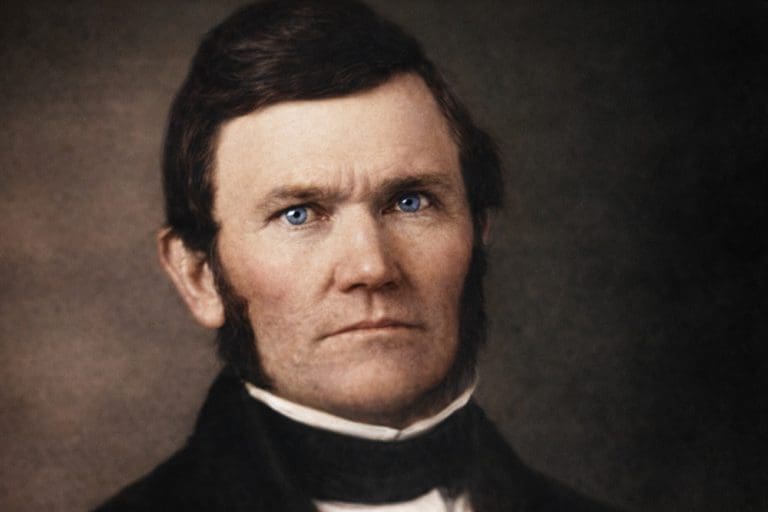


About six weeks after the death of the Prophet Joseph Smith and his brother Hyrum, eight members of the Quorum of the Twelve Apostles met to conduct some much-needed business in Nauvoo. According to Wilford Woodruff’s journal entry on that day, August 12, 1844, the first item was to call Amasa Lyman as a new member of the Quorum. After some discussion, Wilford recorded: “Moved by H[eber] C. Kimball that Elder W. Woodruff take a mission to England and Preside over the Church and Printing establishment in England, Ireland, Scotland & the adjacent Islands and continent.”
Wilford had only recently returned from a mission to the Eastern United States, and now he had to prepare for his second mission to England, this time as the presiding authority of the Church in Europe. He had much to do and many decisions to make before his imminent departure, not the least of which was how to care for his growing family while he was away.
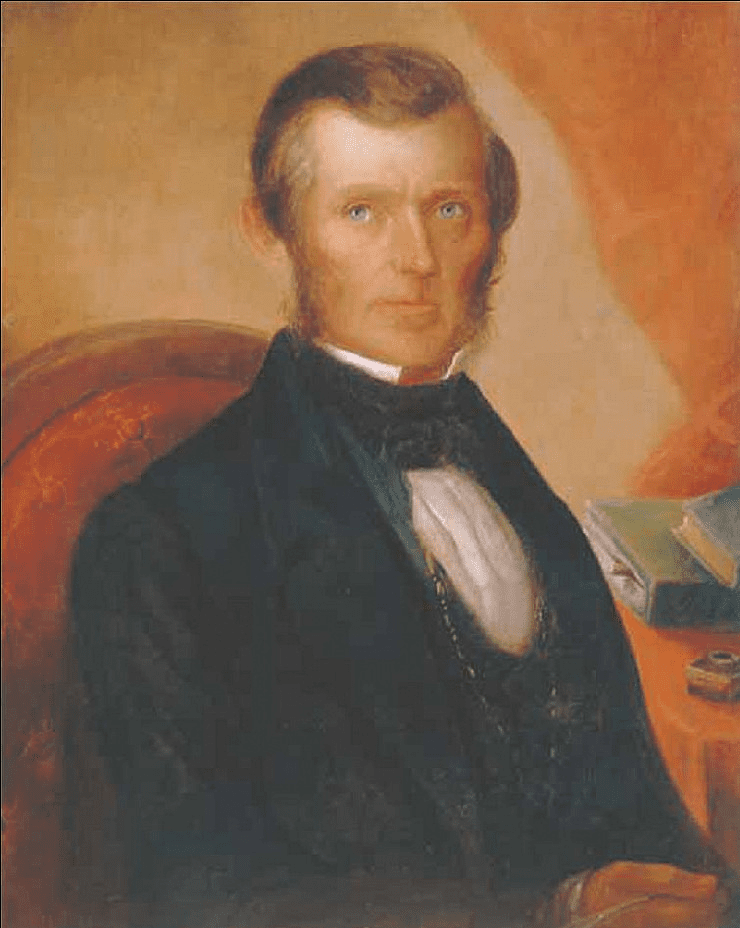
Painting of Wilford Woodruff during his first mission to England, January 20, 1841
Wilford Woodruff the Missionary
By the time Wilford Woodruff and Phebe Carter married in April 1837, Wilford had already served in Zion’s Camp and as a missionary to the Southern United States. A month after their wedding, Wilford took Phebe along with him on a sort of honeymoon mission to Maine, where Phebe’s family lived. Phebe spent some time with her family and worked alongside her husband as his mission companion until she returned to her parents’ home to give birth to their first baby. It was while Wilford was serving in Maine that the Prophet Joseph received what we now know as Doctrine and Covenants 118, a revelation calling Wilford as a new member of the Quorum of the Twelve Apostles, and calling the apostles to preach the gospel “over the great waters.”
Historian Edward Tullidge explained, “Before the age of railroads and steamships had fairly come, going to Great Britain on a mission was very like embarking for another world; and the apostolic proposition to gather a people from foreign lands and many nations to form a latter-day Israel, and with these disciples to build up a Zion on this continent, was in seeming the maddest undertaking possible in human events.”
The Woodruffs finally made it back to Nauvoo from Maine in the spring of 1839. When Wilford left for England in August, Phebe and their baby Sarah Emma were living in an unfinished home and were ill, along with most of the community of Saints. Wilford recorded, “The enemy is striving to bind us down that we shall not go into the vineyard.” Although Phebe and Sarah Emma were soon taken in by friends, Sarah Emma became seriously ill the following summer and died on July 17, 1840.
Preparing for His Second Mission to England
As Wilford prepared for his second mission to England a few years later, he understood the sacrifices that would be required of him and of his family. Yet he was never one to scare off easily—or, really, at all. In Luke 12:32, the Savior assures his disciples, “Fear not, little flock; for it is your Father’s good pleasure to give you the kingdom.” Elder Woodruff was ready to do all he could to build the Lord’s kingdom on earth. Of his missionary service, Wilford boldly stated, “I say, if it cost me my life, let it go: I want to be among the number; I am ready to follow the example of those who have gone before me—when my work is done, I am ready to be offered, if necessary.”
He trusted the Lord and wanted the Lord to trust him, and he was going to take the Lord at His word, believing the promise made in Malachi 3:10–12:
Prove me now herewith, saith the Lord of hosts, if I will not open you the windows of heaven, and pour you out a blessing, that there shall not be room enough to receive it.
And I will rebuke the devourer for your sakes, and he shall not destroy the fruits of your ground; neither shall your vine cast her fruit before the time in the field, saith the Lord of hosts.
And all nations shall call you blessed: for ye shall be a delightsome land, saith the Lord of hosts.

A page of the Book of Malachi from Wilford Woodruff’s personal Bible
Wilford was going to prove the Lord and he expected the windows of heaven to open. He was on the Lord’s errand and his task was clear, as explained by Brigham Young in a letter to the Saints in Europe at the end of August 1844:
To all the Elders and Saints in Europe greeting.
We send our beloved brother Wilford Woodruff to England to take charge of all the business transactions pertaining to the Church of Jesus Christ of Latter Day Saints both spiritual and temporal. We wish you to give diligent heed to his council in all things and as we have not the opportunity of Informing you of what has transpired this season by letter, our beloved brother will make known unto you all things. . . . For he is qualified to teach the Saints in the things pertaining to the Church and kingdom of God established in these last days.
Caring for the Woodruff Children
That same week, as all the business of the Church was on his mind—organizing temple construction; making visits to Emma Smith, Lucy Mack Smith, and Mary Fielding Smith; and still so deep in mourning following the deaths of Hyrum and Joseph Smith only two months earlier—Wilford also had to decide how to provide for his family during his mission. He wrote in his journal on August 27:
I have left my family and friends almost yearly to go on missions in the vineyard of the Lord, for the last ten years of my life, but have never attempted to take my family with me before for the purpose of accompanying me on a mission, but as I am now about to leave my own country to again visit foreign climes to preach the gospel of Jesus Christ & take care of the churches which will probably be a long mission I conclude it best to take my family with me according to the council of the Twelve so this day is spent settling accounts taking inventory of Goods and chattels left, packing up goods, receiving letters, bidding friends farewell blessing the Saints, which continued until midnight.
Although he wrote, “I conclude it best to take my family with me,” he and Phebe would only be taking one of their three children to England with them. Little Wilford, who they called Willie, was now four years old and would stay across the river in Iowa with the Benbows. John and Jane Benbow, converts from Wilford’s first mission in England, were the couple who introduced him to the United Brethren in 1840. They were stalwart and loyal friends of the Woodruffs. Phebe Amelia, age two, was going to leave Nauvoo with the Woodruffs and travel to Phebe’s family in Maine as the Woodruffs made their way east. Only their one-year-old daughter Susan would accompany the Woodruffs to England.
Even after making the decision for their children, and despite their trust in the Lord to look over their own “little flock,” Wilford and Phebe were concerned for their children. On August 28, Brigham Young and Heber C. Kimball gave a blessing to Phebe and also to Susan. Wilford recorded that Phebe was promised, “Your life & health shall be precious in the eyes of the Lord and in the hour of distress & trouble thou shalt be preserved by the power of God. . . . Thy children shall be preserved until thou shall return & meet with them again.”
Leaving Nauvoo, the group traveled with Hiram Clark and Dan Jones and their wives, along with a few others, on the way to Chicago. In mid-September, they made their way across Lake Huron, where Wilford helped put out a fire in the engine room in the middle of the night, in his bare feet and night clothes, while Phebe stayed below and comforted a panicked woman. Wilford recorded that it was over quickly, but “all were sea sick or Lake sick which was equally as bad.” Another fire broke out on board their next ship, on Lake Ontario, just a few days later.
By the end of September, the Woodruffs had reached Wilford’s family in Farmington, Connecticut. Wilford remained with his family a little longer than Phebe and the children, who went on to her parents’ home in Maine. When Wilford joined them, Phebe Amelia was sick and, upon arriving at the Carters, they discovered that members of Phebe’s family were also very ill. Phebe’s sister and niece appeared to be dying of typhus, drawing out the Woodruff’s stay in Maine until they finally felt comfortable leaving their two-year-old daughter with the Carter family. In mid-November, when Wilford was very anxious to be on their way to England, he recorded in his journal: “It is a dark time; I am surrounded with darkness like midnight, the plague or the destroyer is on my right and left hand trying to hedge up my way from filling my mission but I trust the Lord will deliver me in some way.”
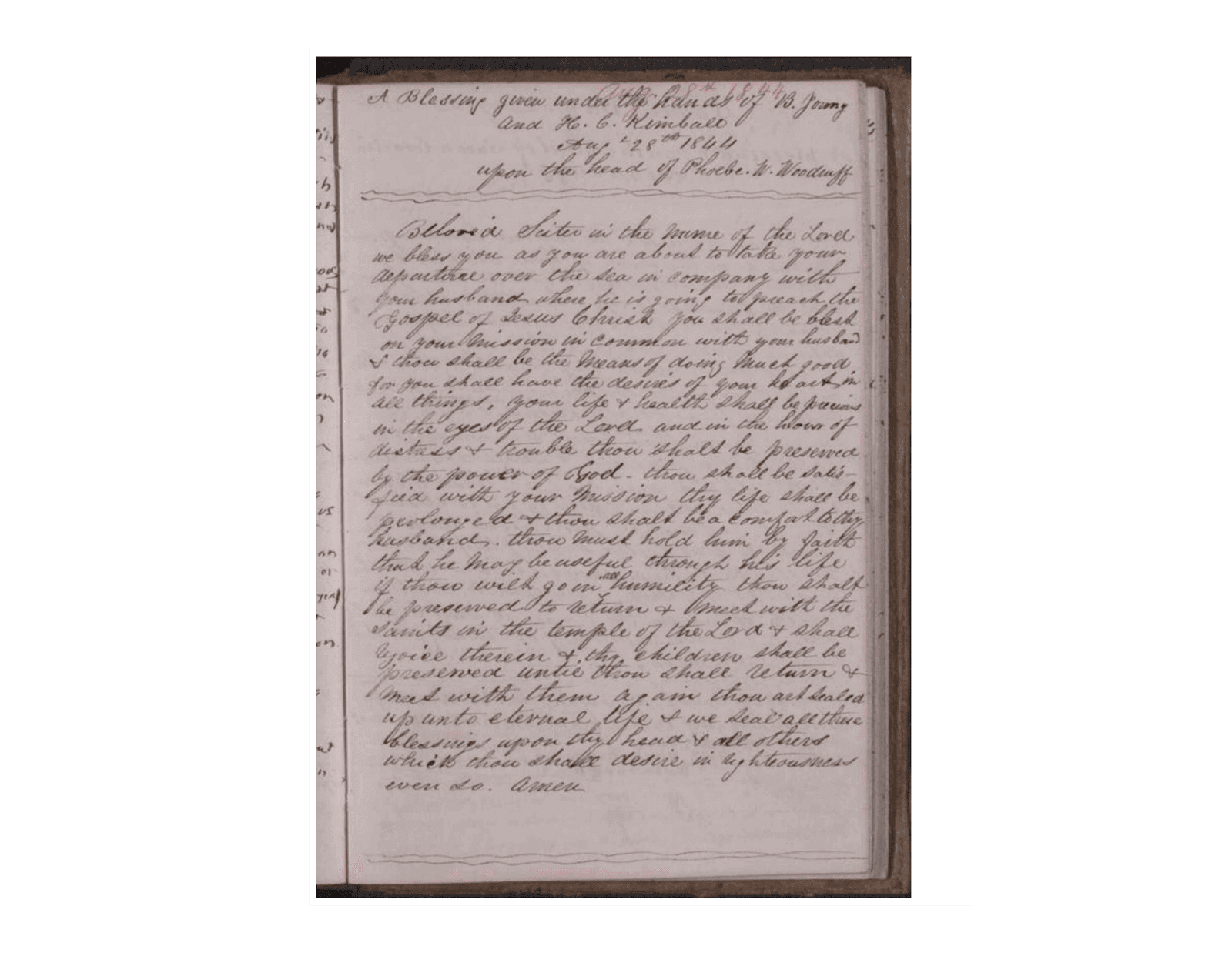
Page from Wilford Woodruff’s journal, August 28, 1844
Leaving Home and Family
Despite their concerns, on November 20th, the Woodruffs—Phebe, Wilford, and baby Susan—said goodbye to Phebe Amelia and left the Carter home for England by way of Boston and New York. Clearly they had stayed longer than Wilford had planned, for on the 21st of that month, he wrote in his journal, “After being blockaded with sickness with my children & friends in Scarboro for near a month & surrounded by great darkness during the time for it seems as though the destroyer was trying to hedge up my way to hinder me on my mission, & where the destroyer is there is darkness & sorrow, yet this I morning I feel like bursting their bands & going my way.”
Finally, by December 8, the little family was on their way out of New York Harbor. There was more talk of rough water, seasickness, and flooding in the cabins, but on December 29, they spotted the Irish coast and realized their journey was almost over. On January 3, 1845, the Woodruffs were in Liverpool.
Building on a Firm Foundation
Leaving Nauvoo at the time Wilford was called to serve a mission required some creative problem solving on the part of the Woodruffs, yet from the records Wilford left behind, not going never seemed to be an option. But why was that, and how did he reconcile the difficulty with the desire? Upon leaving for the first British mission in 1837, his friend Heber C. Kimball expressed the challenge Elder Woodruff would also feel. In his journal, Elder Kimball recorded it this way: “The idea of being appointed to such an important mission was almost more than I could bear up under. I felt my weakness and was nearly ready to sink under it, but the moment I understood the will of my Heavenly Father, I felt a determination to go at all hazards, believing that he would support me by his almighty power . . . I felt that the cause of truth, the gospel of Christ, outweighed every other consideration.”
In a sermon Elder Woodruff gave in Nauvoo in August 1844, immediately before departing, he explained:
Inasmuch as you will be united in heart mind and action in supporting your councillors, the authority of the Church, the priesthood of God, and follow the council given you, as you have endeavored to follow the council of the Prophet while he was living, you will be safe and blessed and will prosper; but if you are divided and reject the counsel of God you will fall, union and faithfulness is your salvation. It is true you have been led by one of the best men that ever has graced humanity, or tabernacled in flesh but he has gone, he has sealed his testimony with his blood. He has loved this people unto death. I would now call upon this people to be united in building upon the foundation which The Prophet Joseph has laid.
Wilford was going to carry on building upon that foundation. The promise in Malachi 3:10—“Prove me now herewith, saith the Lord of hosts, if I will not open you the windows of heaven, and pour you out a blessing, that there shall not be room enough to receive it”—provides some insight into how Wilford Woodruff could trust that the Lord would help him guide, not just the Lord’s “little flock” of those early Saints, but his own “little flock” of Woodruffs. As the Lord promised, their children were protected while they were away. They received updates from the Benbows and the Carters on the health and welfare of their children; and baby Joseph was born safely in Liverpool in the summer of 1845.
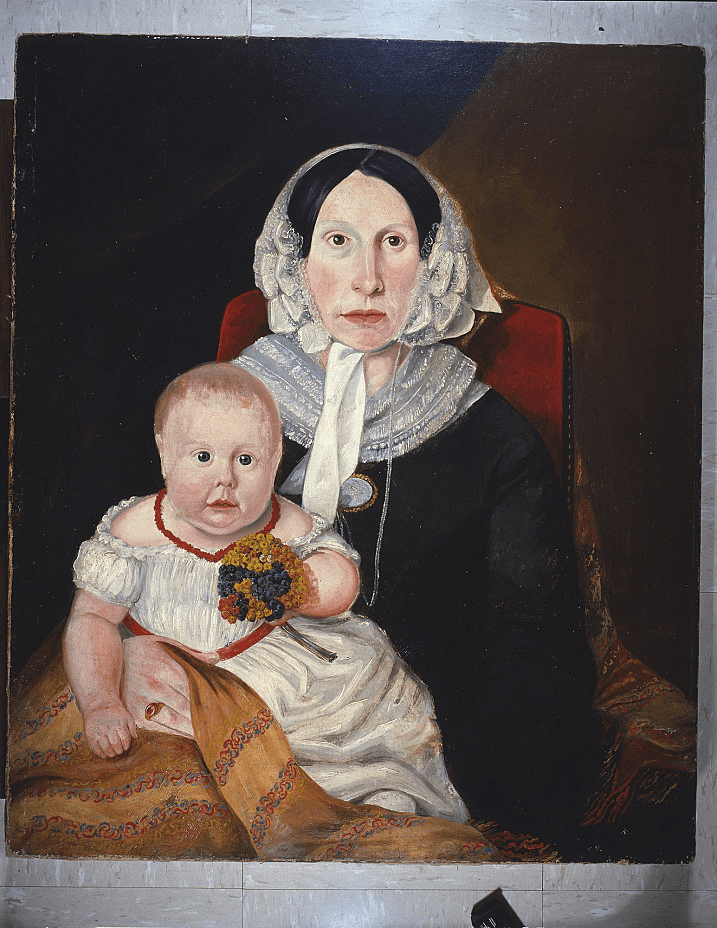
Portrait of Phebe and Joseph Woodruff in England, December 1845
In addition to the blessings for their family, the windows of heaven continued to be opened to bless the missionary work in England. Wilford successfully resolved some fiscal mismanagement and conflicts between mission leadership; he efficiently sorted out the very complicated and threatened publication of the Doctrine and Covenants in England by a former member of the Church who sought to seize the copyright; and he organized several hundred new converts to immigrate to Nauvoo.
Those who made their way west with the Saints from England and farther afield in Europe during the nineteenth century made up about one hundred thousand converts by the turn of century. They were a much-needed addition to the faithful population of the Saints settling in the Intermountain West. Now in 2025, with more than 380 temples in various stages of construction and use, and a worldwide Church population of over seventeen million members, the windows of heaven continue to be opened for the faithful Saints who, like the Woodruffs, trust in the Lord.
 Kristy Wheelwright Taylor serves as the Board Secretary for the Wilford Woodruff Papers Foundation and helps with transcription and writing with the Project. She has loved getting to know Wilford Woodruff better through his own words. Kristy has a master’s degree in Humanities from Brigham Young University and has worked as an English Instructor at Purdue University, copy editor, technical writer, travel writer, and historical researcher and writer, and now spends much of her time volunteering in community and church work. You can find her book, Prepare Me for Thy Use: Lessons from Wilford Woodruff’s Mission Years, at Deseret Book and Amazon.
The Wilford Woodruff Papers Foundation’s mission is to digitally preserve and publish Wilford Woodruff’s eyewitness account of the Restoration of the gospel of Jesus Christ and make his records universally accessible in order to inspire all people, especially the rising generation, to study and to increase their faith in Jesus Christ. For more information, please explore wilfordwoodruffpapers.org.
Footnotes
1 Wilford Woodruff’s Journal, August 12, 1844, p. 309, The Wilford Woodruff Papers,
https://wilfordwoodruffpapers.org/p/mX3.
2 Painting of Wilford Woodruff by Filippo Pistrucci, courtesy of the Church History Library, The Church of
Jesus Christ of Latter-day Saints, ChurchofJesusChrist.org/study/ensign/2006/01/contents?lang=eng.
3 Edward W. Tullidge, The Women of Mormondom, New York: Tullidge and Crandall, 1877.
4 Wilford Woodruff’s Journal, July 25, 1839, p. 105, The Wilford Woodruff Papers,
https://wilfordwoodruffpapers.org/p/vJn.
5 Letter to the Saints, October 11, 1844, p. 2, The Wilford Woodruff Papers,
https://wilfordwoodruffpapers.org/p/Ozvr.
6 Wilford Woodruff’s Bible, p. 410, The Wilford Woodruff Papers,
https://wilfordwoodruffpapers.org/p/EWrm.
7 Wilford Woodruff’s Journal, August 28, 1844, p. 332, The Wilford Woodruff Papers,
https://wilfordwoodruffpapers.org/p/913.
8 Wilford Woodruff’s Journal, August 27, 1844, pp. 327–328, The Wilford Woodruff Papers,
https://wilfordwoodruffpapers.org/p/86o.
9 Baby Joseph would be born in England a year later.
10 Wilford Woodruff’s Journal, August 28, 1844, p. 330, The Wilford Woodruff Papers,
https://wilfordwoodruffpapers.org/p/gL6.
11 Wilford Woodruff’s Journal, September 18, 1844, p. 339, The Wilford Woodruff Papers,
https://wilfordwoodruffpapers.org/p/nxl.
12 Wilford Woodruff’s Journal, November 15, 1844, p. 357, The Wilford Woodruff Papers,
https://wilfordwoodruffpapers.org/p/ELv.
13 Wilford Woodruff’s Journal, August 28, 1844, p. 330, The Wilford Woodruff Papers,
https://wilfordwoodruffpapers.org/p/gL6.
14 Wilford Woodruff’s Journal, November 21, 1844, p. 359, The Wilford Woodruff Papers,
https://wilfordwoodruffpapers.org/p/Jk2.
15 Edward W. Tullidge, The Women of Mormondom, New York: Tullidge and Crandall, 1877.
16 Wilford Woodruff’s Journal, August 25, 1844, p. 325, The Wilford Woodruff Papers,
https://wilfordwoodruffpapers.org/p/6R9.
17 Image of oil on canvas painting of Phebe Carter Woodruff and her son Joseph by Thomas Ward.
Courtesy of the Church History Museum, The Church of Jesus Christ of Latter-day Saints,
history.ChurchofJesusChrist.org/media/portraits-of-childhood-phoebe-woodruff-child?lang=eng#1.




KathleenFebruary 6, 2026
WOW - he was an incredible Saint, leader and missionary!
Jamie QuistFebruary 5, 2026
Thank you for this article. I enjoy reading about the struggles and faithfulness of the early saints.