









I have spent much time in Israel in the last thirty-five years, and so the existential threat that the country has lived with has been a painful reality to me. I have long known that the Iranian regime, known as the Islamic Republic and Revolutionary Guard Corps, is ignited by a vision of an Israel genocide, completely wiping it off the map. I’ve had a front-row seat to shellings from Gaza by Iran’s proxies and checked the bomb shelter in my hotel for easy access. I have heard clerics call for the blood of Jews to irrigate the dry fields like water in a trough. I’ve seen the villages that have been in easy reach of Hezbollah, another Iranian proxy. I’ve talked to friends in Israel who have described Iranian rockets raining upon them.
So, it wasn’t surprising to me that the incomparable Mossad with its boots-on-the-ground, uncanny intelligence gathering, positioned Israel with a direct and exacting way to defang its sworn enemy. For Israel, an Iran with a nuclear bomb, spelled an end to the little democracy’s very existence. This was not hyperbole. Iran made it clear.
With its growing stock of enriched uranium coming so quickly to weapons grade, Iran was quickly getting the means to do what it always said it would do to Israel.
Israel was bold in its defense, striking Iran’s major nuclear facilities, missiles, and eliminating those who plotted directly against them—the top military leaders and atomic scientists. Survival was at stake. But Israel did not have the weapon or military capacity to effectively hit Fordow, the massive nuclear facility buried 300 feet underground in a mountain. Only the United States with its GBU-57 Massive Ordinance Penetrator bunker buster bombs could do that.
Last weekend, in a precision strike in the middle of the night, called Midnight Hammer, the U.S. military hit three nuclear facilities in Iran–Natanz, Isfahan, and Fordow- in order “to destroy or severely degrade Iran’s nuclear program” according to Secretary of Defense Pete Hegseth.
Because of the underground inaccessibility of the Fordow facility, the U.S., with its powerful bunker buster bombs and B-2 stealth bombers is the only nation on earth with the capacity to reach to that depth and destroy the facility.
It was a focused, powerful, and historic move, involving more than 125 aircraft, including seven B-2 stealth bombers, multiple fighters, dozens of air-refueling tankers, submarines and intelligence, surveillance and reconnaissance aircraft. The coordination alone is breathtaking, but that somehow in this 24-hour news cycle, that word of it did not leak out is equally remarkable, meaning that the operation was carried out with great secrecy.
Prime Minister Benjamin Netanyahu on Sunday released a video saying:
“You remember that from the beginning of the operation, I promised you that Iran’s nuclear facilities would be destroyed, one way or another. That promise has been fulfilled,” Netanyahu said.
“The United States powerfully continued the IDF and Mossad’s strikes on Iran’s nuclear program. This program threatened our very existence and endangered the peace of the entire world.”
Remembered as a Turning Point
Matti Friedman, writing from Israel for The Free Press explains:
If these strikes…succeed in destroying Iran’s nuclear program and breaking the regime’s chokehold on its own people and those of other countries—then today could be remembered by hundreds of millions of people in this region, and by billions watching from afar, as a turning point.
Since the mid-1990s, Israel’s attempts to achieve peace with its neighbors and to inhabit a more humane Middle East were crippled by terrorism often inspired, sponsored, or directed by the clerical regime in Tehran.
The Islamic Republic and its Revolutionary Guard Corps were never interested in an accommodation with Israel. Since coming to power in 1979, the regime has desired Israel’s destruction as a matter of theological principle. They worked ruthlessly to undercut any attempt to muddle toward some kind of understanding that would make the lives of Muslims and Jews better in the real world. The media framing of Israel’s dilemma as an “Israeli-Palestinian” conflict has always been a simplistic fiction: For decades the most powerful driver among Israel’s enemies has not been the Palestinians, but Iran—a country 75 times the size of Israel and more than 1,000 miles away.
Iranian support was key to the rise of Hezbollah, the Party of God, in Lebanon in the 1980s and 1990s. The Iranian example helped inspire the rise of the Palestinian Hamas, the Islamic Resistance Movement, in those same years. The latter group killed many hundreds of Israeli civilians long before its massacres on October 7, 2023, triggered the current war…
In places like Yemen and Iraq, Iran-funded rocket arsenals appeared in the hands of religious fanatics who publicly declared their desire not for peace but for death. Thousands of brainwashed young men in headbands marched in Gaza City and Beirut, pledging themselves to martyrdom in the style of the Islamic Republic. Our own society adapted accordingly, the old Israeli optimism fraying as time passed, and as the fundamentalists on the other side—and on ours—grew stronger, selling fantasies and feeding off despair.
The inhumanity of this period reached a crescendo with the brutal Gaza war of the past 20 months, launched by one of Iran’s clients and joined by several others—and then in the past week, during which we Israelis have all been forced into an obsession with types of ballistic missiles, Shahed drones, B-2s, F-35s, Arrow interceptors, metal, concrete, and explosive payloads.
Human beings have disappeared into safe rooms and basements. The world outside has been turned over to deadly machines.
Israel is a tiny place—the width of the country is the length of an American commute. In these restricted confines, the Iranian warheads have caused destruction of a degree we haven’t seen before, and have triggered a corresponding degree of fear.
The Religious View Driving the Supreme Leader
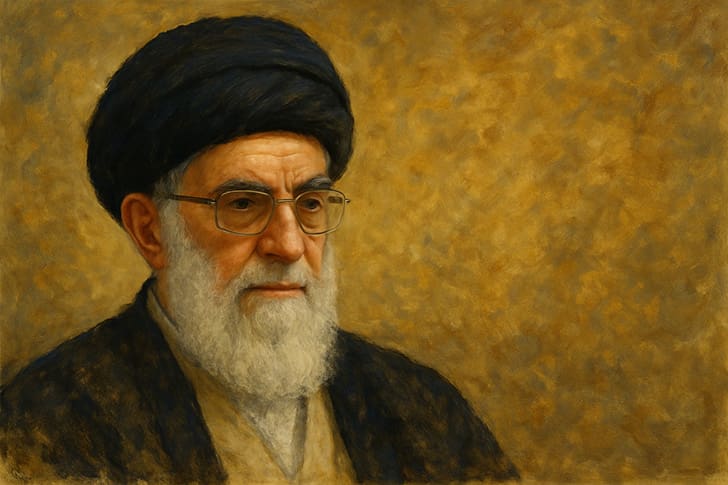
In 1989, Ayatollah Ali Khamenei became Iranian’s Supreme leader inheriting the revolutionary doctrine of his predecessor that Israel was the “little Satan” and America the “Great Satan.” On Israel, over the decades, Khamenei’s remarks have always been incendiary and promised destruction. He said, “Israel is a cancerous tumor that must be removed and will be removed.” “The Zionist regime will not last long.” He praised Hamas, Hezbollah, and Islamic Jihad for their armed attacks on Israel, calling them “heroes” and “freedom fighters.” He tweeted in 2020 that “Fighting the Zionist regime is fighting oppression.”
He has equal disregard for America, and again, over decades has said, “America is the most hated government in the world. It is the embodiment of arrogance.” Another time he said, “We will never trust America. The Americans are liars and hypocrites.”
If Israel and America are reliable targets for the Ayatollah, they aren’t the only ones in his gunsight. His vision goes beyond simple, national interest and is shaped by a revolutionary ideology and anti-Western worldview. His plan is to export the Islamic Revolution and sees the Islamic Republic as a model for Islamic governance everywhere.
No one would be more chilled by that idea than the average citizen of Iran, who know the horrors, suffering and cruelty of the Ayatollah’s regime personally. Still, his goal is to replace the Western-led regional order with one where Iran and its allies have seized control of governance around the so-called Shia crescent.
Khamenei uses the term “Axis of Resistance to describe the Iran-aligned movements that resist Western or Zionist efforts, and his goal is to unite them toward his larger dream of expelling the West. He looks to make Shia’s, instead of Sunni Muslims the dominant, governing group in countries where that is possible. To that end his regime has supported with arms, training and finances terror groups around the region. These are names you know for violence, aggression, bullying. They are the bad boys and the thugs of the evening news who foment trouble and war in their nations.
His Resistance Axis includes Hezbollah (Lebanon), Hamas and Islamic Jihad (Palestine), Iraqi Shi’a militias, Syrian regime forces, and the Houthis (Yemen). This axis is both military and ideological—a means of surrounding and pressuring Israel, deterring U.S. influence, and reshaping the region.
He has said, “Our duty is to support any nation or group that fights against the Zionist regime.”
Khamenei envisions a Middle East where Iran is the religious and political center of gravity, Israel no longer exists, U.S. forces are expelled from the region, and the ideology of his Islamic Republic shapes governance.
His primary tool that made these threats real was a nuclear bomb, and now that possibility will be closed for several years. Neither Israel nor America is looking particularly for regime change. There was just one goal in the strike this past weekend. Stop Iran from getting a nuclear weapon. History will mark this.







Harold RustJune 24, 2025
Thanks, Maureen, for a thoughtful review of all the key facts. As much as our leaders and prophets have warned against the consequences of of war, we also have scriptural and even “modern revelation “ confirming the necessity at times to fight in defense when an enemy is pursuing your death and destruction. Even the converted Lamanites of Helaman’s time were willing to allow their young me to go to war in defending. Thus, there are realities which require sober and serious personal decisions transcending a goal of peace and love and charity toward all. Peace doesn’t really mean no conflict; the Lord’s peace comes from genuinely pursuing what is most aligned with what God would have us do …at that time.
Barry HansenJune 23, 2025
Thank you, Maureen, for your informed explanation of the situation. Much appreciated.