











To read more from Daniel, visit his blog: Sic Et Non.
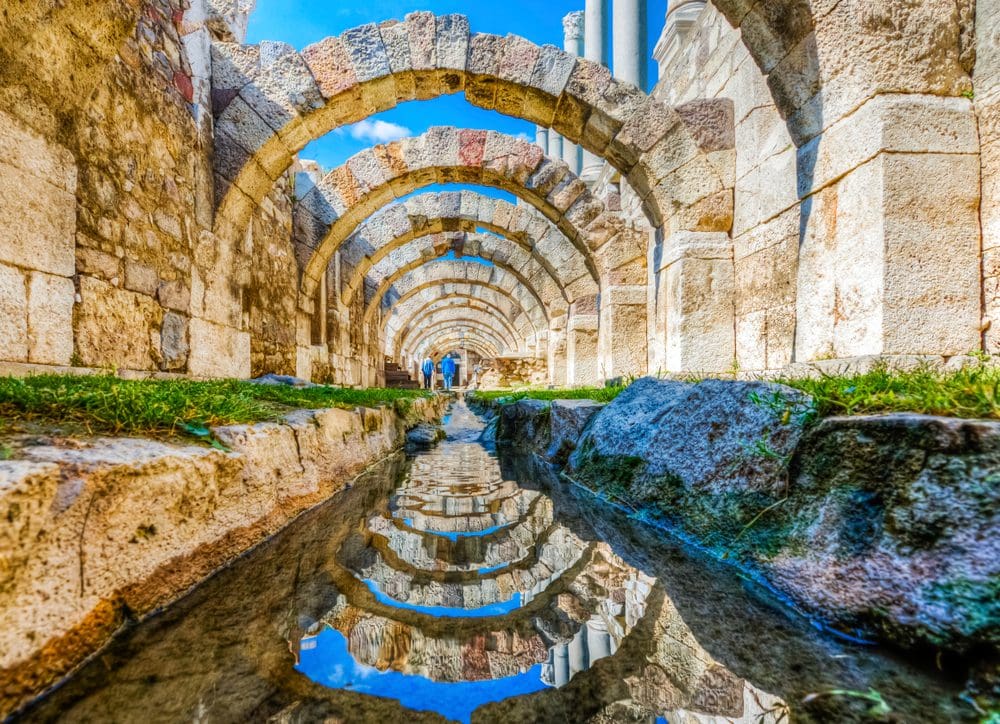
Cover image: Agora of the ancient city of Smyrna.
In Revelation 1:4, the apostle John announces his intent to address “the seven churches which are in Asia.”
But what does this mean? As used in the New Testament, “Asia” refers to what is often called “Asia Minor.” Essentially, it is the western area of the Anatolian Peninsula. In John’s day, “Asia” was a specific Roman province. (Japan and China were, literally, not even on the map.) And what is “Anatolia”? Largely, but not quite entirely, it is what we know today as Türkiye or Turkey. But that name, and the arrival of the Turks from Central Asia that provided it, were still centuries away.
“The seven churches which are in Asia” are seven branches of the ancient Christian church in the area—located in, respectively, Ephesus, Smyrna, Pergamos, Thyatira, Sardis, Philadelphia, and Laodicea (1:11), cities that are located, on average, about fifty miles apart, and which may have been postal centers that served seven distinct geographic regions. Were they the only branches? Were they the most important branches, or simply representatives? We don’t know for certain.
John describes a vision that he experienced while on the island of Patmos, which lies not quite forty miles off the Anatolian coast. He is also told to compose an account of it, and to send it to the seven churches.
“Write the things which thou hast seen,” he is told in the vision, “and the things which are, and the things which shall be hereafter; the mystery of the seven stars which thou sawest in my right hand, and the seven golden candlesticks. The seven stars are the angels of the seven churches: and the seven candlesticks which thou sawest are the seven churches” (1:19-20).
“The angels of the seven churches” may be either (a) heavenly messengers or guardians assigned to them, (b) their leaders, or messengers from them (the Greek word “angeloi” means “messengers”), or (c) personifications of the “spirit” of each of them.
I’ll go through the seven cities in the order followed by John, commenting along the way. As he lists them, they form a rough circle, initially moving northward from Ephesus—probably because Ephesus was the Roman capital of Asia Minor—and finally coming back down to Laodicea, which is southeast of Ephesus:
“Unto the angel of the church of Ephesus write; These things saith he that holdeth the seven stars in his right hand, who walketh in the midst of the seven golden candlesticks; I know thy works, and thy labour, and thy patience, and how thou canst not bear them which are evil: and thou hast tried them which say they are apostles, and are not, and hast found them liars” (2:1-2)
In the first century, of course, no Church magazine regularly published photographic charts of the General Authorities, and communication was both slow and relatively poor. Pretenders evidently traveled about claiming apostleship, and the local branches needed to discern between legitimate claims and counterfeits. In several of his epistles, for instance, Paul was obliged to defend the authenticity of his own apostolic calling.
“And [thou] hast borne, and hast patience, and for my name’s sake hast laboured, and hast not fainted. Nevertheless I have somewhat against thee, because thou hast left thy first love. Remember therefore from whence thou art fallen, and repent, and do the first works; or else I will come unto thee quickly, and will remove thy candlestick out of his place, except thou repent” (2:3-5)
John commends the past faithfulness of the Ephesian saints but faults their current lackluster commitment and sternly warns that, barring reformation, they may be cut off altogether.
“But this thou hast,” he says, “that thou hatest the deeds of the Nicolaitanes, which I also hate. He that hath an ear, let him hear what the Spirit saith unto the churches; To him that overcometh will I give to eat of the tree of life, which is in the midst of the paradise of God” (2:6-7).
We know very little about the “Nicolaitanes,” but they seem to have been a dissenting Christian sect that permitted idolatry and sexual immorality—which seems to indicate that division and apostasy were present within the church when John received his vision around roughly 95-96 AD.
Notably, no promise is made here of an earthly triumph for the Ephesian saints. Instead, John tells them to hold firmly to the Gospel in hopes of salvation in the life to come.
To the saints in Smyrna, the modern Turkish city of Izmir (then, as now, an important trading center and seaport), the Lord says:
“I know thy works. . . . Fear none of those things which thou shalt suffer: behold, the devil shall cast some of you into prison, that ye may be tried; and ye shall have tribulation ten days: be thou faithful unto death, and I will give thee a crown of life. He that hath an ear, let him hear what the Spirit saith unto the churches; He that overcometh shall not be hurt of the second death” (2:9-11).
Once again, there is a promise of victory—but only in the next life, not in this world. So too, it seems, with Pergamos:
“And to the angel of the church in Pergamos write . . . I know thy works . . . and thou holdest fast my name, and hast not denied my faith. . . . But I have a few things against thee, because thou hast there them that hold the doctrine of Balaam, who taught Balac to cast a stumblingblock before the children of Israel, to eat things sacrificed unto idols, and to commit fornication. So hast thou also them that hold the doctrine of the Nicolaitanes, which thing I hate. Repent; or else I will come unto thee quickly, and will fight against them with the sword of my mouth. He that hath an ear, let him hear what the Spirit saith unto the churches; To him that overcometh will I give to eat of the hidden manna, and will give him a white stone, and in the stone a new name written, which no man knoweth saving he that receiveth it” (2:12-17).
John’s message to Thyatira seems to be more positive but, even here, he warns against the idolatry, apostasy, and sexual misbehavior that has crept into the branch:
“And unto the angel of the church in Thyatira write . . . I know thy works, and charity, and service, and faith, and thy patience, and thy works; and the last to be more than the first. Notwithstanding I have a few things against thee, because thou sufferest that woman Jezebel, which calleth herself a prophetess, to teach and to seduce my servants to commit fornication, and to eat things sacrificed unto idols. And I gave her space to repent of her fornication; and she repented not. Behold, I will cast her into a bed, and them that commit adultery with her into great tribulation, except they repent of their deeds. And I will kill her children with death; and all the churches shall know that I am he which searcheth the reins and hearts: and I will give unto every one of you according to your works.”
“But unto you I say, and unto the rest in Thyatira, as many as have not this doctrine, and which have not known the depths of Satan, as they speak; I will put upon you none other burden. But that which ye have already hold fast till I come. And he that overcometh, and keepeth my works unto the end, to him will I give power over the nations: And he shall rule them with a rod of iron; as the vessels of a potter shall they be broken to shivers: even as I received of my Father. And I will give him the morning star” (2:18-28).
Those who endure “to the end” will be blessed. Thus, again, the promised reward seems to come after a faithful end.
“And unto the angel of the church in Sardis write; These things saith he that hath the seven Spirits of God, and the seven stars; I know thy works, that thou hast a name that thou livest, and art dead” (3:1).
Not, I think, the most auspicious greeting. And it doesn’t get much better:
“Be watchful, and strengthen the things which remain, that are ready to die: for I have not found thy works perfect before God. Remember therefore how thou hast received and heard, and hold fast, and repent. If therefore thou shalt not watch, I will come on thee as a thief, and thou shalt not know what hour I will come upon thee” (3:2-3).
There are still a few faithful saints in Sardis and, if they hold out until the end, they will receive a heavenly reward:
“Thou hast a few names even in Sardis which have not defiled their garments; and they shall walk with me in white: for they are worthy. He that overcometh, the same shall be clothed in white raiment; and I will not blot out his name out of the book of life, but I will confess his name before my Father, and before his angels” (3:4-5).
So what about the saints living in ancient Philadelphia? To the angel of that church, the Lord says,
“I know thy works . . . thou hast a little strength, and hast kept my word, and hast not denied my name. Behold, I will make them of the synagogue of Satan, which say they are Jews, and are not, but do lie; behold, I will make them to come and worship before thy feet, and to know that I have loved thee. Because thou hast kept the word of my patience, I also will keep thee from the hour of temptation, which shall come upon all the world, to try them that dwell upon the earth. Behold, I come quickly: hold that fast which thou hast, that no man take thy crown. Him that overcometh will I make a pillar in the temple of my God, and he shall go no more out: and I will write upon him the name of my God, and the name of the city of my God, which is new Jerusalem, which cometh down out of heaven from my God: and I will write upon him my new name.” (3:8-12)
Laodicea was famous for its financial wealth, its textile industry, and a locally-produced eye-salve. It apparently obtained its water from the hot springs in nearby Hierapolis but, by the time the water had reached Laodicea, it was neither cold, clean, and refreshing nor any longer hot and medicinal. All of those characteristics play a role in the message to the church members in Laodicea, a message that contains nothing positive:
“I know thy works, that thou art neither cold nor hot: I would thou wert cold or hot. So then because thou art lukewarm, and neither cold nor hot, I will spue thee out of my mouth. Because thou sayest, I am rich, and increased with goods, and have need of nothing; and knowest not that thou art wretched, and miserable, and poor, and blind, and naked: I counsel thee to buy of me gold tried in the fire, that thou mayest be rich; and white raiment, that thou mayest be clothed, and that the shame of thy nakedness do not appear; and anoint thine eyes with eyesalve, that thou mayest see. . . .
“As many as I love, I rebuke and chasten: be zealous therefore, and repent. . . . To him that overcometh will I grant to sit with me in my throne, even as I also overcame, and am set down with my Father in his throne” (3:15-21).
Some mainstream Christian church historians have spoken of the early Christian movement as a lusty infant, just beginning its steady and inexorable growth into the strong institution that caught Constantine’s favor, became the official religion of the Roman Empire, and formed the West. Such a healthy, prosperous child, however, is difficult to recognize in these verses from the Revelation of John. Nor do we see the unquenchable fire of which some speak. Rather, what we see is a flickering flame threatened by persecution, waning enthusiasm, apostasy, and moral transgression—and a promise of heavenly reward to those who manage, nonetheless, to hold out faithful to the end. Which illustrates the need for the Restoration that occurred many years later.
[Dedicated to the memory of Bianca Palmieri Lisonbee, 1953-2023]






Tim FlahertyOctober 18, 2023
I'm afraid I am not familiar with this Bianca Palmieri Lisonbee, 1953-2023, for whom this article was dedicated.
Jamie QuistOctober 18, 2023
Thank you for the backstory and history of these areas. It's like, "Oh, wow, that makes so much more sense." How can a lay person access this kind of information?