




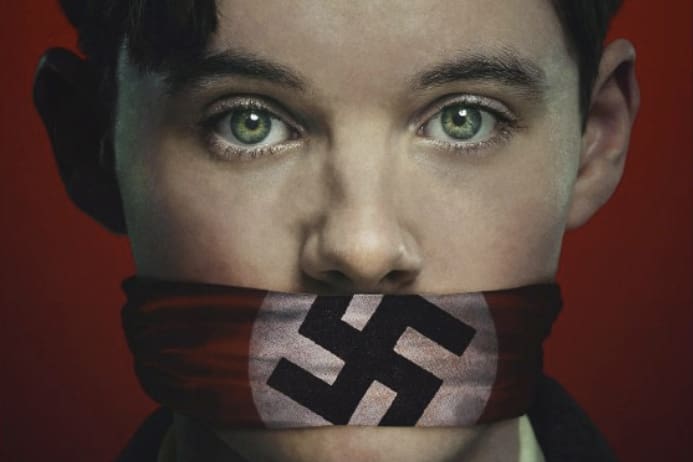


Truth or Treason?, from Angel Studios, is a new movie that premieres Oct. 17, 2025. Trailer is below. Angel Studios is “driven by purpose, and built to share stories that amplify light.”
I love movies, but the offerings lately seem barren. They are either harsh, dark, or predictable. They celebrate the anti-hero. They are made with inflated budgets but lack meaning. They seem to be the product of a world weary of itself. I can easily skip them.
That is why the new movie Truth or Treason? is such a refreshing change, a jewel in the sand, because in every way it is excellent. You shouldn’t miss this one. It is about courage, honor, and the ennobling instincts that would fire a 16-year-old, Helmuth Hubener, and his two friends to defy the Nazi regime. It’s a story that both warms you and puts you on the edge of your seat.
A Passion Project
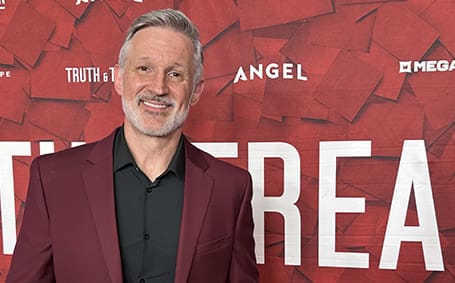
Director Matt Whitaker created this as a passion project, and it was more than 20 years in the making, but it was a story that wouldn’t let him go until it arrived on the movie screen. He said, “I felt deep in my soul that I needed to tell this story to the world.” When love compels a project, the results are deeply affected as the creator pushes through doors and details to get it just right.
This movie makes you both want to stand up for something and sit down and think. At times, you want to shout, “Hurrah!” The film is taut, tense, and moving, and, because it is based on real events, lets us meet a character who, in his youth, chose something hard, but right, someone you’d like to know. Here is a real hero on the screen.
Helmuth Hubener is Compelled to Stand Up

Helmuth’s world is gradually turned upside down as the Nazis become a looming presence, but he is stirred to action when his own branch president asks the congregation to do the Nazi salute before church meetings, and his Jewish friend is suddenly excluded from the congregation. When he begins to hear banned BBC broadcasts and becomes more aware of the strangling lies and vicious actions of the Nazi’s, something in his nature will not allow him to stay silent.
He believes he can help bring Hitler down, and he has the tools to do it because he is gifted in intellect and writing well beyond his years. He creates tracts to paste onto signs in public places and stuff into mailboxes and enlists two friends, Rudi Wobbe and Karl-Heinz Schnibbe, to help him extend the reach.
Can he stay a step ahead of the Nazi’s? The story is innately intriguing, but the execution of the film is stunning. The film, shot in Lithuania, has the feel of 1940s Hamburg with its old-world buildings and cobbled streets. Every piece of paper on the Nazi’s desk who is directing the search to find Helmuth is authentic to the time period.
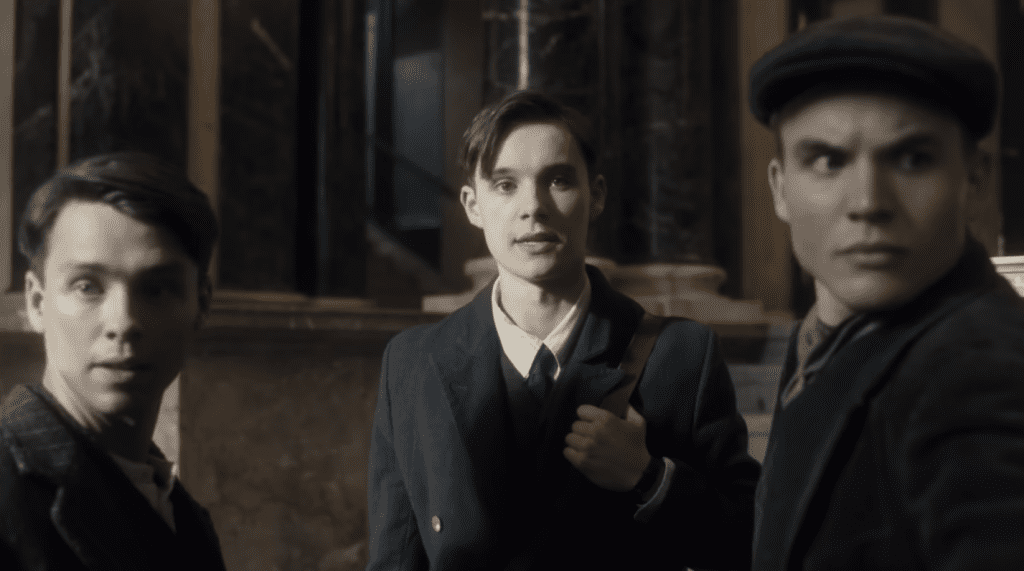
The photography is beautiful, with those scenes shot when it is primarily dark, being a play of light and shadow that mirrors the theme. The acting is deftly done and believable.
A Script Worthy of the Story
As a writer, what particularly intrigued me was the script, co-written by Whitaker and Ethan Vincent. It was intelligent and absorbing, in part, because whenever Helmuth is talking, they draw upon his own words for his dialogue. Through him, you hear the Nazi propaganda of the period and the BBC response, and you marvel at the verbal powers of a boy so young.
Yet, this isn’t just a straightforward hero story but also explores some of life’s harder choices and messy contradictions. Its complexity adds so much interest. Whitaker interviewed every member of that branch who was still living twenty-five years ago and learned that the branch president was a good and faithful man, who had the well-being of his congregation in mind when he ordered the Nazi salute at church meetings.
Whitaker said, “It’s so easy to look back 80 years and see things in black and white and wonder how he could act like that. I don’t have an easy answer, but I will say that he probably saved the lives, not only of those members of the church in Hamburg, but perhaps throughout Nazi Germany. So I think we should be very careful about casting judgment on someone in a time when it was really tough to know what to do.”
The story becomes more riveting again, because the Nazi who hounds the streets and sniffs out clues looking for Helmuth is not portrayed as an unmitigated monster. He has a wife and loves his child by night, while he can torture people by day. You wonder, “How did this happen?”
Matt Whitaker said that at some point in the film, every character has a moment of decision when they choose whether to stand up for the truth or not. That is not as easy a decision as you might think, because the choice comes with consequences not just for you, but for family and friends.
Was it Right to Stand?
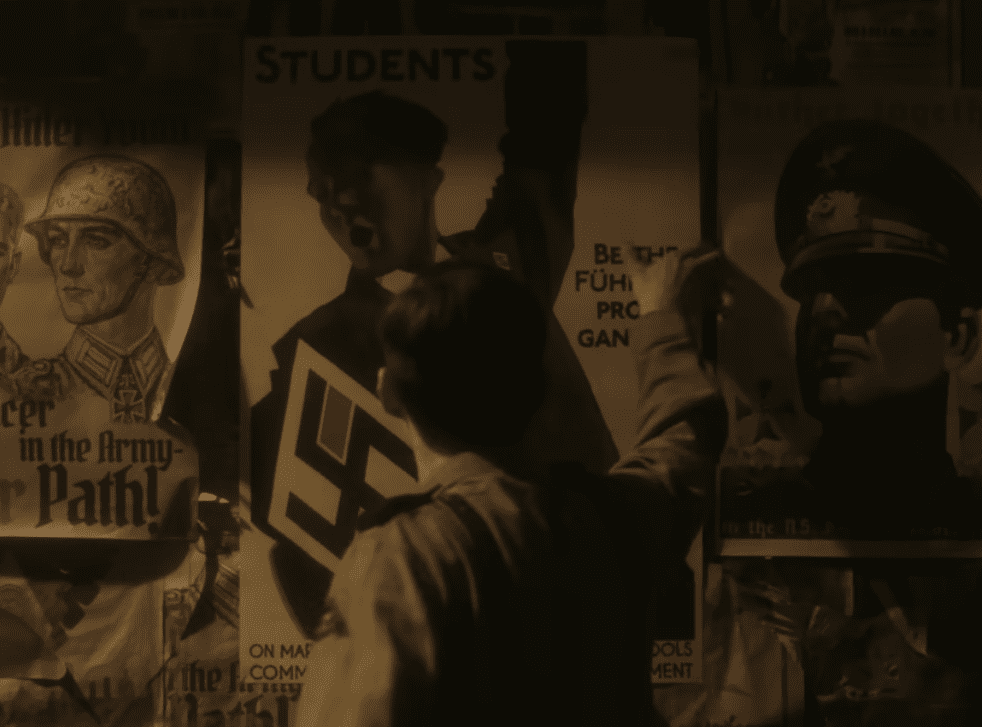
Was it right for Helmuth to stand up against the Nazi’s? Whitaker said, “Absolutely, in my view.
“Did he put the other members of the church in danger? He did.” Whitaker acknowledged.
When he met one of Helmuth’s brothers, his wife left the room while they were talking. “When I went into the next room to talk to her, she said, ‘Helmuth knew he was going to put us all in danger, and he did it anyway.’” After 70 years, she still carries a wound.
Whitaker said, “What is the role of a peacemaker? Are there times when a peacemaker stands down, instead of stands up?” Exploring that question is a moving part of the story that adds to making the viewing multi-layered.
Whitaker First Hears Helmuth’s Story
Passion projects start somewhere, and for Whitaker, it was in a phonebook.
Whitaker was busy on a documentary project about Saints and Soldiers in 2001, when he first heard the Helmuth Hubener story and was surprised to learn that one of his two teenage companions, Karl-Heinz Schnibbe, was still alive and living in Utah. They looked him up in the phone book, called him, and met with him.
Schnibbe talked about Helmuth Hubener’s story, and Whitaker said, “It changed my life.
“First, he made it very clear that Helmuth was his best friend and he was just trying to follow in his footsteps. He also acknowledged that Helmuth saved his life.” How that happens is a very dramatic moment in the movie.
To make the documentary, Whitaker and Schnibbe, and a small documentary crew traveled to Germany, and there he began what would become a focus for him of interviewing people who knew Helmuth and the story first-hand, people who had been trapped under the Nazi terror and could speak about it. He had enough material for a very long television series, but chose to cut down the volumes that he knew about the subject into this two-hour movie script that never stops moving.
Each scene is packed with character development and content that flows powerfully into the next. It is Whitaker’s vast knowledge of the back story that makes the movie work so well.
Getting the Right Cast

For Whitaker, getting the cast just right was pivotal, especially for Helmuth. What teenager could pull this off? His London-based casting director sent him over 100 tapes of possible actors, but none had that heroic spark. Then he received a tape from Ewan Horrocks.
Whitaker said, “I saw this tape, probably on my iPhone, and my eyes opened up and I said, ‘Wait a minute! Rewind, start that again. I just saw something there that was incredible. He had a light in his eyes.
“We went to meet him in person, and sometimes it happens that you see someone on tape and you have high hopes, and then you meet them in person and it’s like ‘Oh shoot.’ He walked in, and I said, “This is the kid. This is Helmuth. I called my wife that night and broke down and started crying. I shouted, ‘We found him. We found him. You’ll see.’
The Producer
Russ Kendall, one of the three film producers, has been with Whitaker since the beginning of this long saga to get this story on screen, and he said that during the 20 years this film was percolating, he and Whitaker did many other projects together, including television series, much musical content, and other feature films.
He said that during that time, “We’ve continued honing our craft and becoming better storytellers. That means the film’s even better than it would have been 20 years ago.”
Whatever made this film so compelling was worth the price, because this one is a winner.
Here is the trailer:







MaryannOctober 22, 2025
This movie was intense throughout, and very thought provoking. The main theme is to be true to what you know is right, and to have the courage to speak that truth. Helmut, a 17 year old LDS boy, prays and is strengthened in courage, to the point of being willing to face death for his convictions. Although the movie was fantastic, the torture scenes were just too much for me. The pain suffered by these valiant young men, along with millions of others, and the unbelievable evil that existed brought me to sobs. It wasn't news, of course. I have read many books about WWII and learned about it in school. I am 74, and even after all these years, the unfathomable evil that Hitler and his cohorts engaged in is too much for me to bare.
Juliann BradshawOctober 22, 2025
I clapped at the end of the movie to honor the brave boys and the director willing to bring forth the story. It is a hard watch and will stay with you. The director did not spare the audience the harsh realities of torture and living with fear. How can a government be honored who has to revert to scapegoats, lies and torture? A populace willing to let an entire race be murdered while they themselves have to turn in friends, neighbors and coworkers. What did 16 year old Helmut accomplish? His story is his legacy. We see ourselves in the characters and it indicts or inspires. Would I be so convicted, so brave, so true to my beliefs? Would I put my friends, family and congregation in danger because I felt truth burning in my soul? Are you brave enough to go see this movie? Leave 12 and under home.