










To sign up for Meridian’s Free Newsletter, please CLICK HERE.
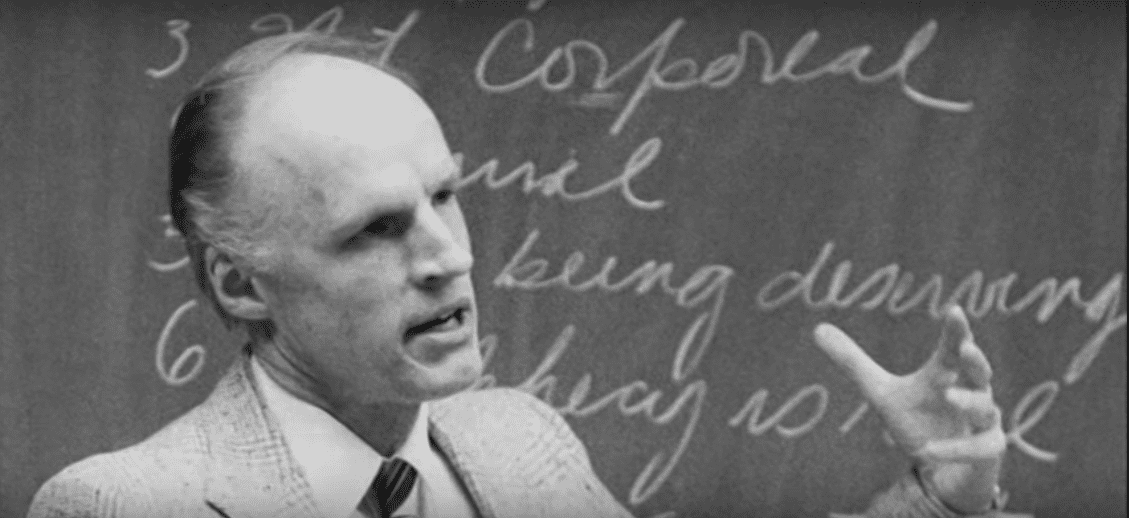
Barnard N. Madsen is the author of The Truman G. Madsen Story: A Life of Study and Faith (This article is adapted from chapter 8, “We Four and No More”)

I awoke in the passenger seat to the smell of steak and potatoes grilling over a crackling wood fire. It was dark outside, but as I opened my eyes and stretched I felt a rush of emotion as I saw Dad in the headlights, doing the cooking. I remembered he had given a talk at Aspen Grove earlier that night. Because I was still a boy, as he drove over the bumpy dirt road between Midway and his beloved Brighton I had fallen asleep and somehow stayed there. The cool mountain air, pine scent, and sound of the creek running by further awoke my senses. When he saw I was fully awake, Dad said, “Time to eat.” We said a blessing and sat on the front bumper, headlights still on, as we enjoyed together the meal he had prepared. It was a little crazy to be cooking by headlight and eating our dinner that late, but it was possible — and so Dad did it. That night, like so many other memories, etched into my consciousness the reason I loved my dad: because he showed first that he loved me.
This story shows how my dad tried to balance his service outside our home and in our family. And it also shows how he carried on a tradition of fatherhood because his father had also brought him, and his brothers, to Brighton. In short, my father answered the call to fatherhood because his father did.
As we approach Father’s Day, here are some of the lasting things my dad taught me about his father, and how to be a father.
Less than thirty days after giving birth to their third son, Axel Madsen’s wife died of a simple infection leaving him a widower just six years into their marriage. My dad was two. How Axel chose to fulfill his role as single parent is a story of faithful submission and sacrifice and, indeed, fulfillment of the prophecy in a patriarchal blessing that “as a father in Israel” he would “be known far and near.”
Oral tradition
Axel was a goodly father and taught my dad and his brothers somewhat in all his learning (see 1 Nephi 1:1). “We hear talk now,” my dad recalled, “about how we should have home nights and that you should read the scriptures together and you should be involved in wholesome recreational activity. That was every night in our home. Every night we read, and read aloud and rotated reading. We read classics. We read contemporary literature and we read scripture.“
“Dad had a ‘home night’ instinct from the beginning. . . . There was an omnipresence of adventure stories and scriptures. We had ‘wall-to-wall beds’ in the home,” my dad remembered, “usually side by side in the cool basement during summers. Together we read aloud from such exciting sources as: Treasure Island, Daniel Boone, Rifles Beyond Fort Pitt, The Last of the Mohicans, The Swiss Family Robinson, Robinson Crusoe, and all the major narratives of the Book of Mormon.”
“We read at least a chapter a night. This began to soak in. We learned to pronounce. We learned to read carefully. We learned to look up words that we had mispronounced. He wouldn’t tell us. He told us to look it up, then we’d remember it.”

“One consequence is that all three of us learned early not only to read but to read out loud with proper enunciation.”
“I cannot overestimate how that helped us with confidence in reading. He would correct us. He was a self-taught English master and he knew pronunciation and he knew spelling. . . . This became a distinct advantage to us in school as elsewhere. It also built a closeness that we have never lost. To my home training, then, I owe my love for words.”
A Listening Ear
My dad remembered his father’s tradition, “on [his] returning from whatever, [he’d say] ’Report.’ He loved to be regaled with blow-by-blow [accounts] of the day or the week’s events. He listened. He really listened. He asked questions that kept the flow going, instead of clipping it or half-hearing, or turning away to his own preoccupations. He had an aptitude for vicariousness. I doubt there has been that kind of father around since the days when fathers and sons and daughters worked alongside each other in the seeding and plowing and horse managing on the self-contained farms.
“He was a brilliant conversationalist, on the telephone, waiting in line, confronting a waiter, meandering around Uncle Julius’ [Springdale, Utah] motel, sitting at a formal dinner, standing at the door, lingering in the foyer.”
“How goes the battle?” A veteran of the Great War and a leader of boys at home and in the Church, Axel asked of others (and himself), “Are the sinews of war being provided at home? Is the morale good? Or are you yielding ground—drawn back by the forces about us—making more concessions? Has your attitude changed in any way toward some of the pressing problems of the day affecting youth?”
“How goes the battle?” was a question he also asked his sons, and they in turn asked their children. The question is reminiscent of what Elisha’s servant asked the prophet after arising early and seeing the city surrounded with horses and chariots: “My master! How shall we do?” and Elisha answered, “Fear not: for they that be with us are more than they that be with them” (2 Kings 6:15–16). War veteran Axel aimed to instill that same view and courage in his boys.
Family First
“He was with us almost every night,” my dad recalled. “And how he maintained his real estate business through all of that is one of the mysteries. Apparently we paid the bills and got by.” He taught his sons, “Do the duty that lieth nearest thee.” He also taught them a fundamental law of happiness: “Believe that where you are is the best place for you to be as long as you have to be there.”
“I’ve learned since,” my dad said, “that he went on his own quietly to theaters to see films, to see if they were good enough for his boys. And if they were, then he took us. Somehow he made connections between movies and literature.”
Adventures in Contentment
“In the long run life will teach you not to put your trust in things,” Axel taught his boys. “I am grateful for the infinity of things I can live without. Life is for living, not acquiring. It is a good thing i was not a man of wealth; I would have spoiled you boys rotten. Each of you has made it on your own.”
“He embraced David Grayson. The Grayson Omnibus was on his bed table. he read sections of it aloud and often until we knew them the way most children know nursery rhymes. Grayson was the pen name of a New York businessman who finally withdrew from the hectic business jungle and settled down on a placid farm anxious only to produce enough to get along and, with his sister, Harriett, to stretch a pension across what years remained to him. . . . A whole chapter on the pleasures of shaping and sanding a new axe handle. A whole page on the joys of eating homemade bread, just the bread, the savor of the bread, without butter, syrup or jam or confounding the bread with sandwich tastes. . . . And each venture into the calm and soothing uses of a day unhurried somehow communing with the rhythms of nature, he ends with the phrase, ‘This has been a day of pleasant bread.’ The kind of benediction one might offer at the end of a Thanksgiving dinner. Every day was Thanksgiving.”
“Through sheer indolence,” Axel taught his boys, “we miss half the joy of living. Even omnipotent power and wisdom cannot give it. Joy dwells in the ordinary. Daily duties and daily bread are the sweetest things in life. Thank God every morning when you get up. Get your happiness out of your home or you will never know what happiness is.
“Pleasure may exist when conscience utters protest,” Axel often said. “happiness never.”
The Great Outdoors
“Weekends were the strong point,” my dad said. “During the week work and school kept us more or less apart during daytime. But then he would load up the car on the weekend, usually with others and cousins. And we would have romping outings. This meant parks and Pom-Pom Pull Away and games. It meant butterfly nets. It meant going up and exploring various canyons and loving nature. . . . Somehow that exposure to the beauties of nature got into my craw very early.” My dad’s dad taught him to love Brighton.
Dad said he“often wondered if the travel-urge in [his father] was the other side of his delimited youth; crawling in the beetfields, only hearing of the places beyond the point; and perhaps the train whistles with their beckoning to worlds beyond.”
“He was the most perceptive, delightful, every-moment- its-own-adventure traveler I have ever known,” my dad re-called. “‘Look at that,’ he would say. The tone of voice was always one of wonder, amazement, new discovery. It might be a scene he had embraced a hundred times before (like the looming beauty of Zion Park peaks, or something brand new like a formation that made familiar mountains seem altogether new. . . . A nook, a glade of pines and stream. He told me once that someone said to him, ‘You are the kind of man who spends hours on mountain tops and waters them with your tears.’ I don’t know who the man was or what prompted him to say it. Dad, I think, remembered it because it was true. . . . another world? yes, and a better one. a place with bowered vines or trees, or, as he loved to say ‘a bit of Eden.’ Then out into it, and picnic. We ate more dinners in various shady lanes up City Creek Canyon, or on our front porch, in defiance of the low gear traffic that ground by, or at parks and city places than dining at home.”
Celebrate Life
“I think Dad had a genius for getting us to cooperate in various ways,” my dad recalled. “We had a shop. There was some division between work and play: ‘let’s get the work done’ and ‘let’s get this built, then let’s go and celebrate.’” It was the same “after every minor boyish triumph from a school assignment completed to a job done. Dad would say, ‘Let’s go out and celebrate.’”
“He loved life because he loved the mission that descended upon him. And he took it seriously. And his strength came from suffering, service, and sacrifice, the three words he used to sum up the life of his own father and mother.”
Suffering, Service, and Sacrifice
“That is both more true and less true than first appears. He was for sure filled with gifts and qualities and promise. He would sit at the piano and with a facility and grace run up and down the scales, and you could hear the click of his long fingernails on the keys. His fingers, someone said, looked like those of a surgeon or a concert pianist. But no opportunity. He wielded a wheelbarrow to pay for his brothers’ musical aspirations and his younger brother’s mission.
“He would look at our slight frames in the shower [at old Deseret Gym] and say, ‘You can’t make your living with a pick and shovel. That is horsework.’ But it was the kind of work he did all through his youth. . . . His sense of mission and his self-commission to fill the aching void for the bereft ones and to let other hopes and plans ‘go hang’ was more than is expected of ordinary mortals. He consistently advised young widows and widowers to remarry, saying, ‘It is the only solution.’ Why then was it not his? Not because there were no immediate opportunities. Aunt Dessie claims she once asked me, age five, where Dad was and I replied, ‘Out with some dame.’ But he felt that in his own case, making and molding the family was to be the all-inclusive meaning of his life. More: he saw that as a divine mandate.”
The Greatest Privilege and Joy
Of his father, my dad reminded me, “now a whole new generation has arisen to call him ‘Gramps’ and to increase the awareness of his legacy—that fatherhood is the greatest privilege as it is also the greatest joy of life; that giving oneself to one’s family is the work of the Lord, par excellence; and that all else in life that seems to matter much, matters most in its effects on the family. I wince when I hear people say of a man, ‘he was only a father.’”
On my mission in Germany, I learned the proverb, “What we have inherited from our fathers we must earn to keep.” I’m grateful for the sacrificial heritage of a grandfather, and a father, to whom their family was everything. May we who have the privilege of being fathers honor ours (and our heavenly Father) by taking our own call to fatherhood seriously.




Jeffrey FarleyJune 21, 2016
I never met him but have been a fan of his writing/speaking for over 40 years. Wish I could have been in some of his classes. This was beautifully written. Thanks for sharing the story.
Nadine AllenJune 21, 2016
Agree with my friend, Jo Ann Okelberry! Loved his words, teachings, speeches, publications and miss him! Thanks for sharing interesting insights into his exemplary role as a father too! Nadine Allen, S. Jordan, UT