



Honest and Wise: Seeking Unity in a Divided Political World

“You can’t be a good Mormon and a Democrat!” The words were spoken by the gospel doctrine teacher in my ward in the 1980’s, a woman who happened to be the sister of a prominent church leader. Only later did I realize just how surprising that statement was, given that many other members of that Church leader’s family were Democrats. Another reason the words were surprising is that sitting in that classroom were several faithful Latter-day Saints who were Democrats.
Latter-day Saints are called to build Zion–a people “of one heart and one mind.”
Latter-day Saints are called to build Zion–a people “of one heart and one mind” (Moses 7:18), for “if ye are not one, ye are not mine” (D&C 38:27). Alma taught covenant unity: bearing one another’s burdens, mourning together, comforting each other, with hearts “knit together in unity and love” and no contention (Mosiah 18:8-9, 21).
Nevertheless, I occasionally heard similar statements in those years. It wasn’t hard to understand why people would say such things. Though still young, I was deeply involved in Republican politics. By 18, I had founded the Teenage Republicans in Utah County, I had been a United States Senate page, and I had been elected as the youngest delegate in the nation to the Republican National Convention. I had been attending political conventions since age 12, when my father began a string of unsuccessful campaigns. I knew the moral flashpoints of the era. I also knew the Church often took positions that seemed more aligned with one party than the other. It was easy for some to conclude that the “faithful” choice was obvious.
Yet, even in heavily-Republican Provo, where I grew up, I knew committed, thoughtful, Latter-day Saints who were Democrats. At the time, I didn’t always understand their reasons. Without social media, politics was rarely discussed casually because of its potential to stir contention.
I came to recognize that members aligned with different parties for many reasons.
Over the years, I came to recognize that members aligned with different parties for many reasons. Some believed one could support a candidate or platform while disagreeing on certain issues. Others believed Church policies would evolve in the future, as policies occasionally have in the past.
In conversations I had, Democrats I knew often defended their party on the grounds of caring for the poor, seeing government as an effective tool for lifting the vulnerable. The argument sometimes implied that if you really cared about people, you would vote for Democrats, while Republicans were motivated by self‑interest. But I did not support Republicans because I wanted wealth or lacked compassion. I believed their policies were more effective in lifting the poor and did more to empower families and communities. Yet, I knew faithful, intelligent Democrats who reached different conclusions.
As political history unfolded, I noticed something else: there were members of both major parties who fell short of gospel standards. Some had moral failings. Some supported policies that raised constitutional concerns. Some took positions contrary to Church teachings on marriage, life, family, or religious freedom. Others adopted rhetoric that fostered division or animosity. I saw good Saints continue to support such leaders–not because they endorsed everything about them, but because they valued a different set of priorities.
The Doctrine and Covenants says, “honest and wise men should be sought for diligently, and good men and wise men ye should observe to uphold” (D&C 98:10). The Doctrine and Covenants also states: “And that law of the land which is constitutional, supporting that principle of freedom in maintaining rights and privileges, belongs to all mankind, and is justifiable before me” (D&C 98:5-6).
We are always choosing among imperfect options, each with strengths and flaws.
However, over time, I came to appreciate an important principle. These verses do not say that we should seek after and uphold perfect leaders. In our representative democracy, we are always choosing among imperfect options, each with strengths and flaws. Our laws should be constitutional, supporting freedom and maintaining universal rights. However, with imperfect people making the laws, bills and executive orders from both parties routinely face Constitutional challenges.
Thus, a vote for a candidate means: “On balance, this best advances my principles.” It does not mean, “I endorse everything this person has ever done and will ever do,” or “I agree with the entire party platform.”
Caricaturing one another’s votes as not meeting the ideal is a quick way to breed misunderstanding and animosity. Expecting perfection from candidates or parties breeds cynicism and disengagement. And disengagement simply hands influence to those who may not share our values. Representative democracy requires honest and wise voters as much as honest and wise leaders.
Over the years, I have watched both parties support policies that courts later struck down. Both have produced leaders whose personal conduct was deeply disappointing. And I have come to understand how faithful Church members could still, in good conscience, support such leaders. The principles of D&C 98 are guideposts–not weapons with which to shame fellow Saints.
We let religion inform our politics without claiming neighbors offend God by making different choices.
The First Presidency teaches that “[s]ome principles compatible with the gospel may be found in various political parties” and warns that voting a straight ticket “without careful study … is inconsistent with revealed standards.” Thus, we let religion inform our politics without claiming neighbors offend God by making different choices.1
Political positions shift over time. Those once accused of disloyalty to the Church in one era might now urge others to abandon their party over a candidate’s policies, character, or conduct. Yet even when one issue feels decisive, reasonable Saints–prayerfully applying the same scriptures–can reach different conclusions. Matters such as protecting life, practicing personal integrity, helping the underprivileged and poor, preserving religious freedom, and keeping the peace all carry weight in the Lord’s eyes.
I still admire many of the leaders from my youth, even while acknowledging their flaws. Over time, I have found myself disagreeing more with certain directions within my own party, just as I have been unable to fully embrace the platform of the other. Many Saints today experience a similar sense of political homelessness.
Zion can unravel quickly if we let political identity supersede covenant identity.
Some conclude that a particular candidate is unfit for office by the standards of D&C 98. Others view that same candidate as the best available option. The danger comes when either conclusion is promoted as a universal commandment. Many political issues cut so close to the core of who we are as individuals, it is easy to feel threatened when our neighbor supports the “wrong” candidate. Zion can unravel quickly if we let political identity supersede covenant identity.
Some may consider joining a third party or abandoning parties altogether. However, our system tends to favor two major parties.2 If fair-minded people withdraw from party politics, candidate selection will be left to those who may prioritize ideological extremes, special interests, or partisan agendas over the common good. Even small acts of engagement, such as voting in primaries, attending precinct meetings, or becoming an informed participant, help shape our communities.
Doctrine and Covenants 134 teaches that “governments were instituted of God” for our benefit, and that peaceful societies depend upon laws protecting life, property, and the free exercise of conscience (vv.1- 2). It further states that citizens will be held accountable for our actions toward the government and should seek and uphold officers who “administer the law in equity and justice” (vv. 1 & 3).
Taken together with D&C 98, these verses remind us that civic engagement is not merely a personal preference but a part of our stewardship as disciples. We are invited to participate thoughtfully in public life and to help sustain just and equitable governance.
We may disagree sincerely about how gospel principles translate into public policy. But we must not let those disagreements break our fellowship.
Of course, political debate naturally brings disagreement. But the Church urges members “to be active citizens by registering, exercising their right to vote, and engaging in civic affairs, always demonstrating Christlike love and civility in political discourse.”3 Our discipleship must shape our citizenship. Few things strain unity more quickly than politics. From where boundary lines should be drawn between homes, to how boundaries should be enforced at a country’s borders, political controversy can breed anger, resentment, and animosity. We may disagree sincerely about how gospel principles translate into public policy. But we must not let those disagreements break our fellowship.
As President Dallin H. Oaks has counseled:
On the subject of public discourse, we should all follow the gospel teachings to love our neighbor and avoid contention. Followers of Christ should be examples of civility. We should love all people, be good listeners, and show concern for their sincere beliefs. Though we may disagree, we should not be disagreeable. Our stands and communications on controversial topics should not be contentious. We should be wise in explaining and pursuing our positions and in exercising our influence.4
As a trial attorney, I’ve seen how the adversarial courtroom process, with two sides clashing over the facts, refines arguments, clarifies truth, and can even lead to reconciliation. Politics demands the same: good-faith participants sharpening one another’s views through principled debate, not dogmatic division. In both the courtroom and the covenant community, truth is refined through humility, patience, and good-faith engagement.
We naturally assume our conclusions are right and others’ wrong. Yet, we reach better conclusions when we challenge our assumptions, engage sincerely, and remain open to correction, improving our positions through dialogue, and avoiding pitfalls created by dismissal.
Differences will always exist. In a covenant community, we can fortify Zion not despite those differences but through them. A faithful sister who votes for a party emphasizing social safety nets is not a heretic. A devoted brother who votes for a party emphasizing self‑reliance and traditional values is not selfish and uncaring. Labeling opposing political choices as inherently evil fosters the contention Christ condemned (3 Nephi 11:29), fracturing wards and families faster than the results at any ballot box.
True unity flows from charity.
True unity flows from charity, “the pure love of Christ” (Moroni 7:47), which “suffereth long, and is kind… thinketh no evil” (1 Corinthians 13:4-5). It assumes the best of others: that Democrats in our pews seek “honest and wise” leaders per D&C 98:10, just as Republicans do. President Oaks models this, urging us to disagree without being disagreeable, and placing discipleship above partisanship.
The assertion that “You can’t be a good Mormon and a Democrat!” was wrong in the 1980s, and any assertion that “You can’t be a good Latter-day Saint and a Republican” is equally wrong today. When we vote our conscience on election day and then clasp hands in the next sacrament meeting, we testify that our true allegiance is to Christ, not caucuses. As we seek unity across political divides, our differences can refine us toward the day when “every knee shall bow” in perfect harmony (D&C 88:104). Let us choose love over litmus tests, building bridges where ballots divide.
1. "First Presidency Letter Emphasizes Participation in Elections, Reaffirms Political Neutrality," Church News, June 6, 2023, https://www.thechurchnews.com/leaders/2023/6/6/23751117/first-presidency-letter-emphasizes-participation-in-elections-reaffirms-political-neutrality/.
2. See David B. Magleby, "The Necessity of Political Parties and the Importance of Compromise," BYU Studies Quarterly 54, no. 4 (2015): 65, https://scholarsarchive.byu.edu/byusq/vol54/iss4/3.
3. First Presidency Letter
4. Dallin H. Oaks, "Loving Others and Living with Differences," Ensign, November 2014, https://www.churchofjesuschrist.org/study/general-conference/2014/10/loving-others-and-living-with-differences?lang=eng.
Abraham and Sarah: A Love Story Without End
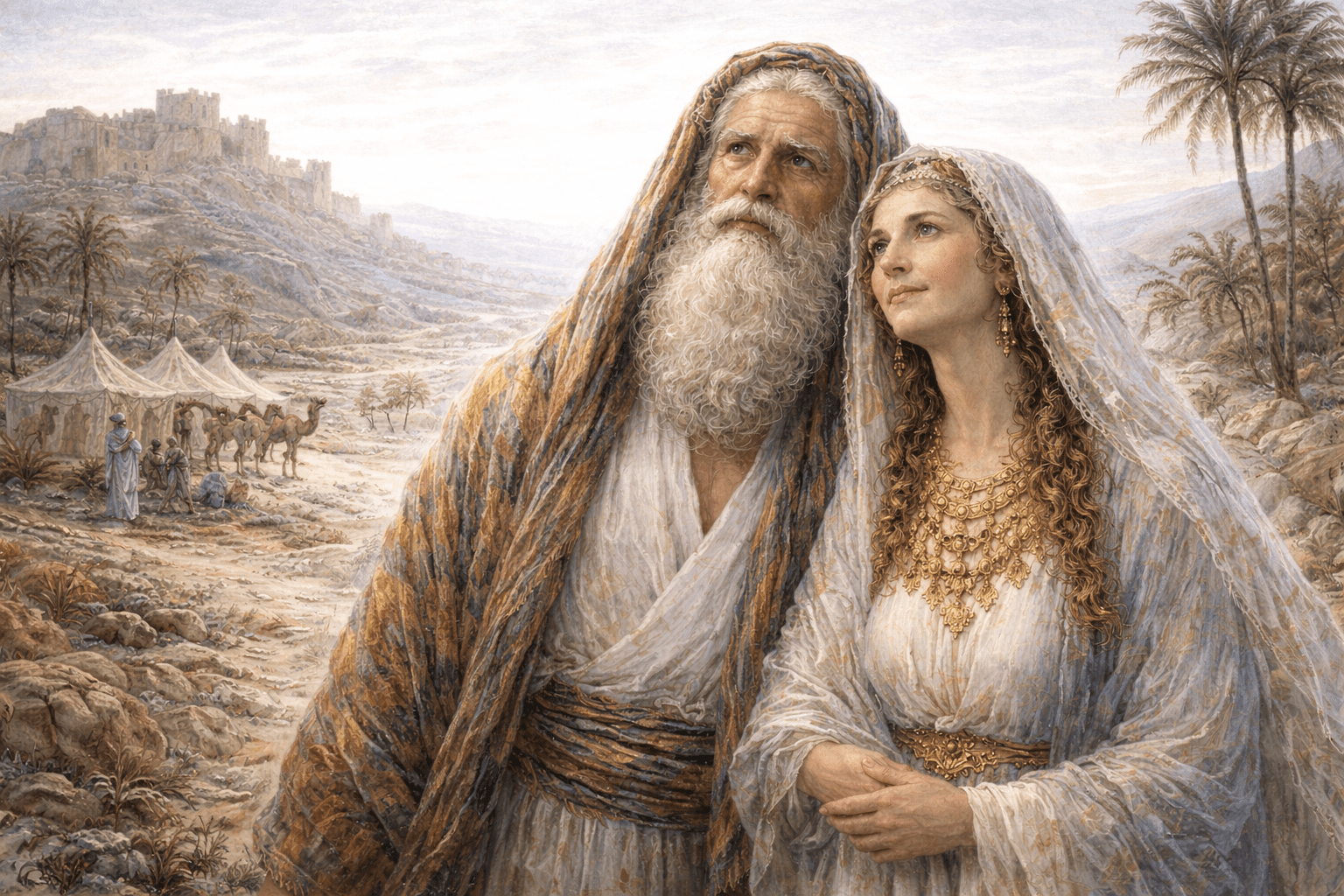
The Abraham story is wonderfully larger than Abraham. When the prophet Isaiah (whose “great words,” the Savior declared, should be searched “diligently” [1] ) addressed those who “seek righteousness,” he urged them to remember not only their illustrious forefather but also their equally illustrious foremother: “Look unto Abraham your father, and unto Sarah that bare you.. For the LORD shall comfort Zion.” [2]
The story of Abraham and Sarah is truly the story of Zion, beginning with two hearts united as one in one of the greatest love stories on record. It is a story that continues to this day and of which we are very much a part.
Their names at first were Abram – the “the father is lifted up” – and Sarai – “princess.” Whatever connection she may have had with a ruling earthly dynasty, she was surely a princess in both appearance and demeanor. Her striking physical beauty would turn the heads of kings, but her true beauty, which would only increase through the years, was that of the soul. She was indeed Abraham’s match, appointed to be his wife, says Jewish tradition, even before they were born. And what had been arranged in heaven came to pass on earth, we are told, because of the virtuous lives they led growing up. [3]
Of Sarai we hear little before her marriage to Abram, but their close blood relationship may well suggest that they were acquainted with each other early on. We might even surmise that her faith and prayers had already made a difference in the severe trials he was called upon to face as a young man. What we know with certainty is that she was, as recounted by the first century Jewish scholar Philo of Alexandria, “the darling of his heart,” and their love for each other was profound. [4]
Their talents and spiritual gifts were complementary, with some of hers exceeding his in important ways. But from the beginning of their marriage she was ever his ardent support, faithful friend, and close confidant.
“Everywhere and always,” wrote Philo, “she was at his side,. his true partner in life and life’s events, resolved to share alike the good and the ill.” [5] Theirs was the quality of relationship enjoyed by the ancient inhabitants of Enoch’s city of Zion, so named, we are told, “because they were of one heart and one mind.” [6]
The joint labors of Abraham and Sarah are legendary. In the Book of Abraham, when the patriarch is obediently preparing to leave Haran for a land he has never seen, he mentions that he and Sarah took with them “the souls that we had won.” [7] Their cooperative efforts in winning souls is widely attested in Jewish tradition, which reports that wherever they settled, they held perpetual open house, welcoming all in need to partake of physical and spiritual refreshment. “Abraham our father used to bring [people] into his house and give them food and drink and be friendly to them,” offering to teach God’s truths to all interested. “Abraham used to convert the men and Sarai the women.” [8] In a world notorious for its violence and cruelty, one couple was reaching out in love to bless mankind.
Such efforts brought a remarkable divine promise that from then on, all who received the gospel would be accounted Abraham’s seed. [9] It seemed a divine vindication of the mothering and fathering roles that Sarah and Abraham had already been playing in blessing the needy and bringing souls to Christ. In this sense Abraham and Sarah were already the parents of a new and flourishing community of the righteous, a new Zion in the making.
But the divine promise went further, foretelling that Abraham would have literal posterity through whom God would bless all the nations and families of the world. Nothing could have brought greater joy to the heart of Abraham and Sarah, who up to that point had been childless. What excitement this promise must have elicited, what discussions it must have prompted, what dreams it must have inspired. With the highest of hopes, Abraham and Sarah left Haran to receive the promised blessings of a posterity that would change the world.
But Sarah continued childless, while their journey seemed to bring them into one hardship after another. To their everlasting credit, the record of those travails speaks of their prayers, not protests, as they met their difficulties with deepening patience and faith. One of those trials was the grievous famine that set in soon after they had arrived in the promised land. So dire was the situation that they were forced to go to Egypt, where crops depended not on rainfall but on the annual flooding of the Nile.
On the very night before they were to cross the border, Abraham was divinely apprised that this journey would expose him to mortal danger, which would be averted if – and the Lord willed that it be so – Sarah would say she was Abraham’s sister. This divine directive is not mentioned in the Bible, but is found in the Book of Abraham and one of the Dead Sea Scrolls, which adds that Sarah wept that night and did not want to go Egypt. It is a telling detail, showing that she would rather face the ravages of famine than deny her marriage and the eternal covenants she had made. Integrity was one of her hallmarks.
With his wife weeping, Abraham inquired of the Lord about the necessity of going to Egypt, only to learn that they must go. How did Abraham in turn convince Sarah? By patience and persuasion. All would be right, he reassured her, if they followed the Lord’s instructions.
But when she was later forcibly taken by Egyptian soldiers to Pharaoh’s palace, she faced the greatest dilemma of her life. To obey the counsel of her husband, she must say that she was Abraham’s sister, thus hiding the marital relationship. And to be true to her covenants, she could not let Pharaoh have his way with her, even though her refusal would mean certain death.
Abraham had hearkened to the voice of the Lord. Would she hearken to the counsel of her husband, even at the sacrifice of her life? Or would she choose to conveniently relinquish the hardships and toils of her life to become the new queen of Egypt with all the dazzling wealth and fame that this world could offer?
At the peril of her life she chose to keep her covenants, proving her absolute loyalty to her husband and God. God responded by sending an angel to protect her from Pharaoh’s advances and afflict the king and his court with sore plagues. The whole incident in Egypt was considered by the ancients as “a crucial event in the history of mankind,” [10] with the end result being what is depicted in Facsimile 3 of our Book of Abraham, showing Abraham sitting by invitation on Pharaoh’s throne.
Returning to the promised land with the lavish wealth that Pharaoh had bestowed upon them, Abraham and Sarah resumed their joint ministry of love. In the words of a modern rabbi, they “were not just ‘a married couple’ but a team, two people working in harmony” and “walking together along the same path, united in thought, word, and deed.” [11] Together they served, together they obeyed, and together they believed in the promises of posterity, naturally supposing that these promises were meant for both of them as parents.
Until one day Sarah was overwhelmed with the thought that the promises had never specifically mentioned her as the mother. So she, as the legal codes of the day required, brought to her husband a second wife. The accounts indicate that she was doing it for Abraham’s sake, but knew he would not agree unless he thought that she truly desired it for her own sake – that thereby the offspring would be hers by adoption. Hence her plea to Abraham, asking him to do it for her sake. Each sought first the happiness of the other, with Abraham accepting her suggestion only after he had received revelation on the matter.
Sarah’s action in giving her maid Hagar to Abraham is lauded as one of the great unselfish acts of her life in ancient sources and modern revelation. Abraham’s union with Hagar immediately produced a son, Ishmael. Was this then the fulfillment of the promises in which Sarah had for so long believed? Only time would tell.
As her biological clock continued to tick and she finally entered menopause, Sarah now saw that the great promises of Abraham’s posterity would not include her as the biological mother. Even so, there was no bitterness, no harsh words as she selflessly gloried in her husband’s success. She was the personification of charity itself, which “suffereth long, and is kind, and envieth not, and is not puffed up, seeketh not her own, is not easily provoked, thinketh no evil, and rejoiceth not in iniquity but rejoiceth in the truth, beareth all things, believeth all things, hopeth all things, endureth all things.” [12]
One day when she overheard what appeared to be a casual comment by an unknown traveler mention that she would have a son, she silently chuckled to herself. But the traveler turned out to be a messenger from the Almighty, sent to bestow a blessing that would literally change the course of nature and finally grant to her the great desire of her heart. “What is it,” the Danish philosopher Soren Kierkegaard commented on this story, “to be God’s elect? It is to be denied in youth the wishes of youth, so as with great pains to get them fulfilled in old age.” [13]
Sarah’s baby was named Isaac, from the Hebrew verb “to laugh” or “to rejoice.” The name was both a reminder of his parents’ inexpressible joy at the birth of their son, as well as a foreshadowing of the joy to be brought by Isaac’s descendant Jesus, similarly to be born by miraculous means.
Sarah’s joy in obtaining what she had longed for over decades did not diminish her service to others. She continued to work alongside her husband to build the kingdom of God and serve the needy. Together, according to ancient tradition, they labored tirelessly to welcome “all the lowly and oppressed, the needy and miserable, the suffering and the downtrodden.” [14] Sarah’s lamp was always lit, and she carried with her the presence of the Spirit in such abundance as to be manifest to those around her. As remembered in Jewish sources, Sarah was “without blemish, and of complete faith,” a veritable “tapestry of perfection” in “wisdom, in beauty, in innocence, in accomplishment, in consistency.” [15] Her nobility is attested even in Muslim tradition by no less an authority than the learned Al-Tabari. Although descended from Hagar, he recorded that Sarah “was one of the best human beings that ever existed.” [16]
But her greatest glory came not by individual accomplishment but in proving faithful to something larger than herself, her eternal companionship with Abraham as they sought to establish Zion – beginning with their own marriage. Their mutual selflessness and sacrifice for each other provide a pattern, for “when both sides of the equation are reduced,” notes Nibley, “the remainder on both sides is only a great love.” [17]
No wonder that at her passing Abraham wept, joined in sorrow by vast multitudes who came from far and wide to pay their grateful respects to this godly woman who had been like a mother to them. She was gone, but the love of Abraham and Sarah was too strong to be broken by death. The great latter-day revelation about eternal life holds up both Abraham and Sarah as the type of the exalted couple who enjoy continuing and eternal increase as vast as the stars of heaven. Here on earth, their posterity also continues to increase as the sands of the seashore. As part of that posterity, Latter-day Saints are commanded to emulate their example and thereby qualify to join them as forever families in the presence of God. We are and forever will be part of their continuing story.
[1] 3 Nephi 23:1.
[2] Isaiah 51:2.
[3] See Zohar 91b, in Harry Sperling and Maurice Simon, translators, The Zohar, 2nd ed. (5 vols.; London: The Soncino Press, 1984), pp. 300-301.
[4] On Abraham 42, in Philo VI, The Loeb Classical Library, 289 (Cambridge, Massachusetts: Harvard University Press, 1966), p. 121.
[5] Ibid.
[6] Moses 7:18.
[7] Abraham 2:15 (emphasis added); and see corresponding verse in Genesis 12:5.
[8] Midrash Rabbah on the Song of Songs 1:3:3, in H. Freedman, Midrash Rabbah: Song of Songs, 3rd ed. (London: The Soncino Press, 1983), p. 39.
[9] Abraham 2:10.
[10] Ben Zion Wacholder, “How Long Did Abraham Stay in Egypt?” Hebrew Union College Annual 35 (1964):43.
[11] Adin Steinsaltz, Biblical Images: Men and Women of the Book (New York: Basic Books, Inc., Publishers, 1984), pp. 21, 24.
[12] Moroni 7:45.
[13] Sren Kierkegaard, Fear and Trembling and Sickness unto Death (Princeton, New Jersey: Princeton University Press, 1968), p. 32.
[14] Angelo S. Rappaport, Ancient Israel: Myths and Legends, 3 Volumes in 1 (New York: Bonanza Books, 1987) 1:276-277.
[15] Rabbi Nosson Scherman and Rabbi Meir Zlotowitz, Bereishis: Genesis – A New Translation with a Commentary Anthologized from Talmudic, Midrashic and Rabbinic Sources, 2nd ed., ArtScroll Tanach Series: A Traditional Commentary on the Books of the Bible (2 vols., 1(a) and 1(b); Brooklyn, New York: Mesorah Publications, Ltd., 1986), 1(a):821.
[16] William M. Brinner, translator, The History of al-Tabari: Volume II, Patriarchs and Prophets Bibliotheca Persica, Series in Near Eastern Studies (Albany, New York: State University of New York Press, 1987), p. 62.
[17] Hugh Nibley, Old Testament and Related Studies, The Collected Works of Hugh Nibley, vol. 1 (Salt Lake City: Deseret Book, and Provo, UT: Foundation for Ancient Research and Mormon Studies at Brigham Young University, 1986), p. 99.
2006 Meridian Magazine. All Rights Reserved.
Is It Possible to Become a Zion People? — Come Follow Me Podcast – Moses 7

Scot
The Prophet Joseph said: “The building up of Zion is a cause that has interested the people of God in every age; it is a theme upon which prophets, priests and kings have dwelt with peculiar delight; they have looked forward with joyful anticipation to the day in which we live; and fired with heavenly and joyful anticipations they have sung and written and prophesied of this our day; but they died without the sight; we are the favored people that God has made choice of to bring about the Latter-day glory; it is left for us to see, participate in and help to roll forward the Latter-day glory.” What can we be doing to help to establish Zion? We’re going to talk about this today.
Maurine
Welcome to Meridian Magazine’s Come Follow Me Podcast. We are Scot and Maurine Proctor and we’re humbled that you would invite us into your homes and air buds, so that we can study together.
I wish we could call each of you by name and tell you that we love you and we love being with you each week. Our little gathering with you feels like a little Zion society. In these few minutes we have to spend together, we are one. We are family. We are learning together and striving to draw closer to the Savior Jesus Christ. This is a sacred and holy time for Scot and me. So, thank you, each one, for joining us and studying the gospel together. We love it.
Scot
Now, that quote we started with from the Prophet Joseph, is one we have heard often. I never tire of it. But he went on to say some more important things:
“… We ought to have the building up of Zion as our greatest object. … The time is soon coming, when no man will have any peace but in Zion and her stakes.”
“In regard to the building up of Zion, it has to be done by the counsel of Jehovah, by the revelations of heaven.”
Maurine
He continues:
“Let me say unto you, seek to purify yourselves, and also all the inhabitants of Zion, lest the Lord’s anger be kindled to fierceness. Repent, repent, is the voice of God to Zion…Let every one labor to prepare himself for the vineyard, sparing a little time to comfort the mourners; to bind up the broken-hearted; to reclaim the backslider; to bring back the wanderer; to re-invite into the kingdom such as have been cut off, by encouraging them to lay to while the day lasts, and work righteousness, and, with one heart and one mind, prepare to help redeem Zion, that goodly land of promise, where the willing and the obedient shall be blessed. …” (Teachings of the Presidents of the Church, Joseph Smith, pp. 187-88)
Now, Brigham Young said whenever the Saints go about trying to build Zion, they always end up building Babylon.
“We can’t discuss Zion very long,” writes Dr. Hugh Nibley, “without running into Babylon, because Babylon is, in all things, the counterpart of Zion. It is described just as fully, clearly, and vividly in the scriptures as Zion is and usually in direct relationship to it. “By the rivers of Babylon…we wept, when we remembered Zion (Psalm 137:1). “They shall ask the way to Zion” when word comes “to remove out of the midst of Babylon.” (Jeremiah 50:5,8)…Just as surely as Zion is to be established, Babylon is to be destroyed.” (Nibley, Hugh, Approaching Zion, Deseret Book Company and FARMS, Salt Lake City, 1989, p. 14).
Scot
Brother Nibley continues:
“When all the accidentals and incidentals are stripped away, what remains that is quintessentially Zion? Buildings, walls, streets, and gates—even of gold and jasper—do not make Zion; neither do throngs in shining robes. Zion is not a Cecil B. DeMille production; the properties do not make the play, no matter how splendid they may be. What makes Zion? God has given us the perfect definition: Zion is the pure in heart—the pure in heart, not merely the pure in appearance. It is not a society or religion of forms and observances, of pious gestures and precious mannerisms: it is strictly a condition of the heart. Above all, Zion is pure, which means “not mixed with any impurities, unalloyed”; it is all Zion and nothing else. It is not achieved wherever a heart is pure or where two or three are pure, because it is all pure—it is a society, a community, and an environment into which no unclean thing can enter…
Maurine
“The Bible contains a fairly complete description of Zion, but there is one aspect of it that only the Latter-day Saints have taken to heart (or did formerly), and it is that doctrine that sets them off most sharply from all of the other religions, namely, the belief that Zion is possible on the earth, that men possess the capacity to receive it right here and are therefore under obligation to waste no time moving in the direction of Zion.” (Ibid, pp. 27-28)
In the early days of the Church, men like Heber C. Kimball and George Q. Cannon said in their writings that the establishment of Zion was the burden of all their prayers and uppermost in their minds and hearts. Is it uppermost in our minds and hearts today? I’m certain that most of us are certainly striving towards having Zion families. Isn’t that what we as parents want more than anything? Unity, harmony, love, charity—to be of one heart in our family?
Scot
Maurine, I know we’ve talked about this many podcasts ago but I can’t get this off my mind. I remember so well when we went into the Souq in Salalah, Oman—the old marketplace. We were walking around and came to a silversmith. He was working with a blowtorch on some pretty raw pieces of silver. I asked him, “How will you know when the silver is ready to be used, when it’s pure?” Of course, I had scriptural intentions in mind. The smith said, “Watch and you will see.” I kept watching as the extreme heat of the blowtorch was doing its work on the silver. He could see I was anxious to understand the refining process of silver. He said again, “Watch and see.” Then, in an instant the silver melted before my eyes, the dross had blown to the sides like magic from the intense and steady heat and now the silver was pure. It became like a wonderful mirror and he, the refiner, could see himself reflected in the silver. He said, “Now you see.” I think God will have a people who have been through the refiner’s fire—and those who get through will be prepared to bring again Zion.
Maurine
There’s a pattern that is so obvious in the scriptures and we shall talk about it now, the calling of prophets and the feelings that come to the hearts and minds of these prophets. Let’s turn to Exodus, chapter 4, verses 10-12 and see how Moses responded to his call:
10 ¶ And Moses said unto the Lord, O my Lord, I am not eloquent, neither heretofore, nor since thou hast spoken unto thy servant: but I am slow of speech, and of a slow tongue.
11 And the Lord said unto him, Who hath made man’s mouth? or who maketh the dumb, or deaf, or the seeing, or the blind? have not I the Lord?
12 Now therefore go, and I will be with thy mouth, and teach thee what thou shalt say. (Exodus 4:10-12)
Moses did not feel prepared or able to do the great work of delivering the children of Israel.
Scot
Let’s look at Jeremiah with his calling [comments as needed]:
4 Then the word of the Lord came unto me, saying,
5 Before I formed thee in the belly I knew thee; and before thou camest forth out of the womb I sanctified thee, and I ordained thee a prophet unto the nations.
6 Then said I, Ah, Lord God! behold, I cannot speak: for I am a child.
7 ¶ But the Lord said unto me, Say not, I am a child: for thou shalt go to all that I shall send thee, and whatsoever I command thee thou shalt speak.
8 Be not afraid of their faces: for I am with thee to deliver thee, saith the Lord.
9 Then the Lord put forth his hand, and touched my mouth. And the Lord said unto me, Behold, I have put my words in thy mouth.
10 See, I have this day set thee over the nations and over the kingdoms, to root out, and to pull down, and to destroy, and to throw down, to build, and to plant. (Jeremiah 1:4-10)
That is quite the calling!
Maurine
And, of course, our Enoch this week received his call at around age 65 and he said:
26 And it came to pass that Enoch journeyed in the land, among the people; and as he journeyed, the Spirit of God descended out of heaven, and abode upon him.
27 And he heard a voice from heaven, saying: Enoch, my son, prophesy unto this people, and say unto them—Repent, for thus saith the Lord: I am angry with this people, and my fierce anger is kindled against them…
31 And when Enoch had heard these words, he bowed himself to the earth, before the Lord, and spake before the Lord, saying: Why is it that I have found favor in thy sight, and am but a lad, and all the people hate me; for I am slow of speech; wherefore am I thy servant?
32 And the Lord said unto Enoch: Go forth and do as I have commanded thee, and no man shall pierce thee. Open thy mouth, and it shall be filled, and I will give thee utterance, for all flesh is in my hands, and I will do as seemeth me good. (Moses 6: 26-27; 31-32)
Scot
And listen to the great prophet Isaiah when he received his calling:
5 ¶ Then said I, Woe is me! for I am undone; because I am a man of unclean lips, and I dwell in the midst of a people of unclean lips: for mine eyes have seen the King, the Lord of hosts.
6 Then flew one of the seraphims unto me, having a live coal in his hand, which he had taken with the tongs from off the altar:
7 And he laid it upon my mouth, and said, Lo, this hath touched thy lips; and thine iniquity is taken away, and thy sin purged.
8 Also I heard the voice of the Lord, saying, Whom shall I send, and who will go for us? Then said I, Here am I; send me. (Isaiah 6:5-8)
Maurine
And when Heber C. Kimball was called to take the gospel to Great Britain, this is how he responded:
“On Sunday, the 4th day of June, 1837,” says Heber C. Kimball, “the Prophet Joseph came to me, while I was seated in front of the stand, above the sacrament table, on the Melchizedek side of the Temple, in Kirtland, and whispering to me, said, ‘Brother Heber, the Spirit of the Lord has whispered to me: “Let my servant Heber go to England and proclaim my Gospel, and open the door of salvation to that nation.”
“The thought was overpowering. He had been surprised at his call to the apostleship. Now he was overwhelmed. Like Jeremiah he staggered under the weight of his own weakness, exclaiming in self-humiliation: “O, Lord, I am a man of stammering tongue, and altogether unfit for such a work; how can I go to preach in that land, which is so famed throughout Christendom for learning, knowledge and piety; the nursery of religion; and to a people whose intelligence is proverbial!”
“Feeling my weakness to go upon such an errand, I asked the Prophet if Brother Brigham might go with me. He replied that he wanted Brother Brigham to stay with him, for he had something else for him to do. The idea of such a mission was almost more than I could bear up under. I was almost ready to sink under the burden which was placed upon me.
“However, all these considerations did not deter me from the path of duty; the moment I understood the will of my Heavenly Father, I felt a determination to go at all hazards, believing that He would support me by His almighty power, and endow me with every qualification that I needed…” (Whitney, Orson F., Life of Heber C. Kimball, Bookcraft, Salt Lake City, 1945, pp. 103-104)
Scot
And I well remember reading of the calling of forty-eight-year-old, Spencer W. Kimball to the Twelve:
“It was noon and I was just entering the house for my luncheon at my new home on Relation Street and Eighth Avenue, Safford, Arizona. As I pushed open the door I heard my little 12-year-old son, Eddie, saying, “No, Daddy is not here. Oh, yes. Here he comes,” as I pushed my way into the room.
“Daddy, Salt Lake City is calling.”
“I had had many calls from Salt Lake City through the years but today an overpowering feeling came over me that instant that I was to be called to a high position in the Church. Why I should think so, I do not know. If ever that thought had entered my mind in times past, I had quickly thrust it from me as being most unworthy.
“It must have taken only a few seconds for me to cross the room to the phone, grasp the receiver and say, “Hello,” but it seemed that an hour’s thinking and retrospection coursed through my mind with lightning rapidity. I realized I had no unfinished business with Salt Lake City. I knew that there were two vacancies in the Quorum of the Twelve but I had given it little concern, knowing that the Brethren would take care of it in due time and it was still some ten weeks before the Conference, at which the vacancies would most likely be filled. There was no reason in the world why I should be called. I instantaneously convinced myself that it was impossible, that I was not capable or prepared or worthy, that no one would be called away from the headquarters of the Church and that there was no reason whatever for the feeling that came with the announcement that Salt Lake was on the wire, but I still had that short premonition that an announcement of great portent was coming. Much happened in that short second. I was upbraiding myself for permitting such a thought to enter my mind; I was proving to myself that it was only an ambitious dream, unworthily presumptuous, and that it was impossible, when the clear pleasant voice of President J. Reuben Clark came:
“Spencer, this is Brother Clark. Do you have a chair handy?”
“Yes, Brother Clark,” I answered with a quivering voice.
His words came with strength and power unmistakable.
“The brethren have just chosen you to fill one of the vacancies in the Quorum.”
I heard the words ringing down into my consciousness, but it was unbelievable.
Maurine
“Oh, Brother Clark! Not me? You don’t mean me? There must be some mistake. I surely couldn’t have heard you right.” This as I sank past the chair to the floor.
“Yes. The Brethren feel that you are the man. How do you feel about it?”
“Oh, Brother Clark! It seems so impossible. I am so weak and small and limited and incapable. Of course, there could be only one answer to any call from the Brethren but-“
A complete panorama came before me of the little, mean, petty things I had done, of the little misunderstandings I had had with people in business and with people in the Church whose feelings I might have hurt. It seemed that every person that had ever been offended because of me stood before me to say, “How could you be an Apostle of the Lord? You are not worthy. You are insignificant. You shouldn’t accept this calling. You can’t do it.” I must have hesitated a long time, for Brother Clark said:
“Are you there?”
Catching my breath I said, “Yes, Brother Clark, but you’ve taken my breath. I am all in a sweat.”
“Well, it is rather warm up here also,” he said good-naturedly, sensing I am sure, the tense emotional strain through which I was passing. It wasn’t the warmth of the summer day and he knew it well.
“Does this mean that I am to sell my home and business and all my belongings and move up to Salt Lake City?” I asked.
“Yes. Ultimately,” he said…
[For days Spencer struggled to feel worthy, to feel ready.]
Scot
“It was just breaking day this Wednesday, the 14th of July. No peace had yet come, though I had prayed for it almost unceasingly these six days and nights. I had no plan or destination. I only knew I must get out in the open, apart, away. I dressed quietly and without disturbing the family, I slipped out of the house. I turned toward the hills. I had no objective. I wanted only to be alone. I had begun a fast.
“The way was rough, I wandered aimlessly and finally came to the top of the hill. I nearly stepped on a snake coiled on my path. An unexplainable sudden strength sent me into a high jump over his striking head. Could this be symbolic of my other worries and problems…
“My weakness overcame me again. Hot tears came flooding down my cheeks as I made no effort to mop them up. I was accusing myself, and condemning myself and upbraiding myself. I was praying aloud for special blessings from the Lord. I was telling Him that I had not asked for this position, that I was incapable of doing the work, that I was imperfect and weak and human, that I was unworthy of so noble a calling, though I had tried hard and my heart had been right. I knew that I must have been at least partly responsible for offenses and misunderstandings which a few people fancied they had suffered at my hands. I realized that I had been petty and small many times. I did not spare myself. A thousand things passed through my mind. Was I called by revelation? …
Maurine
“I was getting higher and the air was thinner and I was reaching some cliffs and jagged rocky points. I came to a steep slide area and it was almost impossible to make the grade…
“As I rounded a promontory I saw immediately above me the peak of the mountain and on the peak a huge cross with its arms silhouetted against the blue sky beyond. It was just an ordinary cross made of two large heavy limbs of a tree, but in my frame of mind, and coming on it so unexpectedly, it seemed a sacred omen. It seemed to promise that here on this cross, on this peak, I might get the answer for which I had been praying intermittently for six days and nights and constantly and with all the power at my command these hours of final torture. I threw myself on the ground and wept and prayed and pleaded with the Lord to let me know where I stood…
“I mentally beat myself and chastised myself and accused myself. As the sun came up and moved in the sky I moved with it, lying in the sun, and still I received no relief. I sat up on the cliff and strange thoughts came to me: all this anguish and suffering could be ended so easily from this high cliff…
Scot
[But] “There was one great desire, to get a testimony of my calling, to know that it was not human and inspired by ulterior motives, kindly as they might be. How I prayed! How I suffered! How I wept! How I struggled!
“Was it a dream which came to me? I was weary and I think I went to sleep for a little. It seemed that in a dream I saw my grandfather and became conscious of the great work he had done. I cannot say that it was a vision, but I do know that with this new experience came a calm like the dying wind, the quieting wave after the storm is passed. I got up, walked to the rocky point and sat on the same ledge. My tears were dry, my soul was at peace. A calm feeling of assurance came over me, doubt and questionings subdued. It was as though a great burden had been lifted.” (Edward L. Kimball, Andrew E. Kimball, Spencer W. Kimball: Twelfth President of The Church of Jesus Christ of Latter-day Saints, Deseret Book Company, Salt Lake City, 1977, see pp. 188-195)
This pattern emerges: We are weak and we are small, but God is strong and God is great and He will give us what we need, when we need it for as long as we need it, to do His work. And he calls the weak and the simple to do His work. And, no matter who we are, or who we think we are, we ARE the weak and the simple.
Maurine
It’s people who feel weak and unworthy of a call that make up this great work, people like Moses, Jeremiah, Enoch, Isaiah, Heber C. Kimball and Spencer W. Kimball—all of whom are like us, who say, “Why me Lord? Are you sure? I am a woman of stammering tongue or I am a man who is weak and the people hate me because I am slow of speech. I love that we can see the human nature of these amazing prophets.
In one of our favorite views of Enoch, after he was called, we read this scripture with such delight (remember, this is the Enoch who said, ‘all the people hate me for I am slow of speech’):
13 And so great was the faith of Enoch that he led the people of God, and their enemies came to battle against them; and he spake the word of the Lord, and the earth trembled, and the mountains fled, even according to his command; and the rivers of water were turned out of their course; and the roar of the lions was heard out of the wilderness; and all nations feared greatly, so powerful was the word of Enoch, and so great was the power of the language which God had given him.
Scholars, Richard Draper, Kent Brown and Michael Rhodes commented on this scripture:
“Heretofore we have found reference to “enemies” who “came to battle” against the people of God. The account in Moses 7:15 [“the people that fought against God”] makes it clear that battling against God’s people [had become] the same as battling against God Himself.” (Bradshaw, Jeffrey M., Enoch and the Gathering of Zion, The Witness of Ancient Texts for Modern Scripture, The Interpreter Foundation, 2021, p. 110)
This scripture means a great deal to us personally. On August 9, 2018 the Coal Hollow Fire was raging in Utah County and would grow exponentially from just 200 acres to nearly 30,000 acres. It was heading directly towards our mountain property at the top of Spanish Fork Canyon.
Scot
Of course, we were very concerned about our beautiful mountain covered in aspen, fir, maple with the forest teaming in elk, moose, deer, mountain lions and bear. With all of our hearts we wanted the fire to be stopped and for all the canyon and the mountains to be preserved in their pristine condition. As Maurine and I drove up the canyon through the thick smoke and against an order of evacuation, we began to think about Enoch and this very scripture we just read together. We felt to re-memorize this verse as we were heading through this area of raging fire. “And so great was the faith of Enoch,” we repeated over and over again, “that he led the people of God, and their enemies came to battle against them,” and now our enemy was this enormous fire, “and he spake the word of the Lord, and the earth trembled, and the mountains fled, even according to his command…” At this point Maurine and I were exercising all the faith that we could muster and we were praying that the Lord would hear our cries and honor our faith. And we absolutely knew that others had faced fires with faith and had lost their homes and property.
Maurine
But we kept praying and memorizing that verse: “and the rivers of water were turned out of their course; and the roar of the lions was heard out of the wilderness; and all nations feared greatly, so powerful was the word of Enoch, and so great was the power of the language which God had given him.” We repeated this verse over and over again as we neared the gate to our development. Firefighters were in place on the mountain where the fire hadn’t come yet. We came in contact with the fire chiefs and asked if we could go up to our property. “Well, an evacuation order has been issued so don’t be long. And be very careful. These things can take a turn on a dime and the whole mountain could be engulfed in flames.” “Thank you,” we said. “And we will be careful and watchful.” We kept repeating this verse and praying that the Lord would increase our faith in the Lord Jesus Christ as our Redeemer and our Deliverer. We went to the top of the development at elevation 9,000 feet. We could see the fire and the smoke rising all around us. We offered a very powerful and very special prayer of thanksgiving and prayed for protection upon the whole mountain.
Scot
When we got to our own property our hearts were in our throats as we saw ashes falling from the skies onto our land. We, of course, could smell the smoke and the fire was growing in breadth and intensity all around us. We continued to repeat Moses chapter 7, verse 13 and then we had a special prayer, including a prayer of dedication of our land and the mountain around us. Again, we knew that many others had faced similar challenges with fire, nevertheless, we prayed in faith and pleaded with the Lord that He would hear our prayers and protect our land. We were just two people. Two weak vessels. Two who loved the Lord and in our humble prayers we included, “…but if not, we will ever love thee and trust thee and give our lives to thee.” Now, in this case, the Lord did spare our land, our beautiful mountain that we share with so many fine, amazing neighbors. We did not and could not know at that point that the devastating Camp Fire would be coming that fall to Paradise, California and surrounding areas that would destroy 240 square miles, more than 153,000 acres, and destroy nearly 19,000 buildings and do more than $16 billion in damage.
Maurine
We tell you this story because in reflecting on the Prophet Enoch and his faith, and thinking about and focusing on the Savior and how He spared Enoch and his people, this greatly increased our faith and our trust in the Lord. We felt extremely blessed that day and still feel humbled and so grateful that we were blessed. When we talked to Latter-day Saints who had lost their homes in the Paradise fire, they also felt blessed in another way. They had been given strength, support, friends and strangers who stepped in to help. The Lord blesses when he turns away the fire and when he doesn’t.
Now, how did Enoch help his people become a Zion society?
We read in Moses 7:18:
18 And the Lord called his people Zion, because they were of one heart and one mind, and dwelt in righteousness; and there was no poor among them.
Because the word Zion was originally not Israeli, the name Zion comes to us possibly from a language other than Hebrew, perhaps even from the Adamic tongue. HAW Theological Wordbook of the Old Testament mentions an Arabic root s-w-n, meaning to protect or defend, which may give Zion the meaning of fortress. (See https://www.abarim-publications.com/Meaning/Zion.html) The word may also mean signpost—which could be similar to a fortress of strength and an Ensign to the world. Also, in the liberal tradition of translation from ancient tongues, Zion can mean “to command,” which could possibly be like Isaiah 2:3: “for out of Zion shall go forth the law…”
Scot
There is something about Enoch and his people that is so attractive. To be of one heart is a very rare thing in the world today. That is a relationship completely void of pride, jealousy, fear, envy, strife, contention, anger, malice, hatred, deceit, mischief, discord, immorality, distrust—the list goes on and on. Where do we start in becoming a Zion people? We start with our own primary relationships—between husband and wife, parent and child, brother and sister, grandparent and grandchild—and with our ministering families and fellow ward members. We feel like we live in a Zion-like ward right now. We have been the recipients of Christ-like love many times here. And we experienced it in other settings.
Back in May of 1999 my father suffered a major heart attack. It was, of course, devastating to my Mom and very hard on all of us. Maurine and I went to the Utah Valley hospital to be with Mom and Dad while Dad was in the ICU. We spent most of the evening with them and finally got home at 2:00 AM. At 4:36 AM I woke up with a truck parked on my chest—in other words, I was having a heart attack—yes, within hours of my Dad’s. We had just started Meridian Magazine three months before and it was an extremely stressful time. So, I ended up in ICU at LDS Hospital and my dad continued at Utah Valley—about 48 miles away.
Maurine
And you insisted that we not tell your dad about your situation and even your mom for some time, so that we would not burden them with more than they could take. We kept calling mom from the ICU hoping she would not hear the beeping noises of all my monitors in the background. You got out of the ICU in about six days and we went right back down to Utah Valley from there to be with dad. It was tough to see Dad starting to fail. We finally brought him home on June 11 and on June 12 he passed away. But this wasn’t the whole story. Our daughter Laura was getting married on June 16 and we were hosting the reception in our yard and because of all that we had been through we just weren’t ready—and there was not a lot you could physically do to get ready. It was just a huge amount of physical labor to be ready in a very short time. And that’s when our Zion-like ward came to the rescue. First of all, Scot, you were only 42 and because you were the youngest high priest in the quorum, I think it scared everyone else to death that they might be next! But, help came in a major way.
Scot
I remember it well because I watched as more than 40 of my brothers from the high priest’s quorum showed up and said, “What do we need to do to get your yard ready for Laura’s reception? We will do anything to help.” We just sat there in tears and could hardly talk, we were so overwhelmed by their offer of kindness and generosity. We said, “All the south window frames are peeling and need to be scraped and repainted. All the windows need to be washed. This rock garden has to be weeded and these plants planted. The trees and bushes all need to be trimmed. The stream needs to be cleaned out. The lawn needs to be mowed and trimmed. These tables need to be in place, these chairs need this, this needs that.” The list went on and on. These were seasoned, amazing members of the Church, full of the love of Christ, full of love for us, full of a desire to be of service to their neighbor who was in real need. The whole yard and house were completely transformed in a matter of less than a day—many man hours—it was a miracle. And, being the recipient of such kindness and love, with never a word of reluctance, complaint or criticism, we felt that Zion-like feeling—being of one heart. We can still feel it to this day.
Maurine
And that feeling was so powerful among Enoch’s people, the Lord Himself came and dwelt among them. And He walked with them 365 years—this is a whole era of the earth that we know very little, but imagine the pre-mortal Jehovah walking with, being with, working with this City of Holiness for more than three-and-a-half centuries. And remember, Enoch and his righteous followers were in attendance at the great gathering at Adam-ondi-Ahman three years prior to Adam’s death. Jesus Christ had already been with and walked with them more than 300 years by the time of the great gathering. Can you imagine if the Savior lived in your community, as a pre-mortal spirit, and also as a God, how glorious and wonderful that would be?
And during this golden period, Enoch was shown great things by the Lord. He was shown every particle of the earth and all the inhabitants thereof by vision. He was baptizing his people unto repentance in the name of the Father and of the Son and of the Holy Ghost. He was teaching his people the pure doctrine of Christ.
Scot
And because of the righteousness and obedience of these people, the people of Enoch, “in process of time,” they were taken up—the entire city. Now, sometimes we might have an artist’s illustration of Enoch and his people and the city in the background looks like a little village built on the edge of a forest with few inhabitants. Remember, Enoch and his people walked with Jesus Christ for 365 years; can you imagine how attractive that was to become an inhabitant of the City of Holiness? Now, we don’t know the population of the City of Holiness, but we do know that after it was taken up from the earth, it continued to grow. Anyone who was righteous and kept the covenants of the gospel of Jesus Christ was taken up to the City of Holiness. And why was that? Because, the merciful pattern of the Lord is that when there is imminent destruction, the Lord warns the people, then removes the righteous before that happens. According to the records we have, Noah was born just four years after the City of Holiness was taken up to heaven. There would be no place for the righteous to escape except up—up to the City of Holiness.
Maurine
That’s all for today. We’ve loved being with you—as always. Next week we will be studying about Noah and the flood in a lesson you just won’t want to miss. Remember to share this podcast with friends and family. Tell them to come to latterdaysaintmag.com/podcast Thanks to Jenny Oaks Baker for the music and to Michaela Proctor Hutchins, our producer. Have a wonderful week and see you next time.
“Come, Thou Fount of Every Blessing” Performed by Jenny Oaks Baker. Used with permission © 2003 Shadow Mountain Records
Like Us, They Could Not See A Far Off—Come Follow Me Podcast: Genesis 5; Moses 6

Maurine
It was a beautiful fall day in 1894. The Manti Temple looked glorious as the morning light almost gave it a heavenly glow. My handsome, six-foot-four-inch, twenty-five-year-old Grandfather, Peter Daniel Jensen was there to meet and marry his beautiful twenty-year-old bride, Sarah Jane Rees. Family was gathered and it was indeed a day of joy and happiness. Grandpa was known to be a consistent journal keeper. How would he describe this glorious day in his sacred journal? I have seen what he wrote for Wednesday, September 26, 1894. It simply read:
“Today I married Sarah Jane Rees.”
Adam and Eve also kept a Book of Remembrance and fortunately, they recorded so much more! Let’s talk about that today.
Scot
Welcome to Meridian Magazine’s Come Follow Me Podcast. We are Scot and Maurine Proctor and we are delighted to be with you again this week as we study Genesis Chapter 5 and Moses Chapter 6 together. When you read the Genesis account you might think this is just a boring genealogy with not much more information than Peter Daniel Jensen’s journal entry. If you were to think that, you would be wrong. Let’s do some exploring together as we look at our brave and majestic First Parents, Adam and Eve and their family, the first family of sons and daughters of God on earth.
I believe if we were given the chance to see our parents, Adam and Eve, again, we would be overwhelmed with our connection to them, the love that we would feel from them, their personal knowledge of us and their majesty and glory.
Now, if you just lay out all the birth and death dates on a simple chart, you see that by the time Adam comes to Adam-ondi-Ahman for the great gathering, it is three years before his death and, according to the Joseph Smith Translation manuscript, he would live to be 1,000 years old—so, he was 997 years old. AND, nine generations of these venerable patriarchs (and likely their wives) were alive at this time! That is pretty exciting—I wish we could have been there at that unprecedented gathering at Adam-ondi-Ahman, just so we could do a little family history work! Wouldn’t that have been top notch?
Maurine
So, what are some things we know about Eve, our first Mother? I have to interject here that some years ago I asked Vivian Adams, who is Bruce R. McConkie’s daughter, to write a piece for Meridian on Eve. She accepted the assignment and the article is not to be missed. We quote from Vivian here:
“And Adam called his wife’s name Eve; because she was the mother of all living. (Genesis 3:20)
“Eve’s name was not only personal, but a title and pronouncement of an overarching, all-embracing, wondrous doctrine: that of the initiation of life, worlds without number. The name, we learn from the Hebrew Havah, means life or life-giver. While this designation points toward the initiation of life on earth, it is meant, in the most holy sense, to point to that ongoing system which will eventuate in the creation of life and generation throughout the universe and beyond. Eve is the personification of the entirety of life’s purpose, and the fact that life stems from only such a covenant mother. The name-title is sacred, as is the word mother which in the Hebrew means bond of the family and adds to our understanding of the eternal plan as it centers in women…
Nothing comes into existence temporally or eternally until the appointed woman, wife, and mother begins the process. Even animal life and plant life do not come into earth’s sentient sphere until Eve evokes it in the joyful fall over which angels rejoiced and which opened the world. It is for this reason that the Prophet Joseph Smith explained that when the Genesis term ruach, or the breath of life “applies to Eve, it should be translated lives.”
“Eve achieved pre-mortal preeminence specifically because she had so conformed to the character, attributes, and principles surrounding eternal motherhood. On any given Sabbath we are wont to sing Eliza R. Snow’s immortal words, “In the heav’ns are parents single? No, the thought makes reason stare! Truth is reason; truth eternal Tells me I’ve a mother there.” We exult in that Mother, knowing that she presides in holiness and truth as the consort of the Eternal Father. That full measure of creation indelibly marked Eve’s soul.” (Adams, Vivian McConkie, Mother Eve and the Mission of Life, Meridian Magazine, Tuesday, January 11, 2022)
Scot
That is beautiful and I do love the fact that when Joseph F. Smith, Vivian’s great grandfather, saw the great vision of the redemption of the dead, he saw Eve and he referred to her as “our glorious Mother Eve” (see Doctrine and Covenants 138:39). There doesn’t seem to be a better description of her and I’m sure when we see her again someday, as we have mentioned, we will be overwhelmed and humbled by her majesty, her glory and her love for us. And this is just our earthly Mother Eve.
Vivian also wrote this:
“Our Glorious Mother Eve,” beginning woman, wife, and mother—the last created being to enter Eden’s paradisiacal temple, the Hebrew gan Eden, the Garden of Delight, —and the first to willingly leave it.” (Adams, Vivian McConkie, Mother Eve and the Mission of Life, Meridian Magazine, Tuesday, January 11, 2022)
Now, we find out as we are leading Church History tours that most people are confused in their mind about where the Garden of Eden was located. Most think it was at Adam-ondi-Ahman, but this is not correct.
Maurine
Exactly, we hear this all the time.
Professor Bruce Van Orden, wrote:
“We must remember that the whole earth was paradisiacal before the Fall. The Garden of Eden was a center place. After the Fall, there was no Garden of Eden or paradisiacal status on earth. Yet relative to the locale of the site of the Garden of Eden, the Prophet Joseph Smith learned through revelation (Doctrine and Covenants 57) that Jackson County was the location of a Zion to be and the New Jerusalem to come. The Prophet first visited Jackson County, Missouri, in the summer of 1831. The Prophet visited Jackson County again in April and May 1832. On one of the occasions, or perhaps both, the Prophet Joseph apparently instructed his close associates, and perhaps even a general Church gathering, that the ancient Garden of Eden was also located in Jackson County.
“Brigham Young stated, “Joseph the Prophet told me that the garden of Eden was in Jackson [County] Missouri.” (Journal of Wilford Woodruff, vol. 5, 15 Mar. 1857, Archives Division, Church Historical Dept., Salt Lake City.) Heber C. Kimball said: “From the Lord, Joseph learned that Adam had dwelt on the land of America, and that the Garden of Eden was located where Jackson County now is.” (Andrew Jenson, Historical Record, 9 vols., Salt Lake City: Andrew Jenson, 1888, 7:439; see also Orson F. Whitney, Life of Heber C. Kimball, Salt Lake City: Bookcraft, 1967, p. 219.) Other early leaders have given the same information.
Scot
President Joseph Fielding Smith said: “In accord with the revelations given to the Prophet Joseph Smith, we teach that the Garden of Eden was on the American continent located where the City of Zion, or the New Jerusalem, will be built. When Adam and Eve were driven out of the Garden, they eventually dwelt at a place called Adam-ondi-Ahman, situated in what is now Daviess County, Missouri. … We are committed to the fact that Adam dwelt on [the] American continent.” (Doctrines of Salvation, 3 vols., comp. Bruce R. McConkie, Salt Lake City:Bookcraft, 1956, 3:74. Compare Answers to Gospel Questions, 5 vols., Salt Lake City: Deseret Book Co., 1957–75, 2:93–95, 4:19–24; and Alvin R. Dyer, in Conference Report, Oct. 1968, pp. 108–9.) (Ensign, January 1994, What do we know about the location of the Garden of Eden?, Bruce A. Van Orden)
So, what are some basic things that we know about Adam?
His name is mentioned 56 times in the scriptures. He plays a role unlike any other man who ever came to earth. Brother Robert Millet writes:
“Few persons in all eternity have been more directly involved in the plan of salvation—the creation, the fall, and the ultimate redemption of the children of God—than the man Adam. His ministry among the sons and daughters of earth stretches from the distant past of premortality to the distant future of resurrection, judgment, and beyond.
“As Michael, the archangel, Adam led the forces of God against the armies of Lucifer in the War in Heaven. Under the direction of Elohim and Jehovah, he assisted in the creation of the earth. After taking physical bodies, Adam and Eve brought mortality into being through partaking of the fruit of the tree of knowledge of good and evil. With the fall of our first parents came blood and posterity and probation and death, as well as the need for redemption through a Savior, a “last Adam.” (1 Corinthians 15:45.) To Adam the gospel was first preached, and upon him the priesthood was first bestowed. From Adam and Eve the message of the gospel of salvation went forth to all the world. Following his death, which occurred almost a millennium after he entered mortality, Adam’s watch-care over his posterity continued. Revelations have come and angels have ministered under his direction. Priesthood has been conferred and keys delivered at his behest.” (Millet, Robert L., The Man Adam, Ensign, January 1994)
Maurine
We believe that it was mighty Michael who came to the Garden of Gethsemane to comfort the Lord Jesus Christ in His Divine agony there. (See Luke 22:43) Adam is the first post-mortal being mentioned by name in the great vision of the redemption of the dead. Here he is called Father Adam, the Ancient of Days and father of all. This same Michael, or Adam, came to protect the Prophet Joseph and Oliver Cowdery from being deceived by Lucifer on the banks of the Susquehanna River and certainly cast him out. (See Doctrine and Covenants 128: 20). Michael or Adam, the earthly father of us all, will someday appear at Adam-ondi-Ahman and there preside briefly over the greatest gathering in the history of the world. He will gather his righteous posterity from all generations of time and there receive all the keys and stewardships back from them and then, in a manner unseen in the history of the earth, present them to the One who will appear and who does preside, the Savior of the world, even Jesus Christ, the Great Jehovah.
Scot
Now, briefly back to the location of the Garden of Eden and how people are often confused. After the Fall of the earth, which had itself been in that paradisiacal state, if even the remnant or vestige of the Garden of Eden, perhaps the Tree of Life with Cherubim and the flaming sword was located in Jackson County, our first parents left that area and ended up, as President Joseph Fielding Smith taught, about 70 miles north, northeast from there, near present-day Gallatin, Missouri in the place we call Adam-ondi-Ahman. And this is where Adam and Eve dwelt. This is where they had an altar and offered sacrifices unto the Lord. This is sacred and holy ground. And what was that Tree of Life, what kind of tree? We really don’t know, but in the Middle Eastern Hebrew traditions, it is almost always an olive tree—a tree that gives life and light and food and strength to the people. A tree that can weather all storms that grows and grows and even if it appears to die, it just will not die. I remember when they brought a 600-year old (perhaps even a thousand-year-old) Olive Tree with a long-line off a helicopter to the BYU Jerusalem Center from the Galilee. As they carefully plopped it in the ground with its entire root system, it wasn’t long before every leaf went dry and the tree just flat-out died…at least everyone thought it was dead. Truman Madsen told us he was just heartsick as he watched this venerable tree not respond to all their efforts to revive it. But, within a period of time, a little shoot started out from the main trunk, and then another, and then another. Before long, the tree was “alive again” and it is a glorious, beautiful tree today. That’s the kind of tree that certainly well represents the symbology of The Tree of Life.
Maurine
So, in these early days of starting the family of man, we have two witnesses of the reality and existence of God the Eternal Father and His Son, Jesus Christ: Adam and Eve! They had walked and talked with Elohim and Jehovah for, we don’t know how long, and they knew them extremely well and had been carefully taught by them. Can you imagine if the main teacher for your life was God Himself and Jesus Christ? … Perhaps that’s the pattern that should be in all of our lives.
Adam stood as the priesthood head of the first dispensation of the earth and Eve was there as a second witness by his side.
In every dispensation there is a witness called, in this case two. And that witness has seen God face to face and has been instructed by Him. And that person then bears his witness of God to others who, in most cases, have to exercise their faith in that prophet’s witness. “But this generation shall have my word through you,” the Lord told the Prophet Joseph in March of 1829. It’s the same pattern. We’ll talk about other heads of dispensations throughout this year.
Scot
And those of us who are parents are, in like manner, to stand as witnesses of God at all times and in all things and in all places” (See Mosiah 18:9) to our children and our posterity. Think of what it would be like if all of us would actually do that, to be witnesses of God the Father and Christ to our posterity all the time. It was through Adam and Eve that their children obtained witnesses of the Father and the Son. And in Adam’s day, “God [also] revealed himself unto Seth, and he rebelled not (like unto his brother Cain), but offered an acceptable sacrifice, like unto his brother Abel…
4 And then began these men to call upon the name of the Lord, and the Lord blessed them.
[Now, listen carefully to this:]
5 And a book of remembrance was kept, in the which was recorded, in the language of Adam, for it was given unto as many as called upon God to write by the spirit of inspiration;
6 And by them their children were taught to read and write, having a language which was pure and undefiled. (Moses 6:3-6)
I like so much this whole idea of keeping a book of remembrance where the testimonies and witnesses of the parents are kept to build faith and, in this case, where the children of Adam and Eve were first taught to read and to write. Imagine this pure and undefiled language, sometimes referred to as the Adamic Language or the Adamic Tongue.
Maurine
“The scriptures state that this language, written and spoken by Adam and his children, was “pure and undefiled” (Moses 6:5-6). Brigham Young taught that it continued from Adam to Babel, at which time the Lord “caused the people to forget their own mother tongue; scatter[ing] them abroad upon the face of the whole earth,” except possibly for Jared and his family in the Book of Mormon (JD 3:100; cf. Gen. 11:1-9; Mosiah 28:17).
“This statement reflects the widely held [Latter-day Saint] belief that the founding members of the Jaredite civilization preserved the Adamic language at their immigration to the new world (Ether 1:33-43;3:24-28). Thus, the description by the brother of Jared of his apocalyptic vision was rendered linguistically inaccessible without divine interpretive help, since “the language which ye shall write I [God] have confounded” (Ether 3:21-28).” (Encyclopedia of Mormonism, Adamic Language, p. 18)
Remember when the Brother of Jared went to the mount with sixteen stones to have them touched by the finger of the Lord? He came down from the mountain with eighteen stones, two of which were designated by the voice of the Lord to be hidden up with the sacred record of Mahonri Moriancumer so that the written account of his vision could be translated from this original, powerful language. (See Ether 3:22-28) These latter two stones would be the same Urim and Thummim that Joseph Smith used to translate the gold plates by the gift and power of God to bring forth the Book of Mormon. (See Doctrine and Covenants 17:1)
Scot
This is all very exciting indeed, isn’t it? And, Maurine, as I’ve been studying for this week’s podcast and also studying the words of our living prophets today, they are coming from the very same source! Listen to this from the Book of Moses:
51 And he called upon our father Adam by his own voice, saying: I am God; I made the world, and men before they were in the flesh.
52 And he also said unto him: If thou wilt turn unto me, and hearken unto my voice, and believe, and repent of all thy transgressions, and be baptized, even in water, in the name of mine Only Begotten Son, who is full of grace and truth, which is Jesus Christ, the only name which shall be given under heaven, whereby salvation shall come unto the children of men, ye shall receive the gift of the Holy Ghost, asking all things in his name, and whatsoever ye shall ask, it shall be given you. (Moses 6:51-52)
This sounds like it’s coming right out of the modern-day missionary discussions! In our day we say, “4 We believe that the first principles and ordinances of the Gospel are: first, Faith in the Lord Jesus Christ; second, Repentance; third, Baptism by immersion for the remission of sins; fourth, Laying on of hands for the gift of the Holy Ghost.
And so, the Gospel of Jesus Christ, the Doctrine of Christ, the first principles and ordinances of the Gospel have been taught from the beginning of time, in fact, Adam and Eve were given the commandment “to teach these things freely unto [their] children.” (Moses 6:58)
Maurine
That’s right. For the Christian world to think that Jesus came to the earth and set up His gospel for the very first time, well, they just have not seen the fulness of the records and they just don’t know that this gospel was preached from the very beginning to Adam and Eve!
57 Wherefore teach it unto your children, [the Lord continues] that all men, everywhere, must repent, or they can in nowise inherit the kingdom of God, for no unclean thing can dwell there, or dwell in his presence; for, in the language of Adam, Man of Holiness is his name, and the name of his Only Begotten is the Son of Man, even Jesus Christ, a righteous Judge, who shall come in the meridian of time.
There we get some insight into the language of Adam. Elohim, the Eternal Father of us all, in the language of Adam is called: Man of Holiness. In that same language, Jesus Christ is called the Son of Man (which is short for the Son of Man of Holiness). And we shall see that the great city that Enoch, the fourth-great grandson of Adam built, is called City of Holiness. Can you see why it is so significant that on every temple is inscribed the words: Holiness to the Lord, The House of the Lord. In our world of almost complete UN-holiness, its good to know that there indeed are holy things and we can be a part of them.
Scot
I have to interject here, Maurine, and tell our listeners about that experience we had at the City of David and at the Temple Mount Dig in Jerusalem. First of all, we take our tours every year to the Temple Mount Dig—a place where they let students, classes, families and tour groups come in, and in a little less than an hour, you are trained how to be an archaeologist and you then actually go through Temple Mount materials, buckets filled with dirt, rocks and other amazing things. You dump each bucket out on a screen and then you carefully spray everything with water and then you go through each remaining item. Our tour participants have found tiles from the First Temple period at the time of Nephi, coins from the time of Christ, a crucifixion nail one year and lots of pottery shards and interesting things. One day we were there and asked one of the archaeologists this question, “What is the coolest thing you have ever found personally here in this dig?” He seemed to not want to answer, he just went on and helped someone else. He came over when we had our next bucket of material to be inspected. I asked him again, “Really, I would like to know what the coolest thing is that you personally have ever found here.” He still didn’t answer.
On the third attempt, he reluctantly and humbly motioned for Maurine and me to follow him. We walked the length of the sorting area and headed to the office area. He really didn’t say much—he just pointed to a newspaper article that was taped up on the wall. It showed a picture of a small bulla, an ancient clay seal, and a picture of him as the one credited for finding it. We were so excited, that seal said on it, in the Aramaic, deka leyeh, meaning Pure for God. Apparently, this stamp or seal was used to mark vessels that were ready to enter the holy temple in Jerusalem. And no vessel of oil or object could enter the temple unless it was marked with this seal which was put into hot wax, “Pure for God.” We were thrilled.
Maurine
But that’s not the end of the story. On another trip to Israel we were with Dr. D. Kelly Ogden and he looked at that same Aramaic seal and said out loud, deka leyeh. That can also be translated at holiness to the Lord. That got us very excited. The Jews at the City of David archaeological site have a gift store with these Pure for God necklaces. They are beautiful. And we thought they would be wonderful to find a way to sell them on Meridian. We were talking to Matania, the manager there one day and telling him about our interest in this necklace. He knew that we were Latter-day Saints, but he didn’t know a lot about our beliefs, our practices or even our temples. We told him we knew our people would love these necklaces. “Why?” he asked. “Because the temple means everything to us and it takes a lot to get into our temples as members of the Church. We have to be worthy to enter in. We have to be “deka leyeh” pure for God.”
Scot
To drive this home for him, I pulled out my Temple Recommend and showed him and said, “We can only obtain one of these if we can live our lives a certain way. We have to keep the commandments. We have to be morally clean. We have to believe with all our hearts in God. We have to live our health code and pay a full tithing. Through all of this we are, we might say, “recommended to God” or better yet, “pure for God.” All of a sudden, everything came clear to Matania. His eyes grew wide and bright and he said, “Ahhhh, I see. I understand.” And I think the reason I love that story is not only because of the intercultural, interreligious understanding that we as members of The Church of Jesus Christ had with this wonderful Jewish man, whom we love, but because there are holy things in the world. There really are. God is holy. Man of Holiness is His Name. Son of Man is Holy—even Jesus Christ, who is the Son of Man of Holiness. Our homes, like unto the City of Holiness, can become holy and have the Spirit of the Lord dwell therein at all times. This is our greatest desire for our home and we know it is for yours.
Maurine
There’s so much more to say about Adam and Eve but we have to talk about Enoch. His story is remarkable and little known or unknown altogether in the Christian world.
Now, Enoch is, as we have said, the fourth great grandson of Adam. He is referred to often in the apocryphal works as “the teacher of righteousness.” He had an insatiable desire to learn and to record everything. He was such a star gazer, he is thought of in ancient texts, as the one who named all the constellations and learned the most about the heavens. He sought to make binding covenants with God and he was also known as “the weeping angel,” because he felt so much compassion for the children of men and for the God who created them. Enoch was ordained a high priest at the age of 25 (see Doctrine and Covenants 107:48), a young age even in our time, but especially in an age when people were living to be nearly a thousand years old!
Scot
When Enoch was 65 years old, what we might call retirement age in our day, he was given his special calling, and listen to this:
26 … the Spirit of God descended out of heaven, and abode upon him.
27 And he heard a voice from heaven, saying: Enoch, my son, prophesy unto this people, and say unto them—Repent, for thus saith the Lord: I am angry with this people, and my fierce anger is kindled against them; for their hearts have waxed hard, and their ears are dull of hearing, and their eyes cannot see afar off;
That’s such a curious description of the people. Enoch became known as the seer and he was specifically called to cry repentance to a people who could not “see afar off,” which is exactly the opposite of a seer.
Do we see that among the people in our day, in our world? Do we live in a time when people cannot “see afar off?” In other words, have people lost their vision? Have they forgotten what is holy? Have they forgotten the past and are they so concerned about the present they cannot even bear to look upon the future?
Maurine
In Proverbs we learn: “Where there is no vision, the people perish.” (Proverbs 29:18)
And I relate so well to Enoch’s response to his mission call from the Lord:
31 And when Enoch had heard these words, he bowed himself to the earth, before the Lord, and spake before the Lord, saying: Why is it that I have found favor in thy sight, and am but a lad, and all the people hate me; for I am slow of speech; wherefore am I thy servant?
It’s fascinating that at age 65 Enoch would refer to himself as “but a lad.” However, his venerable four-greats Grandfather Adam, at Enoch’s birth, was indeed 622 years old. Seth was 492. Enos was 387. Cainan was 297. His own grandfather, Mahalaleel was 227 and his father, Jared, was 162. Maybe that’s why he felt like a lad.
But the Lord encouraged him:
32 And the Lord said unto Enoch: Go forth and do as I have commanded thee, and no man shall pierce thee. Open thy mouth, and it shall be filled, and I will give thee utterance, for all flesh is in my hands, and I will do as seemeth me good.
33 Say unto this people: Choose ye this day, to serve the Lord God who made you.
34 Behold my Spirit is upon you, wherefore all thy words will I justify; and the mountains shall flee before you, and the rivers shall turn from their course; and thou shalt abide in me, and I in you; therefore walk with me.
Scot
Maurine, that’s always been one of my favorite commandments in scripture: “and thou shalt abide in me, and I in you; therefore walk with me.” And it reminds me of the Lord’s words in John, chapter 15, verse 5, one of our memorized scriptures:
I am the vine, ye are the branches: He that abideth in me, and I in him, the same bringeth forth much fruit: for without me ye can do nothing.
And Enoch indeed kept that commandment. And he did walk with Jesus Christ, we learn in Section 107 of the Doctrine and Covenants: “…and he walked with him, and was before his face continually; and he walked with God three hundred and sixty-five years…” (Doctrine and Covenants 107:49)
Now, what kind of immense privilege is that? It appears from all the literature and words spoken about this verse that this was literal, that Jesus Christ Himself was walking with them for all that time. We don’t know how many others were walking with Him, and we don’t know what the population of Enoch’s people were.
But beginning at Enoch’s age of 65, he walked with God—and something happened during that time—those 365 years—because, Enoch became so righteous, and so did his people in the City of Holiness, or Zion, they were taken up from the earth. And this translation of the City of Holiness or, as we more commonly call it, The City of Enoch, took place 55 years after the great gathering at Adam-ondi-Ahman.
Maurine
35 And the Lord spake unto Enoch, and said unto him: Anoint thine eyes with clay, and wash them, and thou shalt see. And he did so.
36 And he beheld the spirits that God had created; and he beheld also things which were not visible to the natural eye; and from thenceforth came the saying abroad in the land: A seer hath the Lord raised up unto his people.
That’s also a fascinating line that Enoch was able to see “things which were not visible to the natural eye.” How much of our existence on this planet falls into that category? We cannot see afar off, we cannot see most of what really is, we see through a glass darkly.
Listen to a brief description of Enoch’s first mission:
37 And it came to pass that Enoch went forth in the land, among the people, standing upon the hills and the high places, and cried with a loud voice, testifying against their works; and all men were offended because of him.
Scot
38 And they came forth to hear him, upon the high places, saying unto the tent-keepers: Tarry ye here and keep the tents, while we go yonder to behold the seer, for he prophesieth, and there is a strange thing in the land; a wild man hath come among us.
39 And it came to pass when they heard him, no man laid hands on him; for fear came on all them that heard him; for he walked with God.
40 And there came a man unto him, whose name was Mahijah, and said unto him: Tell us plainly who thou art, and from whence thou comest?
Now, we stop here because we have another significant article right now on Meridian by our dear friend, Jeffrey Bradshaw, all about this man Mahijah called: Mahijah, The Unlikely Co-Star of the Enoch Story. It’s fascinating.
We’re going to talk a lot more about Enoch next time.
Maurine
But one more thing we have to say this week is from verses 46 and 47 of Moses chapter 6. This is one of the missionary tools he is using on his mission:
46 For a book of remembrance we have written among us, according to the pattern given by the finger of God; and it is given in our own language.
47 And as Enoch spake forth the words of God, the people trembled, and could not stand in his presence.
This whole idea of the language and the words of God that He gave to Enoch is a principle with great power. We’ll explore that next week.
Scot
That’s all for today. We love studying together with you, our dear listeners. Next week we’ll be just studying Moses Chapter 7. We are grateful to Jenny Oaks Baker for the music that accompanies this podcast and to our producer, Michaela Proctor Hutchins. Blessings to you. We are sending our love. See you next time.
“Come, Thou Fount of Every Blessing” Performed by Jenny Oaks Baker. Used with permission © 2003 Shadow Mountain Records
Faith in the Footnotes: A Historian’s Quiet Contribution to a Prophetic Legacy- The Wilford Woodruff Papers
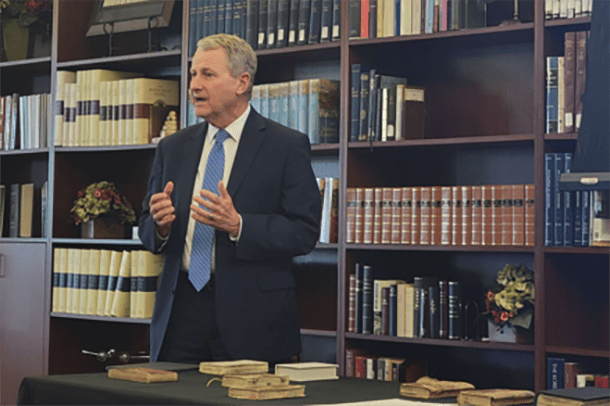
When Elder LeGrand R. Curtis Jr. was released as Church Historian and Recorder in 2022, no one expected that he would soon be volunteering alongside a rising generation of historians and interns in the meticulous task of verifying transcriptions for the Wilford Woodruff Papers Project—least of all Elder Curtis himself.
“I am not convinced that there is a story here,” Elder Curtis said humbly in a recent interview. “I just asked Board Chair, Jordan Clements, what I could do to help on the Project.”
But those who work with him disagree. For them, the story isn’t just about Elder Curtis’s willingness to contribute. It’s about what his service represents—the unassuming devotion of an emeritus General Authority, now working quietly and faithfully to complete a project he helped launch five years ago.
From Oversight to Offering
The Wilford Woodruff Papers Project is an ambitious effort to digitize, transcribe, and make publicly available 70 years of records kept by President Wilford Woodruff, fourth President of The Church of Jesus Christ of Latter-day Saints.

When the newly formed Foundation Board met with Church officials to discuss the feasibility of the Project, Elder Curtis was among the first to offer wholehearted support.
“Elder Curtis was the Church Historian in 2020 when five members of the newly formed Wilford Woodruff Papers Foundation Board met with him and several key Church History Department staff to propose the idea of starting the Wilford Woodruff Papers Project,” said Executive Director Jennifer Mackley. “He recognized the value of sharing Wilford Woodruff’s unique records online and enthusiastically supported the idea. So it felt like we had come full circle for him to volunteer his time and unique knowledge to help complete the Project five years later.”
Board Chair Jordan Clements recalled, “When Elder Curtis served as a Seventy and Church Historian, he was incredibly supportive of the Project. After he received emeritus status, we were delighted when he accepted our invitation to join the Board of Directors. His insights have been invaluable.”
Then, after Elder Curtis and his wife, Jane, returned from their mission directing the Rome Italy Temple Visitors’ Center, his commitment deepened.
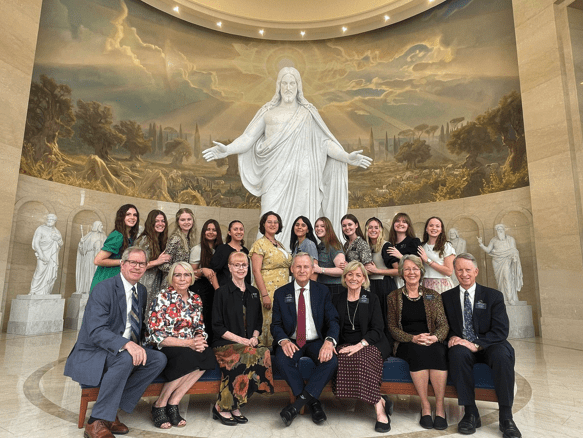
“He called and asked me how he might help with accomplishing our mission,” recalled Jordan Clements. “I put him in touch with Steve Harper, our Executive Editor. Steve had the inspiration to ask Elder Curtis to work with Jason Godfrey to conduct a second-level review of Woodruff documents.”
Elder Curtis began meeting weekly via Zoom with Jason Godfrey, the Project’s General Editor, reviewing transcribed documents letter by letter, word by word, and line by line.
A Humble Scholar, A Rising Generation
“Training Elder Curtis has been an amazing experience—and a humbling one,” said Jason Godfrey. “I initially felt inadequate for the task and was quite nervous about it, but Elder Curtis quickly made me feel supported and valued.”

Godfrey, part of the rising generation the Project aims to inspire, found himself not only teaching Elder Curtis the specifics of the Project’s Editorial Method but also learning from his deep well of experience and insight.
“Elder Curtis was eager to learn,” Godfrey said. “In one specific letter we worked on—from Wilford Woodruff to Brigham Young—Elder Curtis taught me some interesting lessons from that particular time in Church history. Elder Curtis’s impressive background and deep knowledge of Church history has made his time and efforts with the Wilford Woodruff Papers uniquely valuable and worthwhile.”
Executive Editor Steven C. Harper saw the relationship as mutually beneficial: “Jason is embarking on a bright career in the historical profession, and we wanted him to benefit from Elder Curtis’s warmth and wisdom. Elder Curtis is unpretentious and unassuming and loves to bless and help wherever he can.”
Harper noted that Elder Curtis wasn’t just reviewing any historical documents—he was verifying transcriptions of some of the most foundational records of the Church’s early history, authored and preserved by a prophet of God.
From Historian to History-Builder
It’s hard to overstate the symbolic power of Elder Curtis’s role in this Project.
Wilford Woodruff served as Assistant Church Historian and then Church Historian for over 30 years, taking seriously the charge to record the unfolding history of the Restoration. Elder Curtis—himself one of Wilford’s successors in the calling—now finds himself helping transcribe and verify the very records his predecessor kept for the Church and for future generations.
“From the beginning, our main mission has been to make Wilford Woodruff’s unparalleled record and testimony universally accessible and to build faith in Jesus Christ,” said Mackley. “Our secondary goal has been to reach the rising generation. It is extraordinary that Elder LeGrand Curtis is now ‘writing and copying’ under the supervision of Jason Godfrey, a member of that rising generation, while simultaneously mentoring and building faith.”

In essence, Elder Curtis has become a bridge between generations—modeling how learning, discipleship, and scholarship can go hand-in-hand.
Discovering the Man behind the Mission
In verifying documents, Elder Curtis has discovered details about Wilford Woodruff that even he, as a former Church Historian, hadn’t fully appreciated.
“With each document that Jason and I review, I learn details of President Woodruff’s life and character that I did not know before,” he said. “Although you may know the general contours of someone’s life, reading the words of a particular document gives you additional insights. You see aspects of a person’s character displayed in the document.”

One example stood out.
“During the time that the Quorum of the Twelve were leading the Church after Joseph Smith’s death,” Elder Curtis said, “Wilford Woodruff was very devoted to making sure that the branches of the Church followed carefully the instructions that came from the Twelve and did not drift into apostasy.”
Elder Curtis also shared, “Wilford Woodruff knew many people throughout the Church and was devoted to helping them with many kinds of challenges—from doctrinal questions to practical concerns.”
This kind of insight isn’t available through summaries or second-hand histories. It emerges only when one engages with the original sources—and that is exactly what the Wilford Woodruff Papers Project makes possible.
Verified by Professionals, Accessible to All
A key strength of the Project is its professional rigor. All individuals in the database have been researched and verified by certified genealogists—not just individually, but often along with their spouses, parents, and children. This exponentially increases the number of connected names and historical relationships available for discovery. 
The documents themselves are far more than basic biographical entries. They include birth, marriage, death, census, estate, and even divorce records, alongside letters, journals, and sermons—giving unparalleled insight into Church, American, British, and world history.
Through this effort, more than 25,000 individuals have been identified and linked from Wilford Woodruff’s records to FamilySearch and to the Church History Biographical Database. This robust approach has brought the Project closer to completion than ever before.
Board Chair Jordan Clements said of Elder Curtis, “His offering is representative of the remarkable donations of time and money that so many have made. The faith and dedicated service of an army of donors and volunteers has truly brought about miracles.”
A Model for Members
Elder Curtis’s quiet service sets a powerful example for members of the Church. His message to others considering volunteering is simple but profound: “Working as a volunteer on this Project is a great way to help complete a significant endeavor that will bless the lives of many people—regular members of the Church as well as scholars of Church history. As you do that, you yourself will be inspired by what you learn.”
Asked what he enjoys most about volunteering, Elder Curtis responded, “Being part of something important that will contribute to the spreading of greater knowledge about Church History and Wilford Woodruff’s part in it. It is wonderful to learn more about what he contributed to this great Church.” 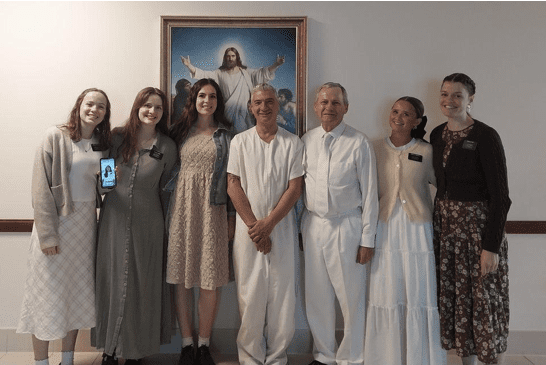
This is the same Church whose history Wilford Woodruff was once charged to preserve, and which Elder Curtis now helps illuminate, one document at a time.
Continuing the Legacy
The Lord instructed Church Historian, John Whitmer, to “obtain knowledge—preaching and expounding, writing, copying, selecting, and obtaining all things which shall be for the good of the church, and for the rising generations” (Doctrine and Covenants 69:7–8).

Today, that charge continues, now through the unlikely but divinely orchestrated partnership between a former Church Historian and a historian from the rising generation.
“We are all striving to build up Zion and can contribute in a variety of ways. The experience has taught me that no effort is wasted or unnoticed in the kingdom of God,” said Jason Godfrey. “It is truly a great honor and blessing in my life to have worked with Elder Curtis and to now call him a dear friend.”
And while Elder Curtis may still wonder whether there’s a story in all of this, the answer from those around him is clear: Absolutely. Not just because of what he’s done, but because of what it represents—a living testimony that in the kingdom of God, no effort is wasted, no contribution is too small, and no calling to serve ever really ends.
The Wilford Woodruff Papers Project’s mission is to digitally preserve and publish Wilford Woodruff’s eyewitness account of the Restoration of the gospel of Jesus Christ from 1830 to 1898. It seeks to make Wilford Woodruff’s records universally accessible to inspire all people, especially the rising generation, to study and to increase their faith in Jesus Christ. See wilfordwoodruffpapers.org.
Why Did the Saints Move to the Rocky Mountains?
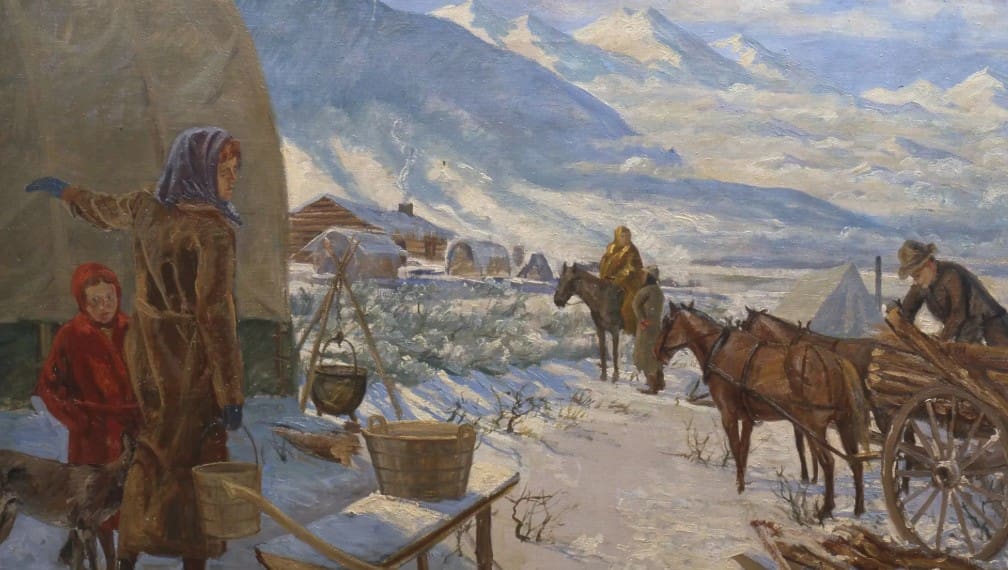
The Know
For Latter-day Saints, Pioneer Day commemorates July 24, 1847, the day when President Brigham Young, who was part of the first pioneer wagon companies, arrived at and looked out over the expansive Great Salt Lake Valley, declaring something like, “This is the right place.”1 While little was known about the desolate Great Basin at that time, early members of the Church knew that Joseph Smith had spoken prophetically to them on several occasions about gathering, principally and crucially, in the Rocky Mountains.2 Going to the Rocky Mountains had become “a settled belief, repeated several times,” beginning earlier in Church history than has usually been recognized.3
As early as February 15, 1831, the US Superintendent of Indian Affairs was informed that some Latter-day Saints in Delaware intended to apply “for permission to go among the Indians; if you refuse, then they will go to the Rocky Mountains,” for where federal permission was not needed because it was then part of Mexico.4 The Saints were already seeking several ways to take the Book of Mormon to the Native Americans, who were understood to be descendants of the Lamanites.
Additionally, on April 11, 1831, Thomas B. Marsh and his wife Eliza wrote to Lewis and Ann Abbott that the Saints were planning to assemble in Ohio:
There our heavenly Father will tell us what we shall next do; perhaps it will be to take our march to the Grand River in the Missouri territory or to the shining mountains which [are] 1500 or 2000 miles west from us. How soon it will be we do not know. In fact, we know nothing of what we are to do until it be revealed to us. But this we know; a City will be built in the promised land, and into it will the descendants of Joseph who was sold into Egypt be gathered.5
Then, on May 7, 1831, Joseph Smith prophesied in Kirtland that “Zion shall flourish upon the hills and rejoice upon the mountains, and shall be assembled together unto the place which I have appointed” (Doctrine and Covenants 49:25). Likewise, on November 3, 1831, Joseph prophesied about gathering the inhabitants of the earth unto Zion, “in the barren deserts” within “the boundaries of the everlasting hills,” where they would be “filled with songs of everlasting joy” (Doctrine and Covenants 133:29, 31, 33).
Wilford Woodruff later reported that in April 1834, Joseph prophesied about “filling the Rocky Mountains with the Saints of God.”6 At the St. George Stake conference on June 12–13, 1892, Woodruff recalled meeting Joseph Smith for the first time in April 1834, when the Prophet said, “This work will fill the Rocky Mountains with tens of thousands of Lamanites who dwell in these mountains, who will receive the Gospel of Christ at the mouth of Elders of Israel, and they will be united with the Church and the kingdom of God, and bring forth much good.” President Woodruff then commented:
I little thought, when I listened to those words, that I should ever live to see the fulfilment of these words of the Prophet. I little thought that I should ever visit the Rocky Mountains, or ever see the Lamanites of whom he then was speaking. . . . But I have lived to see these days. I have lived to see the Lamanites in these mountains. . . . I have preached the Gospel to them, in connection with my brethren, through interpreters. I have spent many interesting days with these Lamanites in the mountains of Israel.7
On January 6, 1836, Lorenzo Dow Young (a brother of Brigham Young) became ill while finishing the exterior of the Kirtland Temple in freezing conditions. Two weeks later, when a doctor had given him little hope for recovery, Joseph Smith sent sixteen elders with specific instructions on how to administer to him. In that blessing, Hyrum Smith promised the faithful Lorenzo that he would “live to go with the Saints into the bosom of the Rocky Mountains to build up a place there,” which miraculously came to pass.8 Many people in Kirtland were aware of these powerful prophetic forecasts.
Sometime before 1844, the Prophet told Lorenzo Snow that he “anticipated moving to the Rocky Mountains with all his family.”9 And as Oliver B. Huntington recalled, Joseph Smith Sr. (who died in 1840) told him in his home in Nauvoo that the Lord had instructed his son, the Prophet, “that we would stay there just 7 years and that when we left there we would go right into the midst of the Indians, in the Rocky Mountains.”10 That seven-year prophecy was, in fact, fulfilled in 1847.
On July 2, 1842, Oliver H. Olney recorded in his journal that some Church members were forming a company “to go as far west as the Rocky mountains and that without delay. . . . They say that they must go where there is no law to baffle them in their doings.” Five days later, Olney added that this move west would be for the protection of religious freedoms so the Church could “raise up a Righeous branch somewhere near the Rocky Mountains in the far west, where no law can touch you or hinder you on the way.”11 Also in 1842, Joseph Smith “stated many things concerning our “going to the mountains. He said we should go and build many cities and we should become a mighty people in the midst of the mountains and should perform a work that will astonish the nations of the earth,” as Anson Call recorded twelve years later.12
Early in 1844, in his presidential campaign literature, Joseph strongly endorsed the westward expansion of the United States:
When the people petitioned to possess the territory of Oregon, or any other contiguous territory, I would lend the influence of a chief magistrate to grant so reasonable a request, that they might extend the mighty efforts and enterprise of a free people from the east to the west sea, and make the wilderness blossom as the rose; and when a neighboring realm petitioned to join the union of the sons of liberty, my voice would be, come: yea come Texas: come Mexico; come Canada; and come all the world—let us be brethren: let us be one great family; and let there be universal peace.13
Then on June 22, 1844, five days before Joseph was murdered, he said in his final goodbye to the Saints in Nauvoo: “You will gather many people into the fastness of the Rocky Mountains as a center for the gathering of the people.”14 Wherever else the Saints were settling—in Missouri, Texas, Iowa, Wisconsin, England, Scotland—a central stake of Zion was to be established in the heart of the Rockies.
On March 3, 1861, Brigham Young affirmed that “hundreds of people in this house are my witnesses, who heard Joseph [Smith] say, when asked whether we should ever have to leave Nauvoo, ‘The Saints will leave Nauvoo. I do not say they will be driven, as they were from Jackson County, Missouri, and from that State; but they will leave here and go to the mountains.’”15
On August 9, 1846, Brigham confided to Wilford Woodruff that “he had not expected to see the Rocky Mountains this year, but when the Lord commanded him to go direct, he intended to go, [even] if he left all and went alone; but [that] he thought the Lord would let him take the people with him and [that] when He found the place for the temple he would work hard until it was built. He said [that] the Lord, revelation, [and] a vision was with him.”16 On January 14, 1847, Brigham Young sent back from Winter Quarters wise instructions based on the will of the Lord, guiding the Saints in successfully moving forward to reach Zion (see Doctrine and Covenants 136).
Lastly, on February 17, 1847, the deceased Prophet Joseph Smith appeared to Brigham Young in a dream as the first pioneer companies were preparing to leave Winter Quarters on the Iowa–Nebraska border and begin moving up the trail into the Rocky Mountains. In the dream, Joseph instructed Brigham,
Tell the people to be humble and faithful, and be sure to keep the Spirit of the Lord, and it will lead them right; . . . it will whisper peace and joy to their souls; it will take malice, hatred, envying, strife, and all evil from their hearts; and their whole desire will be to do good, bring forth righteousness and build up the kingdom of God.17
The Why
In the following years, enthusiastic crowds celebrated Pioneer Day on July 24 each year by gathering at the temple block in Salt Lake City to hear Church leaders speak . Those speakers gave many answers to the question of why the Saints had come to the Rocky Mountains: They had not come for political control, for land grabbing, or for the beautiful scenery. Instead, after they had accomplished the work in Nauvoo that Joseph had charged them to finish, they came to establish a central gathering place for the worldwide Zion.
Already on July 24, 1852, Elder George A. Smith articulated several of those reasons. He said they had come so that “they could lie down to rest in perfect peace—without being disturbed by the cruel hand of persecution.” They came to establish “institutions that insure freedom to all, liberty to every person—the liberty of conscience, as well as every privilege which can be desired by any citizens of this earth.” They came because they “were led by the hand of God, through His servant Brigham.” They came to “stand unflinchingly true by the Constitution of the United States.” They came “for Liberty and Truth, forever!”18
The next year, on July 24, 1853, President Brigham Young spoke at length about establishing the kingdom of God and welcoming all on earth, which he said was the reason the Saints came to gather in the Salt Lake Valley.19 He emphasized that they had come voluntarily. They chose to leave Nauvoo peaceably.
Then in celebrating Pioneer Day on July 24, 1854—the seventh anniversary of the Saints’ arrival to the Salt Lake Valley—two leaders spoke passionately on why the Saints had come. Daniel H. Wells spoke strongly about how they came “seeking a home . . . where they might rest . . . and feel secure from the wrath of [those] . . . who had pursued and hunted them with relentless fury, and driven them from the abodes of civilization.” They came, he said, as “directed by the same God who led Moses and the children of Israel out from the land of Egypt.” They came, following their “beloved President at their head,” believing in “a wise and beneficent God” who has said it was His business and His “purpose to provide for [His] Saints.”20 George A. Smith also spoke about the first company coming “to prepare the way for a safe retreat from tyranny and oppression.”21
Having completed that seventh-year landmark, the Saints continued gathering on Pioneer Day to speak and testify about why they came to the mountains of Utah Territory. They continued to emphasize that they came because they had been commanded by God and led by God to do so and that they gathered out of obedience to their beloved Joseph Smith, who had pointed them toward the Rocky Mountains. They spoke emphatically that they came by the providence of God to find peace and safety and to protect their religious rights.
They also saw their coming as fulfilling biblical prophecy. Writing in 1853, Benjamin Brown explained that “the Bible distinctly depicted a great portion of the work of the last days as being on the mountains,” where an ensign (a clear banner of central solidarity) would be lifted to the nations. There, the Lord’s house would be built and “all nations flow unto it, that they may learn the ways of the God of Jacob, and walk in His paths.” All this ties into the fulfillment of Isaiah 33:16–17 and 35:1, which passages speak of the rocks as symbolizing the defense of the Saints, where they “dwell on high” and where God has caused “the wilderness and the solitary place to be glad for them, and the desert to rejoice and blossom as the rose.”22
For these reasons, the Saints sacrificed all they had to come to the Rocky Mountains and “find the place which God for us prepared, far away, in the west.”23
- 1. Wilford Woodruff, “The Pioneers,” Contributor, August 1880, 252–53. For a brief history on commemorations of this day, see Steven Olsen, “Pioneer Day,” in Utah History Encyclopedia, ed. Allen Kent Powell (University of Utah Press, 1994). At its core, Pioneer Day “was a quest for the sacred.” D. James Cannon, “Pioneer Day,” in Encyclopedia of Mormonism, ed. Daniel H. Ludlow (Macmillan, 1992), 3:1083.
- 2. For a list of such statements by Joseph Smith, see John W. Welch, “Joseph Smith’s Short Trip to Iowa, June 23, 1844, to Secure Lawyers to Go with Him to Carthage,” in Joseph Smith: A Life Lived in Crescendo, ed. Jeffrey M. Bradshaw (Interpreter Foundation; Eborn Books, 2024), 2:671–73.
- 3. Ronald K. Esplin, “‘A Place Prepared’: Joseph, Brigham and the Quest for Promised Refuge in the West,” Journal of Mormon History 9 (1982), 92.
- 4. Richard W. Cummins to General William Clark, February 15, 1831, U. S. Office of Indian Affairs, Central Superintendency Records, St. Louis, Missouri, vol. 6, 113–14, William Clark Papers Collection, Kansas Historical Society; emphasis added throughout this KnoWhy article. Cummins also stated that “they had a new Revelation [the Book of Mormon] with them, as their guide in teaching the Indians, which they say was shewn to one of their sects in a miraculous way.”
- 5. Thomas B. Marsh and Eliza G. Marsh to Lewis and Ann Abbott, circa April 11, 1831, MS 23457, Lewis and Ann Abbott Papers, Abbott Family Collection, 1831–2000, Church History Library, Salt Lake City, UT. Spelling and punctuation standardized.
- 6. Scott G. Kenny, ed., Wilford Woodruff’s Journal (Signature Books, 1985), 8:279.
- 7. “Remarks By President Wilford Woodruff,” The Latter-day Saints’ Millennial Star 54, no. 38 (September 19, 1892): 605–6.
- 8. James Amasa Little, “Biography of Lorenzo Dow Young,” Utah Historical Quarterly 14, nos. 1–4 (1946): 46.
- 9. Eliza R. Snow Smith, Biography and Family Record of Lorenzo Snow (Salt Lake City, 1884), 76.
- 10. Oliver B. Huntington, Journal, February 24, 1883, MSS 162, series 1, item 1, box 1, folder 8, L. Tom Perry Special Collections, Harold B. Lee Library, Brigham Young University, Provo, UT.
- 11. Richard G. Moore, ed., The Writings of Oliver H. Olney: April 1842 to February 1843—Nauvoo, Illinois (Greg Kofford Books, 2020), 78–79, 87; spelling silently modernized. See the entries for July 2 and 7 and August 11, 1842. That exploring party, however, did not materialize.
- 12. Anson Call statement, circa 1854, MS 364, Church History Library, Salt Lake City, UT. For a book-length defense of Anson Call’s reliability concerning this prophecy attributed to Joseph Smith, see Gwen Marler Barney, Anson Call and the Rocky Mountain Prophecy (Call Publishers, 2002). This would be the basis for the prophecy attributed to Joseph Smith in B. H. Roberts, ed., History of the Church of Jesus Christ of Latter-day Saints (The Church of Jesus Christ of Latter-day Saints, 1909), 5:85; and B. H. Roberts, A Comprehensive History of The Church of Jesus Christ of Latter-day Saints (Brigham Young University Press, 1965), 2:181–82.
- 13. “General Smith’s Views of the Powers and Policy of the Government of the United States, circa 26 January–7 Febrary 1844,” pp. 11–12, The Joseph Smith Papers.
- 14. “Autobiography of William Bryan Pace (1832–1847),” Doctrine and Covenants Central.
- 15. Brigham Young, in HYPERLINK “https://journalofdiscourses.com/8/86″Journal of Discourses, 26 vols. (London, 1854–86), 8:356.
- 16. Wilford Woodruff, Journal (January 1, 1845–December 31, 1846), August 9, 1846, Wilford Woodruff Papers.
- 17. “Brigham Young, vision, 1847 February 17, p 1–2,” Church History Catalog, CR 1234, online at catalog.churchofjesuschrist.org; spelling silently modernized.
- 18. George A. Smith, in Journal of Discourses, 1:42–45.
- 19. Brigham Young, in Journal of Discourses, 1:233–45. See also Brigham Young, in Journal of Discourses, 9:137.
- 20. Daniel W. Wells, in Journal of Discourses, 2:25; Doctrine and Covenants 104:15.
- 21. George A. Smith, in Journal of Discourses, 2:22.
- 22. Benjamin Brown, Testimonies for the Truth: A Record of Manifestations of the Power of God, Miraculous and Providential, Witnessed in the Travels and Experience of Benjamin Brown (Liverpool, 1853), 30.
- 23. William Clayton, “Come, Come, Ye Saints,” Hymns, no. 30. These words were written on April 15, 1846, near Locust Creek in Iowa, on the muddy trail 103 miles west of Nauvoo. Hanna Seariac, “The Pioneer Anthem: The Compelling Story Behind ‘Come, Come, Ye Saints,” Deseret News, May 26, 2022.
Why Do Latter-day Saints Pay Tithing?

View the original post on Scripture Central.
“Those who have thus been tithed shall pay one-tenth of all their interest annually; and this shall be a standing law unto them forever, for my holy priesthood, saith the Lord.” Doctrine and Covenants 119:4
The Know
In 1831, the Lord commanded the members of the Church to live the law of consecration. This law was revealed in detail in Doctrine and Covenants 42, which commanded the Saints to consecrate all that the Lord has and will bless them with in order to build up His kingdom and establish a Zion community. Between 1831 and 1838, the voluntary offerings that some Saints made when living the law of consecration referred to their offerings as tithing. This is also found in some revelations instructing the saints to live this law and the law of sacrifice.
In 1831, for instance, the Lord stated that “it is a day of sacrifice, and a day for the tithing of my people; for he that is tithed shall not be burned at his coming” (Doctrine and Covenants 64:23; see also 85:3). Similarly, in 1833, the Lord commanded the Saints in Kirtland to build a temple, declaring it was to be built through tithing: “Let it be built speedily, by the tithing of my people. Behold, this is the tithing and the sacrifice which I, the Lord, require at their hands, that there may be a house built unto me for the salvation of Zion” (Doctrine and Covenants 97:11–12).
While the word tithing stems from a root meaning tenth in English, Steven C. Harper has noted, “Saints at the time understood tithing to refer to any amount of freely consecrated goods or money.”1 Thus, early mentions of “tithing” took on general meanings, similar to “donation” or “contribution.” As the Saints tried to live the law of consecration, focusing on tithing became an important part of the Saints’ worship. As Saints sought to live their covenants, however, many sought clarification on what was expected.
In 1837, for instance, Newel K. Whitney, the bishop in Kirtland, wrote a letter to the Saints that was published in the Messenger and Advocate, the Church’s newspaper at the time. In this letter, Newel emphasized that tithing was still an important principle that the Saints needed to live, drawing upon Malachi 3:10 to emphasize the blessings with which the Lord would bless the Church: “It is the fixed purpose of our God, and has been so from the beginning, as appears by the testimony of the ancient prophets, that the great work of the last days was to be accomplished by the tithing of his saints. The Saints were required to bring their tithes into the store house, and after that, not before, they were to look for a blessing that there should not be room enough to receive it.”2
At the same time, Harper notes, “The bishopric in Missouri proposed a similar but more specific policy: each household should offer a tithe of 2 percent of its annual worth after paying the household’s debts.”3 This would help ensure that the Church could continue its mission of purchasing land in Zion for the Saints, and eventually so the Church could build a temple in Missouri. In a letter to Joseph Smith dated on February 15, 1838, the apostle Thomas B. Marsh further emphasized the Saints’ desires when he wrote, “The people seem to wish to have the whole law of God lived up to; and we think that the church will rejoice to come up to the law of consecration, as soon as their leaders shall say the word, or show them how to do it.”4
This principle would be clarified further in a revelation given to Joseph Smith on July 8, 1838, in Far West, Missouri. In this revelation, canonized as Doctrine and Covenants 119, the Lord declared, “This shall be the beginning of the tithing of my people. … Those who have thus been tithed shall pay one-tenth of all their interest annually; and this shall be a standing law unto them forever, for my holy priesthood, saith the Lord” (Doctrine and Covenants 119:3–4). A subsequent revelation, Doctrine and Covenants 120, “assigned the First Presidency, the bishopric in Zion, and the high council in Zion to decide how to use the tithes, making their decisions, the Lord said, ‘by mine own voice unto them.’ … Today the council is composed of the First Presidency, the Quorum of the Twelve Apostles, and the Presiding Bishopric.”5
Perhaps due to a misunderstanding of what the law of consecration entailed and what the United Firm was in the early history of the Church, as Harper notes, “Section 119 is widely misunderstood as replacing the law of consecration with the principle of tithing. That is not what it says or how it was understood by Joseph and the early Saints.”6 Rather, as the history leading up to the law of tithing shows, the Saints were more than willing to live the law of consecration, and they continued to do so well after the law of tithing had been revealed.7
Furthermore, “There is nothing in the revelation to indicate that tithing is a lesser or lower law to be replaced someday. The revelation says it is ‘a standing law unto them forever’ and applicable to all Saints everywhere (vv. 4, 7). The Doctrine and Covenants does not say that consecration is a higher law and that tithing is a lower or temporary law.”8 Similarly, Casey Paul Griffiths observed, “Doctrine and Covenants 119 was received within the framework of the law of consecration. It did not rescind or replace the law of consecration. Instead, it was intended to act as a financial law of sacrifice and a subset of the law of consecration.”9
This is also apparent in the reasons given for obeying the law of tithing in Doctrine and Covenants 119:2, which “are the same reasons noted previously for obeying the law of consecration: to relieve poverty, purchase land for the Saints, build a temple, and build up Zion so that those who make and keep covenants can gather to a temple and be saved (see D&C 42:30–36).”10
Just as tithing has been revealed for the Church to follow in this dispensation, it has also been a law that has been practiced in ancient times as well. As Stephen D. Ricks has observed, “Such payment of one-tenth of one’s increase for the support of the community or the maintenance of its religious institutions is a well-attested practice, both among Christians as well as Ancient Israel.”11 Indeed, this principle was practiced at least as far back as Abraham’s time, and so it would only be fitting for it to be restored in the latter-day dispensation as well.12
The Why
When teaching the Saints about tithing, Brigham Young once taught, “The law of tithing is an eternal law. The Lord Almighty never had his kingdom on the earth without the law of tithing being in the midst of his people, and he never will. It is an eternal law that God has instituted for the benefit of the human family, for their salvation and exaltation.”13 The choice to pay tithing, however, is an individual choice that the Lord has offered His children. As Steven C. Harper has noted, “As they were taught the will of the Lord, the Saints became accountable stewards who could choose whether or not to pay their tithes of their own free will.”14
Funds consecrated by the Saints through tithing are to be used at the discretion of the First Presidency, Presiding Bishopric, and Quorum of the Twelve Apostles, following the revealed pattern established in Doctrine and Covenants 120:1. As such, and especially because tithing funds are consecrated to the Lord for the building up of the Lord’s kingdom, all tithing funds are to be given to the Church. While many Latter-day Saints are willing and able to donate to other excellent charities and organizations, these should not be confused with the law of tithing revealed to the Church. Nor should any other act of service done for the Church be confused as tithing. As Stephen D. Ricks has observed, “While the payment of tithes remains a significant part of building the Lord’s kingdom, it does not exhaust the ways in which the Saint may expend his means, energy, time, and talents in serving the Lord’s cause.”15
Tithing is an act of sacrifice strongly connected with the law of consecration. As Hugh Nibley wrote, “To pay a real tithe, given out of one’s own necessities, [is] something of a test and a sacrifice, as tithing is meant to be.”16 That is, “The law of consecration demands everything you have, but at the same time it fills your every physical need; and it is from that sustaining income, from that substance, that you pay your tithes. This makes it a genuine sacrifice and not a mere token offering skimmed off from a net increase that you will never miss.”17
As Harper has observed, “Latter-day Saints learned that if they obeyed even just the instruction to offer a tenth of their annual increase, the Church could pay its debts and begin to carry out the Lord’s instructions to build temples, relieve poverty, and build Zion.”18 Furthermore, they would be able to stand at the last day and be welcomed into the presence of God. “The money offered is calculable. The blessings are not.”19
Further Reading
Steven C. Harper, Let’s Talk About the Law of Consecration (Deseret Book, 2022), 72–78.
Casey P. Griffiths, Scripture Central Commentary on the Doctrine and Covenants, vol. 4 (Scripture Central; Cedar Fort, 2024), 4:101–110.
Steven C. Harper, “The Tithing of My People,” in Revelations in Context: The Stories behind the Sections of the Doctrine and Covenants, ed. Matthew McBride and James Goldberg (Church of Jesus Christ of Latter-day Saints, 2016), 250–255.
Stephen D. Ricks, “A Standing Law Forever (D&C 119 and 120),” in Studies in Scripture, vol. 1, The Doctrine and Covenants, ed. Robert L. Millet and Kent P. Jackson (Deseret Book, 1989), 456–462.
Stephen D. Ricks, “Tithing in Ancient and Modern Israel,” in Hearken, O Ye People: Discourses on the Doctrine and Covenants (Randall Book, 1984), 205–218.
Footnotes
1. Steven C. Harper, “The Tithing of My People,” in Revelations in Context: The Stories behind the Sections of the Doctrine and Covenants, ed. Matthew McBride and James Goldberg (Church of Jesus Christ of Latter-day Saints, 2016), 251; see also Stephen D. Ricks, “A Standing Law Forever (D&C 119 and 120),” in Studies in Scripture, vol. 1, The Doctrine and Covenants, ed. Robert L. Millet and Kent P. Jackson (Deseret Book, 1989), 456. The words in Hebrew and Greek translated as tithing in the Bible also mean a tenth.
2. Newel K. Whitney and others, “To the Saints Scattered Abroad,” Sept. 18, 1837, in Latter-day Saints’ Messenger and Advocate, vol. 3, no. 12, Sept. 1837, 562. It is also noteworthy that Jesus repeated Malachi 3 to the Nephites, as recorded in 3 Nephi 24. See Scripture Central, “Why Did Jesus Give the Nephites Malachi’s Prophecies? (3 Nephi 24:1),” KnoWhy 218 (August 21, 2019).
3. Harper, “The Tithing of My People,” 251.
4. Letter from Thomas B. Marsh, 15 February 1838, p. 45, The Joseph Smith Papers.
5. Harper, “The Tithing of My People,” 253–254.
6. Harper, Let’s Talk About the Law of Consecration, 77.
7. For more on how the Saints lived the law of consecration, see KNOWHY 790 re. law of consecration.
8. Harper, Let’s Talk About the Law of Consecration, 77.
9. Casey P. Griffiths, Scripture Central Commentary on the Doctrine and Covenants, vol. 4 (Scripture Central; Cedar Fort, 2024), 4:102; see also Stephen E. Robinson and H. Dean Garrett, A Commentary on the Doctrine and Covenants, 4 vols. (Deseret Book, 2005), 4:141–143.
10. Harper, Let’s Talk About the Law of Consecration, 76.
11. Ricks, “A Standing Law Forever,” 456.
12. Genesis 14:18–20; Alma 13:15. See Stephen D. Ricks, “Tithing in Ancient and Modern Israel,” in Hearken, O Ye People: Discourses on the Doctrine and Covenants (Randall Book, 1984), 205–218 for a discussion on how tithing was practiced in the Bible as well as how it is similarly practiced today.
13. Brigham Young, “Gathering the Saints, etc.,” in Journal of Discourses, ed. George D. Watt, 26 vols. (Latter-day Saints Book Depot, 1855–86), 14:89.
14. Harper, “The Tithing of My People,” 253.
15. Ricks, “A Standing Law Forever,” 461.
16. Hugh Nibley, “Breakthroughs I Would Like to See,” in Approaching Zion, vol. 9, The Collected Works of Hugh Nibley (Foundation for Ancient Research and Mormon Studies; Deseret Book), 396.
17. Hugh Nibley, “Law of Consecration,” in Approaching Zion, 448.
18. Harper, “The Tithing of My People,” 254.
19. Harper, “The Tithing of My People,” 254.
Why Does the Lord Compare the Earth’s Millennial Glory to the Mount of Transfiguration?

View the original post on Scripture Central.
“When the earth shall be transfigured, even according to the pattern which was shown unto mine apostles upon the mount; of which account the fulness ye have not yet received.” Doctrine and Covenants 63:21
The Know
After Joseph Smith returned from Missouri to Kirtland, “the Saints were extraordinarily anxious to learn the Lord’s will about Zion.”1 Despite the overall righteousness of many of the Saints, some had apostatized while Joseph was away, and others who had traveled to Missouri with him had ill feelings about the state of the land Zion was to be located in. In answer to these concerns, Joseph Smith received Doctrine and Covenants 63, revealing the Lord’s will concerning the building up of Zion and the need to live worthily enough to inherit the blessings the Lord has prepared for the Saints.
After warning against various sins, the Lord promised the faithful that they would not only be able to inherit the city of Zion but also prepare themselves for the Millennium: “He that endureth in faith and doeth my will, the same shall overcome, and shall receive an inheritance upon the earth when the day of transfiguration shall come; when the earth shall be transfigured” (Doctrine and Covenants 63:20–21). As Casey Paul Griffiths has observed, the Lord’s reference to “the ‘day of transfiguration’ refers to the day the earth ‘will be renewed and receive its paradisiacal glory’ (Article of Faith 10).”2 Through these verses, the Lord set the following instructions for building the city of Zion in context of the eternal glories that life in Zion is preparing the Saints to receive.
One additional aspect of these promises of millennial glory is found in the second half of verse 21: “When the earth shall be transfigured, even according to the pattern which was shown unto mine apostles upon the mount; of which account the fulness ye have not yet received” (Doctrine and Covenants 63:21; emphasis added). In this verse, the Lord is most likely referring to events at the Mount of Transfiguration, in which “Jesus taketh Peter, James, and John his brother, and bringeth them up into an high mountain apart, and was transfigured before them: and his face did shine as the sun, and his raiment was white as the light”3 There, the Apostles saw Moses and Elias, heard the voice of the Father declare that Jesus was His Son, and also saw Jesus in His full glory (see Matthew 17:3–9). Peter, James, and John were then instructed, “Tell the vision to no man, until the Son of man be risen again from the dead” (Matthew 17:9).
While the Lord has not revealed everything that happened on the Mount of Transfiguration, some prophets have clarified what happened on that occasion. In 1839, for instance, Joseph Smith taught, “The Savior, Moses, and Elias gave the Keys to Peter, James, and John on the Mount when they were transfigured before him.”4 This would mirror Joseph’s own experience in the Kirtland Temple in which Elijah, Elias, and Moses appeared to Joseph and Oliver Cowdery. At that time, the two were also given priesthood keys (see Doctrine and Covenants 110). For Joseph and Oliver, this occurred in a holy temple that was accepted by the Lord. For Peter, James, and John, this occurred on a mountaintop, which could serve as a natural temple.5
C. Wilfred Griggs has also noted that the Mount of Transfiguration was closely connected to the temple in early Christian thought, as is evidenced in Peter’s declaration, “Lord, it is good for us to be here: if thou wilt, let us make here three tabernacles; one for thee, and one for Moses, and one for Elias” (Matthew 17:4). According to Griggs, this could be understood as the desire to build “a three-part temple,” especially because “the words used there are, in fact, the words used for temple in the Old Testament.”6 Even with the command that the participants were not to reveal everything from that holy manifestation, “enough is present to ensure the establishment of a temple context for this experience. The priesthood keys were therefore temple related.”7
Furthermore, some Apostles have discussed the events that occurred upon the Mount of Transfiguration in terms of the temple. Heber C. Kimball, for instance, explicitly connected the experience of Peter, James, and John to the experiences of all Latter-day Saints who are endowed in the holy temple in this dispensation:
Jesus took Peter, James, and John into a high mountain, and there gave them their endowment, and placed upon them authority to lead the Church of God in all the world, to ordain men to the Priesthood, to set in order the Church and send forth the Elders of Israel to preach to a perishing world. For the same purpose has the Lord called us up into these high mountains, that we may become endowed with power from on high in the Church and kingdom of God, and become kings and priests unto God, which we never can be lawfully until we are ordained and sealed to that power, for the kingdom of God is a kingdom of kings and priests, and will rise in mighty power in the last days.8
Joseph Fielding Smith likewise taught, “The Savior took the three disciples up on the mount, which is spoken of as the ‘Mount of Transfiguration,’ he there gave unto them the ordinances that pertain to the house of the Lord and . . . they were endowed. That was the only place they could go. That place became holy and sacred for the rites of salvation which were performed on that occasion.”9
Joseph Smith also hinted at this possibility throughout some of his Nauvoo sermons and writings. In an editorial for the Times and Seasons in September 1842, for instance, Joseph wrote that Peter was “endowed by the Lord.”10 Just over nine months later, Joseph taught again, “At one time God obtained a house where Peter was endowed.”11 These remarks came specifically in the context of temple ordinances being performed in Nauvoo, including baptisms for the dead, washings and anointings, endowments, and sealings.12 As such, Joseph clearly intended to convey that Peter was “the recipient of temple-related ordinances” and had received a temple endowment like those being performed in Nauvoo.13
Steven C. Harper notes that in addition to teaching that Peter had been endowed, “Joseph’s Nauvoo teachings strongly suggested that Peter’s more sure word of prophecy was a kind of knowledge he gained via a process of covenant making and keeping, mediated by templelike ordinances that led recipients ultimately to certainty of eternal life.”14 As such, Peter’s life and teachings recorded in the New Testament reflected an experience that all worthy Latter-day Saints could experience in the temple. The events on the Mount of Transfiguration appear to have had a significant impact on Peter, who later referred to the event as allowing the Apostles to be “eyewitnesses of his majesty” (2 Peter 1:16; see vv. 16–18).
The Why
In the temple, Latter-day Saints learn about the past, present, and future of the earth as they make covenants with God. These covenants prepare Latter-day Saints to live with God and return to His presence. Faithfully living these covenants will also allow Latter-day Saints to “receive an inheritance upon the earth when the day of transfiguration shall come,” just as the Lord has promised (Doctrine and Covenants 63:20). Furthermore, these covenants are made through Priesthood authority that has been restored through the Prophet Joseph Smith by Peter, James, John, Moses, Elias, and other angelic messengers.
As Latter-day Saints progress through the temple, they are likewise able to ritually enter the presence of God in the celestial kingdom. When the words in Doctrine and Covenants 63:20–21 are understood through this lens, it becomes clearer why the Lord stated, “The earth shall be transfigured, even according to the pattern which was shown unto mine apostles upon the mount” (Doctrine and Covenants 63:21). The future of the earth is glorious—it will become part of the celestial kingdom (see Doctrine and Covenants 88:25–26).
Ultimately, as Griffiths concluded, “While we do not know everything about what happened on the Mount of Transfiguration, it is clear that what was shown to Peter, James, and John was of great importance to the future of God’s children and to the destiny of the earth itself.”15 And while the full details have not been revealed, modern Latter-day Saints can continue to utilize the instructions throughout Doctrine and Covenants 63 and in the temple to prepare themselves for that glorious future day.
Further Reading
Casey Paul Griffiths, Scripture Central Commentary on the Doctrine and Covenants, 4 vols. (Scripture Central; Cedar Fort, 2024), 219–34.
C. Wilfred Griggs, “The Sacred and the Temple in Ancient Christianity,” in The Temple: Plates, Patterns, and Patriarchs. Proceedings of the Sixth Interpreter Foundation Matthew B. Brown Memorial Conference, “The Temple on Mount Zion,” 4–5 November 2022, ed. Stephen D. Ricks and Jeffrey M. Bradshaw (Interpreter Foundation; : Eborn Books, 2024), 1–32.
Steven C. Harper, “Peter and the Restored Priesthood,” in The Ministry of Peter, the Chief Apostle, ed. Frank F. Judd Jr., Eric D. Huntsman, and Shon D. Hopkin (Brigham Young University, Religious Studies Center; Deseret Book, 2014), 361–73.
Footnotes
1. Steven C. Harper, Making Sense of the Doctrine and Covenants: A Guided Tour Through Modern Revelations (Deseret Book, 2008), 218.
2. Casey Paul Griffiths, Scripture Central Commentary on the Doctrine and Covenants, 4 vols. (Scripture Central; Cedar Fort, 2024), 2:223.
3. Matthew 17:1–2. This revelation may have come shortly after Joseph Smith translated Matthew 17 as well, which may help explain some of the context behind this revelation and its discussion on the Mount of Transfiguration.
4. “Discourse, between circa 26 June and circa 4 August 1839–A, as Reported by Willard Richards,” p. 65, The Joseph Smith Papers; spelling and punctuation modernized.
5. See John M. Lundquist, “What Is a Temple? A Preliminary Typology,” In Temples of the Ancient World: Ritual and Symbolism, ed. Donald W. Parry (Foundation for Ancient Research and Mormon Studies, 1994), 84–87. On another occasion, Joseph Smith taught regarding certain keys or “signs and words . . . which cannot be revealed to the Elders till the Temple is completed. The rich can only get them in the Temple. The poor may get them on the mountaintop as did Moses.” “Journal, December 1841–December 1842,” p. 94, The Joseph Smith Papers; spelling, capitalization, and punctuation standardized.
6. C. Wilfred Griggs, “The Sacred and the Temple in Ancient Christianity,” in The Temple: Plates, Patterns, and Patriarchs. Proceedings of the Sixth Interpreter Foundation Matthew B. Brown Memorial Conference, “The Temple on Mount Zion,” 4–5 November 2022, ed. Stephen D. Ricks and Jeffrey M. Bradshaw (Interpreter Foundation; Eborn Books, 2024), 4.
7. Griggs, “Sacred and the Temple,” 4.
8. Heber C. Kimball, in Journal of Discourses, 26 vols. (Latter-day Saints Book Depot, 1855–86), 9:327.
9. Joseph Fielding Smith, Doctrines of Salvation, ed. Bruce R. McConkie, 3 vols. (Bookcraft, 1954–56), 2:170.
10. “Baptism,” Times and Seasons 3 (September 1, 1842): 904.
11. ”Discourse, 11 June 1843–A, as Reported by Willard Richards,“ p. 246, The Joseph Smith Papers; spelling and punctuation modernized.
12. ”Discourse, 11 June 1843–A, as Reported by Willard Richards,“ p. 246, The Joseph Smith Papers.
13. Steven C. Harper, “Peter and the Restored Priesthood,” in The Ministry of Peter, the Chief Apostle, ed. Frank F. Judd Jr., Eric D. Huntsman, and Shon D. Hopkin (Brigham Young University, Religious Studies Center; Deseret Book, 2014), 367.
14. Harper, “Peter and the Restored Priesthood,” 367.
15. Griffiths, Scripture Central Commentary, 225.
Why Are Saints Invited to Live the Law of Consecration?

View the original post on Scripture Central.
“And behold, thou wilt remember the poor, and consecrate of thy properties for their support that which thou hast to impart unto them, with a covenant and a deed which cannot be broken.” Doctrine and Covenants 42:30
The Know
When Joseph Smith was commanded to move the Church to Kirtland, Ohio, he and the Saints were promised that the Lord would there “give unto you my law; and there you shall be endowed with power from on high” (Doctrine and Covenants 38:32). Details about that law and promised blessing were soon revealed in Doctrine and Covenants 42, detailing the law of consecration that the Saints were invited to begin following.1 In short, the Saints were commanded to consecrate, or sanctify, all that the Lord has blessed and will bless them with in order to assist in building up His kingdom, thus enabling all to establish once again a pure Zion community.
When Joseph received this revelation, many in the Kirtland area had already been prepared for it. The word Zion prophetically appears in the Book of Mormon almost fifty times.2 By early 1831 Joseph Smith had also worked on his inspired translation of the Bible through the early chapters of Genesis, which spoke of a people whom the Lord named “Zion, because they were of one heart and one mind, and dwelt in righteousness; and there was no poor among them” (Moses 7:18). In addition, many would have also read about the early Church in Jerusalem, whose members “were of one heart and of one soul: neither said any of them that ought of the things which he possessed was his own; but they had all things common” (Acts 4:32). Perhaps most of all, they may have been deeply inspired when they read that the righteous people in the Book of Mormon had been greatly blessed for four generations as they “had all things common among them” after the resurrected Jesus instructed and ministered among them (4 Nephi 1:3).
Previously, in 1829, Isaac Morley had started a small community called the Family on his farm just outside of Kirtland that sought to emulate this idealistic belief of early Christianity.3 When the first missionaries came to Kirtland in the winter of 1830–31, many in this community, including Isaac Morley, were well prepared and readily joined the Church.
However, there were significant problems in how certain principles had been practiced by the Family that worried Joseph. As Steven C. Harper summarized, “Their practices undermined personal agency, stewardship, and accountability,” and many members were still only interested in their own profit at the expense of others in the Family.4 Thus, John Whitmer noted that they “were going to destruction very fast as to temporal things.”5 When Joseph received section 42, it offered many needed divine corrections to how these well-intended Saints were trying to implement this exalted law.
The revelation clearly taught that the law of consecration could be practiced only when based on righteous principles and doctrines. Harper thus compared the law of consecration to “a three-legged stool,” with each leg being a foundational doctrine: agency, accountability, and stewardship.6 The law of consecration is also founded on the truth that “individual freedom and the private ownership of property . . . exist in relationship to God. Our culture ignores God’s ultimate ownership of everything, but the law of consecration is founded on that fundamental truth.”7
God will never take away anyone’s power to act for themselves, and individuals alone are accountable for what they do with the things they have been given stewardship over. Hence, the Lord declared, “Every man shall be made accountable unto me, a steward over his own property, or that which he has received by consecration, as much as is sufficient for himself and family” (Doctrine and Covenants 42:32).
Practicing this law became a primary concern for many members of the Church. The members of the Family were among the first to accept this revelation, and Joseph recorded that their errors were “readily abandoned for the more perfect law of the Lord.”8 This was especially true when Doctrine and Covenants 70 was revealed, which affirmed that “none are exempt from this law who belong to the church of the living God” (verse 10).
In the early days of the Church, members who consecrated their property would lay it “before the bishop of my church and his counselors” and actually deed it to the Church. The bishop in turn would then give the member stewardship over that property (Doctrine and Covenants 42:32). The call to consecrate properties was given, moreover, in connection with a command to “remember the poor, and consecrate of thy properties for their support that which thou hast to impart unto them, with a covenant and a deed which cannot be broken” (Doctrine and Covenants 42:30). This call was made several times in those years, especially as poor Saints moved into Kirtland and Missouri and relied on the compassion of their fellow Saints (see Doctrine and Covenants 48:2–3).
Oftentimes, property deeded to the Church did not actually exchange hands, but the act nonetheless showed the Saints’ faith and willingness to live the laws and principles of God.9 It was also left up to their discretion what or even how much they consecrated—Joseph even instructed the bishop Edward Partridge not to infringe upon any man’s agency, knowing that the Lord would judge each individual one day.10
A specific initiative to apply the law of consecration included the organization of the Literary Firm, intended to use consecrated funds to support those people who were working full-time to print Church scriptures and materials. In addition, the United Firm (occasionally known as the United Order) operated between 1832 and 1834 and consisted of eleven leaders using their consecrated properties to assist each other in managing some affairs of the Church.11 While the United Firm was dissolved with the revelation in Doctrine and Covenants 104, that was not the end of the law of consecration—simply the end of one way that the law of consecration was practiced by those particular people to accomplish a dedicated goal.12
In 1838, an additional revelation was received regarding how the Saints could live the law of consecration. In a letter to Joseph Smith, the Apostle Thomas B. Marsh optimistically reported, “The people seem to wish to have the whole law of God lived up to; and we think that the church will rejoice to come up to the law of consecration, as soon as their leaders shall say the word, or show them how to do it.”13 In response to their faithful readiness, Joseph Smith received and delivered Doctrine and Covenants 119 on July 8, 1838, which declared that the Saints now “shall pay one-tenth of all their interest annually; and this shall be a standing law unto them forever” (verse 4). As a standing law forever, Latter-day Saints pay tithing today as part of keeping the law of consecration.14
The Why
In The Church of Jesus Christ of Latter-day Saints today, members no longer deed their property to the Church and receive in return a written stewardship for their property. However, that does not mean Saints do not live the law of consecration today, as it has never been rescinded. Steven C. Harper summarized, “Some peripheral practices have been adapted, but all of the core doctrines endure. Some means have been modified. The end of eternal life remains.”15 Likewise, President Gordon B. Hinckley taught, “The law of sacrifice and the law of consecration were not done away with and are still in effect.”16
In the temple endowment, Latter-day Saints specially covenant to keep the law of consecration as it has been explained in Joseph Smith’s revelations. As such, the imperative to keep all aspects of that law is something that Latter-day Saints should strive to keep. By paying a full tithing as well as by dedicating to God’s purposes all our time, talents, and all else God has blessed us with, people find fulfillment, love, and joy, living this outward recognition that everything is ultimately God’s and that He honors people by enabling us to bless others in this world. As Harper notes, “There is nothing in the temple or the Doctrine and Covenants that discourages us from keeping the law of consecration here and now. We are not waiting for a green light from the Lord. He is waiting for us.”17 Through living the law of consecration, Latter-day Saints can take hold of the promise the Lord gave to all who follow it: “That my covenant people may be gathered in one in that day when I shall come to my temple. And this I do for the salvation of my people” (Doctrine and Covenants 42:36).
As Hugh Nibley has observed, the temple covenant made to live the law of consecration is “made by the individual to the Father in the name of the Son, a private and personal thing, a covenant with the Lord. He intends it specifically to implement a social order—to save his people as a people, to unite them and make them of one heart and one mind, independent of any power on earth.”18 Ultimately, it is up to each individual to live the law and underlying principles of consecration, and by so doing they can most effectively remember the poor, the needy, and help prepare all the world for the Second Coming of Christ, just as the Lord promised in revealing this exalted and exalting law.
Further Reading
Steven C. Harper, Let’s Talk About the Law of Consecration (Deseret Book, 2022).
Steven C. Harper, “‘All Things Are the Lord’s’: The Law of Consecration in the Doctrine and Covenants,” in The Doctrine and Covenants: Revelations in Context, ed. Andrew H. Hedges, J. Spencer Fluhman, and Alonzo L. Gaskill (Religious Studies Center, Brigham Young University; Deseret Book, 2008), 212–28.
Frank W. Hirshchi and Karl Ricks Anderson, “Consecration,” in Encyclopedia of Mormonism, ed. Daniel H. Ludlow, vol. 1 (Macmillan, 1992), 312–15.
Hugh Nibley, Approaching Zion (Foundation for Ancient Research and Mormon Studies; Deseret Book, 1989), 422–86.
Footnotes
1. See Scripture Central, “Why Were the Saints Commanded to Gather in Ohio? (Doctrine and Covenants 38:32),” KnoWhy 788 (April 15, 2025).
2. For example, “seek to bring forth my Zion at that day” (1 Nephi 13:37), “the laborer in Zion shall labor for Zion” (2 Nephi 26:31), and “I . . . shall establish again among them my Zion” (3 Nephi 21:1).
3. For more on the Morley farm and community, see Mark Lyman Staker, Hearken, O Ye People: The Historical Setting of Joseph Smith’s Ohio Revelations (Greg Kofford Books, 2009), 43–48.
4. Steven C. Harper, Let’s Talk About the Law of Consecration (Deseret Book, 2022), 10.
5. John Whitmer, History, 1831–circa 1847, p. 11, The Joseph Smith Papers.
6. Harper, Let’s Talk About the Law of Consecration, 14.
7. Harper, Let’s Talk About the Law of Consecration, 13. God has repeatedly declared that all things in the heavens and the earth are His; see Doctrine and Covenants 104:14; Moses 6:4; Exodus 9:29; Psalm 24:1–2.
8. History, 1838–1856, volume A-1 [23 December 1805–30 August 1834], p. 93, The Joseph Smith Papers.
9. See Harper, Let’s Talk About the Law of Consecration, 27–35.
10. Harper, Let’s Talk About the Law of Consecration, 50–51.
11. For more on the Literary Firm, see Harper, Let’s Talk About the Law of Consecration, 36–39. The United Firm was referred to as the United Order in the printed revelations to obscure its identity from enemies of the Church and is still referred to as such in the Doctrine and Covenants today.
12. See Harper, Let’s Talk About the Law of Consecration, 40–45, 57–63. For a more complete discussion of the United Firm, see Max H. Parkin, “Joseph Smith and the United Firm: The Growth and Decline of the Church’s First Master Plan of Business and Finance, Ohio and Missouri, 1832–1834,” BYU Studies 46, no. 3 (2007): 5–66; Staker, Hearken, O Ye People, 230–35.
13. Letter from Thomas B. Marsh, 15 February 1838, p. 45, The Joseph Smith Papers.
14. While some may believe that the law of tithing is a lesser law or a replacement to the law of consecration, nothing in Doctrine and Covenants 119 frames it as such. As Harper, Let’s Talk About the Law of Consecration, 76–77, notes, the reasons the Lord told Saints to pay tithing “are the same reasons noted [in Doctrine and Covenants 42] for obeying the law of consecration: to relieve poverty, purchase land for the Saints, build a temple, and build up Zion so that those who make and keep covenants can gather to a temple and be saved. . . . There is nothing in the revelation to indicate that tithing is a lesser or lower law to be replaced someday.” Casey P. Griffiths, Scripture Central Commentary on the Doctrine and Covenants, vol. 4 (Scripture Central; Cedar Fort, 2024), 102, likewise observes: “Doctrine and Covenants 119 was received within the framework of the law of consecration. It did not rescind or replace the law of consecration. Instead, it was intended to act as a financial law of sacrifice and a subset of the law of consecration.” See also Frank W. Hirshchi and Karl Ricks Anderson, “Consecration,” in Encyclopedia of Mormonism, ed. Daniel H. Ludlow, vol. 1 (New York: Macmillan, 1992), 312–15.
15. Harper, Let’s Talk About the Law of Consecration, 100.
16. Teachings of Gordon B. Hinckley (Deseret Book, 1997), 639.
17. Harper, Let’s Talk About the Law of Consecration, 95.
18. Hugh Nibley, Approaching Zion (Foundation for Ancient Research and Mormon Studies; Deseret Book, 1989), 468.
I Asked the Lord to Help Me Focus on His Work Instead of Mine

“Therefore, if ye have desires to serve God ye are called to the work; . . . And faith, hope, charity and love, with an eye single to the glory of God, qualify him for the work.” (D&C 4:3,5)
Recently, as I was praying, I asked the Lord to help me focus on His work instead of helping me do mine. I told the Lord I was willing to march forward wherever His footsteps took me. Well, the Lord took me seriously. Within the week, I received four invitations to serve. Mind you, these invitations do not include the daily opportunities given to me to help my neighbor, help a stranger find their ancestors on the Family Tree app or share a portion of my testimony about the Savior; three of the four were stake callings.
First, I was called to be the Historical Committee Chair for the 2025 Pioneer Trek for our stake, then invited to participate in a 2026 Pioneer Trek in a completely different part of the country. Next, I was asked to be part of a Stake Family History Training Team; then lastly, I was released and recalled to our Stake Relief Society Presidency.
Although, continuing to serve as the Stake Relief Society counselor over family history, and being part of a family history training team made sense considering my love for ancestral sleuthing, but the pioneer trek seemed a bit over the top. First of all, I’ve never been on a Pioneer Trek much less know what a Historical Committee Chair does, and though it involves ancestral stories combined with documenting the Trek, it still seemed like a stretch. So, I decided to call my cousin, Kay, who use to organize and lead massive treks in Colorado.
Since it has been decades since Kay and her husband have been pushing hand carts through mountain passes, I was surprised to learn they were recently asked to consider becoming Pioneer Trekkies once again. So, naturally, she asked me if I’d be willing to join them if their 2026 Trek moves forward. “Hmm”… I thought; “It will be quite an adventure.”
In 2026 my cousin will be nearly 70 years old, her husband will be in his 70’s, and I will be a young, naive nearly 67 year old from sea level, hiking and pushing a handcart in the rockies. My response to my cousin’s request to possibly join them on this quest was, “I need to get in shape! And spend time hiking in high altitudes.” While I am certain this endeavor will be hard, glorious, and educational, I’m also certain the Lord is preparing me for something more.
As I contemplated my recent invitations to engage in the Savior’s work, I couldn’t help saying out loud, “The Lord sure does have a sense of humor!” Yet, in all seriousness, I know the Lord doesn’t simply ask you to do things. Deeper layers of purpose, resulting in our growth and development, usually lay at the center. I’m confident I will learn new things, meet new people, but mostly gain experience and have multiple opportunities to fully rely on the Savior.
“The weak things of the world shall come forth and break down the mighty and strong ones, . . . that every man might speak in the name of God the Lord, even the Savior of the world.” (D&C 1:19-20)
What my stake leaders didn’t know, but the Savior was quite aware, is nearly forty-five years ago, I had the privilege of experiencing the majesty and intensity of the Rocky Mountains by participating in a fall semester with The National Outdoor Leadership School (NOLS). Although it has been over forty years since I strapped on my backpack and laced up my hiking boots, I do remember a few things about outdoor survival and relying on the Lord through my NOLS experiences.
At the end of my first month of backpacking in Wyoming’s Wind River Range with my NOLS Fall Semester 1 classmates, my group elected to fast during our four-day, forty mile walkout. Even though I had a warm sleeping bag, a tent, and amazing winter gear for protection, I still experienced hypothermia after two days of fasting and traversing snow-covered boulder fields with whipping winds threatening to sweep me off into the lake below. I’m certain, had I traveled with the Willie and Martin handcart companies, it would have only been by the grace of God that I would have seen the Salt Lake Valley. Otherwise, I’m sure I would have frozen to death along the trail.
As I reflect upon my NOLS adventure, thoughts about the pioneers crossing the plains and traversing the mountains lingered in my soul. Where I was equipped with a sixty-pound pack on my small frame, stuffed with warm clothes, protective wear, and all sorts of things to help me survive for the three-month course, I envisioned those who crossed the plains and braved the snowy mountains with worn out clothes and shoes. I stand amazed at their tenacity and commitment to press on.
While my body weakened from lack of nutrition and navigating mountain trails, I felt the experience helped me gain an inner strength previously untouched. Perhaps times of great exertion, both physically and spiritually, often bring the blessing of fortitude moving forward.
“As President Hinckley reminded us last April, ‘Whether you are among the posterity of the pioneers or whether you were baptized only yesterday, each is the beneficiary of their great undertaking.’ All of us enjoy the blessings of their efforts, and all of us have the responsibilities which go with that heritage.”
Certainly, one does not have to cross the plains, hike through mountains or cross the ocean to be considered a pioneer or gain spiritual stamina. My thoughts turned to my Great-great-grandparents, Andreas Anderson and Johanna Olasdotter who were born in Sweden and left for Denmark planning to take their family to America. Andreas and Johanna, had saved enough money for their family’s passage, but shortly after their voyage began, a storm arose forcing them to shore. Andreas died in Denmark about a year later after joining the Church, leaving Johanna with their seven children and an eighth child on the way. Although, he never made the journey to Zion, some members of their children did.
Andreas’ oldest child and my great-grandfather, Nils Peter Anderson, was the first of his family to embark on a transatlantic journey in 1875, finally settling in Brigham City, Utah. Other siblings followed, but some of Andreas and Johanna’s children chose to remain in Denmark.
“We believe in the literal gathering of Israel and in the restoration of the Ten Tribes; that Zion (the New Jerusalem) will be built upon the American continent; that Christ will reign personally upon the earth; and, that the earth will be renewed and receive its paradisiacal glory.” (A of F 1:10)

Johanna’s journey became one of serious struggles after Andreas died. She was now a widow with eight fatherless children and feared the Danish authorities would send her back to Sweden since she’d only been there a year. Whereas Andreas had an unwavering testimony of the Gospel, Johanna was skeptical of this new religion, only joining because of him. Yet, after Andreas’ death, that changed.
My Grandfather Orlando Anderson recorded his father’s (Nils Peter) memories of Andreas’ death. Orlando stated that “Grandma (Johanna) said that a short time after Grandpa (Andreas) died that Grandpa came to her and shook her by the shoulders and said, ‘Var trofast, Johanna, för evangeliet är sandhed.’ [Be faithful, Johanna, for the gospel is true.]¹” Johannes did eventually cross the ocean and join her children in Utah where she lived the remainder of her life.
Without question, Andreas and Johanna prayerfully sought and followed the Lord’s counsel and guidance to make the journey to Zion and gather with the saints. I’m certain Andreas envisioned and believed full heartedly in the possibility of gathering with the saints alongside his beloved wife, Johanna, and his blessed eight children. I believe they were willing to march forward wherever the Savior’s footsteps took them even though their vision was not to be realized in this life, yet trusting they would all be together eternally.
When we prayerfully ask, “Where do you need me, and what do I need to do?”, we are not merely asking for direction; we are inviting God to shape us. We are opening our hearts to the layers of purpose that He has prepared for us. He knows our past, present, and future, and we are trusting that every call to serve we feel impressed to except is for our good—and for the good of those around us. Whether it’s leading a committee, walking the path of the pioneers, or connecting with our ancestors through family history work, we are part of something much bigger than ourselves. We are engaged in the Lord’s work of salvation; to help Him “to bring to pass the immortality and eternal life of man”², and He will be by our side every step of the way encouraging us to become who He needs us to be.
Notes
- Andreas Anderson’s Death as Told to Orlando Anderson by His Father Nils Peter Anderson from 13 September 1941 to 14 September 1941
- Moses 1:39
FEATURES