



Saturday’s Warrior: Will a Stage Production of the 70’s Attract an Audience of Today?

The new film version of Saturday’s Warrior will hit the theaters Friday, April 1, but last night at its VIP premiere, casts from many of the former productions and the video joined to give the movie a send-off.

Saturday’s Warrior has simply been an LDS phenomenon in its earlier versions, leaving most of the rising generation the idea that they might have a sweetheart somewhere they were pledged to in the pre-mortal life.

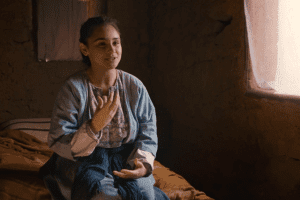
Monica Moore Smith who plays Julie Flinders.
Though co-creator Lex de Azevedo says this is an “extra-doctrinal” idea, this movie, which is essentially a modern version of the prodigal son, was difficult to create because it has been so beloved in its earlier form. How can you top it? It’s like remodeling your mother. It is almost too adored to touch.
One woman said at the premiere that she had watched the 1987 video version of the play nearly every Sunday growing up, and knew every song and every dance step.
In fact, de Azevedo said he has resisted making this movie for many decades, worried that it wouldn’t translate into film or meet the exaggerated expectations.

Lex de Azevedo
When de Azevedo had first created the show with Doug Stewart as writer, he was almost embarrassed at the response it was so huge. It had been meant only for a local performance, but ended up running for years with something like 130 performances in Salt Lake alone.
He said, “This play was first created when the Brady Bunch was on television.” The humor then was Hee Haw and the Carol Burnett show, something that wouldn’t play well to a generation reared with different sensibilities.
A film version that would appeal to today’s audience had to have its own personality without losing the elements that has made it a perennial icon. This is tricky stuff.

Alex Boye
When Alex Boye, who plays a sort of heavenly coordinator for earthly births, first learned he got the part, he told his wife and in-laws who seemed remarkably thrilled. Because he joined the church at 16 and grew up in England, he had only seen bits and pieces of the earlier show and had no idea the hallowed ground he had just entered until he saw their over-the-top response.
Kenny Holland, who plays the wandering son, Jimmy, also was unacquainted with the show. When he received an email about auditioning for the part, he thought the tryouts were on Saturday for a movie called Warrior.
They, who know so little about the show, are the few exceptions compared to so many who have been rooting for Todd and Julie to get together and Jimmy to come home for at least 40 years
First Decision: When Does This Happen?
The first thing that de Azevedo and Michael Buster, the film’s co-writer and director had to address was in what time frame this movie would take place. Would they abandon the early 70’s with its focus on zero population growth—something nobody much talks about these days?
They finally decided that a film that takes place during World War II or some other time frame still appeals to an audience. It is the story itself that must be timeless—and since this is essentially a prodigal son story, that message would play well in any time frame.

Kenny Holland
Holland, who won the lead role in a four-month audition, was recommended for the part by his mother when she saw an audition request on Facebook. Like Jimmy, he is a musician, but also like Jimmy he has had his prodigal leanings. He said, “The Jimmy character and I share a lot of common interests and experiences. To jump into that role was an interesting, difficult and exciting thing for me. I got to learn a lot about myself through the character.”
He is releasing an album on May 1, called Boats which means “based on a true story.”
Translating to Film
Translating a play from the 70’s to a film for today’s audience also means characters had to be rounded out, back story added, their black and white world nuanced with more gray. Jimmy has to find out what it means to hit rock bottom before you learn core truths. Todd is more than just some guy in the park who responds to Elders Kesler and Green. You see where he comes from and why he would be searching so hard for something more.
De Azevedo said they particularly tried to strengthen the women’s roles. In the stage play the mother had been one dimensional, and you didn’t know much more about her than that she was adept at producing babies. Here her backstory and sacrifice are highlighted.

Pam, in a wheel chair, is a symbol of pure faith and something more in the new film. According to Anna Daines, who plays the role, “We tried not to drastically change Pam, but make it more clear that when something hard happens to you, you have to consciously choose faith.”
Tone and Humor
Buster said that a key discussion for the creators centered on tone. If they were going to laser in on the dramatic elements could they keep the humor? They did, but it is not as broad as in the original, the slapstick is gone—except, perhaps, with the perennial favorites, the two elders who have such high expectations for what they are going to accomplish on their missions in the pre-mortal world and are smacked with reality on their mortal missions.
They come off as funny, sometimes disappointed and Kesler is hilariously and naively arrogant.
Buster said the creators also decided to avoid gimmicks in the show, except for a couple of nods to the past for those who have seen it for years. Those who have never seen the show will see this as standing alone with no need for past references. Those who have loved it for decades will recognize references in the new venue.
Listen for the name of the airline captain when a voice over the intercom speaks during the airport scene. Watch for the Piano Guys in a scene in the park.
While some music is cut from the original (Goodbye “Daddy’s Nose”), Lex has created some new songs, including the open sung by a flamboyant Alex Boye. The film does not start with the familiar Saturday’s Warrior song, “Who are these children coming down, coming down?” This was changed as they thought it started out the film on too ponderous a note, that it was taking itself too seriously.
With all the changes to the original (what the creators hope are improvements), de Azevedo believes it will still make audiences laugh and cry. He said he has had the people who loved the original in his mind the entire time during the creation of this new film.
His wish? That he had had a million more dollars to make the film but he says, “You can’t be perfect on any budget, but you can have magic on any budget.”
On the Set for Saturday’s Warrior

It is midnight and we are just arriving at Ogden, Utah’s Union Station, which has been transformed by the crew of Saturday’s Warrior to look like the pre-mortal world. That may sound like some fancy trick, but with lights glowing through white, sheer fabric, hung down from doorways, and a bit of camera magic, you can get the idea.
Wasn’t the pre-mortal world a bit like a train station anyway, with lots of people waiting to take the trip of a lifetime? At this late hour, the publicist had told us to go through the dark door and head toward the light, so we should have known right away, this would be a unique evening.

When you are shooting a movie and you can’t have random people in your shots, you have to do things like keep the cast and crew up all night to shoot in an emptied train station.

Alex Boye’, dressed in gold, right down to his gold shoes was acting as a sort of maitre’d’ of heaven, directing people where they should go. People everywhere wore white satin gowns having just emerged from singing in a heavenly choir.
And right in the center of this were Tod and Julie sitting on a bench. Yes, we had arrived just in time to see the iconic film scene that has changed the lives of a generation of Latter-day Saints, who since they saw this play have thought they, too, must have fallen in love in heaven.

For those who don’t remember, or for those who just don’t know, here’s the scene. Tod and Julie are in love and she’s about to leave for earth. She asks him if on earth he will date other girls, and he responds that he might because he won’t remember who she is, at which point she is miffed. How can he even consider dating someone else? Julie pouts and Tod tries to reassure her. How long have they loved each other, he asks. “Forever,” she acknowledges.

While the scene is filmed, we whisper in the back, behind the camera with Lex de Azevedo, one of the two originators of Saturday’s Warrior, and the producer of the film, and, of course, begin by asking him a pertinent question.

Meridian: So many people have been impacted by the idea, presented in Saturday’s Warrior, that they’ve made a romantic connection with someone in the pre-mortal world—and many hope that’s true. Doesn’t that actually plow new ground that isn’t doctrine?
Lex: This comes up every now and then. Saturday’s Warrior is a fantasy. This is not a Sunday School lesson. It is not an article in the Ensign. This is not a talk in General Conference. It has no pretense of being doctrine. It’s fantasy and it’s a musical comedy at that. It is out of the realm of doctrine.

Here’s something that people need to understand. It is what I call extra-doctrinal. There are things that are undoctrinal. These are things that directly conflict with the doctrine. But something extra-doctrinal is something that is outside of the doctrine. You could take everything we know about the pre-existence and you could put it in a tiny paragraph. So anyone who writes anything about the pre-existence, they are going to be exploring territory that is extra-doctrinal. But here is the irony of it.
Through the years I’ve had thousands of letters of people whose patriarchal blessings said they did choose each other in the pre-existence. Do we throw out all of these patriarchal blessings?
It is extra-doctrinal—and does it hurt anybody? No. If we were to say something undoctrinal, that would be different. To say that God wasn’t an anthropomorphic being, but is just a big spirit out there, that would actually be destructive to faith. But to say that we loved each other and cared for each other for eternity, does that hurt anything? How do you deal with all these patriarchal blessings?

Meridian: Orson Whitney did say, of course, we expect that the relationships that we build in this life we will take to the next life, and, of course, we expected that the relationships we built in the pre-mortal world would come with us here.
Lex: We’ve also had our Church leaders caution us that singles shouldn’t be waiting for the one and only.
Meridian: So you’ve had people hound you over the years to do a film version of Saturday’s Warrior. Why do it now?
Lex: Why do this now? For forty years I have resisted. I have had people through the years want to fund it and approached me about doing it, and I resisted, mostly because I didn’t know how to do it, nor did I think it could be done any better than it was done as a stage play.

Saturday’s Warrior is kind of hallowed ground. It is hallowed by the lives that it has changed and for 40 years hardly a week has passed when someone hasn’t come up to me and expressed with great emotion how it has changed their life.
I’ve always thought I’d rather let it rest in peace than do something less than it deserved.
Then, we were living in Brazil last year and we were on a “mission.” We had sold our house in Utah and we thought we’d be there for about three years. One night I heard a voice in the middle of the night. It prompted me and said, “Go home and make Saturday’s Warrior.”
What is the craziest thing is that my daughters two years ago had been pushing me to make it and I said, “No. It’s a stage play. Leave it alone.”
Then the next night I had this same strong prompting. We had just bought a car in Brazil, but I said to my wife, “Honey, I think we are supposed to go home and make Saturday’s Warrior.”
We came home, but I didn’t know how we were going to do it. Once I had finally made up my mind to move ahead with the project in successive nights I saw the whole show laid out before me and knew how we could do it. Now I am so excited because it will be better than the original stage play.
We’ve opened it up in a way. This movie is less about religion and church and more about people, and about the idea that there’s more to life than just what we see.

Meridian: What are the differences between this new film and the stage play that was so popular some time ago?
Lex: The problem with the video that was created from the play is that they filmed the stage play. That doesn’t work. Film is a different medium. When you go from one medium to another you have to adapt to the medium.
What we are doing is Saturday’s Warrior, but it is more complete. In the original stage play you didn’t know anything about the parents. Who was Mr. Flinders? Who was Mrs. Flinders? You didn’t know anything about Tod who was betrothed to Julie in the pre-earth life. They pledge their love in the pre-earth life and then he just shows up in the park.
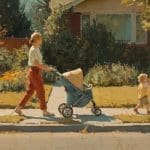
What we have been able to do in the film is flesh out these characters. We make it San Francisco in early 1972, hippies in the park and bell bottoms, long hair and the whole thing. That keeps the theme zero population meaningful, because the book The Population Bomb came out and that was a big issue. When you do a period piece you do it about the issues of the day. If you set a film in the thirties, your issue is prohibition. Prohibition is not an issue today, but you still enjoy the piece. The family is caught up in this zero population issue because they are a huge family.
In this new version of Saturday’s Warrior, Mr. Flinders had wanted to be a professor at Columbia in New York and she was a talented singer, dancer, and actress. She wanted to be on Broadway.
They had plans to go to New York when they got married, but what happened? His Dad got sick, then they had twins, and then life happened, and he ends up as a music teacher in a small town.
So he has this big family and they have a family act like the Osmonds or the Partridge Family, but their oldest son, Jimmy, is a highly gifted singer/songwriter/guitar player. Think Jim Morrison of the Doors. Along with playing with his family band, he’s also in a counter-culture band like the Grateful Dead or the Doors.

He and the band write a song called “Zero Population” which zooms to number one on the charts, launching the band to be the top band in the United States and just devastating the family. It affects their livelihood because he was kind of the Michael Jackson of the Jackson Five or Diana Ross of the Supremes. So you have that conflict and then you have that he would write this song.

The other thing we do is give Tod a back story. We see Tod’s life when he sings “Paper Dreams.” When he comes to earth he is born in a trailer to an abusive father, alcoholic mother. The kid gets beat up by bullies. He wonders, “Who am I? Just a wandering kid, a cypher on the wall, not really brave at all.”
In the song we see him as a teen, picks his Mom up and puts her in bed, kisses her, picks up his knapsack and leaves home to see the world. He goes to India looking for truth, hoping to find a guru, he goes to the Big Sur area in northern California. He is a seeker of truth and an artist and he ends up in San Francisco, Golden Gate Park where he runs into the missionaries. We now know who these characters are and we care more about them. That’s the big difference and we’ve set it in a musical setting. It is a musical family with their own band. Jimmy is in a group called Warrior.
Meridian: How is the music different from the original?
Nobody has ever heard the music to Saturday’s Warrior that I envisioned. The reason being what became the original stage play was a stake production which we did in LA and I did a demo recording for the cast and choir—just me on piano, drums and bass and the thing took off and we couldn’t stop it and that is what people think the music is.
Now they’ll hear the music with orchestra, the rock songs they’ll hear with guitars, fully fleshed out. I have deleted several songs and there are four new ones in the show. It is still very much Saturday’s Warrior, but it is much more meaningful to us today.
Meridian: With trepidation I ask, what are the deleted songs?
If I tell you I am liable to get hate mail. One of them is “Daddy’s Nose.” There’s a nod to Daddy’s nose when Mr. Flinders is having rehearsal with the family he comes out and says I’ve got this great idea for a comedy song in our family act. He puts on his glasses and big nose and he says, “It’s come to me. We’ve all got Daddy’s nose and the gag is ‘even Mom’s got it.’” The kids look at their Dad and say “That is the worst idea I’ve ever heard in my life.” That’s how we deal with it and then we throw it out.
Meridian: Tell me about the songs you’ve added.

We’ve added an opening number for Alex Boye who is in charge of this little part of the pre-mortal world. We’ve added a song called “In the Blink of an Eye”. He is the new heavenly maître d’. As he ushers people to earth, he sings life is just a blink of an eye. “Whether you’re short or tall or big or small, your neighbor’s hot, but your man is not, make the best of what you’ve got.” It’s this big gospel number.
We wrote an extra number for Tod to sing in the park. It’s called “There’s Got to Be More to Life than Just What We See”. There’s a number we wrote for Jimmy’s band—kind of a 70’s rock number, and then we’re considering putting in a final concert number for Jimmy after he’s changed his life. It’s the story of the Prodigal Son basically and he comes back home.
This is a few years later and you see him cleaned up, a new Jimmy. He is no longer with his counter-culture rock group. He’s more like a Billy Joel, and he is at the piano singing more of a dignified song.
Meridian: Will this have interest beyond the Mormon community?
Lex: We hope it will. We have made it less churchy, less religious, although it is set with an LDS family. “Fiddler on the Roof” is a Jewish story, but it’s for everybody and “Schindler’s List” is for everybody and “Witness” was set in Amish community. It’s more about there’s just more to life than just this life. It is less preachy, less in your face than the original Saturday’s Warrior.
Meridian: So when does this come out?
Lex: It’s going to come out in spring of 2016.
Meridian: How are you doing on the distribution?
We have a distribution and we’re ready to go. We won’t hit with a national distribution at first. We will launch it locally in Utah first and build up to big box offices and then take it city by city after that.
Meridian: Any signature touches in the show?
Lex: We thought it would be funny if during the park scene, there were two guys playing checkers and they were Senator Orrin Hatch and Senator Harry Reid. Hatch said yes and Reid said no—and they always say its Republicans who have no sense of humor. Governor Herbert came up to do a scene with us. We even thought it would be fun during the airport scene to have a gray-haired President Uchtdorf look-alike rush down the hall as they are calling for the pilot. We’re having fun with this show.

What’s next on the docket for Lex de Azevedo?
I started doing some comtempoary classic oratorios. Many people are familiar with “Gloria” on the birth of Christ that was shot in Israel with a Jerusalem Symphony and aired on PBS stations. I did “Hosanna”, the last days of the life of Christ and I am writing “Alleluia” about the teachings of Christ. In the area of film, Carol Lynn Pearson and I have written a musical about a young girl with a religious background who comes in second place in the American Idol because she refuses to sing the song that would have won her first place. It is a cute story.
We are also talking about doing “My Turn on Earth” as a motion picture.
Here is a list of the cast and crew for the production:
CREW
Executive Producers–Lex de Azevedo, Emilie de Azevedo Brown, Rachel de Azevedo Coleman
Composer–Lex de Azevedo
Based on Stage Musical by–Lex de Azevedo, Doug Stewart
Movie Rewrite–Lex de Azevedo, Michael Buster, Heather Ravarino
Director–Michael Buster
Director of Photography–Mike Schaertl
Producer–Jarrod Phillips
Associate Producer–Heather Ravarino
Choreographer–Bonnie Story
Wardrobe Designer–Jennifer “Iffer” Mitchell
CAST
Jimmy–Kenny Holland
Heavenly Guide–Alex Boye’
Pam–Anna Daines
Julie–Monica Moore Smith
Tod–Mason Davis
Adam–Brian Clark
Terri–Alison Clark
Elder Kestler–Clinton Pulver
Elder Greene–Morgan Gunter
Mack–Carleton Bluford
Donna–Kassandra Haddock
Shelley–Bailee Johnson
Alice–Caroline Labrum
Benjy–Ethan Mouser
Ernie–Jacob Buster
Emily–Abigail Baugh
Peter–James Bounous
Saturday’s Warrior 2016: The Story behind the new Big-Screen Movie

 “Do you even want all of these kids?” the clerk asked, as he stared at the young family.
The year was 1973, and composer Lex de Azevedo stood in line at a grocery store in Los Angeles. As the successful Music Director of the hit TV show, The Sonny & Cher Comedy Hour, he was no stranger to the mood and culture of the times. Having been raised in Southern California and lived there for most of his life, he was very much at home. However, this cavalier comment from a grocery store clerk took him aback.
He thought to himself: “Do we even want our children? How could you even ask such a question? These children are a gift from God. They are part of His plan!”
In that moment, the idea for Saturday’s Warrior was born.
As Lex witnessed the growing chasm between his LDS beliefs about life’s meaning, and the changing beliefs of the culture around him, he was troubled. For instance, the world’s answer at that time to many social problems was simply to limit the number of births, or as it was called, “zero population.” Lex, however, believed that the answer was not to limit the number of children coming to this world, but to understand why they were coming, and the purpose behind life. People needed to know that life began in a pre-mortal world. Families were an indispensable part of the Plan.
It wasn’t long before Lex began writing songs with lyricist Doug Stewart for a musical. Maybe, they thought, it would be something Ricks College would consider putting on for a few nights. Little did they know . . .
In 1974, the live stage musical of Saturday’s Warrior began. In Salt Lake City, there were 246 consecutive sold-out shows. In Los Angeles, audiences flocked to fill the huge civic auditoriums night after night. In Phoenix, Saturday’s Warrior sold more tickets in two hours than Elton John sold in two weeks. It was an LDS cultural phenomenon unlike anything that anyone had ever seen.
The musical was about a fictional Mormon family with a rebellious teenage son, and it struck a chord with audiences everywhere–Mormon or not. Thousands of Mormons brought their non-Mormon friends to the show as if to say: This is who we are. This is what we believe. This is how we feel.
Why the name “Saturday’s Warrior?” It was based on the idea that some of the most obedient, noble and valiant spirits in the pre-mortal world—the Lord’s warriors—were reserved to be born on earth in these latter days: the earth’s “Saturday” before Christ returns in glory on “Sunday.”
 Saturday’s Warrior was light-hearted and funny at some times, gut-wrenching at others. It explored the doctrines of pre-mortal existence, eternal marriage, and the divine plan of happiness in a way that audiences loved. The music was contemporary, captivating, and heart-warming; people couldn’t stop singing it. Some scenes were serious: parents aching over the faith-crisis of their teenage son. Some were more tongue-in-cheek: playful sequences about how pre-mortal life might have looked. But ultimately, it resonated with people in a profound way, as if to reinforce their belief that there is more to this life than just this life.
When he was writing it, Lex wondered if people would come. Come they did, and for years. After several years of record-breaking attendances at theaters, another production company released their version of Saturday’s Warrior on VHS. This video of a staged performance introduced the Saturday’s Warrior music and message to another generation of LDS youth. For many, this is their only exposure to Saturday’s Warrior.
Over 40 years have passed since the debut of Saturday’s Warrior on the stage, and yet, scarcely a week goes by that someone doesn’t seek out Lex to tearfully tell him that it changed their life, or the life of someone near them. Many have even told Lex that they were born because their parents saw Saturday’s Warrior!
For many years, people have also asked Lex why he has not produced a film version of Saturday’s Warrior. It’s not that the opportunity never arose. After all, thousands of people have encouraged him to do it, including investors who have even offered financing. However, Lex never felt entirely comfortable with the idea of a film version for several reasons.
First, Saturday’s Warrior’s plot and story construction had been designed for the stage, and the characters largely were products of their time. Second, he felt that Saturday’s Warrior was a sort of “hallowed ground” because of all the lives it had changed. As such, perhaps it was a legacy best left alone. Third, if it were to be resurrected as a movie, it would have to been done right—with exceptionally good quality with a global distribution—and that would be very time-consuming and expensive.
However, last year, one morning he woke up with an impression. Even though he had resisted doing so for many years, he felt strongly that the time was now. The film of Saturday’s Warrior needed to be made. His initial reaction to that feeling was a resurrection of so many feelings that he had felt before: it simply couldn’t be done. Though he had tried to visualize what a film version would look like for many years, he had always ended up deciding against it. However, this time things were different.
Not long thereafter, Lex awoke with another idea: the solution for restructuring the plot so it would work perfectly as a movie. Rather quickly, everything began coming together, and Lex couldn’t help feeling that, after 40 years, the time was now right. He began preparations for the screenwriting and production process.
Today, less than a year later, the new script is all but finalized. Auditions and casting are almost complete. New songs have been written and recorded. Wardrobe and sets are being secured. A “dream team” production crew has been hired, including director Michael Buster. Purdie Distribution is now involved, the same company that distributed Meet the Mormons. News outlets are picking up the story. After 40 years, it is happening.
For Lex and countless fans, the time is right. It is time to make a new Saturday’s Warrior for a new generation, to bring back the magic of the beloved stage musical–and take it to the world. Not as a stage musical, but a big screen movie, complete with a live-orchestra sound track, celebrities, and technology that no one could have ever dreamed of in 1974.
Where will the money come from to make the movie all it can be—and to ensure that it has an impact like it did 40 years ago? Part of it will come from the multitude of eager fans of the original musical. The funding effort will be designed around letting fans be a part of the movie project and production, with “insider” information and involvement.
 There’s a lot of excitement and speculation about the cast. Several celebrities are planning to be in the film, contingent only on the shooting schedule working with their existing obligations. Fans who are part of the fundraising campaign will be the first to know who the celebrity cast members will be. Some fans will get promotional rewards, like tickets to a premiere. Some will even be able to be in the movie!
In one very significant way, history will have to repeat itself for the movie to “go global.” Going global will take tens of thousands of people willing to share the fundraising campaign on social media—much like Mormons shared the original musical with their friends decades ago. Fans will be invited to be “Saturday’s Warriors” and do just that with this slogan: “The 1970s musical changed thousands of lives. Let’s change millions!”
Lex and his team of filmmakers firmly believe that Mormons will share Saturday’s Warrior’s message once again, and in an even more powerful way than they did 40 years ago. Why? Because the world needs to know, now more than ever, that there’s more to life than just this life.
Go to https://saturdayswarrior.com for information on how to be part of Saturday’s Warrior – The Motion Picture, Coming in 2016.
FEATURES