



Picture This—One Very Significant Gate in Old Jerusalem

If you have been to Jerusalem, you may already know that there are eight gates into the Old City. They each have names and a history—going clockwise from the southeast: Dung Gate, Zion Gate, Jaffa Gate, New Gate, Damascus Gate, Herod’s Gate, Lions’ Gate and Golden Gate (or Mercy Gate). But one of these gates has been sealed for 483 years and is the most significant of them all. Let’s take a look.

We have walked and taken our tours through every one of the gates of Jerusalem many times—except one. But let’s start with the ones we do go through.
First of all, the ancient walled city of Jerusalem is quite small, only .35 square miles (0.9 square kilometers) or just under 300 acres. The city is divided into four distinct quarters: The Christian Quarter, the Muslim Quarter, The Jewish Quarter and The Armenian Quarter.
The current wall with all the gates that you see today is not very old, only built just under 500 years ago by Suleiman the Magnificent. The walls of Jerusalem that Nephi knew were built by Hezekiah in the late 8th century B.C. (more than 27 centuries ago) and were 23 feet thick (7 meters) and more than 26 feet high (8 meters). Parts of that wall still remain and can be seen by tourists if you know where to look (we love going there).

We most often access the city through the Dung Gate. This leads us directly to the queue for people who want to go up onto the temple mount. It also is the fastest and easiest way to get to the Western Wall or the Wailing Wall as some call it. Originally known as the Maghrebi Gate, in the 19th century, Zionists began to refer to the gate as Sha’Ar Ha’ashpot or The Dung Gate. This was done to reference the ancient gate in the Jerusalem Wall where the residue was taken from the Jewish Temple to the Hinom Valley where it was burned.

To get into the Jewish Quarter and to take people to our dear friend, Joseph Zanbil, who has the most amazing stories and is licensed to sell antiquities, we go through the Zion Gate. Look closely at the stones there and you will see them pocked with bullet holes and machine gun fire from the Six Day War in 1967. Amazingly, cars can go through this gate but only one at a time. Maurine and I have driven a rental car through here and had to do a little forward and reverse maneuvering to get through. We always tell our groups to be careful as we walk through this gate—to look for cars trying to hurry their way through the tight passageway.
The Zion Gate was built in July 1540 just west of the location of the old medieval gate. This has been a continuation of the Cardo (the heart of the city) or the Street of the Jews. It is mostly accessed by tourists and residents of the Old City today.

Coming around clockwise beyond the Zion Gate we come to the Jaffa Gate (I took this photo looking south while standing in the Jaffa Gate), the ancient gate that led to the road to Jaffa or Joppa—yes, the same place on the sea where Simon the Tanner lived and the Apostle Peter met the men who had been sent from Caesarea by Cornelius (see Acts chapter 10) AND from where the ancient Prophet Jonah left of his sea journey that turned out to be a whale of a mission (see Jonah 1:1-17)!
I do love the name of the Jaffa Gate in Arabic: Bab el-Khalil, which translates as “Gate of the Friend” and refers directly to Abraham, “the beloved of God.” Abraham is known among the Arabs and the Turks as “the friend.” I knew that from my years living in Turkey.
Next, we come to the New Gate, which wasn’t cut into the wall until 1889 and was placed here to allow access from the Christian Quarter to the new neighborhoods that were being built outside the wall. We seldom use this gate as tourists. This gate is placed at the highest elevation of the current wall which is 2,590 feet above sea level (790 meters).
 The largest gate in the current wall is the Damascus Gate. It is especially significant because not far outside this part of the wall is where most Protestants and Latter-day Saints feel Golgotha and the Garden Tomb are located. The actual gate where Jesus would have entered or exited this part of the city is located about 20 vertical feet below where tourists and citizen enter today and can be seen when you walk near the gate and then look off below and to your left.

This gate is the entrance to the very busy part of the Muslim Quarter where locals do their daily shopping for produce, groceries and normal needs like shoes, clothing and, well, lots of candy—especially licorice. We know these things. This massive gate was the way that led to the main road to Damascus, Syria and is extremely trafficked and busy to this day. The ramparts at the top of the wall provide a wonderful walk for tourists around a good portion of the city with views that can be seen from no other angle.
The next gate is the Herod Gate (sometimes spelled Harod Gate). It is a small entrance into a residential section of the Muslim Quarter. Though we have used it occasionally, most often we do not take our tours through this. One of the most interesting things about this area is Solomon’s Quarries or Zedekiah’s Cave, a 5-acre (20,000 square meters) underground limestone quarry located under the Muslim Quarter and accessed near this gate. It has been carved over a period of thousands of years and is a remnant of the largest quarry in Jerusalem.
Some call Herod’s Gate the Flower Gate, from the Arabic Bab al-Zahra. This is likely a mis-pronunciation of the nearby cemetery al-Sahira which means the sleepwalkers. Many believe those buried in this cemetery will be the first to rise in the resurrection.
 The seventh gate (going clockwise) is the Lions’ Gate, named that because of two carved lions at the top of the gate on the wall, but more traditionally known as St. Stephen’s Gate because Stephen was stoned to death near this part of the wall.
How did those lions get carved into the wall? By legend, Suleiman the Magnificent had a dream in which he was devoured by wild beasts for failing to rebuild the walls of Jerusalem so he promptly applied himself to the enormous task and marked this motivation by having the lions carved into the façade.

Wait, I mentioned that one of the gates was sealed. Yes, it’s the last one—the Gate Golden, or the Mercy Gate. This is a beautiful gate (shown above with the two arches), the only one on the eastern part of the current wall of Jerusalem. This is the gate through which Jesus made His triumphal entry into the city.
 At the time of Jesus, the Gate Golden or Mercy Gate may have looked like this model shown above. It was the entrance from the Mount of Olives and was the closest path to the temple.

This is the oldest gate of Jerusalem. Parts of the gate date to five different periods: the time of Hezekiah, Zerubbabel, the Hasmonean period, the Herodian period and then to the Ottomans. The gate Jesus would have entered into has been discovered and is about fifteen or eighteen feet below what we observe.

So why is this sealed?
The gate was closed by Muslims in 810 then reopened by the Crusaders in 1102. It was walled up again by Saladin in 1187 but fell into disrepair. Suleiman the Magnificent ruled the Ottoman Empire for 46 years, longer than any other ruler (1520-1566) and he had it carefully walled up in 1541 and it has remained that way.
Some say Suleiman may have made this move purely for defensive reasons, but in Jewish tradition, this is the gate through which the Anointed One—the Messiah will enter Jerusalem. The Ottomans not only wanted to block the Messiah by sealing the gate, but they built a large cemetery in front of it as a second defense against a Messiah. The tradition was that a Jewish priest or kohen could not enter a cemetery and therefore would be blocked from coming this way.
Here’s what we know as Latter-day Saints from a prophet of God who recently gave us these words:
“My dear brothers and sisters, in a coming day, Jesus Christ will return to the earth as the millennial Messiah. So today I call upon you to rededicate your lives to Jesus Christ. I call upon you to help gather scattered Israel and to prepare the world for the Second Coming of the Lord. I call upon you to talk of Christ, testify of Christ, have faith in Christ, and rejoice in Christ!”[i]
Sealed gate or not, Jesus will return! And we know it!
And now, you can picture this.
[i] Nelson, Russell M. The Lord Jesus Christ Will Come Again, General Conference, October 2024.
Picture This—The Immovable Ladder of Christianity’s Holiest Site

Nearly all Christian tourists who visit Jerusalem make the center of their pilgrimage the Church of the Holy Sepulchre. Approximately 1.3 billion Catholics consider this the holiest of Christian sites. This 4th century church is built over what many consider Calvary’s Hill and the Tomb where Jesus’ body was laid. Now, they say it’s bad luck to walk under a ladder—let’s take that superstition to the extreme.

The Church of the Holy Sepulchre in Jerusalem, one of Christianity’s holiest sites, where millions visit Calvary’s Hill and Jesus’ tomb each year.
The Church of the Holy Sepulchre was first constructed under the encouragement and direction of Queen Helena, mother of Constantine, in the 4th Century. Though little of that original building remains, it is still an extremely historic and significant site. When Helena made her pilgrimage to the Holy Land, she was determined to find all the holy sites, including the birthplace of Jesus, the Hill Golgotha, and any of the sites connected to Mary, the mother of Jesus.
Helena is reputed by some at that time to be the one who discovered the “true cross of Jesus,” though it had been 300 years since the crucifixion. The Church of the Holy Sepulchre was built over the supposed holy sites of the crucifixion and the tomb where Jesus body was laid by Joseph of Arimathea. Helena died in the year 330 AD in Constantinople. Her legacy was to create traditional holy sites so that millions of people could come and walk in the footsteps of Jesus. She was also creating an economic model for these pilgrimage sites.
Over the centuries, care over the church itself has been shared and is shared to this day by no less than six denominations. The primary custodians are the Greek Orthodox, Armenian Apostolic, and Roman Catholic Church with minor or lesser duties shared by the Coptic, Ethiopian, and Syriac Orthodox churches. The whole edifice is parceled into sections, some being commonly shared while other belonging strictly to another sect.

The ancient door of the Church of the Holy Sepulchre, locked and unlocked daily by the Muslim Neseibeh family since the 7th century.
The key to the door of the church has been in the hands of the Muslim Neseibeh family since the seventh century. Every morning and night, a member of that family comes, as Muslims and neighbors, to lock and unlock the ancient doors of the church. Everyone gets along with the holders of the large keys to the door, but there is tension over much of the rest of the care and ownership of the church.
Once a man was sitting in his chair on his sect’s side of the line in contemplation and study. As the sun grew hot and he was not in the shade, he moved his chair just 20 cm (less than 8 inches) to get in some shade and his chair crossed a line and a major fight erupted with eleven people ending up in the hospital from the physical blows.
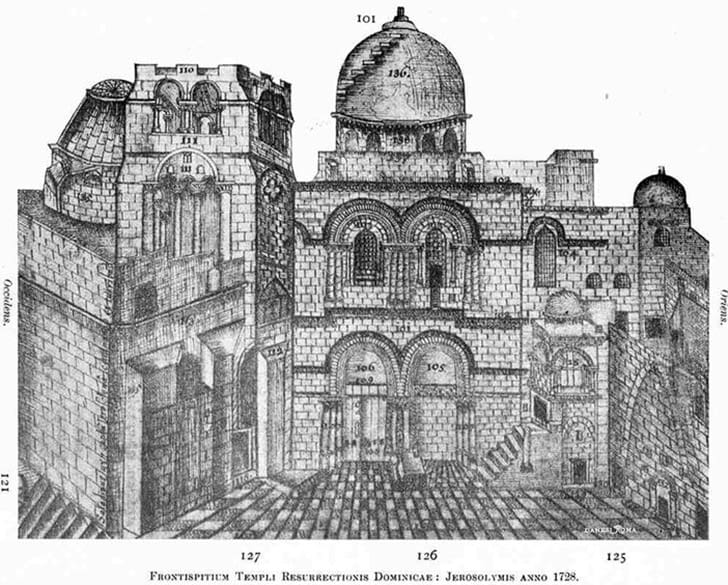
One controversy has become almost comical (unless you are a priest or a member of one of the resident caretaker sects of the church). Sometime before 1728, a ladder was placed against the right window on the second tier of the façade of the Church of the Holy Sepulchre, perhaps to clean the windows or work on a windowsill or do some other small repair. We don’t know. We know the approximate placement of the ladder because of the above engraving by Elzéar Horn, marked and dated 1728.

The ladder rests on a ledge and is attached to a window owned by the Armenian Apostolic Church. No one can come or has come to agreement as to who can even touch, let alone move this now immovable ladder.

So, the ladder has remained in place for nearly 300 years, and millions of people have walked under it, most of whom never even knew it was there.
And now you can picture this.
FEATURES