





Protecting the Symbols of Christ’s Church: How a Trademark Lawsuit Aligns with Prophetic Guidance
On April 17, 2026, The Church of Jesus Christ of Latter-day Saints filed a lawsuit claiming to have a legal interest in various design elements associated with Church publications, as well as the word “Mormon.” The case was filed against the Open Stories Foundation and John Dehlin, host of the Mormon Stories podcast.
This move has reminded many of us of the 2018 General Conference address by President Russell M. Nelson in which he discouraged using the word “Mormon” to refer to the Church and declared: “To remove the Lord’s name from the Lord’s Church is a major victory for Satan.” Some have wondered whether this new lawsuit contradicts President Nelson’s prophetic emphasis on using the Church’s revealed name rather than calling it the “Mormon Church.”
However, when we look carefully at the history, the prophetic counsel, and even the legal realities, a different picture emerges. The Church’s actions are not only consistent with prophetic teaching but also a natural extension of it.
The Prophetic Foundation: Nearly 50 Years of Consistent Teaching
Long before President Nelson’s 2018 address, Church leaders have been emphasizing the importance of using the correct name of the Church.
1979, President Marion G. Romney: “We, The Church of Jesus Christ of Latter-day Saints”
President Romney acknowledged that the nickname Mormon is associated with the Church and its members, but that the Lord Himself declared in Doctrine and Covenants 115:4 that the proper name of the Church is The Church of Jesus Christ of Latter-day Saints. The name carries identity, mission, and divine ownership.
1990, Elder Russell M. Nelson: “Thus Shall My Church Be Called”
Elder Nelson emphasized that removing the Savior’s name from the Church diminishes its identity and obscures its purpose. He warned that nicknames, even well-intentioned ones, can shift focus away from Christ. He reminded us of a 1982 instruction against using a nickname to refer to the Church: “We feel that some may be misled by the too frequent use of the term ‘Mormon Church’” (Member-Missionary Class, Instructor’s Guide [Salt Lake City: The Church of Jesus Christ of Latter-day Saints, 1982], p. 2).
1990, President Gordon B. Hinckley: “Mormon Should Mean ‘More Good’”
Just six months later, President Hinckley referenced the “excellent address on the correct name of the Church” delivered by Russell M. Nelson and said, “I commend to you a rereading of his talk.” President Hinckley then acknowledged the widespread use of the nickname Mormon. “I suppose that regardless of our efforts, we may never convert the world to general use of the full and correct name of the Church. Because of the shortness of the word Mormon and the ease with which it is spoken and written, they will continue to call us the Mormons, the Mormon Church, and so forth.”
He then encouraged members to live so that the name Mormon would be associated with goodness. This was an acknowledgement that the word Mormon is part of the “brand” of the Church. Like a logo, symbol, or trademark of a popular company, such as Apple, Nike, or Coca-Cola, the word Mormon is associated with The Church of Jesus Christ of Latter-day Saints and its members.
President Hinckley, therefore, urged members to protect that brand by being good examples to the world so that when people hear the word Mormon, they would associate the Church and its members with the idea of “more good.”
2010, Elder Russell M. Nelson: “Be Thou an Example of the Believers”
Many of us still remember that in 2001, the Church launched the mormon.org website, and that in 2010, it included a feature allowing members of the Church to post their profiles and testimonies of the Church. In October 2010 General Conference, Elder Nelson encouraged people to “invite friends and neighbors to visit the new mormon.org website.” He also said, “If you have blogs and online social networks, you could link your sites to mormon.org. And there you can create your own personal profile.”
Many of us still remember how in 2011, the Church launched the “I’m a Mormon” campaign, which featured members of the Church sharing stories about their lives and their faith. However, while members of the Church were identified by the nickname, “Mormons,” the Church was also careful to link the nickname to the full name of The Church of Jesus Christ of Latter-day Saints.
2011, President Boyd K. Packer: “Guided by the Holy Spirit”
For example, shortly before the launch of the “I’m a Mormon” campaign, President Packer acknowledged that the word Mormon is associated with the Church and its members: “Because of the Book of Mormon, we are frequently called the Mormon Church, a title we do not resent, but it is really not accurate.”
2011, Elder M. Russell Ballard: “The Importance of a Name”
Shortly after the launch of the “I’m a Mormon” campaign, Elder Ballard taught that names shape identity and covenant belonging. He urged members to use the full name of the Church whenever possible.
2018, President Russell M. Nelson: “The Correct Name of the Church”
In a renewed effort to encourage the use of the correct name of the Church, the Church discontinued the use of Mormon.org, and President Nelson gave his now-famous address regarding the correct name of the Church. His statement was clear: “To remove the Lord’s name from the Lord’s Church is a major victory for Satan.”
However, his emphasis was not on policing casual conversation on abandoning prior trademarks or brands associated with the Church, but on ensuring that the Church’s official identity—its name, its voice, its symbols—remain centered on Jesus Christ. Since the time the Lord Himself declared the official name of the Church in Doctrine and Covenants 115:4, the message has been consistent: The name of the Church is sacred. Protecting it is a matter of discipleship.
Why the Church Still Protects the Word “Mormon”
At first glance, it may seem contradictory for the Church to discourage the nickname “Mormon” to refer to the name of the Church while simultaneously defending the word “Mormon” in court. But legally and doctrinally, these two actions serve the same purpose: protecting the identity of the Church of Jesus Christ.
1. The Church has used “Mormon” as a trademark for nearly 200 years
When President Nelson was asked about his request that people use the correct name of the Church, and not call it the “Mormon Church,” he added that “We have to be careful to protect the name Mormon.” He elaborated by saying that the Church is not “tossing it out.” Rather, “We just want to be accurate.”
In this regard, the recent Complaint explains: “Plaintiffs have continuously used in commerce marks incorporating the term MORMON for nearly 200 years.” (Complaint, ¶15.) This includes not only the word Mormon, but also:
- Book of Mormon
- Book of Mormon Stories
- Mormon Battalion
- Mormon Handicraft
- Mormon Tabernacle Choir
- Mormon Messages
- Mormon Channel
These uses created a family of marks strongly associated with the Church. In fact, the Church owns U.S. trademark registrations for each of these words, including the word “Mormon.” (Complaint, ¶ 28.)
2. Trademark law requires the Church to defend its marks
If the Church does not protect its trademarks, including those containing the word Mormon, it risks losing exclusive rights to them. That would allow anyone to use the term in ways that imply Church endorsement or authority.
3. The Church clarified this publicly
In its Newsroom article “Getting It Right: Clarifying Trademark and Branding Concerns,” the Church explained that protecting trademarks is a legal responsibility. The Church must prevent confusion about what is and is not an official Church product or message.
In other words, the Church is not promoting the nickname Mormon. It is protecting its identity.
Why the 2026 Lawsuit Was Filed
The Complaint alleges that the defendants’ use of the name “Mormon Stories” and their adoption of a logo designed in a way that resembles the Church’s own light rays and Christus-centered imagery creates confusion about whether the podcast is affiliated with the Church.
The Complaint states that the defendants’ branding “has caused and will continue to cause individuals to be confused and access Defendants’ content mistakenly believing it comes from or is affiliated with or endorsed by the Church.” (Complaint, ¶1.)
As evidence of this confusion, the Complaint quotes numerous comments posted to the Mormon Stories Facebook and YouTube pages. For example, one person wrote, “Hi I’m confused r u for or against the mormon church.” Another added, “I subscribed to his channel immediately thinking it was church affiliated. Very purposefully deceptive.” Also, “Just last year a new convert in my ward went on to Mormon Stories, not realizing it was anti and got caught up in it. I was able to talk to her about it and she realized what was going on.” (Complaint, ¶54.)
The Complaint further notes that the defendants declined to include a simple disclaimer clarifying that their podcast is not affiliated with the Church and, after agreeing to cease using copyrighted images, “used a copyrighted image of a Church temple to advertise a podcast episode.” (Complaint, ¶2.)
Crucially, the Church emphasizes: “The Church does not seek, in any way, to influence the content of Defendants’ podcast.” (Complaint, ¶3.) This is not about silencing criticism. It is not about controlling speech. It is not about suppressing ideas. It is about preventing confusion. It is about protecting sacred symbols. It is about preserving the identity of the Church of Jesus Christ.
The Sacred Weight of Symbols: Why Protecting Trademarks Protects the Name of Christ
An organization’s brand consists of tangible and intangible elements that can affect the sense of familiarity and trust people have in the organization. This can include visual elements, such as a logo, color, or font, or things we don’t see, such as the values, purpose, and mission of the organization. These elements work together so that when you see the familiar logo, typeface, and colors of a company you trust, you can feel confident that you know what you are getting when you walk into the store or place an order online from that company.
An organization’s brand is so valuable that our laws provide it with legal protection. Many well‑known companies have gone to court to protect the colors, shapes, and text of their logos because, in trademark law, these visual elements function as powerful identifiers of the source. Think of the Disney typeface, the brown color of UPS trucks, or the McDonald’s golden arches. As these design elements become associated with an organization, the law treats them as part of the company’s identity. If another business adopts a similar look, even unintentionally, consumers may assume a connection that doesn’t exist. For that reason, companies are not only allowed but often required to defend these visual marks or risk losing exclusive rights to them.
Trademark law holds that if you do not defend a mark, you lose it. However, protecting a brand is not just about protecting your legal rights or crushing your competition; it’s about preventing confusion and preserving the integrity of what that symbol represents.
Similarly, in religious worship, symbols are not merely decorative. They are declarations of identity. The scriptures teach that the Lord’s people have always been marked, sealed, or set apart by sacred signs: The blood on the doorposts at Passover, the priestly garments of ancient Israel, the menorah, and the emblems of the sacrament, among many others. These outward symbols point to inward values, beliefs, and commitments.
The Church’s modern symbols function in much the same way. From the Christus statue to the light‑rays motif in various logos. These symbols are visual testimonies of what we believe, who we are, and whose Church this is. This is why protecting trademarks is not just about corporate image management. It is about safeguarding the sacred identity of the Church itself. When a symbol represents the Church, it represents the name of Christ. And when that symbol is misused, misappropriated, or imitated in ways that cause confusion, the name of Christ is obscured.
The 2026 Complaint makes this point clear. The Church alleges that the defendants adopted a logo “calculated to imitate the Church’s logos”, including the light‑rays design, colors, and font that has become widely associated with official Church materials. The concern is not aesthetic similarity. It is spiritual confusion. When a symbol that represents the Church is used in a context the Church did not authorize, the public may reasonably, but incorrectly, assume that the message is the Church’s message.
President Nelson’s 2018 teaching that removing the Savior’s name from the Church is “a major victory for Satan” applies not only to the official name of the Church, but to the misuse of the symbols we trust that are associated with the Church, such
as the logos, fonts, and even the word “Mormon.” If the Church’s identifiers can be replicated freely, then anyone can speak in the Church’s voice, borrow its authority, or cloak their message in its familiar and trusted imagery.
Protecting the colors, typeface, images, and even nicknames associated with the Church is therefore not a contradiction of prophetic counsel. It is a fulfillment of it. It is one more way the Church ensures that when people encounter its symbols, they encounter the teachings and authority of Jesus Christ, not a counterfeit, not a confusion, not a competing voice. In a world of noise, clarity is a form of discipleship.
The Larger Principle: Clarity in a Confusing World
In a world overflowing with voices, some faithful, some critical, some misleading, the Church has a responsibility to ensure that members and seekers can: “identify, recognize, and trust materials created or authorized by the Church.” (Complaint, ¶4.) This is not merely a legal concern. It is a spiritual one. When the identity of the Church becomes blurred, the identity of Christ becomes blurred. When the voice of the Church becomes confused with other voices, the voice of Christ becomes harder to hear. Protecting trademarks is simply one way the Church protects the clarity of its witness.
A Call to Clarity
Legal disputes can easily become sources of division, misunderstanding, or suspicion. Disciples of Christ are invited to:
- Seek understanding before judgment
- Value clarity over confusion
- Honor the name of Christ in all we do
- Avoid contention, and
- Remember that the Church’s identity is not just a brand. It represents sacred covenants
As explained in the Church press release regarding the suit, “In November 2025, the Church contacted Open Stories Foundation privately about concerns with its branding. The goal was to resolve the matter privately and amicably. The Church then engaged in good-faith mediation and proposed several options to reduce confusion while minimizing disruption.
When those efforts did not result in resolution, the Church filed a complaint in federal court to protect its intellectual property.” The Church’s efforts to protect its name, its symbols, and its trademarks are ultimately efforts to protect the name of Jesus Christ, which stands at the center of our faith.
Conclusion: The Name and Symbols We Bear
When we were baptized, we took upon ourselves the name of Jesus Christ. When we partake of the sacrament, we renew that covenant. When we speak of His Church, we speak of His name. Protecting the symbols associated with that name legally, doctrinally, and spiritually is not a contradiction. It is a sacred stewardship.
The Church’s recent legal actions, far from conflicting with prophetic teaching, reflect nearly fifty years of consistent counsel: Honor the name the Lord has given His Church. Protect it. Defend it. Cherish it. This includes the symbols that represent His name and His Church. For in doing so, we honor Him whose name it bears.
What a New Analytic Tool Tells us about President Nelson’s Talks
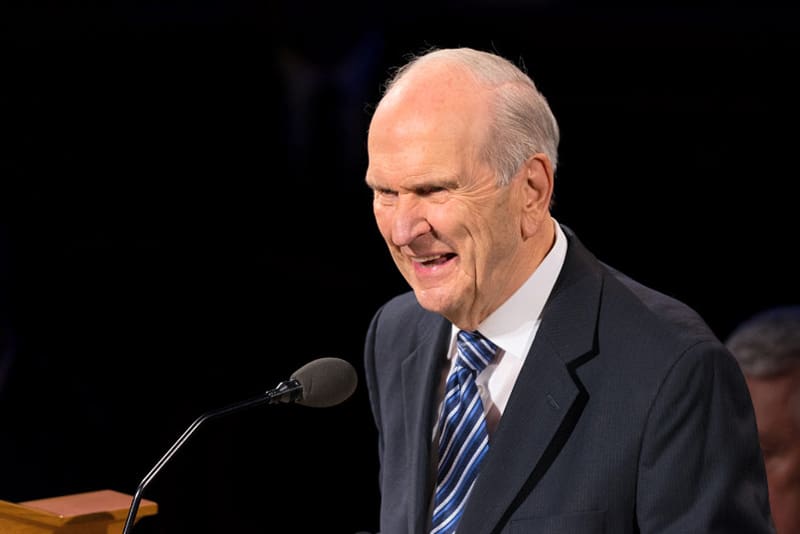
Since President Russell M. Nelson’s passing this week, I have been reflecting on the life of this great man. His love and wisdom have filled our lives and caused us to look forward to each general conference in anticipation of his next message and list of temple announcements. In his seven years and eight months as President, he has had an outsized impact on the Church and the world. There are many things that I will remember about him, but most of all, I will remember his deep faith and confidence in the Lord. He has inspired me to attend the temple more frequently and to keep striving to be the best I can be.
This edition of General Conference by the Numbers examines some of President Nelson’s teachings and accomplishments.
As a speaker in general conference, President Nelson gave 112 talks and participated in 83 conferences. Here is a portion of his speaker profile from searchgeneralconference.com1:

Here are the verses that he most frequently referenced:

President Nelson’s 112 conference talks are the 3rd most of any speaker. His 6,726 scripture references are the most of any speaker by a large margin, as shown in the following table:

Gathering Israel on both sides of the veil
Throughout his service as a general authority, President Nelson taught the importance of the gathering of Israel. The following chart shows that 17% of all conference talks given in the Nelson era mentioned the gathering of Israel.

Perhaps his most eloquent explanation of the gathering was in Let God Prevail when he said:
The Lord is gathering those who will choose to let God be the most important influence in their lives.
For centuries, prophets have foretold this gathering, and it is happening right now! As an essential prelude to the Second Coming of the Lord, it is the most important work in the world!
Unique to President Nelson was his emphasis on gathering Israel on both sides of the veil. Borrowing the phrase from President Ezra Taft Benson, President Nelson enthusiastically taught that the gathering is taking place on both sides of the veil. This helps everyone to understand that you can participate in the gathering by doing missionary work, family history work and temple work. As a result of his effort, many general authorities are now also teaching this concept. The phrase ‘both sides of the veil’ was spoken in 9% of all conference talks in the Nelson era as shown in the following chart:

Temples
Throughout his time as a general authority, President Nelson consistently emphasized the making and keeping of sacred covenants. In his October 2021 general conference address, The Temple and Your Spiritual Foundation, President Nelson discussed the importance of the temple in the tumultuous times that we live in.
During his presidency, President Nelson announced 200 new temples – an astonishing 26 per year. Since the time of President Gordon B. Hinckley, temple construction has greatly accelerated. The following table shows the rate of temple announcements and construction2:

The Name of the Church
Soon after President Nelson was ordained an apostle, he began focusing attention on the correct name of the church as revealed by the Lord in D&C 115:4:
For thus shall my church be called in the last days, even The Church of Jesus Christ of Latter-day Saints.
Changing the name of the church was difficult and inconvenient, especially with internet technology based on domain names and hashtags. By this action, President Nelson demonstrated the importance of obeying the Lord with exactness even when it is difficult.
Here is the timeline:
- In April 1979, Marion G. Romney gave a talk titled We, The Church of Jesus Christ of Latter-day Saints. In that talk, President Romney explained why the name Mormon was frequently used when referring to the church and he exhorted everyone to use the name the Lord has designated.
- In April 1990, Elder Russell M. Nelson gave a talk titled “Thus Shall My Church Be Called”. In his talk, Elder Nelson carefully explained the significance of the name: The Church of Jesus Christ of Latter-Day Saints.
- On Feb. 23, 2001, the First Presidency sent a letter to the membership of the Church on how to refer to the name of the Church. The letter said: “As the Church grows across boundaries, cultures and languages, the use of the revealed name, The Church of Jesus Christ of Latter-day Saints (Doctrine and Covenants 115:4), is increasingly important in our responsibility to proclaim the name of the Savior throughout all the world,”. The letter discouraged use of the terms “The Mormon Church,” “The Latter-day Saints Church” or “The LDS Church.”
- In April 2011, President Boyd K. Packer quoted 3 Nephi 27:2-6 and emphasized the importance of using the correct name for the church.
- In October 2011, Elder M. Russell Ballard restated the importance of using the correct name for the church.
- On August 16, 2018, President Russell M. Nelson announced that the Lord had impressed on his mind, the importance of calling the church by its correct name.
- In October 2018, President Nelson explained the importance of the name change in general conference.
- In October 2021, Elder Neil L. Andersen, reinforced the message in his talk: The Name of the Church Is Not Negotiable
Covenants
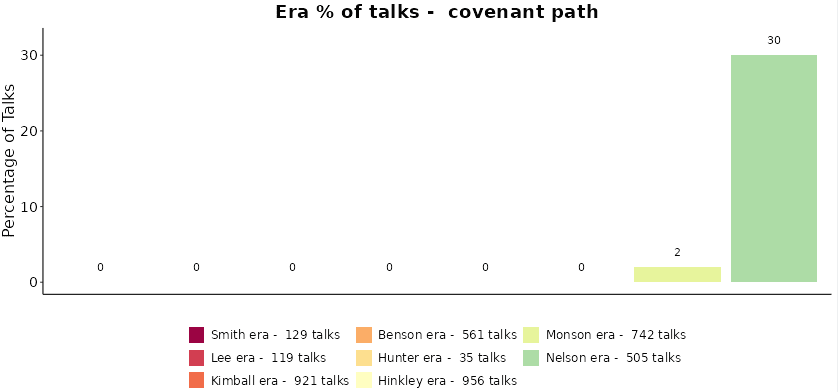
In his conference talks, President Nelson boldly declared our lineage as children of Israel and the importance of making and keeping sacred covenants. Nearly all of his conference talks included covenant language. Early in his presidency, he introduced the term ‘covenant path’ as a shorthand way of referring to the making and keeping of covenants. We now hear phrases like “stay on the covenant path” or “get on the covenant path and stay there”.
Language is important, and President Nelson was effective at using language to emphasize his teachings. As a result of his effort, the phrase ‘covenant path’ was used in 30% of all conference talks in the Nelson era, as shown below:
Come, Follow Me
It is hard to overstate the importance of the Come, Follow Me program introduced by President Nelson in April 2019. By introducing this program just prior to the pandemic, President Nelson demonstrated that prophets can see around corners. In addition to supporting home-based scripture study, the Come, Follow Me program has inspired many podcasts and materials that enhance scripture study and gospel learning.
References
- President Nelson’s full speaker profile is available at searchgeneralconference.com
- Source: churchofjesuschristtemples.org
Please Don’t Call Me a Mormon

Cover image via Gospel Media Library.
I have lived on the East Coast of the United States for 36 years. When my friends discover I grew up in Salt Lake City, Utah, they inevitably ask, “Are you a Mormon?” I have learned to respond, “No. I am a member of The Church of Jesus Christ of Latter-day Saints.” This response has led to some delightful conversations and has often cleared up misconceptions about The Church of Jesus Christ of Latter-day Saints.
Before President Nelson reminded us how critical it is to use the correct name of the church in his October 2018 conference talk, I was always a bit ashamed when people learned I belonged to the “Mormon” church. I understood that they held misconceptions about the Church. These misconceptions colored their opinion of me, and my inquirers seldom wanted to know more.
In the most recent General Conference President Nelson reminded us that we have “retired” the name “Mormon Church.” It is not to be used to describe those who belong to The Church of Jesus Christ of Latter-day Saints, not by members and not by inquirers. President Nelson said, “In the early days of the restored Church, terms such as Mormon Church and Mormons were often used as epithets—as cruel terms, abusive terms—designed to obliterate God’s hand in restoring the Church of Jesus Christ in these latter-days.” (October 2018 General Conference)
Disparaging nicknames have long been used to embarrass or marginalize certain ethnic groups. However, these groups have stood up for themselves, insisted that they not be referred to by these denigrating nicknames. For some reason members of The Church of Jesus Christ embraced the nickname that obliterated God’s hand in restoring The Church of Jesus Christ in these latter-days.
Correcting the name of the church is in no way a slight to Mormon, the historian who abridged the book we zealously embrace. Mormon was a great man. He was an amazing general, a brave warrior, a superb and very gifted historian. There is not a writer in all history I admire more than Mormon; but Mormon was a man.
Who Mormon Wasn’t
Mormon was not born of a virgin. A new star did not appear in the heavens when Mormon was born. Prophets did not prophecy of his birth for centuries. He did not heal lepers or give the blind their sight. He did not raise his soldiers from the dead. He did not take upon himself our sins. The earth did not shake at his passing. Mormon was not the ONLY begotten son of God the Father.
Mormon worshipped Jesus Christ. Of Jesus Christ Mormon said, “I was visited of the Lord, and tasted and knew of the goodness of Jesus” (Mormon 1:7). Mormon spent his life recording the words of other prophets who testified of Christ. He read first-hand reports of the Savior’s involvement with the people in the Americas. He had access to all kinds of testimonies we don’t have because he had to read all the records and choose what to include in his abridgement.
I am certain Mormon would have agreed with the apostle John who said regarding Christ, “His shoe’s latchet I am not worthy to unloose.” Mormon probably cringes to note that the Savior’s church is being called by his name.
Fear of Offense
It takes a lot of courage to use the correct name of the Church, as President Nelson counseled. We might fear we will offend people if we inform them that it is not “politically correct” to use the offensive nickname. However, I have found that people are grateful for the correction. I was grateful that my sister informed me it was politically correct to refer to her husband as “Asian.” I was grateful to my daughter who informed me it is politically correct to refer to her daughter as child with Down Syndrome and not a Down Syndrome child. People generally don’t want to be seen as uninformed, and when kindly corrected, they respond well.
Another reason we might be reluctant to use the correct name of the Church is because it is quite a mouthful. It takes a lot longer to say, “The Church of Jesus Christ of Latter-day Saints. It doesn’t roll off our tongue as easily as “Mormon.” I like to use this obvious fact to connect with my listeners. I will usually make a joke about the long name of the Church and speculate about why Jesus Christ chose such a long name for his restored Church. My listeners and I often enjoy a good laugh together.
President Nelson made this correction about using the correct name of the Church during the time my husband and I were serving as mission leaders. It was helpful to have the missionaries to practice using the correct name of the Church until it rolled off their tongue with ease. We invited them to say the correct name over and over again until they felt no embarrassment taking up an extra second of someone’s time when they used the entire name of the Church.
Hidden Benefits
I believe President Nelson was inspired to remind us to use the proper name of the Church for several reasons. For sure, this practice will help non-members recognize that we worship God the Father and Jesus Christ and nobody else. However, in addition, his inspired counsel reminds us, as members, whose we are.
Imagine the difference remembering the correct name of the Church will make when we invite someone to come to church. We will be careful not to say, “Hey, why don’t you come to my church this Sunday,” Or “We are having a party at my church…”.
The Church of Jesus Christ of Latter-day Saints is not my church. It is not President Nelson’s church or Joseph Smith’s church. You and I are beyond privileged to be members of The Church of Jesus Christ— The Church of Jesus Christ of Latter-day Saints.
Consider the following invitation: “I am going to The Church of Jesus Christ of Latter-ay Saints this Sunday. Will you come with me?” or “There is an activity at The Church of Jesus Christ of Latter-day Saints this Saturday. Will you come with me?”
Using the correct name of the Church reminds us how blessed we are to be members of the actual Church of Jesus Christ, how fortunate we are to have Jesus Christ himself leading this church, how reassuring it is to be learning correct doctrine, and what a privilege it is to have access to those with authority to help us make sacred covenants.
Old Habits Die Hard
My husband and I conducted an experiment in our stake mission prep class. We pulled several high school students aside and separately asked them how they would tell a stranger what church they belonged to. Each one of them said, “I belong to The Church of Jesus Christ of Latter-day Saints.” This made me wonder if the reluctance to “retire” the inappropriate name of the church is due to old habits. Our young people know the correct name of the Church and are using it.
When we follow the example of these youth and accept the invitation of President Nelson, it will entirely change others’ perception of the restored Church. It will also change the attitudes of those of us who are blessed to be members of the church that Jesus Christ himself restored to the earth in the latter-days. We will constantly be reminded that we belong to a church that is not a church of men; it is the church established by the Son of God.
JeaNette Goates Smith is a retired Marriage and Family Therapist and the author of four books about family relationships. She and her husband Bret served as mission leaders in the Dominican Republic from 2017 to 2020. For more information go to www.smithfamilytherapy.org.
FEATURES