






How Film Brings the Book of Mormon Witnesses to Life—Now Streaming Free

To read more from Daniel, visit his blog: Sic Et Non.
“Burying the lede” is a phrase from journalism. It means to withhold the most important information in a story until later. The “lede” is the introductory section of a news story, usually the first paragraph, and delaying, hiding, or “burying” it is generally regarded as bad journalistic practice. After all, many consumers of the news won’t read past the headline.
I won’t commit that error in this column, so here’s the “lede”: The Interpreter Foundation’s 2021 dramatic film Witnesses is now available for free streaming throughout the current month, February 2025. Its accompanying 2022 docudrama, Undaunted: Witnesses of the Book of Mormon, is now permanently available for free streaming. We’ve released them online in support of this year’s “Come, Follow Me” curriculum, which focuses in February on the coming forth of the Book of Mormon and on the witnesses to the golden plates.
Happily, too, the Foundation’s 2024 theatrical movie, Six Days in August, which tells the dramatic story of the succession crisis that followed the deaths of Joseph and Hyrum Smith in 1844, is now streaming from a variety of commercial platforms. I’ll provide information at the close of this column about how to access these films.
I want, though, to give a bit of my own personal background story for these films. What is it that has led me, a mild-mannered (and now retired) BYU professor of Islamic studies and Arabic, to become a movie mogul? Why am I devoting so much time and effort to making films when I could, instead, be working on my backswing and immersing myself in daily games of Bingo and Solitaire?
Even where I grew up in greater Los Angeles, there were only a few television channels when I was young. Moreover, although the current generation may find it difficult to imagine, there were no videotapes or DVDs or Blu-rays for rent, and no streaming platforms. As a result, we couldn’t simply think of just any movie that we wanted to see and then watch it at our convenience. Instead, we were at the mercy of a small handful of network and local programmers.
Still, I’ve been interested in film for a long time. In fact, I was already a discriminating consumer of cinematic art even as a precocious child: One summer, for example, KHJ-TV Channel 9 (now KCAL-TV) broadcast the 1956 version of “Godzilla, King of the Monsters!” nine times in the space of a week, and I watched every single showing. Indeed, after all the intervening decades I can still hum important parts of the musical score—especially the stirring theme that plays as the Japanese navy takes Dr. Serizawa’s secret invention, the “Oxygen Destroyer,” out to sea to put an end to the giant reptile.
However, my sophisticated cinematic tastes took a quantum leap forward during my undergraduate years at BYU. There were still no videos or streaming services, but the student-run Film Society and the university’s exceptional International Cinema screened old reel-to-reel movie prints that I had never seen. Once or twice, I even took night classes that ran vintage American films. For the first time, I discovered such classics as John Ford’s “How Green Was My Valley (1941), “Citizen Kane” (1941) and “The Magnificent Ambersons” (1942) by Orson Welles, Frank Capra’s “It’s a Wonderful Life” (1946), the haunting “Portrait of Jennie” (1948), and Elia Kazan’s “On the Waterfront” (1954)—though, of course, I still recognize “Groundhog Day” (1993) as the greatest film ever made. I was enraptured and, at one point, I seriously thought for at least a week of scrapping everything else to become a film historian.
But I didn’t drop everything else. In the end, and even despite a brief flirtation with economics, my strong interest in the premodern history of religion and religious thought—and the pivotal influence of such figures as Hugh Nibley and Truman Madsen—prevailed. I focused on the ancient and medieval Near East, and eventually on Islamic studies. But I also saw that there was much to be done in the study, advocacy, and defense of the scriptures and doctrines of the Restoration—in what is (outside of the Latter-day Saint community, anyway) commonly termed “apologetics.” And that’s why, despite my retirement, I haven’t retired. I’m still too busy.
Back in 2006 and 2007, while I was affiliated with the Foundation for Ancient Research and Mormon Studies (FARMS), I was peripherally involved with the two landmark “Journey of Faith” documentaries about the Book of Mormon that it produced. They are still available online at https://journeyoffaithfilms.com, and are very much worth watching. They persuaded me of the powerful potential of film to convey the results of faithful scholarship to a large audience. But my decades-long interest in film and my commitment to advocating and defending the faith really came together in 2017, when the Interpreter Foundation—pursuing an idea suggested by my theater-major wife, and with Mark Goodman, James Jordan, and Russell Richins as our core filmmaking team—produced a 25-minute piece about an important Latter-day Saint composer (and former Tabernacle organist) entitled “Robert Cundick: A Sacred Service of Music.”
It was my wife’s and my first venture as co-producers, and it was something of an experiment, to see what we could do. We concluded that the enterprise had been a success—it was, for example, broadcast on BYUtv—and that what we had created was of sufficiently high quality that we could honorably continue. So, again working with Brothers Richins, Jordan, and Goodman, we decided to try our hand at something even bigger.
I had been deeply impressed by the witnesses of the Book of Mormon since at least the time, soon after its initial publication in 1989, that I first read Richard Lloyd Anderson’s “Investigating the Book of Mormon Witnesses.” I had continued to study and to think about the Witnesses, and I felt that their story was insufficiently known and that, even among Latter-day Saints, the power of their testimonies was not fully appreciated. So, I was thrilled when our filmmakers proposed creating a major film—and eventually two films, both a dramatic movie and an accompanying docudrama—about the Witnesses. I didn’t need to be persuaded. I had thought about such a film for many years. I simply never imagined myself in the position to actually make it.
These are the two movies—“Witnesses” and “Undaunted”—that we now offer freely to viewers. I believe deeply in the message that they attempt to convey.
In the lead-up to their creation, I solicited statements about the Witnesses from four of the leading historians of the Church. These four scholars happened to be friends of mine, and I hoped that their stature and authority would help the Saints, and others who might be interested, to understand something of the significance of the testimonies of the Witnesses. I share them again here, with the same intent.
First, I requested a statement from the late Richard Lloyd Anderson, J.D., Ph.D., a Professor Emeritus of Church History and Doctrine at Brigham Young University. He was, by several light years, the premiere authority on the Book of Mormon Witnesses:
“Thousands of authorized copies of the Book of Mormon,” he wrote, “have reprinted the signed experience of the eleven Book of Mormon witnesses, Three who described that an angel held and turned the individual plates of an ancient New World Bible and Eight who narrated how they were given an ordinary experience of “hefting” the record and examining the carefully crafted characters on it. About 200 reported interviews with these eleven are collected, which report the constant affirmation of these witnesses of seeing and lifting this historic, prophetic record, with its independent account of Christ visiting America.”
My second statement comes from Richard L. Bushman, Ph.D., Gouverneur Morris Professor of History Emeritus at Columbia University, former Howard W. Hunter Visiting Professor in Mormon Studies at Claremont Graduate University, and a former president of the Mormon History Association:
“The testimonies of the three witnesses,” he said, are “the closest we come to rational evidence for Mormon belief. Three men attest to a sensory encounter with the gold plates and a divine being. In an age of skepticism, when all religious belief is under attack, their statement becomes more relevant every day.”
The third comes from the late James B. Allen, Ph.D., Lemuel Hardison Redd Jr. Professor Emeritus of Western History at Brigham Young University, a former Assistant Church Historian for the Church of Jesus Christ of Latter-day Saints, and another former president of the Mormon History Association:
“The testimonies of the witnesses to the Book of Mormon,” he said, “make Joseph Smith’s account much harder to dismiss than it would otherwise be. Plainly, since others announced that they, too, had seen and “hefted” and heard, this means that, whatever else it was, Joseph’s account must reflect more than merely private imagination or simple personal dishonesty. If the witnesses are judged to be reliable men of good character, their declarations pose a serious challenge to anyone who considers the claims of the Restoration.”
My fourth invited statement came from Thomas G. Alexander, Ph.D., another Lemuel Hardison Redd, Jr., Professor Emeritus of Western History at Brigham Young University and yet another former president of the Mormon History Association:
“Imagine the publication and distribution of the Book of Mormon without the testimony of the witnesses,” Professor Alexander invited us. “If there were none, Joseph Smith would have had to rely on his own word that he translated the plates. Many, perhaps most, people would probably have rejected the word of an uneducated farm boy. Joseph had enough difficulty even with the witnesses convincing others of the truthfulness of his story. Other people including the eight witnesses saw the plates, but only the three witnesses saw them in the possession of the heavenly messenger who delivered them to Joseph. The Lord asked them to testify to the truthfulness of Joseph’s ministry, which they did. Most important, during their lifetimes all three witnesses left the church. Oliver Cowdery and Martin Harris returned to the fold, but David Whitmer remained in Richmond, Missouri, estranged from Mormonism throughout the remainder of his life. Nevertheless, in spite of rumors to the contrary, all three continued to insist on the truth of their witness.”
We invite you to learn more about the Book of Mormon Witnesses. We invite you to enjoy these films. We also encourage you to go onto sites such as IMDb and give the films your honest rating. (Critics of the Church have been gleefully rating them as negatively as possible.) Moreover, if you like them we encourage you to share them with others. (On the other hand, if you don’t like them, I hope that you’ll forget ever having heard of the movies. “These are not the droids you’re looking for.”) Candidly, too, we would welcome your tax-exempt support for future filmmaking. Interpreter is a nonprofit foundation, overwhelmingly led and staffed by volunteers, but significant expenses are unavoidable.
**
As noted above, “Witnesses” will be available throughout February for free streaming. Its docudrama sequel, “Undaunted: Witnesses of the Book of Mormon,” is freely available into the indefinite future. Both can be accessed at “The Witness Initiative”: https://witnessesfilm.com.
Venues for watching “Six Days in August” are listed at “JustWatch”: https://www.justwatch.com/us/movie/six-days-in-august-2024.
“Robert Cundick: A Sacred Service of Music” is available for free streaming at https://interpreterfoundation.org/vid-now-available-for-viewingrobert-cundick-a-sacred-service-of-music/.
Come, Follow Me Podcast #42: “Ye Are the Children of the Covenant”, 3 Nephi 20-26

Scot
If you knew that the Lord Jesus Christ would spend the day with you and all who would come to the occasion from your home stake, what do you think He would teach you? What do you think He would do? What would be the most important truths He could communicate with you? What would YOU want to know from Him? Let’s explore these thoughts and explore the record of actual witnesses to such a day.
Maurine
Hello dear friends. We are Scot and Maurine Proctor and we are so delighted to be with you today and share this time in this virtual study group. Before we go on, I just have to say, we’ve seen a 2025 Church History Come Follow Me Calendar from the press and it is SO beautiful. It is stunning. It really will add so much to your homes and offices and bedrooms and dens, with the added bonus of having you keep track of your Come Follow Me readings at a glance. These calendars will be a must on your Christmas lists. All the photos were shot by Scot on the Smith family farm in one morning—a day never to be forgotten. The Smith family farm is where Joseph saw the first vision, was visited by Moroni, found the plates and so much more, and these photographs all feel touched by a heavenly light this place deserves. I can say with all my heart you will love these calendars. My only concern is that you buy one and you will wish you had bought ten more as gifts. And at this introductory price of just $15, well, I truly would order more than one! We have such a rich, wonderful spiritual legacy and I believe this calendar captures that legacy so well. You can look at them and pre-order them today—while supplies last—at latterdaysaintmag.com/2025 that’s latterdaysaintmag.com/2025.
Scot
Thanks for that plug, Maurine. I’m so excited to get these calendars out to everyone we know. Now, this week we are studying just 151 verses together—but these verses are packed with insights, doctrines, stories and meaning. These seven chapters are extremely helpful in understanding the nature of Jesus Christ. These passages teach us some of the things that are most important in our lives, namely the holy scriptures.
I have to recall, first, an experience we had years ago with our children in Family Home Evening. The question was posed, “If you could ask Jesus Christ anything, even anything you wanted, the wish of your heart, and you only had one question, what would it be?”
Maurine
One of the children said, “I would ask him for a hundred dollars!” (He was very young). Another said, “I would ask him for a really nice car.” Obviously, a teenager.
Scot
I think I said something like: I would love to know the age of the earth and how it was created. And then you, Maurine, trumped us all with your extremely insightful question. Do you remember what you asked?
Maurine
I do. I said, “What do you know that I don’t know?”
Scot
I gasped and said, “Ohhhhh, why didn’t I think of that?” The children all didn’t know that they could ask that much. It was really quite an unforgettable moment. And here in this week’s reading we have another of those unforgettable moments. This is in 3 Nephi 26, verses one through six:
1 And now it came to pass that when Jesus had told these things he expounded them unto the multitude; and he did expound all things unto them, both great and small.
Maurine
Scot, can you imagine being in a setting like this and the Lord Jesus Christ expounds all things to us, both great and small? How thrilling would that be? How amazing would that be? How exciting it would be to have HIS commentary on HIS words. Now, remember the setting: These faithful have all gathered to the Temple. They are all obedient. They are all willing and ready to listen to whatsoever He tells them. This is a wonderful pattern for us.
Now, let’s read in verse 3:
3 And he did expound all things, even from the beginning until the time that he should come in his glory—yea, even all things which should come upon the face of the earth, even until the elements should melt with fervent heat, and the earth should be wrapt together as a scroll, and the heavens and the earth should pass away;
4 And even unto the great and last day, when all people, and all kindreds, and all nations and tongues shall stand before God, to be judged of their works, whether they be good or whether they be evil—
Scot
Now, as a geologist’s son, I’ve always been fascinated by the elements melting with fervent heat and what it means that the earth should be wrapt together as a scroll and the heavens and the earth should pass away. OH! How I would love to have heard all the Lord’s commentary on these events. And then look at verse 6:
6 And now there cannot be written in this book even a hundredth part of the things which Jesus did truly teach unto the people…
Okay, let’s take that literally for a minute. Our current chapters 11-26 of 3 Nephi comprise about 31 pages of English text—if we don’t even have “a hundredth part” of the things that Jesus taught, we could have a record, someday yet to come forth, that is more than 3,000 pages—just covering the visit of Christ to the people in Bountiful! That’s more than the Old Testament, the New Testament, the Book of Mormon, the Doctrine and Covenants and the Pearl of Great Price combined! And that is just from a few days visit from Jesus to these faithful at the Temple! NOW, THAT is an exciting thought that fires the imagination!
Maurine
It really does. It reminds me of the Savior as He talked to the two disciples on the road to Emmaus. Remember?
27 And beginning at Moses and all the prophets, he expounded unto them in all the scriptures the things concerning himself.]
There is that pattern again. How would you like to have the Savior expound unto YOU “in all the scriptures the things concerning himself”? I think that is what President Nelson is saying, that the Lord is willing to talk to us! He is willing to answer our questions? He is willing to reveal things to us which have never been revealed before. He is willing to give to us individually, knowledge upon knowledge and revelation upon revelation.
Scot
That’s exactly right. And for the two disciples on the Road to Emmaus, for the faithful at Bountiful, they could say in unison:
Did not our heart burn within us, while he talked with us by the way, and while he opened to us the scriptures? (see Luke 24: 32)
I actually think that is what He, the Lord, is inviting us to do and to experience as we daily study and ponder and pray over the scriptures—His words. I think that is such a powerful invitation—especially in these times for turmoil, trouble and strife—or ANY time, for that matter.
Maurine
It certainly is. And isn’t it amazing that one of the critical things the Lord admonishes the people at the temple in Bountiful to do is to study the scriptures, but more emphatically, He commands the people to read and study the writings of the Prophet Isaiah. Now, why would He push so hard—even give a commandment to read and study the words of Isaiah. It reminds me of the 39th verse of the fifth chapter of John where He admonishes the Jews: Search the scriptures; for in them ye think ye have eternal life: and they are they which testify of me.”
Scot
I was just thinking that. He’s commanding the people then and us now to study and read the words of Isaiah for they, too, “are they which testify of me.” At the time of Christ, many people prided themselves on the deep study of the scriptures, but they were missing the point and certainly missing the Savior. They would look for eternal life in the scriptures and yet they would not see the very person who was offering it to them!
And why all this emphasis on studying the scriptures? Of course there are many reasons—not the least of which is just pure obedience, but let’s look at an insight from Elder Holland on this:
Maurine
He teaches:
“Because ours is the last and greatest of all dispensations, because all things will eventually culminate and be fulfilled in our era, there is, therefore, one particular, very specific responsibility that falls to those of us in the Church now that did not rest quite the same way on the shoulders of Church members in any earlier time. Unlike the Church in the days of Abraham or Moses, Isaiah or Ezekiel, or even in the New Testament days of James and John, we have a responsibility to prepare the Church of the Lamb of God to receive the Lamb of God—in person, in triumphant glory, in His millennial role as Lord of Lords and King of Kings. No other dispensation ever had that duty.
“In the language of the scriptures, we are the ones designated in all of history who must prepare the bride for the advent of the Bridegroom and be worthy of an invitation to the wedding feast (see Matthew 25: 1-12: 22:2-14; D&C 88:92,96) Collectively speaking—whether it is in our lifetime or our children’s or our grandchildren’s or whenever—we nevertheless have the responsibility as a Church and as individual members of that Church to be worthy to have Christ come to us, to be worthy to have Him greet us, and to have Him accept and receive and embrace us. The lives we present to Him in that sacred hour must be worthy of Him!
Scot
Elder Holland continues:
“So, setting aside fear of the future or concerns about the dimensions of a backyard bomb shelter, I am filled with awe, with an overwhelming sense of duty to prepare my life (and to the extent that I can, to help prepare the lives of the members of the Church) for that long-prophesied day, for that transfer of authority, for the time when we will make a presentation of the Church to Him whose Church it is.
“I do know this: When Christ comes, the members of His Church must look and act like members of His Church are supposed to look and act if we are to be acceptable to Him. We must be doing His work and we must be living His teachings. He must recognize us quickly and easily as truly being His disciples. As President J. Reuben Clark Jr. once advised, our faith must not be difficult to detect.8
“Yes, if in that great, final hour we say we are believers, then we had surely better be demonstrating it. The Shepherd knows His sheep, and we must be known in that great day as His followers in deed as well as in word.
Maurine
Elder Holland concludes:
“Surely that is why President Hinckley said: “It is not enough [for us, you and me, now, in our time] to simply be known as a member of this Church. . . . We must live as true followers of . . . Christ.”9
“Yes…these are the latter days, and you and I are to be the best Latter-day Saints we can. Put an emphasis on the last word there, please.
“When will all of this finish? When shall Christ appear publicly, triumphantly, and the Millennium begin? I have already told you that I don’t know. What I do know is that the initial moments of that event began 184 years ago. [He gave this talk 16 years ago] I do know that as a result of that First Vision and what has followed it, we live in a time of unprecedented blessings—blessings given to us for the purpose of living faithfully and purely so when the Bridegroom finally and triumphantly arrives, He can personally, justifiably bid us to the wedding feast. (Holland, Jeffrey R., Terror, Triumph, and a Wedding Feast, BYU Speeches, September 12, 2004)
Isn’t that all so humbling?
Scot
It truly is. It’s also very exciting. So, from our readings this week we need to remember that the Lord commands us to study Isaiah—whose purpose and prophecies are designed to lead us directly to Christ.
He also wanted to make sure the Nephites had specific scriptures that they didn’t have in their records, including a prophecy of Samuel the Lamanite and the words of Malachi the Prophet concerning the return of Elijah before His Second Coming and Malachi’s teachings on the law of Tithing.
I have to tell you, our dear listeners, about my feelings and testimony of tithing.
Some three months after I was baptized a frightening and very real challenge was presented to my fledgling faith and new membership in the Church. I shall never forget it.
We lived on a beautiful farm just outside of Rolla, Missouri at the northern end of the Ozarks and in the midst of a verdant forest. I should more accurately describe our 220 acres as a spread of rolling hills covered with woods and beautiful fields and meadows-but mainly thick deciduous woods.
Our home sat on a lovely hill facing to the south, overlooking a beautiful valley and hills. A lone, small gravel road connected us to the outside world. In the distance, some 6/10 of a mile away, we could see old Route 66 that was soon to become Interstate 44. The service roads had been put in for the Interstate on the north and the south of the new four-lane freeway. On the south side of the far service road was a train track. My brother and I used to listen for the trains that would come and we would then run to our living room window and sit on the couch while we counted the cars being pulled by the large diesel engines. I believe our record was 178 cars.
The spring had brought no rain that year and our land was as dry as it had ever been. The tall grasses had all turned brown. The little intermittent creek in the bottomland was nearly dry, with only a few muddy water holes remaining and those full of tadpoles, minnows, and covered with active water skeeters.
It was a Sunday afternoon. In those days we met from 9:00 until 12:00 in the morning and then we came back for sacrament meeting at 6:00 in the evening. Our Bishop, Mervin Petersen, was getting ready to move to Colorado and he and his family were over for dinner. My father was his counselor. My Dad would be called to be Bishop in a couple of weeks.
I remember so vividly walking out on our front porch with my Dad. The wind was especially strong that day, gusting to forty and fifty miles an hour. A gust literally picked me up off the porch and my father grabbed my hand as I was nearly blown away. I felt like a sheet hung on the line to dry, flapping in the wind.
At that moment a train made it’s way from the west to the east with its heavy loads and many-score cars. It was making a lot of noise for some reason—high-pitched squeaking sounds. A number of the wheels of some of the cars were locked in place. With that metal on metal they were throwing sparks out all along the tracks-so much so that we could see the large trails of sparks—like large sparklers—coming from those wheels.
Many dry leaves were swirling in the wind along the base of the tracks and some of them caught fire. In fact, there were several little fires along the track in our view. Within moments some of those burning leaves were carried by the wind across the service road, then the four-lane freeway and the other service road and came like fire-arrows down upon our forest on the south.
From that moment it seemed like things happened faster than I could calculate them. Our beautiful, dry forest was now ablaze and because of the high winds was spreading very quickly. Our Bishop’s family left immediately, but not the Bishop. It was soon apparent that the fire was very serious. Sacrament meeting was called off and all the brethren were called upon to help. “There’s a large fire at the Proctor’s place. We need your help,” the Bishop said as he called the brethren.
A small power line ran through these very woods bringing us the electricity we needed, not only for our lights and appliances, but for the pump on our well that gave us water. If the power line was burned we would have no ability to pump water to protect our home. My father gave my 11-year-old brother and me some instructions. “Fill every thing you can see with water. Any container you can find, fill it with water. You must do this quickly. And continue working until I give you further instructions.” Upon this, he and my 15 year-old-brother went off to fight the fire. My oldest brother had left on his mission to Norway just six weeks before.
My brother and I ran around finding everything we could, buckets, cans, jars, an old ice chest, a feeding trough, everything. We kept looking out at the forest in flames. The strong winds were coming from the south and the fire was being fanned out of control. It was burning with mighty fury now, consuming everything in its path. The flames had leaped over our little road that led to our home and our escape route by car was now cut off-the wildfire was now exploding all around and the flames shot 50 to 70 feet into the air-consuming every tree, every dry bush, every bit of undergrowth.
Four fire departments were now fighting the fire—forty or fifty acres were engulfed in a sea of flames-all of it heading towards our home very rapidly. There was no natural break for the fire. On the other side of the small creek in the bottomlands was a dry field that led up the hill directly to our home. One spark, one tiny flame in this dry mass of weeds and grasses and it would probably be a matter of three to five minutes before the fire would be to our home and consume everything we had.
At this moment, my father and older brother came quickly to the house. My Dad’s eyebrows were singed. His face was red from the heat and black with soot. He said to all of us, “Come quickly, we need to gather and have a family prayer.” I shall never forget this moment. We knelt around my parents’ bed. My father and brother smelled like smoke–the smell lingered through the prayer. My father pled with the Lord that our home and belongings and lives would be spared. He prayed with great fervency. He asked that through the priesthood the fire could be stopped. He reminded the Lord that we had always paid our tithing and asked that the Lord would stop the devouring fire. I was only eight. My heart nearly burst within me in a combination of fear and faith.
We got up from the prayer. My mother had gathered a few items—genealogy and pictures, some ward records that we had in a little box and that’s all. My father said, “Now boys, this is very serious. You must watch for my signal. If the fire continues as it is–you will have to go with Mother and take these few things and you must run with all your might through the back trail out of the woods. You must go quickly. You cannot slow down. You must bring Mother with you-and run until you get to highway V” which was about 2 miles away.
With the lingering feeling of the prayer, and the serious counsel of my father ringing in my ears—he left quickly and thrust himself back into the conflagration.
We were prepared to run. Our hearts were pounding. Now the fire engulfed 80 acres of forest. The flames were so high it seemed like no one could stand even getting near them. We continued to watch. The fire was now only a few feet away from the small, nearly-dry creek in the bottomland. One small paper match could have started the field on fire.
On an instant — and it was marked deeply in my heart — as the trees and undergrowth were burning out of control and as the flames came to the dry field, the wind changed directions. I remember not only the feeling but the sound of the wind going the opposite direction-it was a loud blast and a pop and the wind immediately came from the north. The wind came with great force and power. The wind blew the fire back against itself and within a few hours put itself out. Not one dry thistle of our field was charred. Not one spark landed in the weeds. Not one tree fell from south to north by the creek. The devourer had been rebuked and we were spared.
Maurine
“Will a man rob God?” the Prophet Malachi asked—and this is one of the scriptures added to the Nephite record. “Yet ye have robbed me. But ye say, Wherein have be robbed thee?” The Lord gives the answer: “In tithes and offerings.”
“Bring ye all the tithes into the storehouse, that there may be meat in mine house, and prove me now herewith, saith the Lord of hosts, if I will not open you the windows of heaven, and pour you out a blessing, that there shall not be room enough to receive it.
Now listen: “And I will rebuke the devourer for your sakes, and he shall not destroy the fruits of your ground; neither shall your vine cast her fruit before the time in the field, saith the Lord of hosts.” (See 3 Nephi 24: 8-11)
Scot
I cannot forget the lesson of my youth-to witness “the rebuke of the devourer” and see the tie to faith, to the priesthood and to the payment of tithing. It is one of the foundation stones of my testimony.
This much I do know, the Lord is good with His promises – when He says he will open the windows of heaven and pour out a blessing that “there shall not be room enough to receive it,” He means it—and that blessing may come in whatever way He chooses. In our case, He chose to save our home. In other cases, the blessings may come in health, in perspective, in financial prosperity, in deeper understanding and revelation, in unseen blessings.
But, Maurine, there are only two times where the Lord uses the phrase opening the windows of heaven, one is here in the promise of our faithful payment of tithing, and the other is as the flood comes upon the earth in Noah’s day—an overwhelming outpouring of rain. I believe that is significant.
Maurine
We need to remember why tithing is so critical. Let’s look at this important verse from the 27th chapter of the book of Leviticus: “And all the tithe of the land, whether of the seed of the land, or of the fruit of the tree, is the Lord’s: it is holy unto the Lord. And concerning the tithe of the herd, or of the flock, even of whatsoever passeth under the rod, the tenth shall be holy unto the Lord.” (See Leviticus 27: 30, 32)
Now, what does that mean? Yes, we know that all we receive is from the Lord. Yes, we have learned with Ammon that we are nothing, as to our strength we are weak. (Alma 26:12.) Yes, we know with King Benjamin that we are unprofitable servants and are dependent upon God for our very breath. (Mosiah 2:21.) But, what little we produce in this life, what small increase we have, the God of the Universe and the Lord of Hosts, require us to give them ten percent — it’s not just a test of our obedience, it is a demarcation of our being of the ancient covenant of Israel. That one-tenth IS holy unto the Lord. It is holy and it is His, for He has declared it so.
Scot
And what did the Lord mean about passing under the rod? Listen to this from Ezekiel: “And I will bring you into the wilderness of the people, and there will I plead with you face to face. Like as I pleaded with your fathers in the wilderness of the land of Egypt, so will I plead with you, saith the Lord God. And I will cause you to pass under the rod, and I will bring you into the bond of the covenant and ye shall know that I am the Lord.” (See Ezekiel 20: 35-38).
To pass under the rod is to be counted as his sheep. As we pay our tithing we pass under the rod and are counted as His sheep—and the promise here is that we shall know that He is the Lord.”
I want to be counted as His sheep—as one of His lambs.
Maurine
I do too. That’s critical to me.
Now, speaking of sheep, let’s conclude with a few words about the covenant—THE covenant. Let’s start by laying a foundation stone from one of the very purposes of the Book of Mormon as set forth in the Title Page:
“and that they may know the covenants of the Lord, that they are not cast off forever.” (Title Page of the Book of Mormon)
It’s critical for us to know to the core of our being that we in a covenant with our Heavenly Father and with Jesus Christ. That covenant is so powerful, it is what binds us to them. I’ve always told my institute students—all of whom are in the covenant: You’re not insecure, you only think you are. That’s a simple statement, but if you absolutely knew that you were in a covenant relationship with the God of the Universe and He is ALWAYS good on His promises, then this will give you absolute security. I think we cannot talk about this covenant relationship too much.
Scot
I agree. And that covenant guarantees that all of covenant Israel will be gathered in—that not one will be lost.
This all ties back to the commandment to read and study the words of Isaiah. The Lord said in 3 Nephi 20, verses 12 and 13:
And verily, verily, I say unto you, that when they [the words of Isaiah] shall be fulfilled then is the fulfilling of the covenant which the Father hath made unto his people, O house of Israel.
And then shall the remnants, which shall be scattered abroad upon the face of the earth, be gathered in from the east and from the west, and from the south and from the north; and they shall be brought to the knowledge of the Lord their God, who hath redeemed them. (3 Nephi 20:12-13)
Maurine
There is that promise of the gathering in of all that are lost. President Nelson has said over and over again that the greatest work in the world is the gathering of Israel—on both sides of the veil! The Lord does not see His children any differently on this side or that side of the veil. They are all His family, His sheep—His lambs—and He will gather the flock. That covenant is so powerful, it would really take a great deal to resist His gathering Hand.
Remember, the purpose of the covenant ultimately is to bring us back into the Lord’s presence. A beautiful image in the Book of Mormon that gives us a glimpse of that divine embrace. And it is also a really powerful image of the atonement.
1 But behold, the Lord hath redeemed my soul from hell; I have beheld his glory, and I am encircled about eternally in the arms of his love. (2 Nephi 1:15)
2 O Lord, wilt thou encircle me around in the robe of thy righteousness! (2 Nephi 4:33)
Scot
There are so many references to being clothed in scriptures. The Lord is clothed with majesty, He is clothed with strength. Heavenly messengers are clothed. After we die, we are clothed with a resurrected body. When we first attend the temple, our nakedness is clothed by putting on the holy garment. This is a symbol of putting on the atonement—and wearing it, like an embrace, the rest of your life.
It is a constant reminder of our covenant relationship with the Lord. That covenant protects us and binds us to Him who is eternal.
Maurine
In the covenant, you are being held in the arms of the Lord. You are wrapped as a constant reminder in the atonement. That reminder is that you have partnered with Him in your salvation and eternal life. My coming back into his presence is not just my project alone. God and I have a project, and it’s me.
But then the Lord says:
Be ye therefore perfect, even as I, or your Father which is in heaven is perfect.” (3 Nephi 12:48)
This presents a great dilemma immediately. The Lord cannot look upon sin with the least degree of allowance (D&C 1:31) and I am asked to be perfect. This is unfortunate because I am placed in a very difficult position. Not only am I not perfect, I don’t have a clear idea of what perfect looks like. With my best imagination,
I would think that it would mean that every part, every instinct, every experience, every feeling and every thought would all work together so that you would know how to respond with perfect love, timing, and intelligence at every given moment—that nothing would escape you, that no errant feelings would arise out of nowhere.
Scot
Even then, of course, that is nothing like perfect. Somewhere in our culture, however, there is a hurried, frantic sense of needing to be perfect. We had a friend who told us the other day that often through the day she is brought right up against the idea that nothing she does is right, or good enough. Her house is never clean enough. Her acts of service great enough. Her children must not be trained well, because they are never good enough. She’s always on the line.
How many times we’ve heard sisters in Relief Society apologize because their lesson wasn’t good enough. How many times we’ve seen people take on too much trying to do enough? How many times we’ve heard people say they were stressed—and underlying that is some fear that they won’t perform well enough. Does magnifying a calling really mean making it bigger? Measuring, even against yourself, is endless and destructive. Too often, we as covenant people, are still a worried lot. We may even suspect that we are caught in the trivial, chasing perfection in things that don’t matter at all.
Maurine
All of this is a terrible misunderstanding of “Be ye therefore perfect.” In thisscripture, the word perfect is better translated “whole”, the end point of a process. We’ve talked about that before. It is the end point of a journey that you have made in Christ’s embrace.
And what is asked of us? Our love of the Lord and our willingness. If we think He expects perfection of us right now, we’ll shrink from him in guilt or pain or fear like we might check out of a class from a teacher we perceive as being too hard.
Scot
We may think our relationship with him is even a bit of a power struggle where we have to wrest blessings from him, argue our point with him, pout or remove ourselves from him, thinking he asks too much.
Maurine
So often we miss seeing his true nature, or the true nature of the atonement. We think of the atonement as cleansing us and that is true. It can lift us from the heinous and darkest sins. We may begin our spiritual journey only understanding that if we do something wrong, that we understand as wrong, that we can seek forgiveness and be cleansed. That is a gift beyond imagining—and there is more.
Scot
There IS more. And it is not just that I do wrong, it is that I still am wrong. I’m incomplete. I’ve had experiences that have taught me to see without clarity. I misperceive some things. I don’t have the will to perform all that is good. I don’t see what I should do. I am vulnerable in some ways, and that is right where someone else might hurt my feelings. I hurt others when I don’t mean to, and then it feels unjust if they are mad at me. I commit sins of omission. I commit unintentional sins. I don’t even know exactly what I should be repenting of.
We have to remember that the atonement is about forgiveness and it is also about:
Comfort
Hope
Counsel
Clarity
Empowerment
Rebirth
You are clothed for this journey in that covenant.
Maurine
And here is what we offer: Our whole heart in love and our willingness to be transformed, our wanting to obey the commandments. What we can’t offer right now is our perfection. If we think we can, we hurt ourselves. If we expect it of others, we hurt them. I am grateful for this scripture. We are told that we should seek earnestly the best gifts. For verily I say unto you, they are given for the benefit of those who love me and keep all my commandments, and him that seeketh so to do. (D&C 46:9)
The Lord requires a willing mind. I can’t give perfection, but I can give my willingness. I can give my will. On this covenant journey through the wilderness of life, I will not fight you, debate, go away in a huff. I will let you embrace me and carry me, since thou Father are by far the stronger partner.
Scot
That’s all for today. It’s so good to be with you. Next week we will be studying 3 Nephi 27-30 and 4 Nephi with the lesson entitled: “There Could Not Be a Happier People.” Don’t forget to order your new 2025 Church History, Come Follow Me Calendar at latterdaysaintmag.com/2025 that’s latterdaysaintmag.com/2025. Thanks to Paul Cardall for the beautiful music and thanks to our producer, Michaela Proctor Hutchins who does so much to bring this podcast to you. Blessings to you and can’t wait to be with you next week.
Come, Follow Me for Sunday School: “I am the Law and the Light”, 3 Nephi 12-16

A Recipe for the Pure in Heart
I love warm chocolate chip cookies. When my wife Jennifer and I had high school age children, it seemed almost impossible to get them to slow down to spend time with us. But Jenn knew the secret. She makes amazing chocolate chip cookies and when she did, it seemed kids always wanted to hang around, laugh and talk. I think they loved the cookies, but more than anything, they wanted to lick the batter from the bowl. We ate a lot of cookies during those years!
When it was time to bake cookies, we would get out the ingredients: 2 ¼ cups of flour, 1 tsp baking soda, 1 teaspoon salt, 2 stick of butter, ¾ cup of sugar, ¾ cup brown sugar, 1 tsp vanilla, 2 eggs, and lots of chocolate chips.
Once in a while, because we were making double batches or have lots of hands in the kitchen, we’d get the recipe mixed up. Once we added a tablespoon instead of a teaspoon of salt. That was no good! Once, we forgot the baking soda. Even though we had all the flour in the world, when we left out that tsp of baking soda, those cookies came out as flat as could be.
It’s interesting that everything in that recipe–the baking soda, vanilla, and eggs were necessary to produce the best end result. If any one thing was left out, it didn’t work.
It’s the same in our pursuit of eternal life. You may be exceptional at serving others, but obedience to the commandment is something that can’t be left out. It seems the Lord wants us to be a complete spiritual being. He wants us to possess all of his characteristics. I also believe there is an order—a recipe–for helping us become like him.
Back to my cookie analogy, if I had given my children the ingredients of the recipe separately, their reaction would have been different. Let’s say I gave them 2¼ cups of flour and asked them to eat the flour and then wash it down with a tsp of vanilla, and then eat the ¾ cup of brown sugar, and then the 2 raw eggs; it wouldn’t have worked.
Cookies must have the right ingredients, mixed in the proper order, and carefully prepared and baked. Similarly, the principles taught in 3 Nephi 12 may also be essential ingredients to discipleship and have an order for development in our lives.
As you read 3 Nephi 12, you may want to ask several questions:
- Immediately after appearing to the Nephites and showing himself to them, Jesus teaches the principles similar to those of the beatitudes. Why are these the first principles taught after baptism and following the prophet? These particular principles must be critically important to Him. Why?
- Are these principles simply a list of important character traits we are to develop or is there some purpose in the order or pattern in which they are presented? In other words, are they ingredients to a larger recipe?
There is a pattern evident in the principles in 3 Nephi 12. It begins with a person who is poor in spirit (seeking spiritual help) which causes them to mourn for their sins. Who then, because of their mourning becomes meek and willing. Then, when he/she is meek, they desire righteousness. Then, seeing themselves as dependent on grace, he/she judging and extends mercy. The end result is they are enabled and capable of being pure of heart.

Let’s examine this process more closely. Perhaps we will see it is almost impossible to become pure in heart without the experiences of the preceding characteristics.
Blessed are the Poor in Spirit who come unto me
What does it mean to be poor in spirit? To be poor economically means we lack money or resources necessary to live. To be poor emotionally means we lack the emotional strength to withstand the trials of day-to-day life. To be poor spiritually means we are separated from Christ and seek to draw closer to him. We are spiritual beggars.
Beggars often live in the margins of society. In some religions, those who farm believe that you should not harvest the margins of your field. You harvest the inside of your field but the outer edges you leave for the poor to harvest and keep for themselves. You leave the margins for the beggars.
In Leviticus, God commands Israel to not reap “all the way to the edges of your field or gather the gleanings of your harvest, but leave them for the poor and the stranger.”
Those of us who live in the margins spiritually, rely wholly on the merits of him who is might to save. We realize that spiritually we are dead, having sinned; and know it is by grace after all that we can do that will save us spiritually. So symbolically, we live in the spiritual margins, with no claim to our own harvest but relying on the mercy of the great landowner to let us live in the margins.
Perhaps you have lived in the margins: not just financially, but may be doing so now emotionally or spiritually. Discouraged, doing less than right, maybe afflicted by poor health, family struggles or just weary. To those living in the margins, the Lord promises they will be blessed.
In one of the greatest ironies, the scripture tells us to live in the margins. In doing so, we demonstrate that we know we can’t do anything of our own selves, that we could labor all our days and never approach qualifying for heaven. It is as if we say, “I am content to live as a beggar, relying on the Lord for my guidance, my direction and my spiritual development.”
And the interesting thing is this, the longer I live, the more I see the blessed state in which I live when I voluntarily live in the margins. When my attitude remains as one relying entirely upon the Lord. Giving others the glory in the harvest… “I’ll work the unnoticed in the margins, you can harvest the noticeable center of the field.” When I am dependent on heavens guidance, I see more miracles in my life. Heaven knows I’ve made enough mistakes to genuinely belong in the margins. Perhaps I am more comfortable there because that is where my Savior lived when he was on earth—in the margins.
To be poor in spirit, means we are empty of self-importance or self-knowledge, and even self-righteousness. It is a continuous way of thinking and living whereby we constantly seek His grace. This way of living acknowledges our desperate need for God. When we recognize our spiritual poverty, we acknowledge our complete dependence on Him and place our complete trust in Him.
Robert Wells taught, “I would like to use a short version, as I remember it, of the famous Hugh B. Brown parable to illustrate submission. When he was young, President Brown had a nice yard in front of his home with a lawn, flowers, shrubs, fruit trees, and shade trees. There was a currant bush he had carefully trimmed to be in an attractive shape and to produce the best fruit. Noticing that it had started to branch out again, he went for the pruning shears. As he approached the currant bush, he seemed to hear it say, ‘Oh please, Mr. Gardener, don’t cut me back, I’m just getting started and I want to be big like the shade trees.’
President Brown responded, ‘No, my little bush. I am the gardener here and I have planted thee to be a source of fruit and an adornment in this part of my garden, and I am going to prune thee back to size.’
Many years later President Brown was a full colonel in the Canadian forces in France in World War I. He could see the possibility of an illustrious military career. He wanted to become the first LDS general since Book of Mormon times. He was competent and well prepared. The next vacancy as a general should have been his, but when the vacancy occurred, he was called in by his superiors and told, ‘We are promoting someone else over you.’ In effect they were saying, ‘There has never been a Mormon general in his Majesty’s Royal Forces and there probably never will be.’
He retired to his quarters, crushed with disappointment, and knelt in prayer asking fervently, ‘Heavenly Father, why couldn’t my prayers have been answered? Haven’t I lived up to my covenants? Haven’t I done everything I was supposed to do? Why? Why?’
And then he heard a voice, an echo from the past, saying, ‘I am the gardener here. You were not intended for what you sought to be.’ Humbled, President Brown then prayed for humility and patience to endure the pruning and to grow as the Lord would have him grow.
I translated that story for him on a tour of South America. He told me afterwards, ‘Bob, I know if I had continued in that direction I would never have developed the way the Lord wanted me to so I could eventually serve him as an apostle and in the First Presidency.’”[i]
Poor in spirit means you accept the workings of God in your life gratefully just as a beggar in the margins. And the promise? Theirs is the kingdom of heaven.
Blessed are they that mourn
One who is truly poor in spirit is more likely to mourn. To mourn is to feel or express sorrow or grief over loss, misfortune, or separation. When I see the spiritual gap between myself and my Savior, one natural outcome is to mourn my weaknesses and tendencies for sin.
Why does the Lord want us to mourn or at least suggest we are blessed when we mourn? Could it be that mourning the death of a loved one can lead us to Christ? The pain and suffering of the separation from a loved one may be an essential part of our spiritual discipleship. That by being so separated, we realize and value the power of Christ to reunite us with those who we love.
By mourning for our sins, we come to understand the sorrow for sin and the joy of redemption. My mourning the sins of the world, we empathize with Christ and become more like a disciple as we plead for the grace and power of God to bring peace to the world.
In this way, isn’t mourning a commandment that makes sense for the developing disciple? Bruce Hafen wrote,
“In Luke 4:18, Jesus quotes part of a passage from Isaiah that describes the heart of his ministry. The Isaiah passage reads: “The Spirit of the Lord … hath anointed me to preach good tidings unto the meek; … to bind up the brokenhearted, to proclaim liberty to the captives, … to appoint unto them that mourn in Zion … beauty for ashes.” (Isa. 61:1, 3)
The Savior’s atonement is thus portrayed as the healing power not only for sin, but also for carelessness, inadequacy, and all mortal bitterness. The Atonement is not just for sinners…
It is so important for us to be on the Lord’s side. But we should never forget that the Lord is also on our side.
Each of us will taste the bitter ashes of life, from sin and neglect to sorrow and disappointment. But the atonement of Christ can lift us up in beauty from our ashes on the wings of a sure promise of immortality and eternal life. He will thus lift us up, not only at the end of life, but in each day of our lives.”[ii]
Blessed are the meek
A person who is poor in spirit and mourns, is more likely to be meek. When we are truly reliant on the Lord for his grace, we develop meekness.
The Lord’s disciples follow his word and obey his voice. Like a little child following his father, the meek are earthly beings who choose to follow their spiritual father. His voice is their command. Brother Robert Wells teaches this principle with the following story.
“I was visiting a huge estancia (ranch) in Argentina with over 100,000 acres of lush pampa. They had 20,000 head of cattle on the ranch and over a thousand head of beautiful horses—some for the gauchos to ride, but most were thoroughbred polo ponies that they trained and sold all over the world.
In the course of the afternoon’s conversation I asked the distinguished estanciero (owner) if we would see a rodeo where the gauchos would be breaking wild horses like our western cowboys. The owner was aghast. ‘Not on this ranch you won’t,’ was his emphatic answer. “We would never break a horse. We don’t want to break his spirit. We love them and work patiently with them and train them until they are meek or ‘manso.’’ He said, ‘Our meek (or ‘manso.’) horses are still full of fire and spirit, but they are obedient and well trained. They lose nothing of their speed or maneuverability. A polo pony has to be the finest horseflesh on the face of the earth. They are lightning fast and superbly maneuverable to follow the run-and-gun type of game that world-class polo is. The horse cannot be timid or afraid of anything, but must be obedient and superbly well trained.’
I can see a great spiritual application now to the meaning manso or meek. I don’t feel the Savior wanted us to be doormats to be walked on. I prefer to think he meant that we should be obedient and well trained. You can be strong, enthusiastic, talented, spirited, zealous, and still be “meek” by being obedient and well trained. I can seek to be that kind of a meek person and be proud to have that as my goal—obedient and well trained—and still coexist in the success-oriented world in which we live.”[iii]
Blessed are they who hunger and thirst after righteousness
A person who is meek, is more likely to hunger and thirst after righteousness.
According to Webster, righteousness is defined as “the quality of being morally true or justifiable.” In spiritual terms, righteousness means being at right with God. Righteousness also represents the sum total of God’s characteristics and goodness. When we seek after righteousness we seek (1) to be right with God, justified and aligned with him. As sinners this is only possible through the atonement of Jesus Christ. So, to be right, we must fully repent offering a broken heart and contrite spirit, relying on the merit of Him who is mighty to save. This means we hunger after the grace of Jesus Christ. Then, (2) we do our best to put on the character of God. These characteristics are what we thirst after in our daily walk–goodness, honesty, mercy, kindness, moral worthiness and long-suffering.
But the question remains for all of us: Do we really hunger and thirst after righteousness? I mean we all want to be righteous. But do we, as if we had been fasting for forty days and nights, hunger for righteousness in our life before our earthly needs, moods or wants? Do I desperately want moral goodness above the temptations of the world?
The promise in 3 Nephi 12:6 is that those who hunger and thirst after righteousness will be filled with the Holy Ghost. The more we seek righteousness, the more we will have the Holy Ghost. So, the simple question is “What do I do in my day to hunger after righteousness?”
Perhaps by seeking righteousness and following the Holy Ghost, we separate ourselves from and ever-increasing evil world. Elder Andersen has promised as the evils of the world increase, the righteous (those who seek the character of God in their own life) will find a compensatory power in their life.
“As evil increases in the world, there is a compensatory spiritual power for the righteous. As the world slides from its spiritual moorings, the Lord prepares the way for those who seek Him, offering them greater assurance, greater confirmation, and greater confidence in the spiritual direction they are traveling. The gift of the Holy Ghost becomes a brighter light in the emerging twilight…. My brothers and sisters, as evil increases in the world, there is a compensatory power, and additional spiritual endowment, a revelatory gift for the righteous.”[iv]
Blessed are the merciful
A person who is poor in spirit, mourns, is meek and seeks to be right with the Lord; is more apt to be merciful.
One of the biggest lessons I learned as a first-time Bishop was the beauty of the repentance process. First and foremost, as a Bishop I became more aware of my own inadequacies and shortfalls. Once I saw my own state of relying on the Lord’s grace, it was easier to have empathy for those with whom I worked. It was a humbling experience to see true repentance at work. As a result, I learned to stop judging. There wasn’t a ward member, regardless of what they had done, for whom I did petition heaven for mercy and divine help. I prayed often for the members of my ward that the Lord would extend his grace for them and for me.
Over the years, as I have that when we are merciful we have peace in our life. Because I have sinned, I am completely and utterly reliant on Jesus Christ. How then can I then judge another? Catherine Parry shared the following thought about judging others:
“Those of us with more of Martha than of Mary in us . . . do not doubt the overriding importance of listening to the Lord, [but] does the listening have to be done during dinner preparations? Would it have hurt Mary to have joined us in serving, then we all could have sat down to hear the Lord together? And furthermore, what about the value of our work in the world? If it weren’t for us Martha’s cleaning whatever we see and fussing over meals, there would be a lot of dirty, hungry people in this world. We may not live by bread alone, but I’ve never known anyone to live without it. Why, oh, why couldn’t the Lord have said, “You’re absolutely right, Martha. What are we thinking of to let you do all this work alone? We’ll all help, and by the way, that centerpiece looks lovely”?
What he did say is difficult to bear, but perhaps somewhat less difficult if we examine its context…. The Lord acknowledges Martha’s care: “Martha, Martha, thou art careful and troubled about many things” (v. 41). Then he delivers the gentle but clear rebuke. But the rebuke would not have come had Martha not prompted it. The Lord did not go into the kitchen and tell Martha to stop cooking and come listen. Apparently, he was content to let her serve him however she cared to, until she judged another person’s service: “Lord, dost thou not care that my sister hath left me to serve alone? bid her therefore that she help me” (v. 40). Martha’s self-importance, expressed through her judgment of her sister, occasioned the Lord’s rebuke, not her busyness with the meal. [Quite literally, they were measured by their own standards and found wanting….
While there are many things we must make judgments about, the sins of another or the state of our own souls in comparison to others seems not to be among them…. Our own sins, no matter how few or seemingly insignificant, disqualify us as judges of other people’s sins.”[v]
Blessed are the pure in heart
A person who is poor in spirit, mourns, is meek, seeks to be right with the Lord and is merciful; will be more able to be pure in heart.
Elder Oaks taught that to have a pure heart is to be pure in our motives, desires and attitudes (in addition to our actions). How can our motives and desires be purified without having lived in the margins spiritually and fully relying on the grace of Jesus for all we have and do?
The pure in heart are more able to have the deep motive of purity because of the following:
- They have lived in the margins relying on the Lord
- They have mourned their standing with the Lord and sought the peace of repentance
- They are meek or willing to follow Jesus no matter what
- They desire to be right with Christ and righteous in their daily walk
- They extend mercy and develop a pure love for others
Like baking a great batch of cookies, becoming pure in heart is a process requiring the right ingredients and process. These ingredients of discipleship are so important, the Lord’s primary message to the Jews and Nephites began with these principles. We would do well to follow these same principles in our life.
[i] Robert E. Wells, The Christ-Focused Beatitudes, BYU Speeches, May 20, 1986.
[ii] Bruce Hafen, Beauty for Ashes: The Atonement of Jesus Christ, Ensign, Apr. 1990, 13.
[iii] Robert E. Wells, The Christ-Focused Beatitudes, BYU Speeches, May 20, 1986.
[iv] Neil L. Andersen, A Compensatory Spiritual Power, BYU Speeches, August 18, 2015.
[v] Catherine Corman Parry, Simon, I Have Somewhat to Say unto Thee, BYU Speeches, 1990–91.
Come, Follow Me for Individuals and Families: “The Rock of our Redeemer”, Helaman 1-6

Cover image: Courtesy of the author.
Burg Eltz is one of many beautiful castles not far from us in Germany. Built in 1157, it has remained in the same family and was never destroyed. It’s a fun castle to hike to from several possible directions because it appears suddenly, due to dense vegetation and the Elzbach river on its three sides, towering up high. It is built on an oval rock that serves as its foundation, and many rooms have unusual shapes because their architecture follows the shape of the rock.
I love this idea. What if our lives – without a single piece left spilling over – followed unique patterns on the sure foundation of Christ? What would need to happen to design and structure our efforts to be built on such a foundation?
In Helaman 5:12, a scripture we know well, Helaman counseled his sons to “remember that it is upon the rock of our Redeemer, who is Christ, the Son of God, that ye must build your foundation…which is a sure foundation, a foundation whereon if men build they cannot fall.” The stunning Burg Eltz has lasted more than 850 years on its solid foundation. What would happen in our lives if we truly built them on the sure foundation of Jesus Christ?
Like a mighty fortress on a hill, Jesus Christ will help us weather our storms, withstand temptations that seek to destroy, and be a towering light to those wandering through the dense struggles of life. Helaman 1-6 helps us learn how we can become more like Christ despite the “serious difficulty” and “serious contention” that surrounds us (Hel. 1:1-2).
DISCUSS and PONDER:
Pres. Nelson has challenged us to conscientiously and carefully transform our home into a sanctuary of faith (Becoming Exemplary Latter-day Saints). What have you done to remodel your home, physically or spiritually, into a center of gospel learning? How have you figuratively cut your rooms to fit exactly upon the firm foundation of Jesus Christ? What blessings have you experienced by doing so as a family?

Yielding our hearts to God and building our lives on Christ’s foundation brings spiritual strength and peace.
Pride separates me from the Spirit and strength of the Lord
Helaman 1–6
When I think of pride I think of President Ezra Taft Benson’s noted talk “Beware of Pride” delivered in the April 1989 General Conference. He called pride a “misunderstood sin” and that a message of the Book of Mormon is to teach us of the “sin of pride.” He said, “The central feature of pride is enmity—enmity toward God and enmity toward our fellowmen.” Enmity toward God “takes on many labels, such as rebellion, hard-heartedness, stiff-neckedness, unrepentant, puffed up, easily offended, and sign seekers.” Enmity towards our fellow man “is manifest in so many ways, such as faultfinding, gossiping, backbiting, murmuring, living beyond our means, envying, coveting, withholding gratitude and praise that might lift another, and being unforgiving and jealous.” Pres. Benson calls pride “a sin that can readily be seen in others but is rarely admitted in ourselves.”
We frequently refer to the pride cycle in the Book of Mormon, referring to the pattern of prosperity and downfall, humility and repentance. We see the Nephites struggle as the book of Helaman begins. Contrast some of the descriptors in Helaman 1: anger, stir them up, difficulty, wroth, contention, flatter, divisions, and rebellion; vs. unity, liberty, and the voice of the people. I found it helpful to answer some of the questions posed in Come, Follow Me so I made this chart:
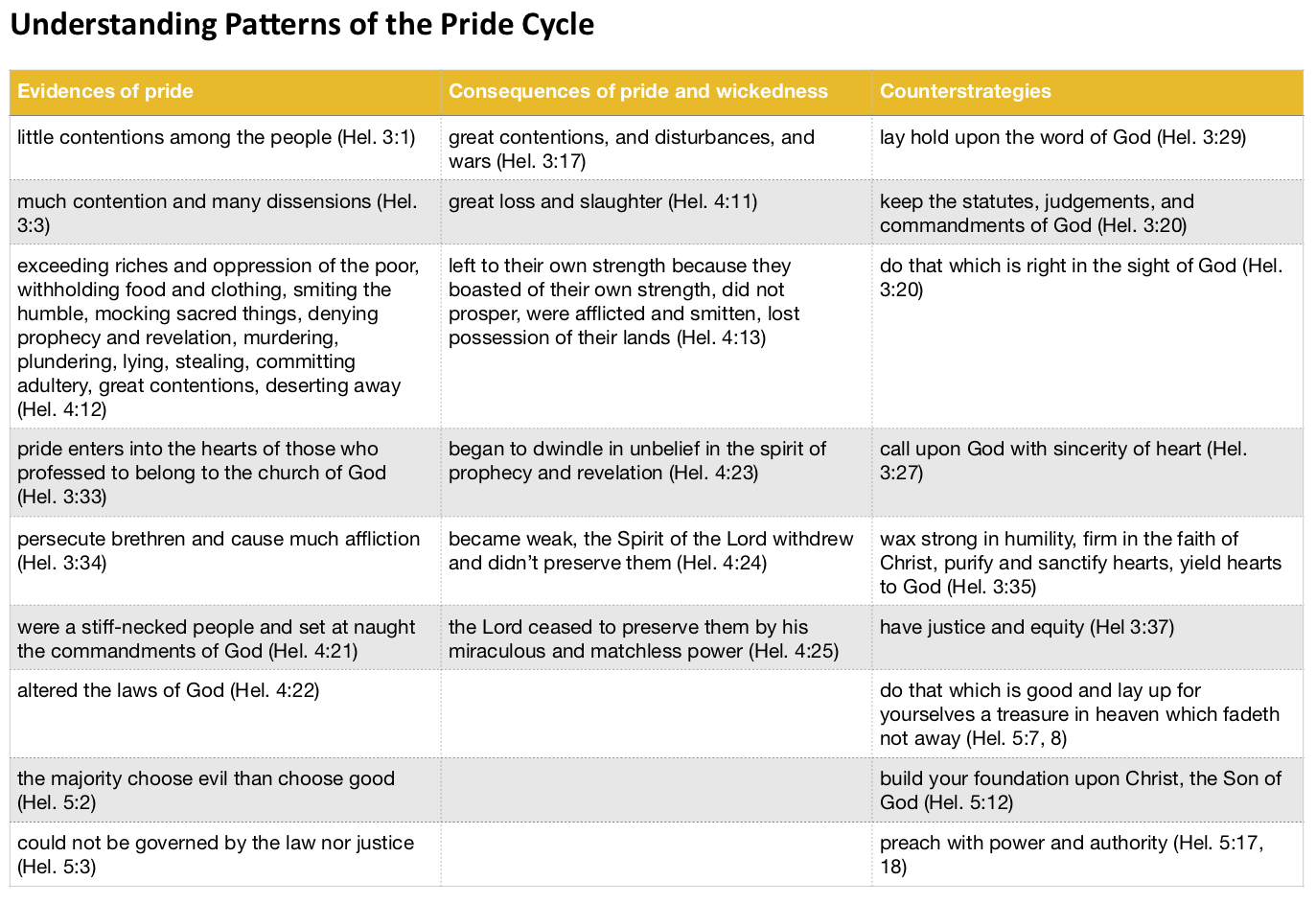
DISCUSS and PONDER:
How does pride separate us, as the Come, Follow Me heading says, from the Spirit and strength of the Lord? How is pride more readily seen in others than in ourselves? How is contention a form of pride? What are some ways we can reduce contention in our home?
ACTIVITY:
- With older kids and teens, watch (or re-watch): Bullying — Stop It (10:22) and discuss. What other ways do we see bullying and meanness manifest? How can we be less hurtful and more kind to others?
- With younger kids, watch The Prideful Ant (4:36) and discuss what the ant learned

Just as yielding is essential for safe navigation on the roads, yielding our hearts to God ensures we are guided safely on the path of faith.
I can be sanctified as I yield my heart to God.
Helaman 3:24–35
I live in Frankfurt, Germany, and there are many cars, bikes, and pedestrians. One of the first critical skills I learned was how to yield to whoever has the right of way. When walking, I stay out of the bike lane so I don’t get hit. When driving, I am extra mindful of bikes and people. I’ve learned the unique traffic patterns in my neighborhood. At one corner, for example, the bikes are given a green light slightly before cars and there are usually several bikes to yield to. I learn to look not only ahead but in my rear view mirror multiple times to make sure all the bikes have gone before I proceed. Sometimes they appear out of nowhere, but when I carefully look, I see them and yield. The autobahn requires eyes on all sides, simultaneously looking ahead and behind. I watch for cars that race up from behind, entering and exiting vehicles, and cars that quickly zip in and through traffic.
What does it look like to yield our hearts to God? How can we better give Him the ultimate right of way?
In Helaman 3, the Church goes through a season of great prosperity:
- continual peace is established in the land (Hel. 3:23)
- many blessings are poured out and the leaders are astonished beyond measure (Hel. 3:25)
- tens of thousands are baptized and united unto the church of God (Hel. 3:26)
- continual rejoicing, peace, and exceedingly great joy in the land (Hel. 3:31-32)
Mormon teaches that:
- the Lord is merciful unto all who will call upon His holy name in sincerity of heart (Hel. 3:27)
- the gate of heaven is open to all who believe in Christ (Hel. 3:28)
- the word of God is quick and powerful and will conquer the cunning snares of the devil (Hel. 3:29)
Yet, pride begins to creep in again for some, and the more humble part of the people “suffer great persecutions, and … wade through much affliction” (Hel. 3:34). We learn what the followers of Christ do to remain strong in Helaman 3:35:
- fast and pray oft
- wax stronger and stronger in their humility and firmer and firmer in the faith of Christ
- fill their souls with joy and consolation
- are purified and sanctified in their hearts because they yield their hearts unto God
DISCUSS and PONDER:
Read in the Guide to the Scriptures the definition of sanctification: “the process of becoming free from sin, pure, clean, and holy through the Atonement of Jesus Christ.” What does this look like in our daily lives? How do we become free from sin, pure, clear and holy? What do we need to do so that Christ always has the right of way as we yield our hearts toward Him? How does this relate to building our lives on the sure foundation of Christ and remodeling our homes into sanctuaries of faith?
ACTIVITY:
Watch (or re-watch) this video: Sanctify Yourselves (4:37) and discuss what it means to be ready and worthy to be used as an instrument in God’s hands. (Elder Holland’s full address is excellent and is found here)

Like luminous stones, spiritual reminders help us see God’s hand guiding us as we build our lives on His sure foundation.
My faith is strengthened by “the greatness of the evidences [I have] received.”
Helaman 5:14–52
How do you see the hand of the Lord in your life? How do you help your family to see more of it? There is so much we can learn from our life experiences. Elder Neil L. Andersen taught recently at General Conference, “God powerfully and very personally assures each of us that He knows us and loves us and that He is blessing us specifically and openly. Then, in our moments of difficulty, the Savior brings these experiences back into our mind” (Spiritually Defining Memories, April 2020).
After hearing wise and heartfelt counsel from their father, Nephi and Lehi “went forth, keeping the commandments of God, [teaching] the word of God among all the people of Nephi ” (Hel. 5:14). They “did preach with great power” and helped many dissenters repent and repair the wrongs they had done (Hel. 5:17). They saw much success, such as in Zarahemla when 8,000 Lamanites were “baptized unto repentance” (Hel. 5:19). They also suffered great afflictions and were cast into the same prison that Ammon and his brethren were cast by the servants of Limhi (Hel. 5:21). This prison-temple, as Elder Holland called Liberty Jail, was a holy place. Though they suffered much and went without food and were threatened, Nephi and Lehi had their own spiritual manifestation and were “encircled about as if by fire” and stood “in the midst of fire and were not burned” (Hel. 5:23). Seeing this “marvelous thing” (Hel. 5:26), their “hearts did take courage” (Hel. 5:24) and they began to teach the stunned Lamanites.
It is often in the greatest struggles of our lives that we grow the closest to God and see His hand. Elder Holland taught, “You can have sacred, revelatory, profoundly instructive experience with the Lord in the most miserable experiences of your life—in the worst settings, while enduring the most painful injustices, when facing the most insurmountable odds and opposition you have ever faced…These difficult lessons teach us that man’s extremity is God’s opportunity, and if we will be humble and faithful, if we will be believing and not curse God for our problems, He can turn the unfair and inhumane and debilitating prisons of our lives into temples—or at least into a circumstance that can bring comfort and revelation, divine companionship and peace” (Lessons from Liberty Jail, Sept. 2008).
I find this counsel especially comforting as I think of what we have all experienced as global humanity these past few months. No matter how hard it gets or what we continue face, the Lord will teach us and reach us if we are willing to walk with Him.
As Nephi and Lehi taught, the prison walls started to shake but they did not fall (Hel. 5:27). Instead, a cloud of darkness and “an awful solemn fear” came upon the Lamanites who had gathered. (Hel. 5:28). The Lord called them to repentance and we learn much about the Lord’s voice and how it speaks to us.
It was “not a voice of thunder, neither was it a voice of a great tumultuous noise, but behold, it was a still voice of perfect mildness, as if it had been a whisper, and it did pierce even to the very soul” (Hel. 5:30). The Lamanites were “immovable because of the fear which did come upon them” and it took them a few times to understand the voice. Through it all, Nephi and Lehi’s faces “did shine exceedingly, even as the faces of angels” and were noticed by a Nephite dissenter named Amininab (Hel. 5:35-26, 39). The others asked Aminadab what they should do and he says, “ye must repent, and cry unto the voice, even until ye shall have faith in Christ, who was taught unto you by Alma, and Amulek, and Zeezrom; and when ye shall do this, the cloud of darkness shall be removed from overshadowing you” (Hel. 5:41).
What happens next is one of the most beautiful redemptive experiences in the Book of Mormon and becomes a “spiritually defining memory” for the 300 souls in attendance.
The people cried unto the voice they heard and the cloud of darkness dispersed (Hel. 5: 42). As Nephi and Lehi shone “in the midst of a flaming fire,” the “Holy Spirit of God did come down from heaven, and did enter into their hearts” (Hel. 5:44-45). Again, a voice as a whisper said, “Peace, peace be unto you, because of your faith in my Well Beloved, who was from the foundation of the world” (Hel. 5:47). The heavens opened and “angels came down out of heaven and ministered unto them” (Hel. 5:48).
We don’t know exactly what this incredible experience looked and felt like, but it had a powerful impact on all who saw and heard. The Lamanite dissenters “did go forth, and did minister unto the people” and “did lay down their weapons of war, and also their hatred and the tradition of their fathers” (Hel. 5:50-51). The Lamanites became, the “more part of them, a righteous people” because of their “firmness and their steadiness in the faith” (Hel. 6:1). They preached unto the Nephites with “great power and authority” and shared their conversion experiences (Hel. 6:4-5).
DISCUSS and PONDER:
Spiritual experiences strengthen us, teach us, and can influence others as we share them appropriately with others. Much good comes when we make an intentional effort to see the hand of the Lord in our life and to share the “evidences” we have received with our families. As a family, what are some ways you can better look for the Lord each day this week?
ACTIVITY:
Show the animated part of Elder Andersen’s talk about luminous stones that help brighten the road ahead.
- Find some clear glass stones, sea glass stones, or any smooth rocks. Slips of paper could also work. Place them in a bowl and encourage family members throughout the week to write a word or phrase on the stones that reminds them look for the Lord’s hand in their day. Maybe they will write PRAYER, SCRIPTURES, KINDNESS, SERVICE, GOALS, or FOLLOW THE PROPHET. Maybe they will write a specific thought or scripture that stood out to them. Maybe they will write something that reminded them of the Lord’s love or a blessing noticed. A single word is sufficient to trigger a powerful reminder.
The goal is to better see how the Lord communicates with us and how we hear him in our everyday experiences. [I’ve recently started sharing on Instagram @illuminatingstones short thoughts and lessons I’ve learned as I’ve been doing this. Follow along if you’d like.]

Burg Eltz’s rooms align with its rock foundation—just as our lives should be structured on the sure foundation of Jesus Christ.
CONCLUSION:
Building our lives on Christ by making and keeping our covenants not only strengthens us but helps all around us. Like the towering Burg Eltz and its rooms designed to align with the oval rock it rests on, we can structure our lives on the Savior’s sure foundation.
Doing so is not easy, and like Nephi and Lehi, we will face afflictions and opposition along the way. Yet, as we turn heavenward, and seek to better see the Lord’s hand in our lives and to hear Him, we will be “filled with that joy which is unspeakable and full of glory” (Hel. 5:44). We will find “great joy and peace” (Hel. 6:14). We will “grow exceedingly in the knowledge of [our] God…[as we] keep his statutes and commandments, and…walk in truth and uprightness before him” (Hel. 6:34). The Lord will “pour out his Spirit” upon us (Hel. 6:36).
Come Follow Me Podcast #31, “Look to God and Live”, Alma 36-38

Maurine
We see many conversations in the Book of Mormon where fathers teach their sons and their impact changes not only their son’s life, but the generations that follow. The lessons are profound. The impact overwhelming. If there was ever scripture that calls out for fathers to step into their parenting role with power, the Book of Mormon is it.
Scot
Hello dear friends and welcome to Meridian Magazine’s Come Follow Me Podcast. Today we are studying Alma 36-38 called “Look to God and Live”. First, let me remind you to read Meridian Magazine every day at latterdaysaintmag.com. We publish intriguing articles on topics that matter to you, articles that inspire, lift and change your heart. You can sign up for the free daily email on our site.
Maurine
A father who took great care in teaching his children once told us that a hamburger can go a long way. What he meant was that life is busy and sometimes pulls us apart from our children with urgencies and tasks. The occasional grabbing a hamburger together or any other activity that puts you one-on-one with your children is worth more than you know. Fathers and mothers, it is your chance to teach them what really matters—the gospel of Jesus Christ. I can’t help but notice in Alma chapters 36-38, where Alma is teaching Helaman and Shiblon, that he has pulled them aside for persuasive and potent testimony bearing, and he does it through sharing the significant spiritual experiences of his own life.
Do your children know about those events and moments in your life that have spiritually shaped you? Have you shared with them the pillars of your testimony, the times the Spirit has so deeply touched you? We have a friend who every week in a Sunday email shares the lesson or the spiritual moments of his last week with his children. What a good idea. They won’t know how much you know and love the Savior if you don’t tell them.
Scot
Alma begins his testimony to Helaman with words we need so much today in our tumultuous world. We have shared events like political divisions and rioting, but we also have tumults of our own souls. We completely understand the words from poet W.B. Yeats, “Things fall apart; the centre cannot hold. Mere anarchy is loosed upon the world.”
Yet, Alma tells Helman “that whosoever shall put their trust in God shall be supported in their trials, and their troubles, and their afflictions, and shall be lifted at the last day” (Alma 36:3).
What more can anyone want? You will not be alone in your trials but supported by the only One who truly can strengthen you when it seems all strength is gone. Or He comforts with unparalleled healing you when the world seems bleak and comfortless.
Maurine
We have known those times. Some of my most meaningful spiritual moments are private and small. It is when I come heartbroken to the Lord in prayer and feel comforted when I arise again. Or when I am afraid to do something, and suddenly I feel new strength to do what looked so hard. Helaman must have had his father’s words ringing in his mind, his entire life at every one of mortality’s tough moments: “whosoever shall put their trust in God shall be supported in their trials, and their troubles”
Scot, you texted me a thought from Elder Neil L. Andersen, just yesterday morning that rings with this same kind of assurance. He said, “As evil increases in the world, there is a compensatory spiritual power for the righteous. As the world slides from its spiritual moorings, the Lord prepares the way for those who seek Him, offering them greater assurance, greater confirmation, and greater confidence in the spiritual direction they are traveling. The gift of the Holy Ghost becomes a brighter light in the emerging twilight.” (Elder Neil L. Andersen, “A Compensatory Spiritual Power for the Righteous” https://speeches.byu.edu/talks/neil-l-andersen/a-compensatory-spiritual-power-for-the-righteous/
Scot
If you truly trust the Lord, then life’s events don’t seem so meaningless, random or painful, because you really know that He will comfort you and make all things work together for your good. I remember the response of an older friend of ours when she learned that she had terminal cancer. She responded with such serenity and said, “We all know that we will die someday. Now I just have a better understanding of the timing.” This was trust and comfort.
There are times when life is just bewilderingly tough, and yet, and yet, there is something alive and full of light inside that tells you all is well.
Now Alma was not speaking just in theory or about something he had read somewhere. he wanted Helaman to be clear , “if I had not been born of God I should not have known these things; but God has, by the mouth of his holy angel, made these things known unto me” (Alma 36:3).
This was powerful, first-hand testimony, and an example of the kind of sharing we can do with our children about our first-hand testimonies.
Maurine
I also like how honest Alma is with Helaman about how lost he had been. He doesn’t back off saying, “I went about with the sons of Mosiah, seeking to destroy the church of God” (Alma 36:4). There is no sugarcoating his sins here. That’s why his change through the healing of Christ is so profound.
He tells the story to Helaman about the holy angel coming to stop him on his way. It is the same story in Mosiah 27, only this time it is told from Alma’s point of view and we get the details of what is happening in his spirit.
Yes, the angel came with “the voice of thunder, and the whole earth did tremble beneath our feet” (Alma 36:7) and, yes, the angel said, “If thou wilt of thyself be destroyed, seek no more to destroy the church of God” (Alma 36:9) but now we learn more of that inner wrestle.
Scot
Alma said, “As I was thus racked with torment, while I was harrowed up by the memory of my many sins, behold, I remembered also to have heard my father prophesy unto the people concerning the coming of one Jesus Christ, a Son of God, to atone for the sins of the world.
“Now, as my mind caught hold upon this thought, I cried within my heart: O Jesus, thou Son of God have mercy on me, who am in the gall of bitterness, and am encircled about by the everlasting chains of death.
“And now, behold, when I thought this, I could remember my pains no more; yea, I was harrowed up by the memory of my sins no more.
“And oh, what joy, and what marvelous light I did behold; yea, my soul was filled with joy as exceeding as was my pain!
“Yea, I say unto you, my son, that there could be nothing so exquisite and so bitter as were my pains. Yea, and again I say unto you, my son, that on the other hand, there can be nothing so exquisite and sweet as was my joy” (Alma 36:17-21).
Maurine
I know no better description of the utter anguish of sin and the unutterable joy of repentance, the awe of moving into that marvelous light. Because of His magnificent generosity, the Lord has given us the inestimable gift of the atonement that means that we can find ourselves again. We can turn back home. We can be reconciled with God and we don’t have to be lost or stay lost.
Sometimes you might make the mistake of thinking that your sins are so grave or have been so damaging that you could never return into that marvelous light. You might look around and see that your bad choices or even your mistakes have moved you out of that light into what seems like eternal darkness. You might feel destroyed by your own anger or the wrong turn you took. You might have destroyed a relationship with a thoughtless or cruel word. You might have an addiction that has plagued you for years and wonder why should I repent today if I will inevitably fail again tomorrow? You might have even come to believe that you are a hopelessly bad person or that your weaknesses have hung on so long that this is “just who I am..”
Scot
You are wrong if you believe your sin has rendered you beyond help. Your sin or mistake or weakness is not as large as the Lord’s atonement. It is an infinite atonement. A gift from an infinite being, whose merits and mercy are well beyond the bounds of your sin or the way you’ve missed the mark. Who are you to believe that any darkness in you cannot be penetrated by His marvelous light? Who are you to think that your sin is bigger than His gift? It is his amazing grace that penetrates down to the level of the lowliest sinner who will come to him.
In fact, remember the words to the song “Amazing Grace”. It goes
“Amazing grace. How sweet the sound
That saved a wretch like me.
I once was lost, but now I am found,
Was blind, but now I see.”
Maurine
The man, who wrote that song, John Newton, was born in 1725 to a Puritan mother, who soon died, and a stern sea captain father who took him to sea when he was only 11.
Many voyages later he was a tawdry youth who drank too much.
He lost his first job in a merchant’s office because of “unsettled behavior and impatience of restraint” and then joined the Royal Navy, but later deserted. He was caught, put in irons, and flogged. He was finally discharged to a ship transporting slaves and then ended up in Africa where he worked for a slave trader.
He said, “I sinned with a high hand” and that might have been the sum total of his life, but something profound happened.
Scot
Newton came to serve on the ship called the Greyhound, and on its homeward journey back to Liverpool, an enormous storm threatened to sink the ship. He recalled a passage from Proverbs, “Because I have called and ye have refused,…I will also laugh at your calamity.” He converted during the storm but, he said, “I cannot consider myself to have been a believer, in the full sense of the word.”
It took him some time, but this former trafficker in slaves became a Christian and dedicated abolitionist. (See https://www.christianitytoday.com/history/people/pastorsandpreachers/john-newton.html)
Maurine
Thus Newton knows what he means when he says “Amazing grace, saved a wretch like me.” Nothing is impossible with the Lord, even our sins, though they be as scarlet can be washed clean.
Elder Holland also tells a sweet story about repentance that happened to Clyn D. Barrus when he was seven years old and living on a large Idaho farm where his nightly assignment was to round up the cows at milking time.
Elder Holland said, “Because the cows pastured in a field bordered by the occasionally treacherous Teton River, the strict rule in the Barrus household was that during the spring flood season the children were never to go after any cows who ventured across the river. They were always to return home and seek mature help.
Scot
“One Saturday just after his seventh birthday, Brother Barrus’s parents promised the family a night at the movies if the chores were done on time. But when young Clyn arrived at the pasture, the cows he sought had crossed the river, even though it was running at high flood stage. Knowing his rare night at the movies was in jeopardy, he decided to go after the cows himself, even though he had been warned many times never to do so.
“As the seven-year-old urged his old horse, Banner, down into the cold, swift stream, the horse’s head barely cleared the water. An adult sitting on the horse would have been safe, but at Brother Barrus’s tender age, the current completely covered him except when the horse lunged forward several times, bringing Clyn’s head above water just enough to gasp for air.”
Maurine
Here Elder Holland turns “to Brother Barrus’s own words:
“’When Banner finally climbed the other bank, I realized that my life had been in grave danger and that I had done a terrible thing—I had knowingly disobeyed my father. I felt that I could redeem myself only by bringing the cows home safely. Maybe then my father would forgive me. But it was already dusk, and I didn’t know for sure where I was. Despair overwhelmed me. I was wet and cold, lost and afraid.
“’I climbed down from old Banner, fell to the ground by his feet, and began to cry. Between thick sobs, I tried to offer a prayer, repeating over and over to my Father in Heaven, “I’m sorry. Forgive me! I’m sorry. Forgive me!”
“’I prayed for a long time. When I finally looked up, I saw through my tears a figure dressed in white walking toward me. In the dark, I felt certain it must be an angel sent in answer to my prayers. I did not move or make a sound as the figure approached, so overwhelmed was I by what I saw. Would the Lord really send an angel to me, who had been so disobedient?
Scot
“’Then a familiar voice said, “Son, I’ve been looking for you.” In the darkness I recognized the voice of my father and ran to his outstretched arms. He held me tightly, then said gently, “I was worried. I’m glad I found you.”
“’I tried to tell him how sorry I was, but only disjointed words came out of my trembling lips—‘Thank you … darkness … afraid … river … alone.’ Later that night I learned that when I had not returned from the pasture, my father had come looking for me. When neither I nor the cows were to be found, he knew I had crossed the river and was in danger. Because it was dark and time was of the essence, he removed his clothes down to his long white thermal underwear, tied his shoes around his neck, and swam a treacherous river to rescue a wayward son.’” (Elder Jeffrey R. Holland, “The Ministry of Angels” https://www.churchofjesuschrist.org/study/general-conference/2008/10/the-ministry-of-angels?lang=eng
Maurine
The Lord has done so much more than swim a treacherous river for us. He has confronted the most treacherous and painful darkness because He loves us.
Alma had been a very sophisticated sinner whose persuasions had caused the spiritual destruction of many—and yet even he could be forgiven. The atonement is much larger than our sins, whatever they be.
This Alma chapter 36 is also deeply moving for another reason.
Scot
This chapter of Alma is written in an ancient Hebrew literary form called a chiasmus. It is a literary device where ideas are repeated in reverse order in the same or modified form. That means that the idea that is first, appears again at the last of the passage or chapter. The second idea appears again second to the last. The third idea appears again third from the last and so forth We’ve heard it often. A simple example would be that “the first shall be last and the last shall be first.”
The reason a chiasm is formed like this is because it means that all of the writing points to the center and the center is usually the most important message. It is the hingepoint, the place of master meaning.
Maurine
In Alma 36, the center is this in verses 17 and 18 where Alma says:
“I remembered also to have heard my father prophesy unto the people concerning the coming of one Jesus Christ, a Son of God, to atone for the sins of the world.
“Now, as my mind caught hold upon this thought, I cried within my heart: O Jesus, thou Son of God, have mercy on me, who am bin the gall of bitterness, and am encircled about by the everlasting chains of death.”
Scot
There it is the point not only of Alma’s teachings, but the cry of every mortal being, “O Jesus, thou Son of God, have mercy on me” for we are all sinners. We might think that big sinners have a big hole in their boat and you only have a little one, but ultimately we are all going to sink anyway, unless we have this saving grace.
It is a moment of deep self-understanding when we can finally see and truly acknowledge our complete need for mercy and grace.
Maurine
If you check online for the chiasmus in Alma 36, you will be able to find it and it will give you added appreciation for the reality that the Book of Mormon is an ancient book. Hebrew chiasm is found in Hebrew biblical scripture, but it is also found in the Book of Mormon.
In fact, it was discovered to be in many places in the Book of Mormon over 50 years ago when in the early morning hours of Aug. 16, 1967, a young missionary in Regensburg, Germany named John W. Welch awoke with a thought playing in his head. He had been with a companion to an academic lecture where he had first learned about this ancient Hebrew literary form called chiasmus.
The thought that he couldn’t shake that morning was, “If [chiasmus] is evidence of Hebrew style in the Bible, it must be evidence of Hebrew style in the Book of Mormon.” (see https://knowhy.bookofmormoncentral.org/knowhy/how-was-chiasmus-discovered-in-the-book-of-mormon).
Scot
And there it was. Many sections and scriptures in the Book of Mormon are chiasms, and these are just another mark of the authenticity of the book. Joseph Smith could not have known about chiasm nor consciously put them in. But the Book of Mormon has many.
So the center or heart of Alma 36 is “O Jesus, thou Son of God, have mercy on me who am in the gall of bitterness, and am encircled about by the everlasting chains of death.”
Maurine
It is the message not just for Alma, but for all of us without the atonement of Jesus Christ. Our situation would be completely impossible without the Savior’s atonement.
This gift saves us from what hurts us the most—our own weaknesses and sins. Nobody sabotages us as much as we sabotage ourselves. What pains us most is not what somebody else has done to us or what we think life has done to us. It is what we have done to ourselves.
Scot
We can understand more about the meaning of sin as it is described in the New Testament by looking at the original Greek. The word that is translated as sin is “hamartia”.
It means to miss the mark, to err or be mistaken, to miss or wander from the path of uprightness and honor. It means to do or go wrong or to wander from the law of God and violate his law.
Maurine
You can see that sin then is a wide spectrum of thoughts and actions—everything from deliberately rebelling against God to simply missing the mark or being mistaken. Because no unclean thing can dwell in the presence of God, we are separated from Him by a wide variety of weakness.
And He is willing to heal them all and move us into that marvelous light. There is no limitation on his capacity to reach down to where we are and lift us to Him—if we are willing.
Scot
Elder Theodore M. Burton once gave a stunning talk at BYU called “The Meaning of Repentance” where he said that part of his responsibility as a General Authority was to consider applications from transgressors to be readmitted into the Church and to restore their priesthood and/or temple blessings.
He said, “Many times a bishop will write: “I feel he has suffered enough!” But suffering is not repentance. Suffering comes from lack of complete repentance. A stake president will write: “I feel he has been punished enough!” But punishment is not repentance.
Punishment follows disobedience and precedes repentance. A husband will write: ‘My wife has confessed everything!’ But confession is not repentance. Confession is an admission of guilt that occurs as repentance begins. A wife will write: ‘My husband is filled with remorse!’ But remorse is not repentance. Remorse and sorrow continue because a person has not yet fully repented. But if suffering, punishment, confession, remorse, and sorrow are not repentance, what is repentance?”
Maurine
To describe what repentance is, he explored the Hebrew word from the Old Testament for repentance, which is “shube.”
Elder Burton said, “When a person despairs and says: ‘There is nothing left for me!’ ‘All hope is gone!’ ‘I can’t be forgiven!’ ‘What purpose is left in life?’ ‘I might as well be dead!’ God instructs the ‘watchman on the tower’ to
‘Say unto them, As I live, saith the Lord God, I have no pleasure in the death of the wicked; but that the wicked [shube, or] turn from his way and live: [shube, shube!] turn ye, turn ye from your evil ways; for why will ye die, O house of Israel? [Ezekiel 33:8–11]”
Scot
Elder Burton continued, “I know of no kinder, sweeter passage in the Old Testament than those beautiful lines. Can you hear a kind, wise, gentle, loving Father in Heaven pleading with you to ‘shube’ or turn back to him, to leave unhappiness, sorrow, regret, and despair behind and now turn back to your Father’s family where you can find happiness, joy, and acceptance among his other children? In the Father’s family, you are surrounded with love and affection. That is the message of the Old Testament, and prophet after prophet writes of ‘shube,’ which is that turning back to the family of the Lord where you can be received with joy and rejoicing. There is an implicit message there that we in the family of Jesus Christ ought never forget. We must receive the former transgressor back into this family with open arms and comfort and bless him for making the change.
Maurine
Elder Burton continued, “That is what Isaiah had in mind when he wrote:
“’Seek ye the Lord while he may be found, call ye upon him while he is near;
“’Let the wicked forsake his way, and the unrighteous man his thoughts: and let him [shube, or] return unto the Lord, and he will have mercy upon him; and to our God, for he will abundantly pardon [if he will only shube]. [Isaiah 55:6–7]”
Shube means to “restore the pledge.” Elder Burton said, “To restore the pledge means to renew one’s covenant with the Lord. Forget all excuses and finally recognize fully, exactly, what you have done. Don’t say, ‘If I hadn’t been so angry,’ ‘If my parents had only been more strict,’ ‘If my bishop had only been more understanding,’ ‘If my teachers had only taught me better,’ ‘If it hadn’t been so dark,’ “’f I hadn’t been so hungry,’’If the stake president had only helped me to understand,’ etc., etc., etc. There are hundreds of such excuses, none of which matter much in the final analysis.”
Scot
“One thing we should remember is that the Lord does not punish us for our sins. He simply withholds his blessings and we punish ourselves. The scriptures tell us again and again that the wicked are punished by the wicked. A simple illustration can show how easily that is done. If Mother tells me not to touch a hot stove because it will burn and hurt me, she is only stating the law. If I should forget or deliberately touch that hot stove, I would be burned. I could cry and complain of my hurts, but who would be punishing me? Would it be Mother—or the hot stove? I would be punishing myself. Even after my finger healed, I would have to remember the law, for every time I would touch that hot stove I would be burned, again and again, until I could learn to obey the law. It was and is the law, and justice would have to be done. This illustration, however, disregards the important element of mercy.
Maurine
To Ezekiel:
None [not even one] of his sins that he hath committed shall be mentioned unto him: he hath done that which is lawful and right; he shall surely live. [Ezekiel 33: 16]
To Isaiah:
I, even I, am he that blotteth out thy transgressions for mine own sake, and will not remember thy sins. [Isaiah 43:25] (Theodore M. Burton, The Meaning of Repentance, https://speeches.byu.edu/talks/theodore-m-burton/meaning-repentance/)
What extraordinary mercy our God has.
Scot
It is not surprising then, that this message also rings in Alma’s talk with Shiblon.
He says: “And now, my son, I have told you this that ye may learn wisdom, that ye may learn of me that there is no other way or means whereby man can be saved, only in and through Christ. Behold, he is the life and the light of the world” (Alma 38:9).
Maurine
That is so clear. No other way. Christ is the only way. People would have you believe that there are many roads to salvation. Sometimes salvation or heaven is described as the middle of wheel that has many spokes that lead in, all going in eventually to the same place. That is a false image. Christ is the only way whereby we can be saved.
The Lord has given commandments that lead us home. People would like to think instead that they have better or even more compassionate ideas. Other ideas are simply false road maps that lead you from one detour to another until you end up nowhere, alone and still far from home.
Scot
In Alma 37, Alma entrusts the Nephite records and the plates of brass to Helaman, and he seeks to impress deeply upon his mind the importance of these records. He notes, for example:
“Behold, it has been prophesied by our fathers, that they should be kept and handed down from one generation to another, and be kept and preserved by the hand of the Lord until they should go forth unto every nation, kindred, tongue, and people, that they shall know of the mysteries contained thereon.
Maurine
That is an enormous responsibility. It is the wisdom of God that these records be carefully guarded and cherished that as Alma says, they retain their brightness and mighty influence for good. This is how the Lord “doth confound the wise and bringeth about the salvation of many souls” (Alma 37:7). Using the plates of brass was how Ammon and his brethren brought about the conversion of the Lamanites.
This is the moment that Alma teaches Helaman and all of us a big lesson about small things.
Scot
He says:
“And the Lord God doth work by ameans to bring about his great and eternal purposes; and by very bsmall means the Lord doth cconfound the wise and bringeth about the salvation of many souls.
8 And now, it has hitherto been wisdom in God that these things should be preserved; for behold, athey have benlarged the memory of this people, yea, and convinced many of the error of their ways, and brought them to the cknowledge of their God unto the salvation of their souls. (Alma 37: 7,8).
Maurine
Alma returns to the theme of the importance of small things a few verses later as he talks about how the Liahona led their fathers through the wilderness.
“40 And it did work for them according to their faith in God; therefore, if they had faith to believe that God could cause that those spindles should point the way they should go, behold, it was done; therefore they had this miracle, and also many other miracles wrought by the power of God, day by day.
“41 Nevertheless, because those miracles were worked by small means it did show unto them marvelous works. They were slothful and forgot to exercise their faith and diligence and then those marvelous works ceased, and they did not progress in their journey;
Scot
“42 Therefore, they tarried in the wilderness, or did anot travel a direct course, and were afflicted with hunger and thirst, because of their transgressions.
“43 And now, my son, I would that ye should understand that these things are not without a ashadow; for as our fathers were slothful to give heed to this compass (now these things were temporal) they did not prosper; even so it is with things which are spiritual.
It is in the power of small choices every day, every day, every day that our spiritual life grows. We choose to read the scriptures every day, every day, every day. In small moments when we could choose to angry, we bridle our temper, every day, every day, every day. We take time to pray instead of run off to our tasks and forget. Every day, every day, every day. These small choices all taken together become very large and shape our very being.
Maurine
The seemingly small choice to neglect spiritual things also impact our lives in large ways. I am reminded of a small thing that brought down a large airliner, killing 101 people.
On Friday, Dec. 29, 1972, Eastern Airlines Flight 401, a jumbo L1011 airliner bound for Miami crashed in the Florida Everglades for a very sad reason.
The flight had been uneventful until it approached the Miami International Airport. Then Bob Loft, an experienced and veteran pilot, ordered the landing gear lowered, but an indicator light failed to confirm that it was down and locked.
Scot
The cockpit radioed the tower, “It looks like we’re gonna have to circle; we don’t have a light on yet.” The Orlando Sentinel reported, https://www.orlandosentinel.com/news/os-xpm-2007-12-29-flight29-story.html
“The jet circled west over the Everglades at 2,000 feet as the cockpit crew spent the final four minutes fixated on whether the problem was a burned-out $12 bulb — or faulty landing gear.
“It’s unclear how, but Loft or [First Officer Albert] Stockstill accidentally bumped the automatic pilot throttle, switching it off. The Lockheed L-1011 began descending. No one in the cockpit noticed.
Maurine
“By 11:41 p.m., Capt. Loft, satisfied the bulb was the culprit, advised the tower they were coming in, returning his attention to flying the plane. But it was too late.
“”We did something to the altitude,’ Stockstill warned.
“’Hey, what’s happening here?’ Loft said as he frantically pulled up while banking to the left in a futile attempt to rescue Flight 401.
Scot
Because the automatic pilot throttle had been accidentally switched off while they focused on the $12 landing light, when they thought they were at 2,000 feet they were actually on a dive crashing into the Everglades.
“The jumbo jet disappeared from the air controller’s radar screen at 11:42 p.m.
“Suddenly, there was a jarring pull to the left, as the wing sliced into the ground. The lights went out and a ball of fire raced down the cabin.
Maurine
“The jet went into a horizontal cartwheel, slamming down and breaking into several large sections, with each spinning across the slick terrain 18 miles west of Miami International.
“Then silence — everything stopped moving.” It was all because of a little thing. Everyone in the pilot’s cabin was frantically focused on the landing gear light and no one saw that the automatic pilot throttle had been accidentally turned off.
Scot
So small things. We build our lives on small things, or lose our lives often just by small distractions that take us away from our spiritual goals. We follow the Liahona through our wilderness or we wander on our own because we are too lazy to put in the prayer energy to receive direction. We choose to be blind instead of receive revelation.
Maurine
Now in Alma 37, Alma has warnings for his son about the plans of the secret combinations and tells Helaman, “Therefore ye shall keep these secret plans of their oaths and their covenants from this people” (Alma 37:29) We have much to say about secret combinations which we will talk about in future podcasts.
Scot
That’s all for today. We’re Scot and Maurine Proctor and this has been Meridian Magazine’s Come Follow Me podcast. Thanks to Paul Cardall for the music that begins and ends this podcast and to Michaela Proctor Hutchins who produces it. Next week we’ll be studying Alma 30-42 “The Great Plan of Happiness.” See you then.
Come Follow Me Podcast #25 “Jesus Christ will Come to Redeem His People”, Alma 8-12

Maurine
Here’s an irony. In our day, when someone wants to change everything that is wrong with the world, they run for president. In the Book of Mormon, Alma, hoping to pull down the pride and craftiness and contentions among his people, saw no way to reclaim them except to give up his office.
Scot
Hello, we’re Scot and Maurine Proctor, and welcome to Meridian’s Come Follow Me podcast on the Book of Mormon. This week we are studying Alma chapters 8-12 and the title is “Jesus Christ will Come to Redeem His People.”
Maurine
Alma hoped to change and reclaim his people by “bearing down in pure testimony against them” (Alma 4:19). Do you want to change things? Change hearts. President Ezra Taft Benson said it this way, “The Lord works from the inside out. The world works from the outside in. The world would take people out of the slums. Christ takes the slums out of the people, and then they take themselves out of the slums. The world would mold men by changing their environment. Christ changes men, who then change their environment. The world would shape human behavior, but Christ can change human nature.” https://www.thechurchnews.com/archives/1999-11-06/the-lord-works-from-the-inside-out-the-world-works-from-the-outside-in-121468
So Alma had it right, and it was right not just for his time, but for all time. Elder Jeffrey R. Holland adds, “In times like ours we all need what Mormon called ‘the virtue of the word of God’ because, he said, it ‘had [a] more powerful effect upon the minds of the people than the sword, or anything else, which had happened unto them’” (Alma 31:5).
Scot
Elder Holland continues, “When crises come in our lives—and they will—the philosophies of men interlaced with a few scriptures and poems just won’t do. Are we really nurturing our youth and our new members in a way that will sustain them when the stresses of life appear? Or are we giving them a kind of theological Twinkie—spiritually empty calories? President John Taylor once called such teaching ‘fried froth,’ the kind of thing you could eat all day and yet finish feeling totally unsatisfied.
“During a severe winter several years ago, President Boyd K. Packer noted that a goodly number of deer had died of starvation while their stomachs were full of hay. In an honest effort to assist, agencies had supplied the superficial when the substantial was what had been needed. Regrettably they had fed the deer but they had not nourished them.” (Elder Jeffrey R. Holland “A Teacher Come from God” https://www.churchofjesuschrist.org/study/general-conference/1998/04/a-teacher-come-from-god?lang=eng
Maurine
Now Alma had success in changing hearts in Zarahemla, Gideon and Melek, but then he came to Ammonihah, a people who were after the order of Nehor, and who believed that all men would be saved without a Redeemer. In other words, do whatever you want in this life. We learn that “Satan had gotten great hold upon [their ] hearts” (Alma 8:9) and in their so-called tolerance of behavior had become a wicked people. You can see it in the terrible way they taunt Alma.
They tell Alma that they were not of his church and did not believe such “foolishness.” There’s that superior word again as if believers are small minded and stupid simpletons. What’s more, they taunt him that since he had delivered up the judgment seat, “thou hast no power over us” (Alma 8:12).
Scot
President Spencer W. Kimball said, “Prophets have a way of jarring the carnal mind” and we might say, that is why they are so often criticized. Yet, President Kimball continues, “Those prophets I have known are the most loving of men. It is because of their love and integrity that they cannot modify the Lord’s message merely to make people feel comfortable. They are too kind to be so cruel. I am so grateful that prophets do not crave popularity.” (President Spencer W. Kimball, “Listen to the Prophets” https://www.churchofjesuschrist.org/study/general-conference/1978/04/listen-to-the-prophets?lang=eng )
Of course, Alma was experiencing anything but popularity in Ammonihah. The hatred, violence and criticism of him was intense. Scholar Duane Boyce, writing of the prophets said, “A Yiddish proverb comments on the stubborn recalcitrance of humankind: “If God lived on earth people would break His windows.” Because it is our general tendency to reject God’s counsels and doings, our decision to accept or reject them ought not to be determined by a majority vote. Prophetic pronouncements are no more likely to be crowd-pleasers in the twenty-first century than they were in the first.”
Maurine
“There is a vast difference that exists between our perspectives and those of God (Isaiah 55:8–9; 1 Corinthians 1:25–29). God perceives not only every thought and intent of every person’s heart but also foresees the eternal consequences of every person’s choices — and not only the consequences of such choices for themselves but also for all others who are affected by them (2 Nephi 9:20).2 He is also a being of perfect holiness (Moses 6:57; 7:35). He has no moral flaws, no selfish motivations (3 Ne. 12:48; 1 John 1:5). He wants only what is right and pure (Alma 7:20), and His love for us is perfect and unending (1 John 4:8). Not incidentally, His divine purpose is to help each of us become as He is (Moses 1:39).
“It is hard to imagine how mortals could be less like God in these respects (Moses 1:10). Our natural condition limits our perspectives, subjects us to a constant battle with our selfish impulses, taints our love, and bends our purposes toward destructive ends (Mosiah 3:19). We are perfect at nothing (Matthew 19:17).”
Scot
Boyce continues, “Because of these vast differences, it seems reasonable to expect God to behave and think differently about various matters than we do, and His ways will routinely make little sense to us…
“All this helps us see why we cannot suppose that the test of authenticity for a prophetic teaching is whether or not it ‘makes sense.’ Scripture and the history of the Church are replete with lessons teaching that we should expect to hear things from prophets that seem utter foolishness (1 Corinthians 1:18–31). Such things naturally invite both ridicule and offense from those who reject the things of God (1 Corinthians 2:4–16). None of this should surprise us.
“Nor should it be a surprise when prophetic announcements make the Saints’ lives harder. When Moses approached Pharaoh, the short-term result was a steep decline in the quality of life for the children of Israel; Pharaoh punished them by making their hard labors even more demanding (Exodus 5:1–23). Similarly, life became more difficult for Joseph Smith once he began to share his First Vision (Joseph Smith–History 1:22–24), and for all the Saints thereafter.” (Duane Boyce, “What it Means to Sustain the Brethren” https://latterdaysaintmag.com/what-it-means-to-sustain-the-brethren/
Maurine
Now Alma had worked hard in Ammonihah, only to be mocked and disdained. The scriptures described Alma’s missionary labors this way, “wrestling with God in mighty prayer” (Alma 8:1), and we know from what he says later that there had been much fasting. It reminds us that missionary work isn’t usually easy. How many doors do you have slammed in your face or how many people do you approach before someone shows any interest? Many good missionaries go their entire mission without a single convert. Appointments are dropped. Suddenly phone calls are not returned. Our missionary efforts require sustained patience and persistence.
For Alma’s efforts, the people “reviled him, and spit upon him, and caused that he should be cast out of their city: (Alma 8:13).
Scot
I often think these traumatic scenes in scriptures are understated. What details are left out since we don’t see the violence directed at Alma, or the many rallied against him with a mob mentality as they throw him from their city, probably even roughing him up in the process.
What we do see is Alma’s response as he is journeying away, “weighed down with sorrow, wading through much tribulation and anguish of soul” (Alma 8”14). What is surprising is that this anguish is not about the way he has been brutally treated, but because of their wickedness and what will come to them because they won’t repent.
Maurine
Elder Holland said, “With admiration and encouragement for everyone who will need to remain steadfast in these latter days, I say to all and especially the youth of the Church that if you haven’t already, you will one day find yourself called upon to defend your faith or perhaps even endure some personal abuse simply because you are a member of The Church of Jesus Christ of Latter-day Saints”.
To those, you will “in your own humble way [step] into a circle of very distinguished women and men who have, as the Book of Mormon prophet Jacob said, “view[ed Christ’s] death, and suffer[ed] his cross and [borne] the shame of the world.”(Elder Jeffrey R. Holland, “The Cost—and Blessings—of Discipleship.”
Scot
What happens next, almost takes one’s breath away because of Alma’s unwavering devotion. An angel appears to him and says “Lift up thy head and rejoice, for thou hast great cause to rejoice; for thou hast been faithful in keeping the commandments of God from the time which thou receivedst they first message from him. Behold, I am he that delivered it unto you” (Alma 8:15)
One amazing point and one remarkable question come from this. First, in the midst of suffering, if you have been faithful, you have reason to rejoice. You have not been knocked from your testimony in hardship. And second, do we have a glimpse into the economy and stewardships of the next life when we understand that this angel who came to the sinful Alma, the Younger, is the same who came to deliver a new message to him now. Has this angel a particular stewardship for Alma? Is that the case for us? That’s an idea that intrigues.
Maurine
The angel commands him to return to the city with a really difficult message, “except they repent the Lord God will destroy them” and this is the moment that astonishes me. Once Alma had received this message, ‘he returned speedily to the land of Ammonihah” (Alma 8:18).
If I were Alma, I might have asked if I could think about it for a few days while I processed my pain and healed up a bit. Or I might suggest that some other missionary might have better luck, since my way of saying things certainly hadn’t worked. He might have said, “I’m just not that popular in Ammonihah.”
No, Alma returns speedily, and these are two words I have let play in my mind for many years. They are up there with Peter leaving his nets “straightway” when Jesus called him to be a fisher of men. Why didn’t Peter say, let me just get this load of fish in and make sure there’s plenty of food at home, and then I will meet you tomorrow?
Scot
This kind of firmness and steadfastness to return speedily or leave your nets straightway really does open your eyes to new heights of human character. I am not talking alone here of the firmness and steadfastness of behavior, but the steadfastness of heart, might, mind, and strength, so that life does not dim our light, so that our souls are not knocked or distracted from our singleness to seek, know and serve the Lord.
Grace under pressure. An eye single to the glory of God. A heart that is unwavering under the squeeze. Firm and steadfast no matter what. What spiritual radiance there is in not waiting for some other time or some other place or some other circumstance to cast ourselves wholeheartedly to God. Life is what happens to us, while we are distracted or self-absorbed with our burdens. If we wait to love others, until our own needs are not crying at us, we will never serve them. If we wait to love God until we are perfectly content that he has answered every request, we will never love him–and we will never know him.
Maurine
Since Christ is our exemplar, two moments from His life touch me deeply with their spiritual radiance in the same way. Clearly Christ’s disciples learn how to stay radiantly steady when life would throw them off course—and they learn it from Him.
“Early in his ministry Jesus had gone to the wilderness for 40 days to fast and be with his Father. After, he was hungered, famished and dehydrated. Like us, he had a mortal body, subject to every discomfort, and he had been in the blazing heat and relentless sun of the Judean wilderness. Then, at what certainly could have been a vulnerable point, Satan came to tempt him.”
Scot
“Temptation is harrowing and difficult for us, but we do not know the increasing pressure, the grueling psychological depths of temptation, that Satan exerted upon the Lord who resisted it so magnificently. At any rate, between the fasting and the adversary’s fiery darts, Jesus had been pounded both physically and spiritually to an extent we don’t experience, when the scripture says, ‘Then the devil, leaveth him, and behold angels came and ministered unto him’ (Matt. 4:12)
“That spiritual triumph could alone impress us, but Joseph Smith tells us something more in the JST. “and now Jesus knew that John was cast into prison, and he sent angels, and behold, they came and ministered unto him” (JST. Matt. 4:11). In that hour of vulnerability and thirst, when he had been worn and weary, stretched thin, he thought not of his own misery, but of John’s. John, who had been thrown in a dungeon, was the object of Christ’s thoughts, and he sent angels to comfort him. That takes my breath away. Who is this Jesus Christ and to what possibilities of light does his character point us?”
Maurine
Here’s another example. “Jesus was stripped, crucified on a cross, probably along a public highway as was the Roman custom, so that all could humiliate and disdain him. He was already bleeding from a beating and a crown of thorns. He was mocked with the sign that was supposed to be an accusation, ‘This is Jesus the King of the Jews’ it read, and the crowd reviled him, ‘If thou be the king of the Jews, save thyself’ (Luke 23:37)—a stab at his mission and his identity. When he said, ‘I thirst,’ he was given vinegar.
Scot
“In that ghastly hour when his flesh was ripped, his lungs collapsing under the pressure, he felt again the full weight of the atonement that he had experienced in Gethsemane. It would seem enough, just to endure, but no, again Christ amazes us. Even in this intolerable anguish, he was concerned for the well-being and care of his mother.
“’When Jesus therefore saw his mother, and the disciple standing by, whom he loved, he saith unto his mother, behold thy son! Then saith he to the disciple, Behold thy mother.’ (John 19:26,27)
Maurine
“What is this spiritual magnificence? What capacities of divine character do we catch a glimpse of? When he is pounded he responds still with this consistent outpouring of love for others and faith in his Father. This is grace under pressure—and though we will never know the intensity of his pain, we have our own small pressures, and, therefore an invitation is extended to stand before them with grace.
“The scripture in James that we know well because of Joseph Smith, is followed by a sentence we often overlook. James tells us that if we lack wisdom, we should ask of God—but—and here is a key, ‘let him ask in faith, nothing wavering. For he that wavereth is like a wave of the sea driven with the wind and tossed’” (James 1: 5,6).
Scot
“Unfortunately, wavering is something most of us know well. You might even say it is the mortal affliction. Our spirituality ebbs and flows. The conditions aren’t always ripe for the flourishing of our spirits—or so it seems.
At one moment, we are filled with the Spirit, we see the grand horizon, we tearfully promise God that we will give all we have and are to him. Yet, there is often a slow, grinding down in our lives. What we feel in the morning has been pounded out of us by the afternoon. What we resolve on Sunday, we forget on Tuesday. The world is too much with us. We are weary. Sometimes our hope is dimmed. The thing we wanted very most, is the thing we don’t receive. The effort, which cost us much and at one time seemed to promise so much, ends in failure. The child of our hopes and dreams disappoints us or rejects our teachings.
We can be true and hopeful when prayers are answered and the crops come in, but what about when we kneel in need and seem to hear only the echo of our own voice?
Maurine
Sometimes in our life we face trials, clearly identified and difficult–death, sickness, financial reversal, the abuse of a family member. But, often just as trying, is the long, tedious, wearing down of every day. The job that needs to be constantly redone. The relentless undoing of our dreams. All the things that work away at us may dim our intentions. We mean to be steady, like a river, and instead we dry up under pressure like a river in Arabia.
Many moments of our life we may just feel dead inside, dead like autumn leaves that blow randomly along a gutter. We cry out to the Lord, “Breathe life into me.”
We want to forge ahead with an eye single to the glory of God. We want to be able to step outside of ourselves and truly see the needs of others, but the struggle is real. It is hard to operate with the grace we intend under the pressure of mortality.
Scot
We find good reasons we couldn’t be as true as we intended. I compare it to developing a habit like running. You’d like to exercise every day, but something comes up. Today it is too cold. Or it is too hot. It is too dark. Or you are busy. You have an ache. Your stomach hurts. Maybe tomorrow would be better. Excuses abound for stopping us from doing the things we really want to.
Christ again is our model. For though God never abandons us, when Christ was performing the mighty atonement, His Father did withdraw from him, that the triumph might be his alone. And Christ cried out, “Eloi, Eloi, lama sabachthani? My God, my God, why hast thou forsaken me?” (Mark 15: 34) And then, feeling thus forsaken, he carried out his work, and with his last words on the cross he said, “Thy will is done.” (JST Matthew 28:54)
Maurine
What manner of men ought we to be? Even as I am. Let us make an affirmation this day to be unwavering. “I know God that thou art there for me, and I will be there for thee. When I look around and don’t find thee in my world or in my sometimes harrowing life, thou art still written on my heart.” (Maurine Proctor “Grace under Pressure” https://ldsmag.com/article-1-7232/)
All that to me is found in that magnificent gesture when Alma speedily returns instead of doing what might have been easy, drag your feet, complain, or hide.
What does Alma find in Ammonihah? That the Lord had everything arranged for him. The great Alma is reduced to begging for food, and he was especially hungry because he had been fasting for many days, and who does he find? Amulek. An angel had already told Amulek that a holy prophet of God was coming and he should receive him.
Scot
Amulek’s being right there was not a coincidence, but a divine orchestration. We see many of these in our own lives. Elder Neal A. Maxwell once explained: “None of us ever fully utilizes the people-opportunities allocated to us within our circles of friendship. You and I may call these intersectings ‘coincidence.’ This word is understandable for mortals to use, but coincidence is not an appropriate word to describe the workings of an omniscient God. He does not do things by ‘coincidence’ but … by ‘divine design.’” (Elder Neal A. Maxwell, “Brim with Joy”.
After a few days of rest, Alma and Amulek begin to preach, and it is clear why Alma would need a good companion. As Alma teaches, the people taunt him, “Who art thou? Suppose ye that we shall believe the testimony of one man?”…We will not believe thy words if thou shouldst prophesy that this great city should be destroyed in one day.” (Alma 9:2, 4).
For those who know the rest of the story of the Book of Mormon, this boast is ironic, because of course that is exactly what happens to Ammonihah. For all its greatness and supposed superiority, it is destroyed in one day.
Maurine
Alma’s warning to the people of Ammonihah is important for all those who have had the light and then turned away from it. He begs them to repent and cites all the things the Lord has done for them. God particularly will not allow them to persecute and destroy his Church, now that they have made their exit.
“For he will not suffer you that ye shall live in your iniquities to destroy his people. I say unto you, Nay; he would rather suffer that the Lamanites might destroy all his people who are called the people of Nephi, if it were possible that they could fall into sins and transgressions, after having had so much light and so much knowledge given unto them of the Lord their God.
Scot
“Yea, after having been a such a highly favored people of the Lord; yea after having been favored above every other nation, kindred, tongue or people; after having had all things made known unto them, according to their desires, and their faith, and prayers, of that which has been, and which is, and which is to come” (Alma 9: 19, 20).
If they have transgressed after so many blessings, it will be better for the Lamanites, who have not received such gifts, than for them. The Lamanites have sinned mostly in ignorance and so their responsibility is different.
The Lord is ever interested in his children not being destroyed, so, of course, he sends this second witness Amulek, and we learn a lot about him very quickly. He is a person of means and reputation in Ammonihah, much of it from his own labor. He is a descendant of that same Aminadi who interpreted the writing that was on the wall of the temple.
Maurine
Whoa. I don’t know that story.
Scot
It is intriguing to get the merest glimpse of a story that Mormon did not choose to include in the plates. He tells us often he can only tell the hundredth part, and this remarkable event, Mormon left out.
Maurine
Now, Amulek tells us he has been an important man for a purpose, which is to acknowledge that for all those trappings, “I have never known much of the ways of the Lord, and his mysteries and marvelous power…but behold, I mistake, for I have seen much of his mysteries and his marvelous power; yea, even in the preservation of the lives of this people.
“Nevertheless, I did harden my heart, for I was called many times and I would not hear; therefore I knew concerning these things, yet I would not know” (Alma 10: 5,6).
Scot
I was called, but I would not hear. I knew, yet I would not know. That describes an interesting human condition we call resistance. But why would we ever resist the Lord? Is it because we are afraid to be vulnerable before Him? Is it because we are afraid He will ask something of us that we don’t want to give? Is it because we imagine we are self-sufficient? Or is it just because we want to live our lives in our own way without any interference?
We cling to our resistance for many reasons, which in the end look very short-sighted. Amulek testifies that he has seen an angel who told him to watch for Alma to come. He testifies that his family has been blessed. He testifies that what Alma has told them is true—and this is enough to rile up the important people. The lawyers, who are making a good living from the trouble they can create, now use their “cunning devices [that] they might catch [Alma and Amulek] in their words (Alma 10:13). Destroy what you cannot bear to hear. That is the outlook of the people of Ammonihah.
Maurine
They want to deliver Alma and Amulek to prison or to be slain. At that moment when the old Amulek might have backed down, now he stands up and whips the people to greater fury by telling them that it is only the prayers of the righteous that have spared them to this point.
Amulek proclaims, “that the foundation of the destruction of this people is beginning to be laid by the unrighteousness of your lawyers and your judges” (Alma 10:27).
We learn, “Now the object of these lawyers was to get gain; and they got gain according to their employ” (Alma 10:32)
Scot
So, of course, they are rewarded for stirring up trouble, “therefore, they did stir up the people to riotings, and all manner of disturbances and wickedness, that they might have more employ” (Alma 11:20). Now, the record makes what looks like an interesting aside as it describes in some detail the Nephite monetary system, but one reason for that, in this place where money matters so much, may be to clarify the nature of the bribe Zeezrom offers Amulek.
The most brilliant accuser of Alma and Amulek was Zeezrom, “a man who was expert in the devices of the devil, that he might destroy that which was good” (Alma 11:21).
“Zeezrom said unto him: Behold, here are six onties of silver, and all these will I give thee if thou wilt deny the existence of a Supreme Being’ (Alma 11:22). An onti was a substantial bribe.
Maurine
We see a second time in these chapters that Amulek can perceive the thoughts of those who seek to snare him. To discern another’s thoughts and pierce clear to their heart and mind is a spiritual gift that is clearly demonstrated here. How often we wish we had this gift!
Amulek says to Zeezrom, ”Thou hast lied before God unto me. Thou saidst unto me—Behold these six onties, which are of great worth, I will give unto thee—when thou hadst it in thy heart to retain them from me; and it was only thy desire that I should deny the true and living God, that thou mightest have cause to destroy me” (Alma 11:25).
Zeezrom continues to lie, split hairs, and change the meaning of words in the dialogue that follows, and Amulek is bold.
Scot
He and Alma both preach what they call the plan of redemption, laying it out so clearly it reminds us why this Book of Mormon is irreplaceable to us. You just don’t see such a clear explanation in any other scripture of the plan of salvation.
They speak of it in terms of restoration. All shall have the bands of death loosed with “the spirit and the body…reunited again in its perfect form…Now, this restoration shall come to all, both old and young, both bond and free, both male and female, both the wicked and the righteous, and even there shall not so much as a hair of their heads be lost; but everything shall be restored to its perfect frame” (Alma 11: 42, 43).
Maurine
Of course, this is because Christ overcame physical death. But for the wicked, they will remain “as though there had been no redemption made, except for loosing the bands of death” (Alma 11:41). “We shall be brought to stand before God, knowing even as we know now, and have a bright recollection of all our guilt” (Alma 11:43).
Hearing things laid out so clearly, even Zeezrom begins to tremble and rethink his words. He was convinced more and more of the power of God.
Amulek had accomplished the unthinkable—actually silencing Zeezrom. Alma reminds him that He cannot lie to God, because God knows all of our thoughts.
Scot
Here another mystery is shared. You know how when people you love leave the church, you begin to see how they revise their own history. They claim they never felt the Spirit. That was just an emotional moment. They say they never had a testimony. They were just influenced by peer pressure. They really don’t know things they used to know. Even if they could repeat the words of doctrine, the Spirit is no longer there to expand the mind and testify of meaning and truth. When they pull back in their spirit, they also pull back in their mind and they no longer have spiritual access to the same realm of spiritual understanding. It just dissolved and blew away on the wind.
Alma explains this to us: “He that will harden his heart, the same receiveth the lesser portion of the word…until they know nothing concerning his mysteries; and then they are taken captive by the devil, and led by his will down to destruction. Now this is what is meant by the chains of hell” (Alma 12:10).
We don’t want to harden our hearts so that the word no longer has a place in us. This doesn’t happen all at once. Hardening our hearts can often be a gradual thing, until one day we wake up and realize we are no longer where we were before.
Maurine
What is hardening our hearts? It is to be resistant, proud, rebellious, stiff-necked and stubborn toward the Lord.
As Elder Marvin J. Ashton said, “Why the heart? Because the heart is a synonym for one’s entire makeup. We often use phrases about the heart to describe the total person. Thus, we describe people as being ‘big-hearted’ or ‘goodhearted’ or having a ‘heart of gold.’ Or we speak of people with faint hearts, wise hearts, pure hearts, willing hearts, deceitful hearts, conniving hearts, courageous hearts, cold hearts, hearts of stone or selfish hearts” (Elder Marvin J. Ashton, “The Measure of our Hearts”
It is the Spirit of the Lord that softens the heart.
Scot
That’s all for today. We’re Scot and Maurine Proctor and this has been Meridian Magazine’s “Come Follow Me” podcast. Thanks to Paul Cardall for the beautiful music that begins and ends this podcast and to Michaela Proctor Hutchins for production. Next week we’ll discuss Alma 13-16, “Enter into the Rest of the Lord.”
FEATURES