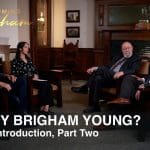



Becoming Brigham, Episode 4: Why Brigham Young?

Is there any purpose to revisiting the life and times of Brigham Young? Don’t we already know everything there is to know about this sometimes-controversial historical figure? Camrey, Dan and John are joined in a roundtable discussion by Matt Grow, who is the managing director of the Church History Department.

Becoming Brigham: The Video Series Premieres

For well over a year now, Redbrick Filmworks and the Interpreter Foundation have been working on a series of mini-documentaries bearing the title “Becoming Brigham.” The first episode goes live today, Monday, 26 January, at noon. (And one of the places where it will be accessible is right here at “Meridian Magazine.”). Further installments will appear on successive Mondays. Each episode—of which there will eventually be about 70 or 75—will run approximately fifteen minutes.
They’re hosted by Camrey Bagley Fox, who portrayed Emma Smith in the Interpreter Foundation’s 2021 dramatic film “Witnesses” and its 2024 film “Six Days in August”; by John Donovan Wilson, who played Brigham Young in the latter film; and by a retired Brigham Young University professor of Islamic studies and Arabic who shall remain nameless lest potential audiences be dissuaded from watching. Each episode features footage shot on location in New York, Ohio, Illinois, Iowa, Nebraska, and Utah, as well as extensive interviews with numerous Latter-day Saint historians who are experts on the subjects being discussed.
In fact, one of the most pleasant aspects of the project has been the wonderful support that it’s received from the Church History Department in Salt Lake City and from the overseers of the historical sites where filming has been done. The creators of “Becoming Brigham” have worked closely with Brent Rogers,
Managing Historian of the Church History Department, and have thus far completed interviews with such scholars as Thomas G. Alexander, James B. Allen, Susan Easton Black, LaJean Carruth, Gerrit Dirkmaat, Brett Dowdle, Ron Esplin, Matt Godfrey, Casey Griffiths, Brittany Chapman Nash, Reid Neilson, John Peterson, Paul Reeve, and Lisa Olsen Tait.
What’s behind the project? A significant factor behind it comes from my disappointment, over the past two or three years, at encountering active members of the Church of Jesus Christ of Latter-day Saints who disparage Brigham Young, the Church’s second president.
Some seem compelled to open any discussion of Brigham by describing him as “flawed.” And in an important sense, of course, this is surely true: Jesus Christ excepted, we’re all flawed—including Brigham’s critics. He certainly didn’t claim perfection for himself. “There are weaknesses manifested in men that I am bound to forgive,” he said on one occasion in 1860. “I am right there myself. I am liable to mistakes,” he continued, acknowledging that he was just as set in his feelings as any man alive, but, he said, “I am where I can see the light. I try to keep in the light.”
Often, the clear insinuation of describing Brigham as flawed seems to be that he was somehow uniquely flawed. Trying to reassure me that, despite his imperfections, they still accept him as the Lord’s instrument in his day, some people have explained to me that, well, God can work through wicked men. But I object to such statements. While he surely had his limitations and his flaws, Brigham Young wasn’t a wicked man. He was a good man.
Some go beyond merely talking him down. There are those who say that Brigham Young and the Quorum of the Twelve engineered an “apostolic coup” to usurp leadership of the Church. One active Church member told me that Sidney Rigdon should have assumed the presidency (or, as Sidney liked to call it, the “guardianship”) instead, but was tragically cast aside by the machinations of Brigham and the apostles. A few former members even assert that it was Brigham Young, using John Taylor and Willard Richards as his “hit men,” who planned the death of Joseph and Hyrum Smith at Carthage Jail—perhaps so they could forge Doctrine and Covenants 132 and impose plural marriage upon the Church. This would be mere laughable nonsense—no serious historian of whom I’m aware accepts it—if it weren’t so repugnant, slanderous, and evil. (The mob and the Carthage Greys must have been surprised and baffled when, having arrived to murder Joseph and Hyrum, they found that Elders Taylor and Richards had already done the killing. But they kept the secret throughout their lives, even when some of them were on trial for the crime. Amazing? No, ludicrous.)
The real historical Brigham Young was the last man who would ever have raised his hand against Joseph Smith. He was absolutely dedicated to the Prophet, both before and after the martyrdom in 1844.
An important scene in the Interpreter Foundation’s 2024 feature film “Six Days in August,” solidly rooted in history, beautifully illustrates his dedication. It depicts Brigham and Heber and others traveling secretly to Far West, Missouri, in obedience to Doctrine and Covenants 115:11 and 118:5, which directed them to depart for their mission to England from the temple site there on 26 April 1839. Such direction made perfect sense when the Saints were still located in Missouri. On 27 October 1838, however, Missouri’s governor, Lilburn W. Boggs, had issued his infamous “extermination order” against the Latter-day Saints and, by April 1839, the Church was gathering to western Illinois. Thus, returning to Far West for a departure to England made little earthly sense—it was in the wrong direction, for one thing—and, in fact, being there as a Latter-day Saint was extraordinarily dangerous. For Brigham and Heber and their companions, though, if Joseph Smith said to depart from Far West, they would do it.
In the early days of the Church, many once-faithful Saints fell away because they would no longer sustain Joseph as the Lord’s anointed prophet. In fact, Joseph said of the leaders in Kirtland that there were only two who had never “lifted their heel” against him—”namely Brigham Young and Heber C. Kimball.” (Heber C. Kimball, of course, was Brigham’s closest friend, even before their joining the Church, and eventually served as Brigham’s first counselor in the Church’s First Presidency.)
Another famous story illustrates Brigham’s deference to the Prophet Joseph. On one occasion, Joseph severely rebuked Brigham—who, you may recall, eventually came (for good reason) to be known as “the Lion of the Lord.” After the Prophet’s chastisement, everyone in the room waited for Brigham’s response, perhaps expecting an eruption. But his reply was, sincerely and simply, “Joseph, what do you want me to do?”
“I felt in those days,” Brigham later recalled of the time before he encountered the Book of Mormon and the Church, “that if I could see the face of a prophet, such as had lived on the earth in former times, a man that had revelations, to whom the heavens were opened, who knew God and his character, I would freely circumscribe the earth on my hands and knees.” And, in Joseph, he knew that he had found such a man.
“I know how I received the knowledge that I have got,” Brigham reflected in 1866. Remembering his early years with Joseph, he said “I had but one prayer, and I offered that all the time. And that was that I might be permitted to hear Joseph speak on doctrine, and see his mind reach out untrammeled to grasp the deep things of God.” Of his own relationship to Joseph, Brigham said that “an angel never watched him closer” and that he “would constantly watch him and if possible learn doctrine and principle beyond that which he expressed.” It required several years of this close attention to the Prophet, he declared with a bit of exaggeration, “before I pretended to open my mouth to speak at all.” Brigham Young took care never to “let an opportunity pass of getting with the Prophet Joseph and of hearing him speak in public or in private, so that I might draw understanding from the fountain from which he spoke.” “This,” he insisted, “is the secret of the success of your humble servant.”
Brigham Young often spoke of Joseph and his work: “I honor and revere the name of Joseph Smith,” he said in 1870. “I delight to hear it; I love it. I love his doctrine.” “I feel like shouting hallelujah, all the time,” he said in 1855, “when I think that I ever knew Joseph Smith, the Prophet whom the Lord raised up and ordained.” “I am bold to say,” he testified in 1862, “that, Jesus Christ excepted, no better man ever lived or does live upon this earth. I am his witness.”
On his deathbed, according to reports, the last words uttered by Brigham Young were “Joseph! Joseph! Joseph! Joseph!” If this is true, it wouldn’t surprise me to learn that the Prophet personally came to welcome his great successor and faithful disciple into the next world. Intriguingly, in this context, it’s reported that Emma Smith’s last words, spoken in Nauvoo on 30 April 1879, were, “Joseph! Joseph! Joseph!” and “Joseph, I am coming!” Just days before her death, she said that she had seen him in a dream, along with their deceased son Don Carlos and the Savior. Joseph, she said, took her to a beautiful mansion and promised her that she would have all of her children in the world to come.
One of the themes that have emerged from the making of “Becoming Brigham” is that, as the historian Ronald K. Esplin says in an interview for the series, among all the claimants to Church leadership who emerged after the murders of Joseph and Hyrum in mid-1844, it was only Brigham and the Twelve who wanted to carry out the full program and carry on the teachings that Joseph had laid out in Nauvoo. Prominent elements of Joseph’s agenda were the completion of the temple and, somewhat paradoxically, forsaking it for the Great Basin West. No other claimant to the succession—including Sidney Rigdon—was so committed to moving forward with those goals. And (no small point!) it was with the Twelve that the keys of priesthood authority resided after the deaths of Joseph and Hyrum.
On 8 August 1844, in the dark days following the martyrdom of the Prophet and the Patriarch, Brigham made this clear to the Saints, “You cannot appoint a prophet,” he said, “but if you let the Twelve remain and act in their place, the keys of the kingdom are with them and they can manage the affairs of the church and direct all things aright.”
Brigham Young and his fellow apostles understood the importance of completing the Nauvoo Temple, as many other would-be leaders (including, apparently, Sidney Rigdon) did not. But it wasn’t only a legacy project for them, an inheritance from their departed friend, Joseph Smith. And the challenges and threats from enemies of the Saints continued, while the pressure on them mounted to abandon Nauvoo and to leave. As the chief apostle, Brigham sought and received revelation. Having inquired of the Lord whether they should stay and finish the temple, he recorded simply in his diary for 24 January 1845: “The answer was we should.”
As President James E. Faust observed, Brigham Young had unwavering confidence in what he was doing because he knew that the plan was not his own. As he told the Saints nearly a decade after their arrival in the Valley of the Great Salt Lake, “I did not devise the great scheme of the Lord’s opening the way to send this people to these mountains.” Well then, who did? “It was the power of God that wrought out salvation for this people,” he insisted. “I never could have devised such a plan.” As one nineteenth-century non-Latter-day Saint visitor to his office recorded (and as others also noted), Brigham had remarkable self-confidence and “absolute certainty of himself and his own opinions.”
“Becoming Brigham” is an attempt to portray Brigham’s earliest encounter with the Restoration, his conversion, his training as an apostle for eventual leadership of the Church, the rise of the Twelve from their initial role as an outwardly-oriented missionary quorum to their eventual leadership of the overall Church. It will discuss Brigham Young’s presidency of the Church, including unvarnished examinations of controversial issues such as violence in Utah Territory (e.g., the notorious Mountain Meadows Massacre), race and slavery, relations with Native Americans, and plural marriage.
It relies upon the best available research concerning Brigham Young and the Twelve to provide a picture of the man that differs from the image in many minds. When I was growing up, I knew of Brigham as the great colonizer, a practical man, an organizational genius. But there was much more to him than that. As the late historian D. Michael Quinn pointed out, “One of the recurring themes in non-Mormon biographies of President Brigham Young is the idea that he was not a very spiritual man. Such interpretations, however, not only misrepresent his character, they also totally disregard the evidence, both published and unpublished, that refutes such a stereotype.”
Nor is the image of Brigham as harsh, callous, and autocratic true to the historical record. “Those of us who have worked with Brigham Young’s words,” says LaJean Carruth in an interview for “Becoming Brigham,” “we see a completely different man, a kinder man. A caring man. A loving man. . . . He wanted to serve God, and he strove with everything he had to lead the Saints.”
“I came to know a man,” says Ron Esplin, “whose heart was with the Lord from the very beginning. . . . He believed in Jesus. He believed enough to follow a disciple of Jesus named Joseph Smith.” As Lisa Olsen Tait puts it, “I do think that Brigham Young, fundamentally at the core of his soul, wanted people to flourish . . . and the way that would happen was by embracing the gospel of Jesus Christ . . . . I kind of like Brigham Young, actually. I think he’s very down-to-earth. I think he’s very human.” “And the people who knew these people best,” says Gerrit Dirkmaat, “like the people who knew Joseph, the people who knew Brigham, well, they’re the ones who are certain that they’re prophets.”
Members of the Church of Jesus Christ of Latter-day Saints today who disparage Brigham Young’s character and divinely-ordained leadership, whether they realize it or not, are sawing away at the branch of the tree on which they themselves sit, the line through which modern priesthood authority and temple ordinances come.
Modern prophets and apostles know better: President Gordon B. Hinckley, for example, kept a portrait of Brigham directly behind his desk, finding strength and inspiration in contemplating it. He often referred to the portrait, commenting that Brigham seemed to “watch over” the work of the Church.
But those who disdain Brigham Young aren’t wrong because accepting their opinions would have bad implications for the Church. They’re wrong because they’re wrong.
**
Several of the quotations used above may be found, with supporting references, in an excellent speech by President James E. Faust, entitled “Brigham Young: A Bold Prophet” (https://speeches.byu.edu/talks/james-e-faust/brigham-young-bold-prophet/).
Hulu Takes Another Jab at the “Mormons”

To read more from Daniel, visit his blog Sic Et Non.
Every week, it seems, there’s a new Hulu or Netflix miniseries focused on Latter-day Saints — and these productions never seem to be positive, friendly, sympathetic, or even balanced. The latest of them — so far as I’m aware! — is Hulu’s Devil in the Family: The Fall of Ruby Franke. With his kind permission, I share something that Christopher Blythe posted a day or two ago on his Facebook page, about Devil in the Family:
I watched the new Ruby Franke docu-series on Hulu. It wasn’t terrible as far as these things go, but, for me, was often hard to watch. I was annoyed by the effort to contextualize my home (“Happy Valley” as the show repetitively called it the first fifteen minutes) and my people in ways that made them seem particularly other from the rest of America in all the worst ways. One of the first silly comments was a guy explaining that “Mormons go on missions to show the world how perfect their lives are.” Uhhhh…. I spent two years on my feet and it definitely wasn’t to convince people we were perfect. Lol. The basic theme of the show was that the faith had caused this once idealized family to seek the appearance of perfection, filled them with guilt, etc. I’m not saying the LDS context isn’t important – I’ve made my career writing about similar things – but I am saying that there is no direct line from LDS-ness to abusing your children, internalized guilt that allows manipulation from psychologists and spouses, or the belief that “woke children” are zombies. But mainly I am exhausted by show after show commercializing my people by stereotyping them as secret hypocrites who present perfection to the world but are actually mentally unstable and dangerous; easily manipulated victims of conmen; sexually repressed; and “in a bubble.” I became a Latter-day Saint 30 years ago and observe our culture professionally. I am convinced that I am surrounded by folks that have lived around the world, speak multiple languages, have overcome great challenges, and are personally and professionally innovative. Sure, I want us to be more mystical and less materialistic, but I am so grateful to have had the opportunity to claim a place among this group of believers.
Meanwhile, in other movie news related to Latter-day Saints, Witnesses is still available for free streaming, contrary to my expectations. And Six Days in August can be streamed from several platforms, though not for free. We probably shouldn’t leave it entirely to Hulu and Netflix to tell our stories for us. They may not have the best interests of the Kingdom at heart.
Perhaps we should make some of our own movies? Today, by the way, our core group of filmmakers captured an interview by John Donovan Wilson of Professor Gerrit Dirkmaat. It’s for the Interpreter Foundation’s documentary series Becoming Brigham, which is now in the first stages of production. I wanted to be there for the interview, which is based on his remarks to the eleventh annual birthday part of the Interpreter Foundation, “Sweeter Than Honey: Brigham Young’s Devotion to Joseph Smith’s Teachings After the Martyrdom.” I regard the interview with Gerrit as a vitally important one for our project, but I was unable to make it.
Also on the subject of cinematography (which seems, for some reason, to be much on my mind of late): I’m very pleased to see that the short film The Good Samaritan — a 45-minute dramatic re-creation of the biblical parable known by that name — won the Audience Choice award at the recent Zions Indy Film Fest. James Dalrymple was the director, while Howard Collett was the producer. I consider them both friends, have worked with both, and look forward, if it proves feasible, to working with them again in the future. Howard, in fact, is our former neighbor and bishop, and is part of a very small — five-member! — reading group in which my wife and I also participate.
One last movie note: I’m hoping to be able to watch this in the not too distant future: “‘Sharing Aloha’: Emotion-rich new documentary about the Polynesian Cultural Center full of ‘magic’:The subjects of a new film by the director of ‘Meet the Mormons’ say he captures the miracles that Hawaii’s most-popular tourist attraction generates in their lives”

FEATURES