





Does the Book of Mormon Fit on the Gold Plates?
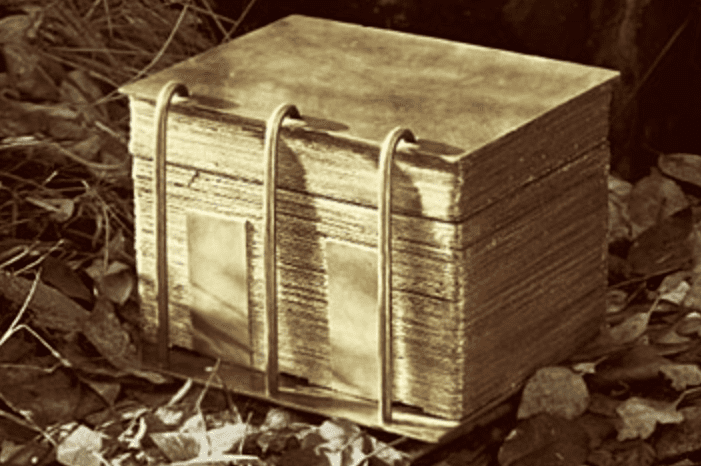
Nearly 200 years ago, on September 22, 1827, Joseph Smith claimed to have recovered an ancient record, engraved on gold plates, from a hill near Palmyra, New York. He had been led to the record by an angel four years earlier, and more than two years after he had taken the plates from the hill, he published the Book of Mormon as a translation of that record revealed to him by the gift and power of God. Eleven witnesses affirmed the historical reality of those plates, and though some left the church, all of them went to their graves testifying that they had seen the plates.
For two centuries, debate has raged as to whether Joseph really possessed and translated an ancient record, and in recent years, a new argument has been gaining traction: the Book of Mormon, some detractors claim, is too long to fit on the gold plates as described by Joseph Smith and the witnesses. Some of the biggest names in online discussions about religion, such as Catholic apologist Trent Horn and skeptic influencer Alex O’Connor, have raised questions about the feasibility of fitting the entire 270,000-word text of the Book of Mormon onto the unsealed portion of a six-inch stack of 6 x 8-inch plates.
A response to this claim by Josh Coates, the executive director of the non-profit B. H. Roberts Foundation, was presented at the 2025 FAIR conference in August and published in the Interpreter journal earlier this summer. Using descriptions of the plates given by the witnesses to establish his parameters, Coates literally did the math and found nearly one million configurations in which the entire text of the Book of Mormon—including the lost 116 pages—could fit onto a set of plates consistent with the historical record.
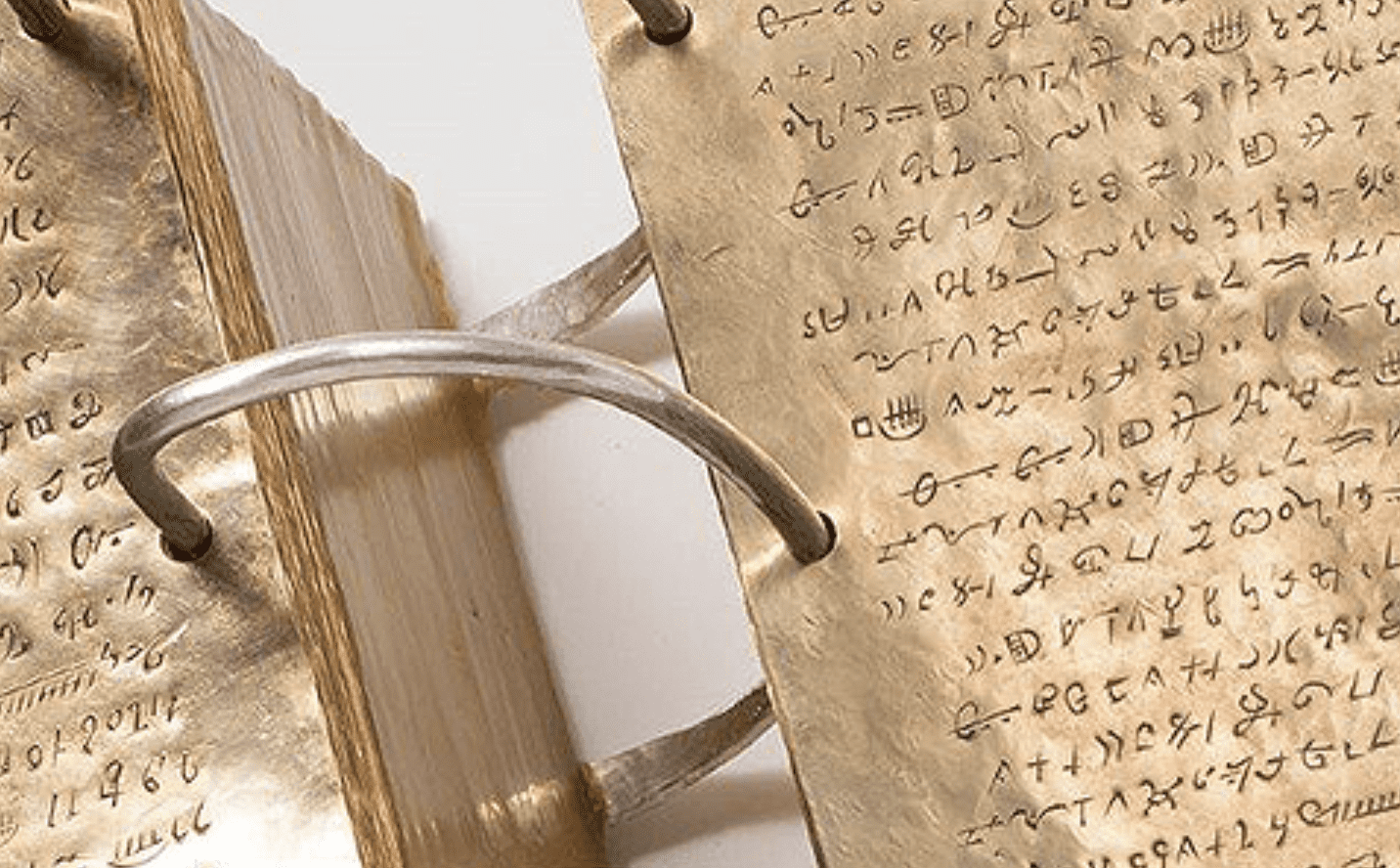
Yet some may still wonder how feasible it would be for ancient scribes and metalworkers to create a record consistent with the configurations produced by Coates, which require nearly 200 plates, each less than two-thousandths of an inch thick and written over in characters less than six millimeters in size.
To answer this question, I’ll compare three parameters discussed by Coates to artifacts found in the Old and New Worlds: (1) the size of the writing, (2) the thickness of individual plates, and (3) the total number of plates. A more in-depth review of this and other evidence can be found in my paper recently published by FAIR, where I comprehensively compared all the dimensions of the gold plates to archaeological discoveries.
Size of Writing
Coates found that the script on the plates could be no larger than 5.4 mm per character, while some configurations required the script to be as small as 2.5 mm per character. (For reference, 12-pt font is typically about 2–3 mm per character.) This may seem impossibly small, but there are numerous examples of metallic inscriptions from the ancient Near East written in script between 2 and 5 mm.
One of two small silver scrolls found in Jerusalem, and dated to 600 BC, has an average script size of 5.4 mm per character. The other, smaller scroll was engraved with characters an average of 3.25 mm in size. The Assyrian king Sargon II (ca. 722–705 BC) commissioned inscriptions onto tablets of silver and gold with characters around 4.5 and 3.5 mm, respectively. An earlier Assyrian king, Tukulti-Ninurta I (ca. 1243–1207 BC), commissioned a gold tablet inscribed with characters a mere 2.2 mm on average. Several other Assyrian inscriptions on gold and silver are known with writing between 3.4 and 4.5 mm.
Admittedly, many of these are relatively short inscriptions on small surfaces, but small writing was used on longer inscriptions, too. An unusually large silver amulet found in Egypt features a 38-line text that translates to nearly 1000 words, written in a small script averaging 1.6 mm per character. A Hittite treaty was engraved onto a large bronze tablet with over 350 lines and 4000 words in its English translation, written in characters that are on average 3.5 mm tall. A Roman legal code, approximately 20,000 words in its English translation, was engraved onto 10 large bronze tablets in Latin characters, an average of 5 mm in height.
The overall average character size across 24 metallic inscriptions I have examined is about 3.4 mm. Writing between 2–5 mm, then, was well within the capabilities of ancient Near Eastern scribes when writing on metals.
Thickness of Individual Plates
Several witnesses compared the thickness of the individual plates to “common tin” of their day. In the early nineteenth century, commercial tin-plate could be between 0.012–0.02 inches thick, with the most commonly available being 0.019 inches, according to Coates’ research. Coates, therefore, used 0.015–0.019 inches as his parameters for plate thickness. Others, such as geologist and engineer Jerry Grover, have argued that the plates could have been even thinner—between 0.005–0.01 inches—based on some witness statements that indicate the plates were “pliable” and comparable to thick paper.
But were pre-Columbian metalworkers capable of making such razor-thin plates? Yes. Gold-copper alloy discs from Nariño, Colombia, ranging from four to six inches in diameter, were measured to be generally about 0.012–0.02 inches thick, exactly the range of nineteenth-century tin plates. A fifth-century gold-copper alloyed bead found in Mesoamerica was made of hammered sheet metal between 0.012 and 0.016 inches thick. Similarly, a golden ornamental plume from Peru, dated to Book of Mormon times, is between 0.012–0.016 inches thick, and has an intricate design engraved on both sides, illustrating that plates this thin could be inscribed on both the front and back.
Even Grover’s estimates for pliable, paper-thin plates are supported by ancient artifacts. Golden crown-like diadems, “fabricated of flexible sheet metal that bends easily,” observes Julie Jones, are “among the earliest worked gold objects from South America.” Heather Lechtman examined gilded copper artifacts from northern Peru, dated to the early centuries AD, which had “edges that were paper-thin.” According to expert Warwick Bray, Peruvian goldsmiths could hammer gold-copper-silver alloys into a thin sheet merely 0.008 inches thick.
So archaeology confirms that thin plates made of gold and copper, comparable to the thickness of nineteenth-century tin or pliable, thick paper, could be manufactured in the Americas during Book of Mormon times.
Total Number of Plates
Even with small writing, the length of the Book of Mormon requires a large number of plates in order to fit on the unsealed portion, and if the plates are really only fractions of an inch thick, there would be hundreds in a six-inch stack. Coates’ calculations resulted in a range of 187–259 plates in the entire stack, while Grover, assuming the plates could be thinner, ended up with even higher estimates of 300–600 plates. Such a large volume may seem unrealistic, but once again, ancient examples of similar size abound.
I already mentioned the Roman legal code on 10 bronze tablets, dated to the first century AD. These tablets are each nearly two feet long and three feet wide—spanning 30 feet across when mounted side-by-side. The total surface area of these tablets is equivalent to 170 Book of Mormon plates of 6 x 8 inches each, as described by witnesses.
Matthew Roper, writing for Scripture Central, mentions several large sets of engraved copper plates, bound together by rings, from ancient and medieval India. One set of 57 plates, each about 16.3 x 9 inches, has a total surface area comparable to 174 Book of Mormon plates. Another set consists of 86 plates, each 17.3 x 8.3 inches, equivalent to 258 Book of Mormon plates. Roper has also identified a copy of the Quran found in China, engraved on 604 gold-gilded copper plates about 4.3 x 6.3 inches each, equivalent to 343 Book of Mormon plates.
Although not bound together as a set, a corpus of nearly 800 ancient Hindu hymns engraved on 493 large plates was discovered in India in 2023. These plates are nearly 27 inches long and 3 inches wide, making their total surface area comparable to 812 Book of Mormon plates.
Clearly, a large volume consisting of hundreds of metal plates is not outside the scope of attested historical practice.
Why Does This Matter?
The parameters required to fit the Book of Mormon onto the plates, as established by Coates and others, may seem extraordinary. Individually, however, each parameter is abundantly attested in archaeological discoveries. Still, the unique combination of small writing across hundreds of razor-thin plates should deepen our appreciation for the consecrated effort that went into making and preserving this sacred record.
Jacob noted “the difficulty of engraving our words upon plates” (Jacob 4:1), and Moroni lamented “the awkwardness of our hands” (Ether 12:24). These words gain greater meaning as we better understand the physical details of how many plates were needed, how thin the plates had to be, and how small they had to write to fit every word of this powerful testament of Christ.
With the recent the anniversary of Moroni’s visits earlier this week, it is worth reflecting on the generations of sacrifice required to engrave the Book of Mormon onto the very gold plates commissioned into Joseph Smith’s care on September 22, 1827, as well as how nearly 200 years’ worth of scholarly discovery now enables us to not only address challenges to our faith, but to also increase our gratitude for those who “labor[ed] diligently to write” (Jacob 4:3).
Neal Rappleye is a research associate for the Ancient America Foundation, and co-host of the newly launched podcast, Informed Saints. He has published widely on the ancient background of the Book of Mormon in Latter-day Saint academic venues. Through Informed Saints, he and his co-hosts seek to bring academic research on Restoration history and scripture to life in new and exciting ways for larger audiences.
The Miracle of Joseph Smith Discovering and Translating an Ancient Record
This article first appeared as part of a series celebrating the bicentennial of the First Vision in 2020. We are reprinting here as part of the Come Follow Me study of the Doctrine and Covenants.
Cover image via Gospel Media Library.
The fact that Joseph Smith actually discovered an ancient record is remarkable. But translating it so quickly was an even greater miracle. Truly the Book of Mormon is, as the Lord described it, “a marvelous work and a wonder.” Even so, the printed text of the book is still its own best evidence of historic, ancient authenticity.
Joseph was told by an angel sent from God, where to find the Book of Mormon plates. In 1838 he stated: “Moroni, who deposited the plates in a hill in Manchester, Ontario county, New York, being dead and raised again therefrom, appeared unto me, and told me where they were, and gave me directions how to obtain them. I obtained them, and the Urim and Thummim with them, by the means of which I translated the plates; and thus came the Book of Mormon” (History of the Church, 3:28).

The gold plates, from which Joseph Smith translated the Book of Mormon, were inscribed with ancient characters and revealed a powerful witness of Christ.
The plates are real! Many friends, family members, and other witnesses testified that the Prophet actually located metal plates inscribed with ancient Egyptian characters that they could heft and hold.
In 1842, the Prophet described the plates in amazing detail: “These records were engraven on plates which had the appearance of gold, each plate was six inches wide and eight inches long, and not quite so thick as common tin. They were filled with engravings, in Egyptian characters, and bound together in a volume as the leaves of a book, with three rings running through the whole. The volume was something near six inches in thickness, a part of which was sealed. The characters on the unsealed part were small, and beautifully engraved. The whole book exhibited many marks of antiquity in its construction, and much skill in the art of engraving. With the records was found a curious instrument, which the ancients called ‘Urim and Thummim,’ which consisted of two transparent stones set in the rim of a bow fastened to a breastplate. Through the medium of the Urim and Thummim I translated the record by the gift and power of God” (“The Wentworth Letter,” History of the Church, 4:536-541).
Witnesses also testified that Joseph not only had the plates, but that he translated them by the gift and power of God. Oliver Cowdery said: “I wrote with my own pen, the entire Book of Mormon (save a few pages) as it fell from the lips of the Prophet Joseph Smith, as he translated it by the gift and power of God, by means of the Urim and Thummim, or, as it is called by the book, ‘holy interpreters.’ I beheld with my eyes, and handled with my hands, the gold plates from which it was translated. I also saw with my eyes and handled with my hands the ‘holy interpreters’ (The Contributor, Volume 5, August 1884, no. 11).
Elder Neal A. Maxwell of the Quorum of the Twelve Apostles shared these insights about how the process of translating the Book of Mormon was a miraculous achievement:

Elder Neal A. Maxwell testified of the miraculous nature of the Book of Mormon translation, emphasizing its divine authenticity and rapid completion
“One marvel is the very rapidity with which Joseph was translating—at an estimated average rate of eight of our printed pages per day! The total translation time was about 65 working days. (See “How long did it take Joseph Smith to translate the Book of Mormon?” Ensign, Jan. 1988, 47.) By comparison, one able LDS translator in Japan, surrounded by reference books, language dictionaries, and translator colleagues ready to help if needed, indicated that he considered an output of one careful, final page a day to be productive. And he is retranslating from earlier Japanese to modern Japanese! More than 50 able English scholars labored for seven years, using previous translations, to produce the King James Version of the Bible, averaging about one precious page per day.
“The Prophet Joseph Smith would sometimes produce 10 pages per day! (see the bulletin Insights: An Ancient Window [Provo, Utah: Foundation for Ancient Research and Mormon Studies (F.A.R.M.S.), Feb. 1986], 1).
“A second marvel of the Book of Mormon translation process is that from what we know, rarely would Joseph go back, review, or revise what had already been done. There was a steady flow in the translation. The Prophet’s dictating resulted—just as the compositor, John H. Gilbert, remembered—in no paragraphing.
“Emma Smith said of the inspired process: ‘After meals, or after interruptions, [Joseph] would at once begin where he had left off, without either seeing the manuscript or having any portion of it read to him’ (“Last Testimony of Sister Emma,” Saints’ Herald, 1 Oct. 1879, 290). One who has dictated and been interrupted must usually resume by inquiring, ‘Now, where were we?’ Not so with the Prophet!
“If one were manufacturing a text, he would constantly need to cross-check himself, to edit, and to revise for consistency. Had the Prophet dictated and revised extensively, there would be more evidence of it. But there was no need to revise divinely supplied text. Whatever the details of the translation process, we are discussing a process that was truly astonishing!” (“By the Gift and Power of God,” Ensign, January 1997.)
Dr. Hugh W. Nibley noted that in addition to the miraculous discovery of actual plates, the spectacular translation of the record, and the impressive testimonies left by numerous witnesses, the best evidence of the Book of Mormon’s historicity as an ancient record, is to be found by simply examining the text of the book itself.
He wrote a witty parable, which cuts to the very heart of the matter. The Book of Mormon itself—not what others say or think about it—matters most, when it comes to historical authenticity. Put the gem (the Book of Mormon) to well-known tests for true ancient gems to see if it measures up or not. And does it ever! In the past 200 years of close examination, the Book of Mormon has never come up short in proving itself to be an authentic record of ancient origin. Here’s Dr. Nibley’s parable:
“A young man once long ago claimed he had found a large diamond in his field as he was plowing. He put the stone on display to the public free of charge, and everyone took sides. A psychologist showed, by citing some famous case studies, that the young man was suffering from a well-known form of delusion. An historian showed that other men have also claimed to have found diamonds in fields and been deceived. A geologist proved that there was no diamonds in the area but only quartz. The young man had been fooled by a quartz.
“When asked to inspect the stone itself, the geologist declined with a weary, tolerant smile and a kindly shake of the head. An English professor showed that the young man in describing his stone used the very same language that others had used in describing uncut diamonds: he was, therefore, simply speaking the common language of his time. A sociologist showed that only three out of 177 florists’ assistants in four major cities believed the stone was genuine. A clergyman wrote a book to show that it was not the young man but someone else who had found the stone.
“Finally an indigent jeweler named Snite pointed out that since the stone was still available for examination the answer to the question of whether it was a diamond or not had absolutely nothing to do with who found it, or whether the finder was honest or sane, or who believed him, or whether he would know a diamond from a brick, or whether diamonds had ever been found in fields, or whether people had ever been fooled by quartz or glass, but was to be answered simply and solely by putting the stone to certain well-known tests for diamonds.
“Experts on diamonds were called in. Some of them declared that they could not very well jeopardize their dignity and reputations by appearing to take the thing too seriously. To hide the bad impression thus made, someone came out with the theory that the stone was really a synthetic diamond, very skillfully made, but a fake just the same. The objection to this is that the production of a good synthetic diamond 120 years ago would have been an even more remarkable feat then the finding of a real one” (Lehi in the Desert; The World of the Jaredites; There Were Jaredites, Deseret Book and FARMS, 1988, 121-22).
Many scholars have produced papers, books and presentations analyzing every word and phrase in the Book of Mormon. The more research we do, the more genuine the historical authenticity of the text is revealed. The record is real. The translation is remarkable. And the evidences for the truthfulness of the text just keep coming.
Proctors on a Mission #15—Some Assignments are a Surprise
When a football team huddles during a game, the quarterback whispers a play to them, and the players, tensed and ready, know just what to do. They have memorized their team’s plays and are ready. But then, when the quarterback is at the line, facing the opposing team, he may realize another call would be better and he calls an audible.
What’s an audible? It means to change plans at the last minute based on newly revealed information. You were certain something was going to be one way, but when you get the whole picture, it turns out to be another.
We received an audible on our mission directly through revelation, as clear and certain as possible. It wasn’t a direction to move us from our mission, because we love being here, but to augment it. Here’s how it came to be.
Once in a while, we hear, with grief, that a friend is leaving the Church, and many times, they say they have learned something about Joseph Smith that has pained and rocked them. We hear these sentiments with sorrow which is then followed by a question for us. Do they really know Joseph Smith or are they responding to some caricature of him that someone has devised? Do they understand the entire context of the event, attribute or moment they take such offense at?
We ask these questions because we love Joseph, have written books about him, witnessed of his prophetic role, and taken people on church history tours for more than thirty years. We are deeply versed in his life and the restoration. What we inevitably hear at the end of our church history tours is this, while someone shakes their head. “I thought I knew, but I never knew Joseph Smith.”
As we discussed this in May, suddenly we received a flow of light, sweet intelligence and a sense of assurance about something we had to do. It was a calling, and we both knew it, with that sense of astonishment one feels when you know you have received revelation.
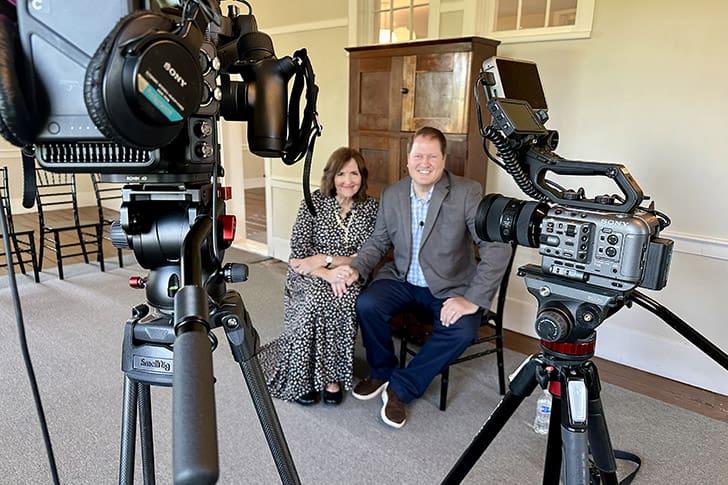
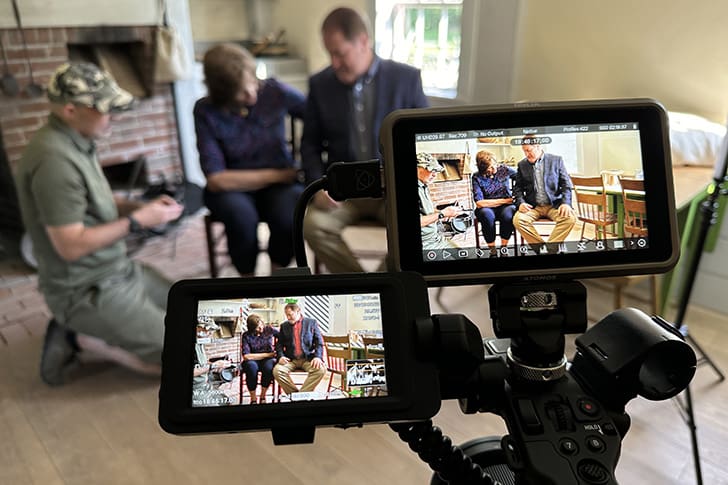
We were to create a series of 60 or more mini-documentaries on the life of Joseph Smith, using the Ken Burns style of film making. Burns takes you to a place and time with images, video footage, and voice actors who help tell the story through the quotes of contemporaries who experienced that time.

As such, they will have a different flavor than other wonderful and moving film and video that have been done on Joseph Smith’s life. They will give more detail, more actual quotes, more deep dive into Joseph’s life. Though they are mini-docs they are many.
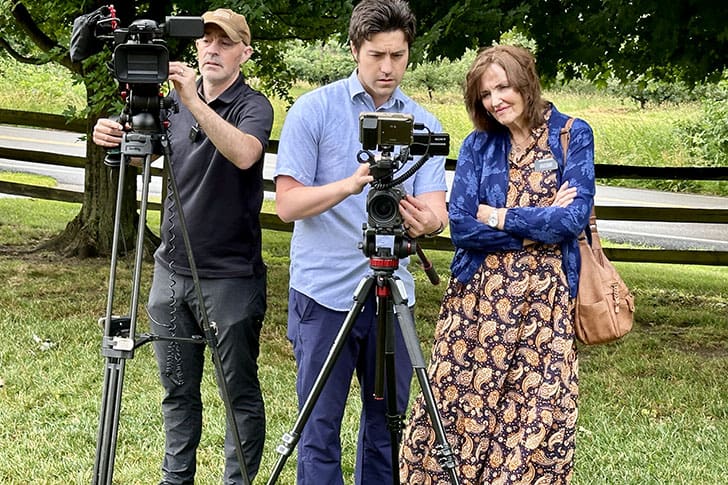
As I described, these documentaries are short and aim to tell the history of Joseph in a way that is textured and rich, faithful and moving, with all the details that demonstrate that this is one of the most compelling dramas to unfold in this time.
What is the world to make of a man who declares that the heavens have burst open and knowledge of God has been given again to humanity? that he has been visited by an angel who has given him an ancient record testifying of Jesus Christ—and then actually produces that record? that he has seen God the Eternal Father and His Son Jesus Christ, who have told him that none of the creeds of the world are correct?
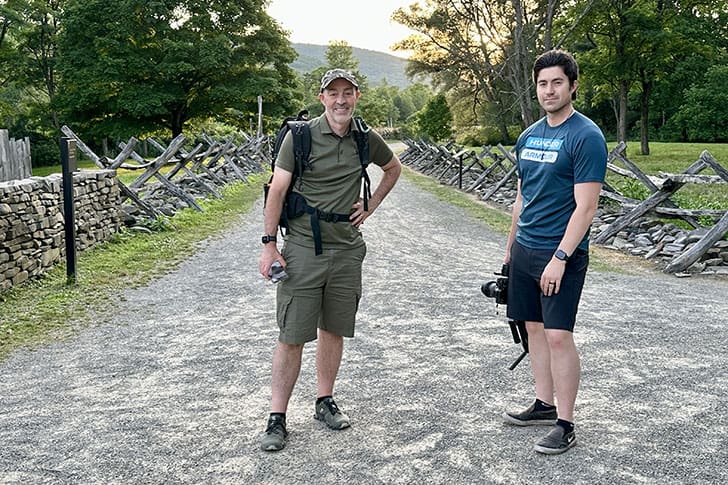
That’s the story. It is a tall project, but as we committed ourselves to it, things started to fall quickly in place. We had to begin shooting in the green of summer, so to shoot Kirtland and the eastern Church history sites meant we would have to leave the mission for 12 days. We had to find the right cinematographers—those who were gifted with a video camera as well as loved the history. Artists with light who knew that movement tells a story. You can so easily tell the difference between a news broadcast and a well-crafted movie scene.
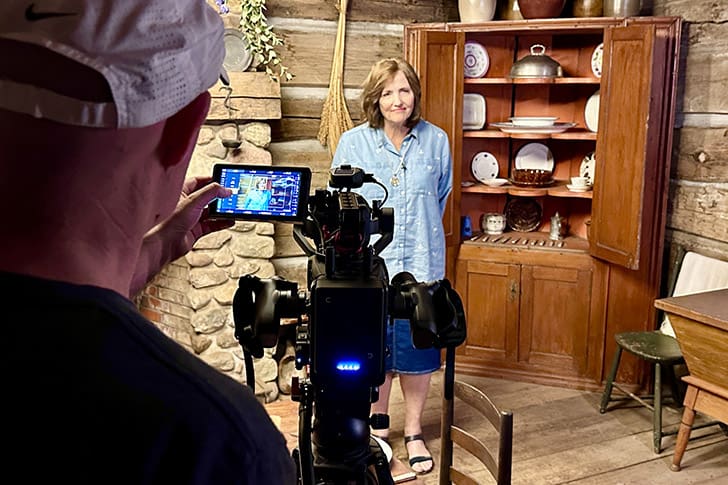
We found these cinematographers in Robin and Geoffrey Saville, a father and son team, who worked seamlessly and endlessly. During those twelve days of work, we had to be at our first spot at 5:30 for sunrise (which usually meant a 4:00 am wake-up call) and often ended back at our hotels as late as 11 p.m. How many nights can you function on four hours sleep? What the body can endure in one night, it balks at the next. Sleep is definitely not over-rated.
We found people who could support the first round of shooting with financial resources. Everywhere we turned was cooperation and friendship from the senior missionaries, arborists and site presidents at each church history location.

When one says that the weather cooperated, you think of big sunshine and bright blue skies. The weather has to do much more for those who create beautiful images. It has to give surprises, light shows, clouds that move in time for sun bursts.
The morning we were at the Kirtland Temple, we drove there while it was dark and the moon was still up. The moon was large and orange, as if we were looking through a filter, and we arrived at the temple in time to capture that orange moon.
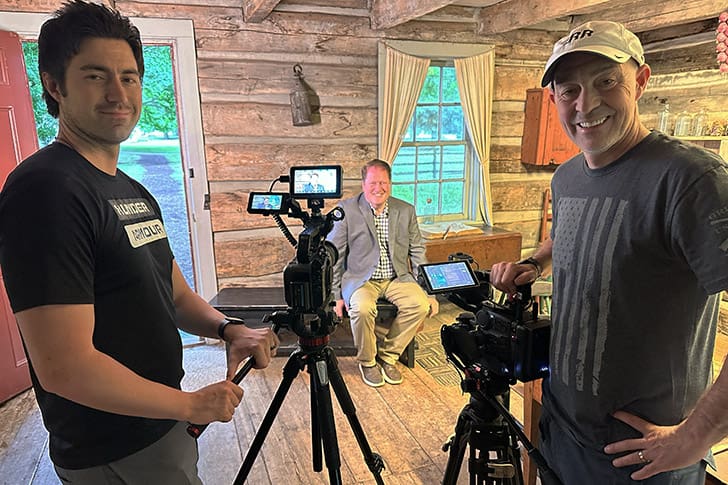
Then, as the sun arose, a low mist lined the hills behind the temple, and were tinged, layer upon layer with pink. No matter how skilled you are at cinematography you cannot do better with an image than what you are given. This exceptional morning was a gift, and, Robin, who is a licensed FAA drone pilot (and undoubtedly the best in the Intermountain West), flew that drone over the temple to create video that was magical. We took it as a divine signature upon the work.
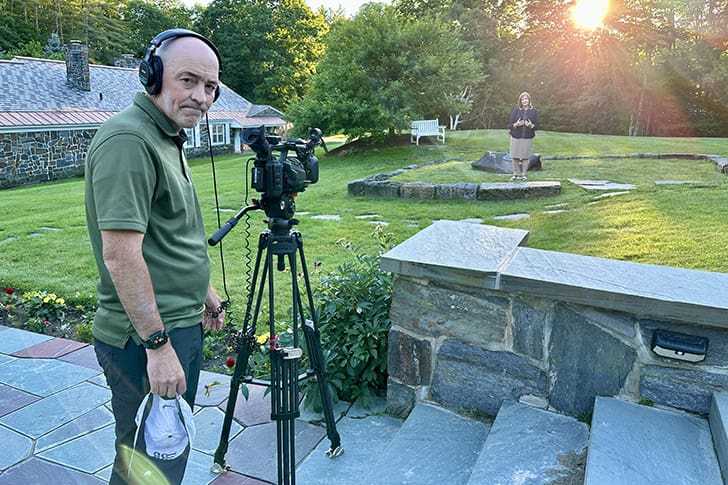
We will give occasional updates of the Joseph Smith Documentary (JSD) as they happen.
Our Love Note to Freddy
In our mission, we are using family history as a major tool to find new friends, who might investigate the Church, as well as help members find names to take to the temple.
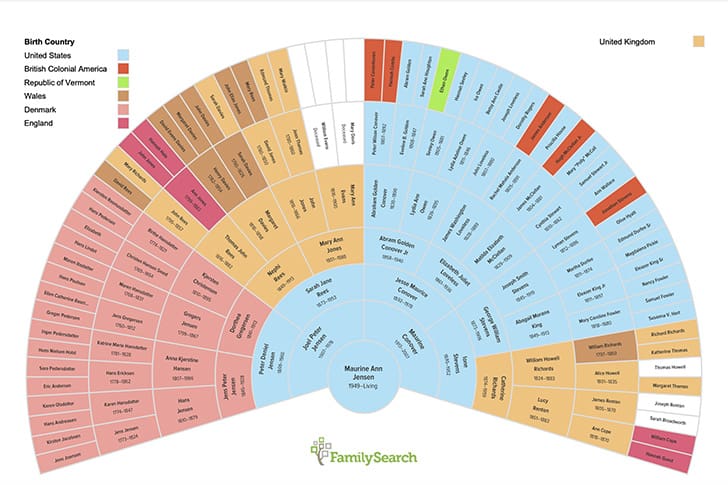
Scot and I have been assembling our finished family history booths for the mission for many months, and the final product looks very professional. It has many pieces and parts, including two large banners, many old family photos, a sample fan chart, and so much more. Since all, but the original banner, which the Church printed for us in Utah, were created in Puerto Rico, we have been in and out of a local Fast Signs shop again and again. They helped us figure out that we needed to print the photos on PVC so they were durable and would last. They walked us through step by step, and we grew confident of their skill.
Screenshot
Then, when we came to pick up the signs (quite a heavy load since we were making 12 booths), the owner, who calls himself Freddy instead of his longer Puerto Rican name, asked Scot between trips to the car, “What’s this?” He was pointing to the fan chart, which was completely full, with the lines colored by origin. Scot showed Freddy how, from the central person, each new circle showed the person’s parents, their grandparents, their great-grandparents and so forth.
Freddy was heartfelt, “I want one of these.” He wanted to see his family, too, laid out and marching back through generations. Then Scot took a load to the car.
Not knowing what Scot had said, I asked Freddy, “Do you know what family history is?” He said, “No.” I showed him the fan chart and gave him the same explanation he had just heard. Then he started to open up to me.
He said, “I have never known who my father is. I wouldn’t know him if he walked into this shop and ordered something. He is anonymous for me. I begged my mother for years and years to tell me, but she adamantly refused.”
Hearing how much this hurt him, I tentatively suggested that maybe she might change her mind? He lamented, “No, she died five years ago.” For him that door was forever closed, but the yearning to know the identity of his father was not extinguished. He longed for this information.
I told him that we were helping people with their family history and he gave us a plaintive look, and tapped his heart, saying how much he wanted to know anything he could find out. He made a prayer gesture with his hands. It was a plea, a groaning from his soul, not just a trivial need. Scot returned, pulled up his phone, and asked Freddy if he knew the name of one of his grandparents who had passed away. (This was, of course, on his mother’s side.)
He knew his grandfather’s name and he thought he knew where he was born. Scot was on FamilySearch, and asked again, “Is your grandmother’s name Catalina?”
“Yes!” Freddy exclaimed. “How did you know?” He pointed to his arms. “I have goose pimples.”
It was a moment of such deep connection between us, with all the formalities of his being a store owner and our being customers cast aside. Here was his heart, right on the line, and we could not get him off of our mind.
The next series of family history training we did with our missionaries, we used a video from President Eyring as the basis. In it he said that we have more than casual curiosity about our families.
Of course! The Lord who has created eternity as a large, unending family unit would place into our souls “more than just a casual curiosity”. It is a longing for our roots, a sense that we cannot know ourselves until we know them, that line of ancestors who gave us breath.
Family History Zone Conference
We flew into Puerto Rico from Boston where we had been shooting the Joseph Smith mini docs at 3:00 am, went home for three hours and slept and then had zone conference that was entirely focused on teaching the gospel, using family history as the bridge between missionary work and the temple. In our mission, we speak often of beginning with the end in mind, which is making covenants in the temple that bind ourselves to God and to our families.
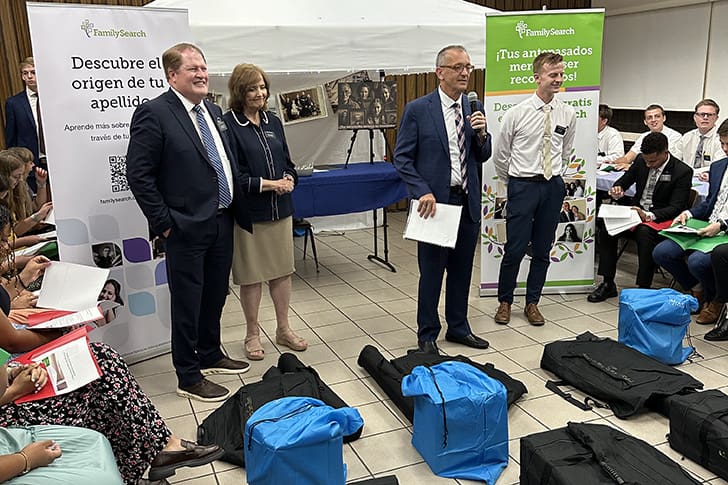
In this conference, every district was given a family history booth, directions on how to assemble each part of it, including how to keep it protected, neat, and ready for the next usage. (These exceptional missionaries, are, after all as young as 18 or 19, and still may not have been keeping their bedroom clean at home.)
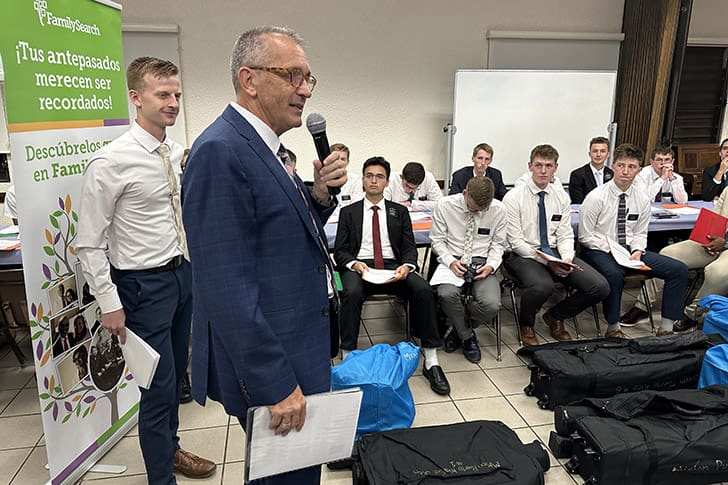
Far more important, our mission president, Paul Horstmeier, called on the words of the prophets to demonstrate this unbreakable link between family history and missionary work.
We currently have three grandsons heading for Spanish-speaking missions and we wish they could use this powerful connection in their mission. I wish we could call each of their mission presidents and share with them the remarkable experiences we are having here in Puerto Rico using family history to find new friends.
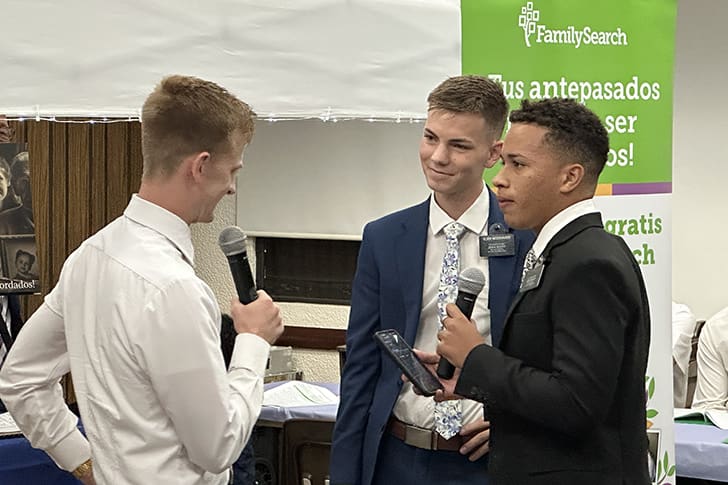
Missionaries must be trained. They must see how to do it. They must understand it soul deep. So, at our zone conference, our mission president called on the prophets to teach us, with their own recorded words.
President Nelson:
“Those who are joining the Church are joining precisely because their ancestors have been praying for one of their posterity to join the Church so that they, the ancestors, can receive their essential ordinances by proxy” (quoting George Q. Cannon).
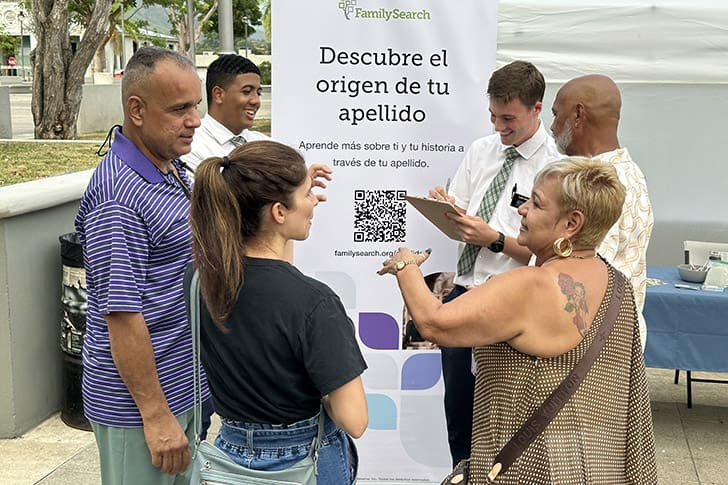
He also suggested some good missionary questions that may be a surprise. They have not been the usual questions our missionaries have asked over the years:
“Tell me about your family heritage.
“Are your parents living?
“What about your grandparents?
“Would you be interested if we could find the names of some or maybe all of your grandparents?”
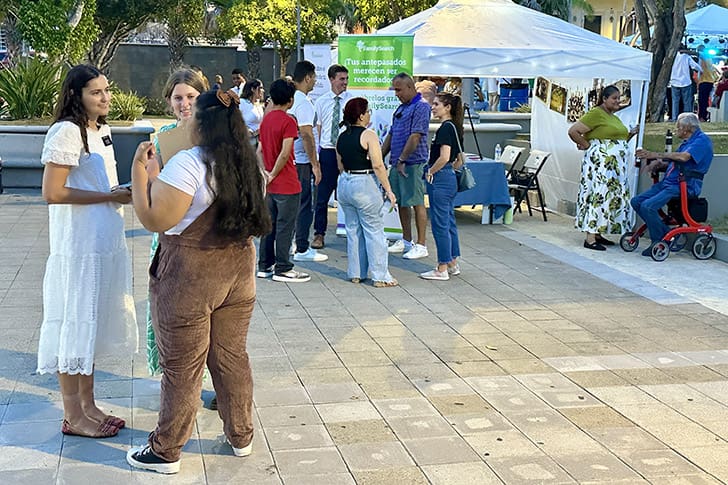
Our missionaries have the goal of setting up a family history booth at least once a month in their districts at festivals, markets and celebrations. That means that every month we will have at least 12 family history booths operating somewhere on the island. It also means we have happy missionaries, because their ability to enter into great conversations grows with people. Those Elijah moments when people feel stirred to turn their hearts to their fathers easily become gospel discussions. Our biggest challenge may soon become keeping up with the people who are interested!
FEATURES