








Have you ever felt that you aren’t good enough—that you don’t measure up? That others are better than you? Have you ever worried about what other people think of you? That your weaknesses are so obvious to others? Do you fear that if they ever looked behind your façade, they probably wouldn’t like what they might see?
If so, you’re not alone. That’s the bad news.
But here’s the good news.
There can be strength in weakness.
In fact, weak people are exactly the type of people the Lord loves to choose to help him in his work.
The Lord said it himself:
Wherefore, I call upon the weak things of the world, those who are unlearned and despised, to thresh the nations by the power of my Spirit. D&C 35:13
Notice how the prophets throughout history felt when God chose them:


You might have noticed a glaring omission in the previous list of prophets—Moses. Since the Come Follow Me curriculum takes us through the book of Exodus in the Old Testament, let’s look into the life of Moses, one of the greatest of all the Hebrew prophets. At the age of 40 Moses murdered an Egyptian who was beating one of his fellow Hebrews. He abandoned his privileged Egyptian lifestyle and spent the next 40 years as a fugitive tending sheep in the desert. At the age of 80, when he met God at the burning bush, Moses felt so unqualified that he turned down his prophetic calling.
In fact, he turned it down EIGHT TIMES!
God said to Moses:
Now go, for I am sending you to Pharaoh. You must lead my people Israel out of Egypt. Exodus 3:10 NLT
Refusal #1. But Moses protested to God, “Who am I to appear before Pharaoh? Who am I to lead the people of Israel out of Egypt?” Exodus 3:11 NLT
Refusal #2. But Moses protested, “If I go to the people of Israel and tell them, ‘The God of your ancestors has sent me to you,’ they will ask me, ‘What is his name?’ Then what should I tell them?” Exodus 3:13 NLT
Refusal #3. But Moses protested again, “What if they won’t believe me or listen to me? What if they say, ‘The Lord never appeared to you’?” Exodus 4:1 NLT
Refusal #4. But Moses pleaded with the Lord, “O Lord, I’m not very good with words. I never have been, and I’m not now, even though you have spoken to me. I get tongue-tied, and my words get tangled.” Exodus 4:10 NLT
Refusal #5. But Moses again pleaded, “Lord, please! Send anyone else.” Exodus 4:13 NLT
Refusal #6. Then Moses went back to the Lord and protested, “Why have you brought all this trouble on your own people, Lord? Why did you send me? Ever since I came to Pharaoh as your spokesman, he has been even more brutal to your people. And you have done nothing to rescue them!” Exodus 5:22,23 NLT
Refusal #7. “But Lord!” Moses objected. “My own people won’t listen to me anymore. How can I expect Pharaoh to listen? I’m such a clumsy speaker!” Exodus 6:12 NLT
Refusal #8. But Moses argued with the Lord, saying, “I can’t do it! I’m such a clumsy speaker! Why should Pharaoh listen to me?” Exodus 6:30 NLT
Yes, Moses protested, objected, pleaded and argued but the Lord’s answer was clear:
“Now go! I will be with you as you speak, and I will instruct you in what to say.” Ex 4:12 NLT
Through all of these refusals, the Lord knew a good candidate when He saw one. God knows spiritual math. He knew that when the weak Moses was multiplied by God himself, the result would be historic!
What is spiritual math?
To represent God, let’s use a symbol that you’ve seen before: the infinity sign.

According to Google, ‘infinity’ stands for something that is limitless or endless in space, extent or size. Infinity is impossible to measure or calculate. Nothing is bigger than infinity.
Infinity. That’s a perfect description for God.
What number should we use to describe an ordinary human being?
Let’s use the simple number one.
1
Therefore, when you multiply the number one (1) by infinity (¥) the answer is infinity.
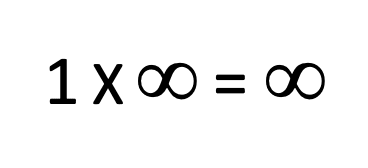
We know that Moses considered himself unworthy— less than a complete man—as a fraction of his real self. Let’s say ½ a person or…
.5
But when you multiply .5 by infinity—believe it or not—the answer is still infinity.

God was saying to Moses: “TRUST ME. Bring what little you’ve got, even if it’s just a fraction. I’ll bring the rest. Together, we can do this.” And that’s exactly what happened.
Eventually, the Lord showed Moses the entire Universe and Moses declared, Now …I know that man is nothing, which thing I had never supposed. Moses 1:10
So, what does all this prophet talk have to do with you and me? We’re not prophets!
Spiritual math also applies to us.
Even when we feel weak and inadequate…if God is with us…we have access to infinite power. When we multiply our paltry selves by infinity, the answer is always infinity.
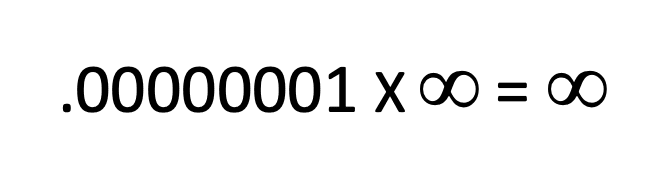
The ‘weak things of the world’ are fully aware that they can’t do it without God. That’s why He chooses them.
But spiritual math has a dark side. As humans, when we start to achieve some measure of success, pride creeps in. We often begin to think that we’re ‘bigger than our britches.’
As Paul wrote, For if a man thinks himself to be something, when he is nothing, he deceiveth himself. Galatians 6:3 KJV
As Paul reminded us…
Remember, dear brothers and sisters, that few of you were wise in the world’s eyes or powerful or wealthy when God called you.Instead, God chose things the world considers foolish in order to shame those who think they are wise. And he chose things that are powerless to shame those who are powerful. God chose things despised by the world, things counted as nothing at all, and used them to bring to nothing what the world considers important. As a result, no one can ever boast in the presence of God. I Corinthians 1:26-29 NLT
Have you ever known someone with worldly success and confidence but who didn’t put God first? Who felt they were too busy or too important to pay Him much attention? Who considered themselves rich and smart and powerful but who didn’t acknowledge the Lord as the source of all their blessings?
You and I know the eventual end to that story—ultimately, they end up with nothing. Zero. Zilch.
Billions x 0 = 0
That’s why God doesn’t often choose the richest, smartest, proudest people—because they think they don’t need God.
I once heard a story about a preacher driving along a country road, passing field after field until he sees an unusually rich crop of billowing waves of ripe grain. He sees the farmer there, standing in his field, and approaches him. “That’s a fine crop you and the Lord are growing there together.”
The crusty old farmer thinks on this a moment and says, “You shoulda seen it when the Lord had it all by Himself.”
But the farmer was myopic. There is a bigger picture. Yes, he had worked hard—planted, weeded, fertilized, and harvested. But God had done the truly miraculous things—the seed, the soil, the sun, and the seasons. God had done 99% of the essential work. The farmer had only done 1% and assumed that he had done it all. Just wait till an early frost wipes out his crop, then we’ll see who’s really in charge.
As the Lord said, “I am the vine, you are the branches. He who abides in Me, and I in him, bears much fruit; for without Me you can do nothing. John 15:5 NKJV
Forgive me for getting personal. The reason I shared the story of ‘the farmer standing in his field‘ is because something similar happened to me. I wasn’t as ‘crusty’ or as dismissive as the farmer in the story. I was an active Church member in every way. Yet, I had some lessons to learn.
In the early 80’s I wrote 2 books that became #1 New York Times bestsellers and sold over a million of copies. My seminar company expanded rapidly. We built a magnificent mountain home in the Sundance Ski Resort near Provo. Life was good. Our crops were bountiful. But sudden money is seductive. It subtly influences you to assume more credit than you deserve.
Then, a perfect storm of disaster struck our family. It was the equivalent of ‘an early frost’ that wiped out all of our crops. Our seminar company ran into economic ‘headwinds’ that cut our cash flow to zero. Our newly finished Sundance Mountain home was destroyed by a freak avalanche. (Yes, a real avalanche!) Our insurance company found an obscure ‘act of God’ clause in our insurance policy and refused to pay the avalanche claim. And because our ‘now-worthless ‘cabin was collateral for a bank loan, our conservative banker demanded payment and proceeded to seize our remaining assets. In a matter of months, we went from flying high to relocating to California to start again from below zero.
It was humbling, to say the least. I went into the closet in our rented California home to pray. I was overwhelmed with shame. The burden of my foolishness was too heavy to carry. I tried to kneel but fell flat on my face. All I could say was, “Help.”
I had a profound spiritual experience in that closet. I can still remember the flood of love and peace I felt. I knew that, despite everything, my Father in Heaven loved me. I somehow knew that my wife and I would get through this financial avalanche. It took years but we eventually recovered and are better for it. Since that day, in my books and speeches and seminars, I am always mindful to give 99% of the credit where it belongs. My contribution is, at best, 1%.
I think that life is designed to drive us to our knees. We learn from our own experience that surrendering to His Way is always the best way. Through life, we learn to be to be more meek, more humble, more childlike. We bring to Him our broken hearts and contrite spirits. He can work with that.
Behold, he offereth himself a sacrifice for sin, to answer the ends of the law, unto all those who have a broken heart and a contrite spirit; and unto none else can the ends of the law be answered. 2 Ne 2:7
That’s what the atonement is about. We can’t earn our way into heaven. The price is too high. We offer up the best we can and ‘after all we can do’—even if our contribution is only 1/1,000,000th of what it takes to gain admission—then, Christs multiplies our tiny, miniscule attempt by the infinity of his atonement, and we enter in to become heirs of all that he has.
And as President Nelson said in October 2021 conference: “Nothing could be worth more than all our Father has!”
I end with this reading from the Psalms using the New Living Translation. (NLT)
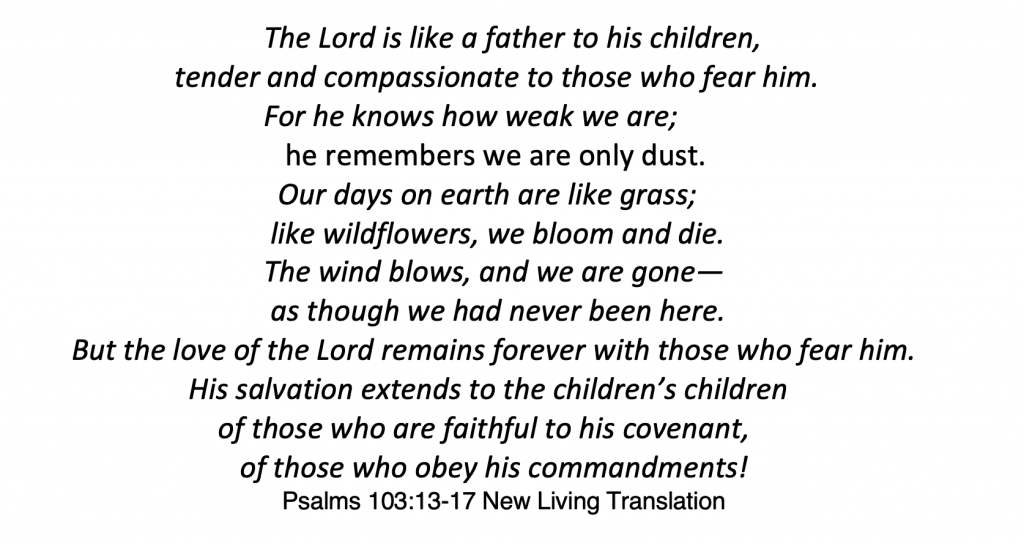
Yes, we are nothing but dust. But dust times infinity is more than enough.







Doug GouldApril 12, 2022
Thanks, Robert, for this insightful article. I was one of your aficionados that bought your "Nothing Down" book, and admired you in more than one of your seminars. Though I'm sorry for what you went through when you lost your Sundance home, it's good to know how well you recovered as you worked through that tragedy with your hand in the Lord's.