










We are all familiar with one of the Lord’s beautiful teachings about the measure of our hearts and our intentions in the story of the widow in the temple, giving two mites in the midst of the great wealth of others. What is it she gave that day and why did the Lord make note of it? Let’s explore.
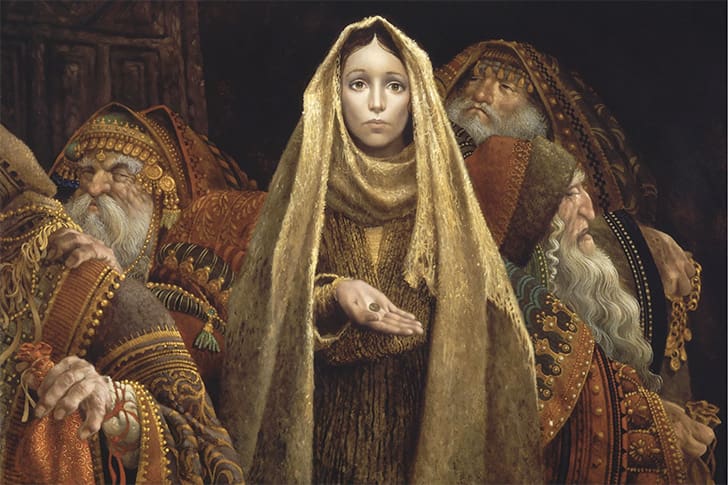
James C. Christensen’s painting, “The Widow’s Mite,” beautifully depicts the widow’s humble offering and great faith in the temple.
First, Maurine and I love the story of the widow in the temple so much, we have this beautiful James C. Christensen painting hanging in our bedroom as a constant reminder. We have spent a lot of time in the Third World and we love working with the poor. This stunning image of the story of the widow’s mite is a constant reminder of its meaning.
President Gordon B. Hinckley, within the first year of his being ordained President of the Church, talked about his feelings for the widow’s mite (and this wasn’t the first time).
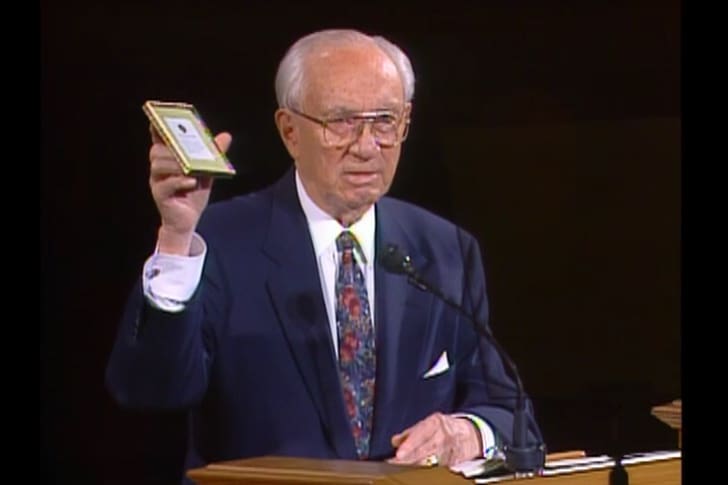
President Gordon B. Hinckley uses a framed widow’s mite to emphasize the sacredness of tithes and offerings, representing the sacrifice of the poor.
“Now, we know that these funds [tithing] are sacred. We have a compelling trust to use them carefully and wisely. I have said before that I keep on the credenza in my office this genuine widow’s mite (too small for you to see, but it’s there nevertheless), given me long ago by Brother David B. Galbraith, who at the time was the president of the Jerusalem Branch of the Church.

A close-up of President Gordon B. Hinckley with a framed widow’s mite, highlighting the careful stewardship of sacred funds.
“I keep it as a reminder of the sacrifice it represents, that we are dealing with the consecration of the widow as well as the offering of the wealthy. I thank all who live honestly with the Lord in the payment of their tithes and offerings. But I know that you do not need to be thanked. Your testimony of the divinity of this law, and of the blessings that flow from its observance, is as strong as is my testimony.”[1]
To understand the original story of the widow’s mites, let’s look more closely at the actual coins she brought to the temple as her offering.
Most of the coins at the time of Jesus were minted in Tyre on the coast of the Mediterranean. Each coin was a blank copper or bronze or silver or gold round slug. It was then heated up and placed on a metal or stone anvil. The die (a solid iron rod about six inches long and ½ – 1 inch in diameter with a pattern on the end of it) was placed over the slug and then hit once with a heavy hammer on one side and then the other—imprinting the desired pattern on each coin.

Ancient widow’s mites represent the humble offering of the poor widow in the temple, illustrating the sacrifice of a believing heart and the tremendous faith of every offering made to the Lord.
These mites or leptons, as they were called, were the coins of the least value at the time of the Savior. One mite, is equivalent to 1/128th of a denarius, a very small amount of money. A denarius was the average worker’s day wage in New Testament times. In our day, the mite would be worth about 1/8 of a U.S. cent. Two mites, then, were 1/64th of a day’s wage and would be enough to buy a few vegetables and a small amount of grain.
The mites of the widow were likely made of copper. From the testimony of Mark, we read:
41 ¶ And Jesus sat over against the treasury, and beheld how the people cast money into the treasury: and many that were rich cast in much.
From the Greek we learn that the word for rich here can be translated ‘wealthy’ or ‘those abounding in material resources.’
42 And there came a certain poor widow, and she threw in two mites, which make a farthing.[2]

This detailed view of an ancient widow’s mite underscores the humble offering it represents, a key element in the story of the widow’s faith and sacrifice.
The poor widow, in contrast to ‘those abounding in material resources,’ can also be translated as a woman who is ‘thoroughly frightened,’ who ‘cowers down or hides oneself for fear,’ who ‘slinks and couches’ and often this can involve the idea of ‘roving about in wretchedness.’ Connoted in the word widow here is one completely ‘bereft.’ akin to ‘sterile’ and ‘barren.’ This means more than infertility—it means ‘one who has lost everything.’
This was very similar to the widow of Zarephath in the time of Elijah the Prophet. And Jesus’ disciples, who had been carefully tutored by Him, understood the lesson.
During a time of famine, Elijah came to the gate of the city of Zaraphath, and saw a widow gathering sticks, a lowly enterprise. He asks her to fetch him a little water, and then as she is going to fetch it, he enlarges the request. “Bring me, I pray thee, a morsel of bread in thine hand.” She explains that she has only a “handful of meal in a barrel and a little oil in a cruse.” All she has is an almost depleted barrel, and she is making a last, scant meal before starvation has taken her and her son. Elijah tells her to “Fear not.”[3]
Here is a parallel which the disciples would have surely seen. The widow was commanded to give to the prophet Elijah (representing the Lord) first and then the blessings would flow to her.
Now, let’s go back to the temple and the time of Jesus, where this faithful widow gave to the temple (representing the Lord) all that she had, then the blessings would flow to her.
In the temple treasury there were fitted thirteen chests or boxes or from the Hebrew word שׁופָרות ‘trumpets’, so called from their shape, into which the contributions were made voluntarily by the temple patrons. It appears from the word ‘cast’ that the widow made her offering “without caring where the two mites would fall,” while the wealthy were calculating and wanting to be seen of all.
43 And he called unto him his disciples, and saith unto them, Verily I say unto you, That this poor widow hath cast more in, than all they which have cast into the treasury:
44 For all they did cast in of their abundance; but she of her want did cast in all that she had, even all her living.[4]
The multi-leveled lesson was not lost on the disciples. It is not the amount that we can give that matters so much as the heart behind it.
And now, you can picture this.
References:
[1] Hinckley, Gordon B. Of Missions, Temples, and Stewardship, General Conference, Priesthood Session, October 1995.
[2] Mark 12:41-42.
[3] See 1 Kings 17:10-13.
[4] Mark 12:43-44.



Dave HansenAugust 6, 2024
Thank you for that article regarding the Widow's Mite. The one thing I wish they would have added is a photo of the anchor side. I have my own mite, but not access to the equipment to show it as nicely as the photos show in the article. For those interested in seeing the reverse side, simply do an internet search for images of a widow's mite. Be aware that there are variations of the details, as well as some that are struck off center or not as round as one would expect. Furthermore, mites are very old, but not necessarily rare.....millions must have been coined. However, they were obviously easy to lose, due to their small size......which is approximately an either of an inch in diameter smaller than a dime. (Mine is 13 mm, or slightly more than a half inch.)