







PHOTO ESSAY

Laie Hawaii Temple Rededication: A Wonderful Weekend of Cultural, Spiritual Activities
-
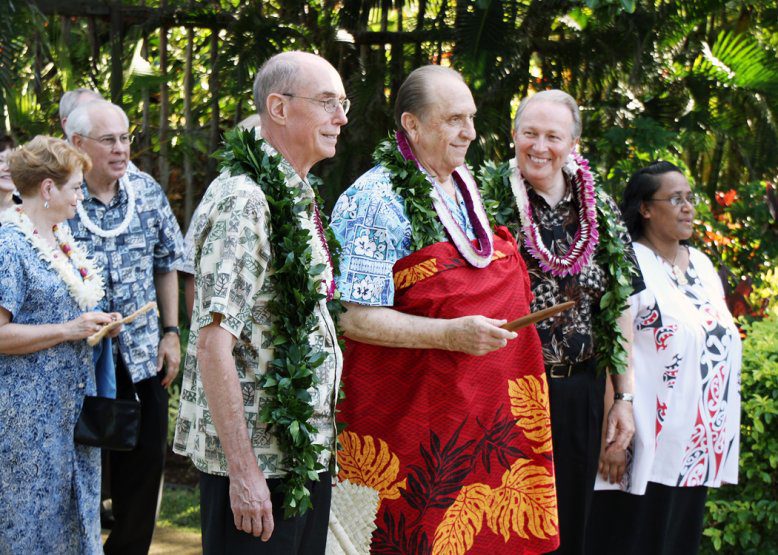
 After bestowing leis and a brightly colored Hawaiian kikepa — a sarong worn over one shoulder, Hawaiian villagers at the Polynesian Cultural Center honored President Thomas S. Monson with island protocol on November 19. LAIE, Hawaii — Islanders are justly famous for hospitably greeting people, but when President Thomas S. Monson and his party arrived at the Polynesian Cultural Center on Friday, November 19, the welcome went into high gear with flower leis, royal Hawaiian chants and hula, a Fijian honor guard and electric carts fully decorated with island flowers, fine mats and tapa or bark cloth. President Henry B. Eyring, First Counselor in the First Presidency, and his wife accompanied President Monson, as did Elder William R. Walker of the First Quorum of Seventy and chairman of the Church Temple Department. President Monson came to rededicate the Laie Hawaii Temple on November 21 following approximately 22 months of extensive renovations and a three-and-a-half-week public open house period. During the open house, over 43,000 people toured the Laie Hawaii Temple.
 -
President Monson accepts a rou, a carved token extended in friendship by the Polynesian Cultural Center Maoris: Others in the picture include (left-right) Sister Vickie Walker and Elder William R. Walker; President Henry B. Eyring; Von D. Orgill, President & CEO of the Polynesian Cultural Center; and Rahira Makekau, a Maori cultural specialist who chanted in response to the village women on behalf of President Monson. From the Cultural Center’s front entrance, President Monson and party moved to the Aotearoa village where, in traditional Maori New Zealand protocol, a number of women called out to him and his party while a warrior, encouraged by his lance-wielding brethren in the background, challenged the group to accept their token of friendship.
-
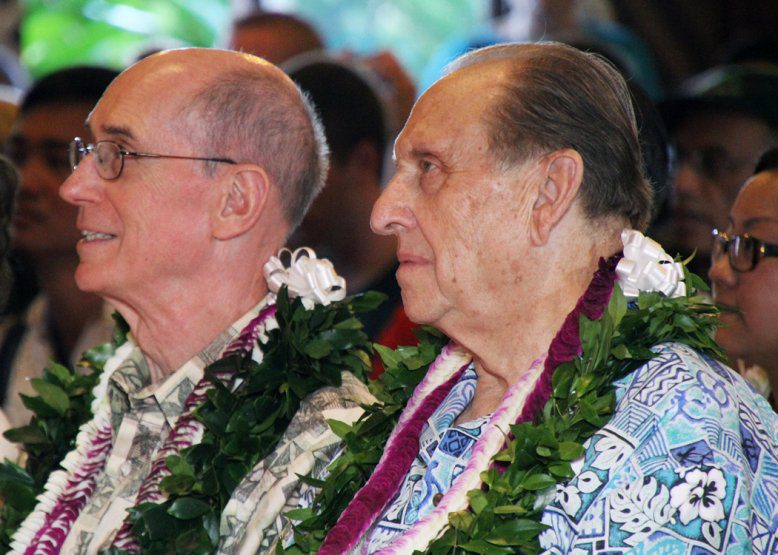
President Monson (right) and President Eyring enjoy the welcome prepared by the Polynesian Cultural Center Maoris. With the rou or token in hand, the president and his party moved into the whare nui meeting house where the Maoris — mostly students at the adjoining Brigham Young University–Hawaii — shared their traditional songs and dances, including the rhythmic swinging of poi and topped off by the fierce posturing of the men’s haka.
-
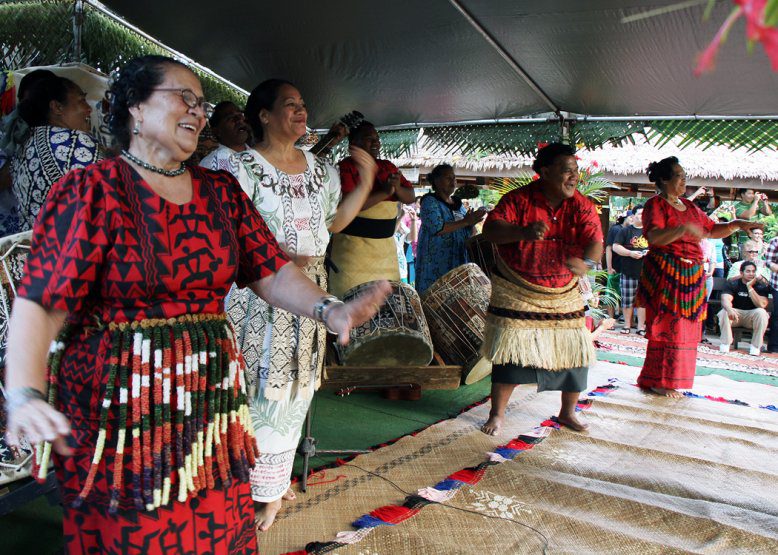
Tongan villagers at the PCC greeted President Monson and his party with drums, bamboo nose flutes and, of course, lively dancing. When President Monson and his party moved on to the Tongan village, PCC guests and others filled the small amphitheater there in his honor as the villagers and Tongans from the community danced and sang in his honor. At one point, President Monson gave a small boy one of his leis and invited him to sit on his lap for the festivities. Several other little children soon surrounded the prophet, wanting a similar vantage point.
-
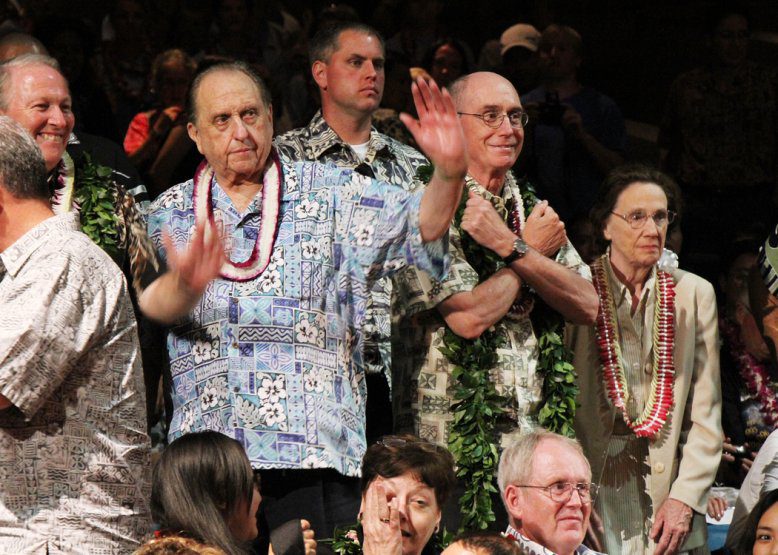
President Monson and all in the village amphitheater learned the hand motions to a simple Tongan mauluulu dance. Left-right, front row: Sister Kathleen Eyring and President Henry B. Eyring, President Monson, PCC President & CEO Von D. Orgill and his wife, Sister Sherri Orgill. Throughout his visit to the Polynesian Cultural Center and the cultural celebration performance the next day, President Monson proved to be a great sport as he warmly stopped to greet many people and interacted with the villagers. For example, he hefted the Fijian war club of the honor guard and tried his hand at Tongan dancing. The villagers and guests loved his impromptu responses.
-
Two Samoan villagers, students at BYU–Hawaii, show President Monson an extra measure of respect by fanning him during the coconut-cracking demonstration. Left-right: Sister Kathleen Eyring and President Henry B. Eyring, President Monson, PCC President & CEO Von D. Orgill and his wife, Sister Sherri Orgill. In the Center’s Samoan village, cultural specialist Kap Te’o-Tafiti demonstrated how fire is made by literally rubbing two sticks together, how to husk a ripe coconut and easily crack it in half with a rock. Then he shredded the coconut meat and strained out the “milk.” Four young men of the village also made climbing a tall coconut tree look simple.
-
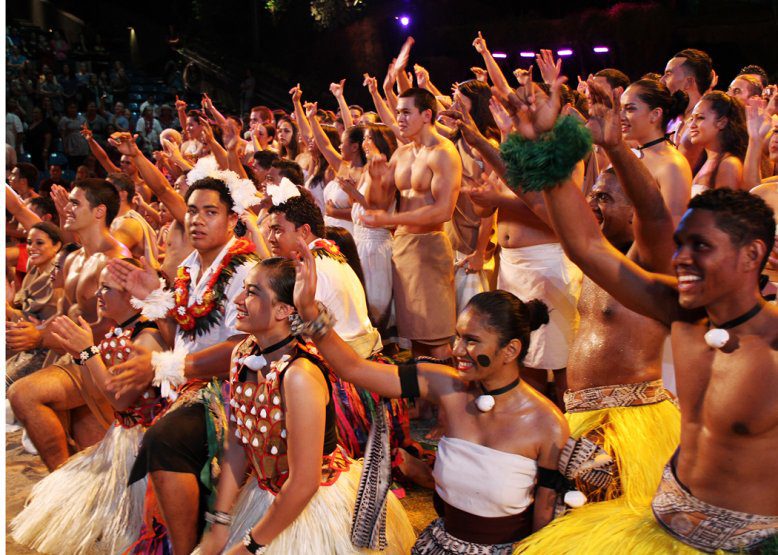
The Ha Breath of Life night show cast and others gathered on stage after the finale to sing Teach Me to Walk in the Light for the prophet. Following dinner in the Ambassador dining area, President Monson and his party attended the Polynesian Cultural Center’s new night show, Ha Breath of Life, which tells a circle-of-life story about the importance of eternal families in a uniquely Polynesian way. After a standing ovation for the night show, the cast reformed on stage and sang a beautiful rendition of Teach Me to Walk in the Light. Many in the audience also stayed behind to enjoy the song and linger in the prophet’s presence.
-
President Monson and President Eyring expressed their appreciation to the PCC night show cast. As he had throughout the afternoon, President Monson responded to the outpouring of aloha at the Polynesian Cultural Center. Even after the president’s party had left the Pacific Theater, many PCC performers remained on the stage to enjoy the spirit of the prophet’s visit. The Gathering Place A Cultural Celebration • November 20, 2010 Since June, a dedicated regional committee led by chairperson Delsa Moe of the Laie 1st Ward, who works professionally as director of cultural presentations at the Polynesian Cultural Center, had been planning and working with the respective stakes throughout Oahu and Kauai to prepare for the temple rededication cultural celebration, entitled The Gathering Place. Almost 2,000 youth put on performances of The Gathering Place on November 20 in the BYU–Hawaii Cannon Activities Center at 2 p.m. and again at 6 p.m. President Monson and his party attended the later performance, which was also broadcast to all church facilities in Hawaii with satellite dishes to accommodate everyone who wanted to see it. Moe explained the committee originally considered trying to stage the event in the 50,000-seat Aloha Stadium in Honolulu, “but there was a football game on. We could have filled it.” She said they also considered the 8,000-seat Blaisdell Center in Honolulu, but there were too many logistical considerations there. Moe said everybody agreed on the name, “because Oahu is known as the Gathering Place in Hawaii, Laie is the gathering place for the Saints, we’re told to gather to the temple, and there are so many scriptures that talk about gathering. We also had the song Ralph Rodgers had written for the PCC that people were endeared to. It was perfect, and worked out very well for us.” She thanked all who participated and helped, including non-members who contributed their professional services and products to the production. For example, lyricist Danny Couch allowed the committee to use his award-winning song, These Islands, as the overture for The Gathering Place, “when we explained the significance of this to us.” She added that prominent hula master O’Brian Eselu, who choreographed the Makakilo Stake’s production, told them that as impressive as all the awards he’s won are, “I consider this to be my most important work ever.” “It’s just been so wonderful how everybody has consecrated their time and their talents for this worthy celebration for our youth,” Moe said. She also said Elder Scott D. Whiting, Area Authority for Hawaii who oversaw all aspects of the temple rededication activities, and her committee wanted the event “to have an eternal impact on our youth. Wherever they are in their spiritual plane, we’re hoping that as a result of participating in this cultural celebration that they commit to making the temple a part of their lives. That it’s not just something their parents do, but it’s something we should all be striving for.” “We want them to look back five, 10, 20 years from now and say one of the best moments in their lives was being part of the cultural celebration that we performed for the prophet.” In his remarks to the entire cast before the second performance began, President Monson agreed, telling the youth they would never forget this event. “It’s something that will stay with you for the rest of your lives,” he said, recalling the Latter-day Saint road shows of his own youth. “I advocate big gatherings like this… You’re a marvelous sight.” “Years from now you’ll be telling your children and grandchildren of the opportunity you had to participate in such a tremendous cultural celebration.” “Stay close to the church. Keep the commandments. Serve where you’re called to serve,” President Monson continued. Then he reminded the youth that the beautiful Laie Hawaii Temple, which would be rededicated the next morning, “shines as a beacon of righteousness to all who behold its light.” President Monson also assured them, “Your efforts will be rewarded many times over.” Then he pronounced a blessing, “that you may feel the love that we have for you. May you also know that your Heavenly Father loves you.” President Henry B. Eyring, First Counselor in the First Presidency, and his wife also joined President Monson at the second performance, along with Elder Quentin L. Cook of the Quorum of the Twelve and his wife, Sister Mary Cook; Elder William R. Walker of the First Quorum of the Seventy and his wife; and Elder Scott D. Whiting and his wife, Sister Jeri Whiting. Then the lights dimmed, and several hundred youth on the floor moved their stadium-style flip cards in synch with the hauntingly beautiful overture sung by award-winning Natalie Ai Kamauu, a Latter-day Saint from Ewa Beach Ward. As people in Hawaii say, it was definitely a “chicken-skin” (goose bumps) beginning.
-
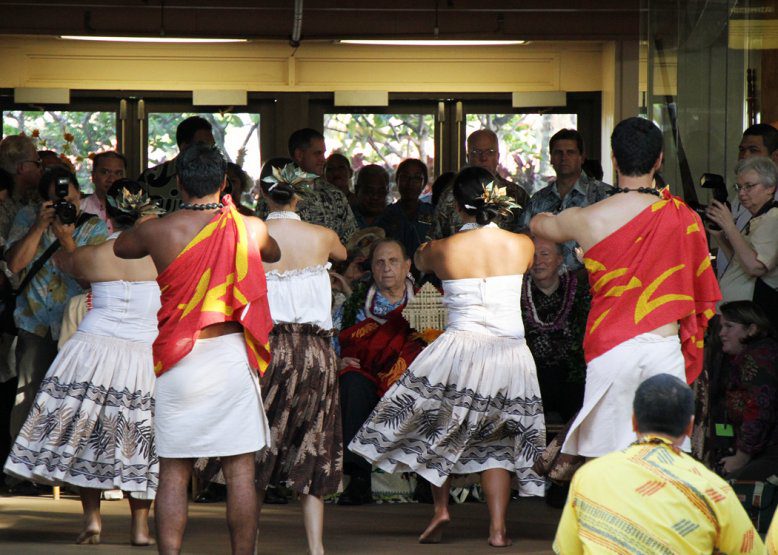
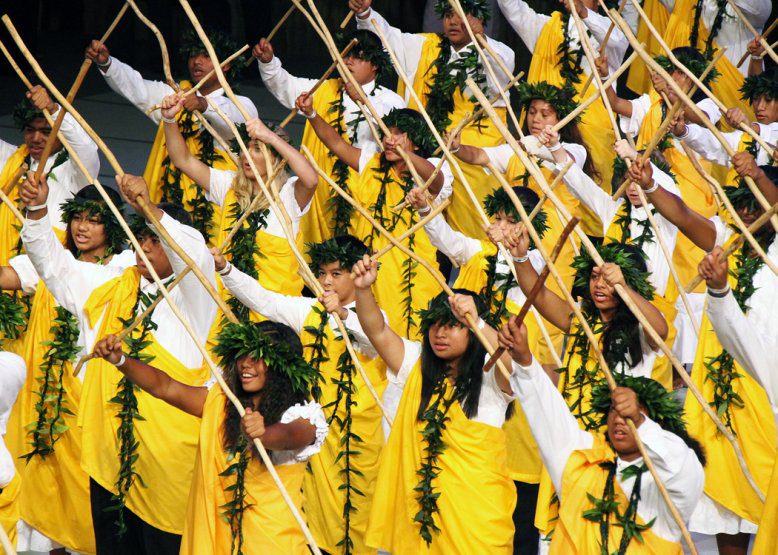
Makakilo Hawaii Stake youth perform a hula kahiko (in the ancient style) recognizing Hewahewa during the temple rededication cultural celebration on November 20, 2010. Following the death of King Kamehameha but about one year before the first Christian missionaries arrived in Hawaii, the kahuna nui or high priest Hewahewa helped overthrow the kapu (taboo) system and advocated the Hawaiian people return to their traditional monotheism. The background chant also honors the temple.
-
Laie Hawaii North Stake youth dramatize the ancient puuhonua that once existed in Laie, a haven from danger and the taboo system for those who could flee there. Tradition indicates in ancient Hawaiian time Laie was the site of a puuhonua where those fleeing warfare or heavy punishments of the taboo system could find sanctuary and absolution, if they could avoid the challenges of getting in. In 1865 the church established Laie as a gathering place for the Latter-day Saints in Hawaii where the Laie Hawaii Temple still symbolizes rising above worldly ills.
-
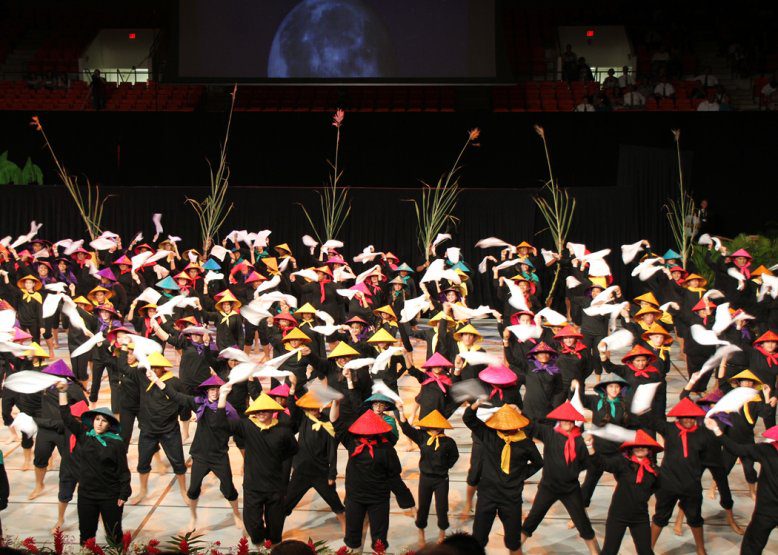
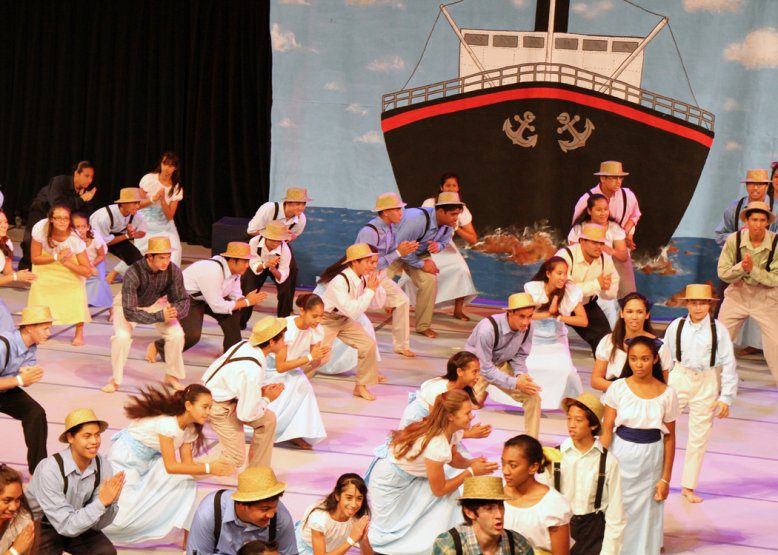
Youth from the Honolulu Hawaii West and Kauai Hawaii Stakes combined to portray the efforts and recreation of contract laborers from Asia who migrated to Hawaii to work in the sugar and pineapple industries. Starting in the second half of the 1800s, thousands of Asians — principally from China, Japan, Korea and the Philippines — came to Hawaii as contract workers. Many of their descendants remained in the islands and intermarried over the years, giving modern Hawaii its distinct multiethnic population. Many have also joined the church.
-
The Mililani Hawaii Stake youth honored the contributions of Joseph F. Smith who first came to Hawaii in 1854 as a 15-year-old missionary. Iosepa, as the Hawaiians called the young missionary, came to love the islands and people, and returned a number of times over a 60-year-span. As president of the church, Joseph F. Smith last came to his beloved Hawaii in 1915 when on June 1 he dedicated the site of the Laie Hawaii Temple. That sacred event led to the construction of only the church’s fifth operating temple at the time, and the first to be built outside of Utah and the continental United States.
-
Kaneohe Hawaii Stake youth portray the construction of the Laie Hawaii Temple between 1916–1918. The youth of the Kaneohe Hawaii Stake recreated a story of how the Saints helped build the Laie Hawaii Temple. Building materials were scarce during the period because of World War I, so the Saints compounded cement from local lava rock and obtained much-needed lumber from a cooperative ship captain. Contractors working on the recent renovation indicated that the original cement core of the temple is still solid and should last at least another 100 years.
-
Waipahu Hawaii Stake youth recreated the popular culture and excitement the military brought to the islands during World War II. Hawaii came into worldwide focus on December 7, 1941, with the surprise attack on Pearl Harbor, and the subsequent arrival and transit of thousands and thousands of military personnel. Many during those years visited the Laie Hawaii Temple grounds and a rest-and-recreation facility for soldiers was set up on the Honolulu Tabernacle lot.
-
The youth from Honolulu Hawaii Stake paid tribute to the extensive contributions of David O. McKay to the islands. Elder David O. McKay first visited Hawaii as a member of the Quorum of the Twelve in 1921 when he envisioned a university would some day partner with the then-new temple in helping spread the influence of the church throughout the Pacific islands and Asia. More than three decades later as head of the church, President McKay directed the Church College of Hawaii to start up in 1955 (CCH became BYU–Hawaii in 1974). He also authorized the construction of the Polynesian Cultural Center, which opened on October 12, 1963.
-
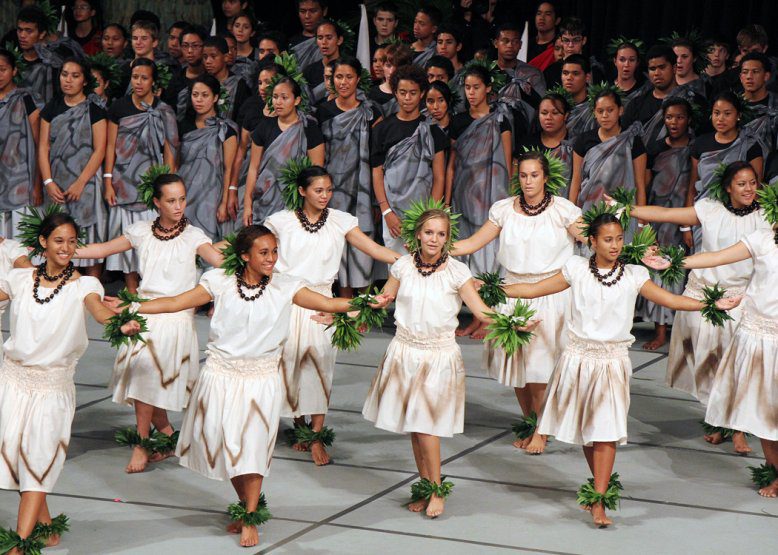
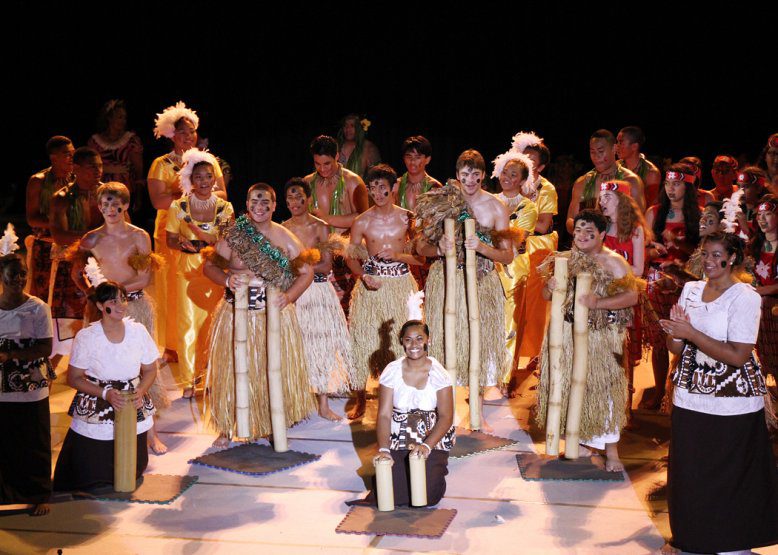
Honolulu Stake youth reflect the Polynesian heritage of the islands, popularized at the Polynesian Cultural Center.
-
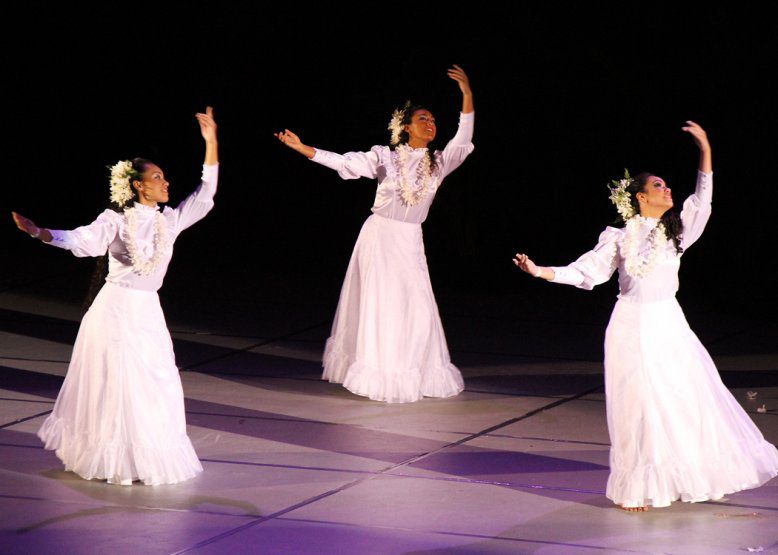
The Gathering Place finale began with an elegant hula performed to a song of the same name that was originally composed by the late Ralph G. Rodgers Jr. for the Polynesian Cultural Center.
-
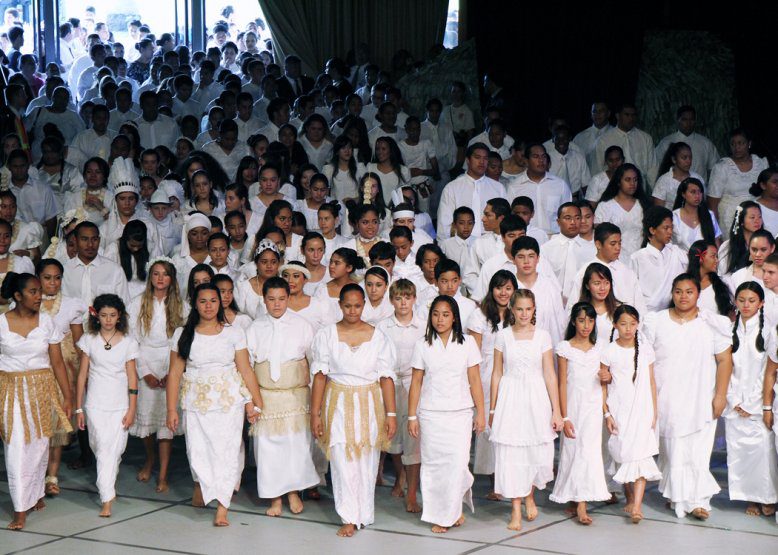
As the hula ended the entire cast of approximately 2,000 youth began to fill the floor and aisles of the BYUH Cannon Activities Center.
-
The combined youth sang I Love to See the Temple and The Army of Helaman as a replica of the temple slowly rose in the background with a picture of the Savior depicted on the large screen above it.
-
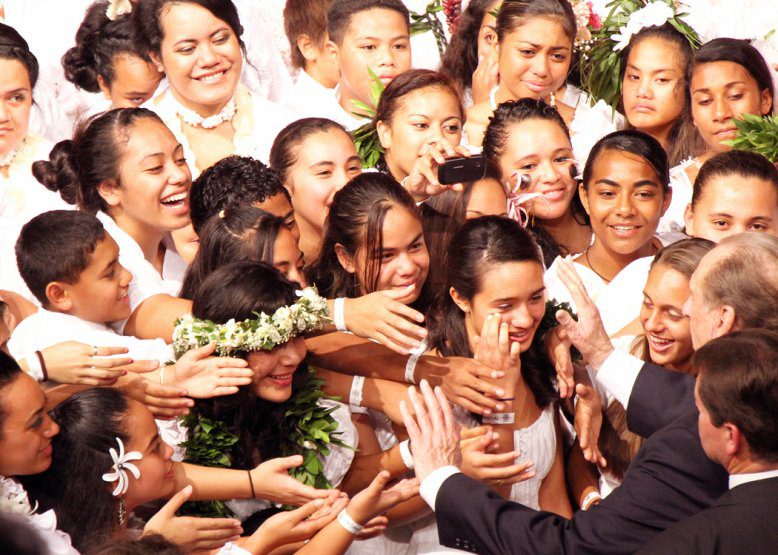
The youth in the front row yearned for an opportunity to shake hands with the prophet, who gradually moved toward the exit and the end of a glorious celebration. President Monson rededicates the Laie Hawaii Temple November 21, 2010
-
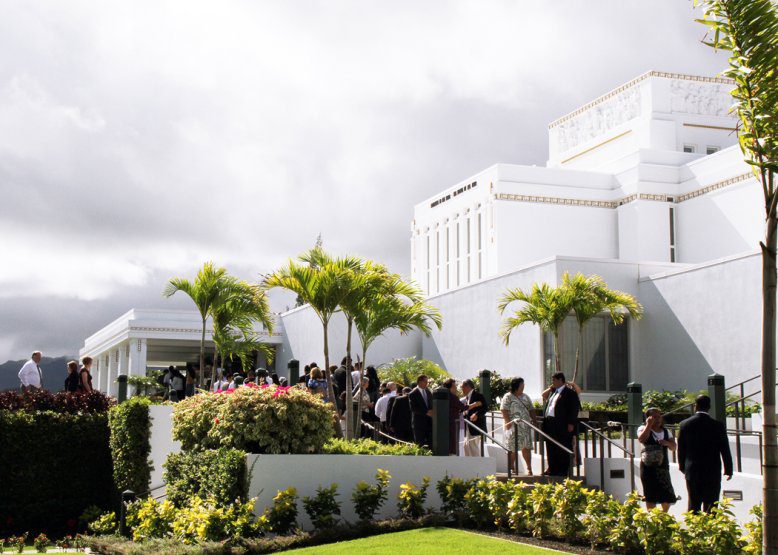
An hour before the rededication ceremonies began, a long line extended from the door of the Laie Hawaii Temple to the parking lot. Regular Sunday services were cancelled so more thousands of Latter-day Saints throughout Hawaii could watch the event in their respective stake centers and chapels via closed circuit broadcast. “This is the House of the Lord. We feel the presence of His Holy Spirit in this sacred temple and pray this will be a memorable occasion for all who participate in any way,” said President Henry B. Eyring, First Counselor in the First Presidency, in conducting the first session of the rededication of the Laie Hawaii Temple from its Celestial Room. Elder William R. Walker of the Seventy and chairman of the church’s temple department, told the Saints, “A temple dedication by a prophet of God is one of the great historic events any of us can witness… We are deeply grateful that the First Presidency has authorized this work to be done. We feel the temple has now been returned to its rightful place as one of the most beautiful temples in all the world.” Elder Walker also spoke of serving a mission in Japan and how the Saints there were strengthened after they made their first temple excursion to the Laie Hawaii Temple. Focusing on temple marriage, Elder Walker quoted Elder Jeffrey R. Walker of the Twelve, who said, “When a young man and a young woman kneel at the altar of the temple to be sealed, it is for them the focal point of eternity.” “This temple and the blessings we receive in the temple are a wonderful manifestation of the love that Heavenly Father has for us,” Elder Walker said. Elder Cook thanked the Laie Hawaii Temple president, H. Ross Workman, his counselors, the matron and her assistants. He also reminded the Saints of the importance of making sacrifice by quoting Joseph Smith: “Only through sacrifice can we be worthy to live in the presence of God. God has ordained that it is through sacrifice that men should enjoy eternal life.” “Many who have lived before us sacrificed all they had,” Elder Cook continued. “We must be willing to do the same if we are to earn the rich reward they enjoy. Sacrificing echoes the supreme sacrifice of the Savior, and causes us to rejoice in what the Savior did for us.” President Eyring noted in his remarks that the temple “is a place of thanksgiving for all the Saints… Temples of God are places of sacred instruction. They are places which draw us closer to God. They are places where we can feel His glory, and anticipate what it will be like to live again with our Heavenly Father and His beloved Son, Jesus Christ.” He also said those who return to the temple can expect to feel several things, “which we have felt this day: The first is gratitude; that overwhelming feeling of thanksgiving to God. The second is to experience the light of understanding as the Spirit teaches us new truths while bringing others to our remembrance; and third is to feel the love of God.” “This has always been from its original construction a beautiful building,” President Eyring continued, saying that it now had a “greater radiance and beauty.” President Monson pointed out that the Laie Hawaii Temple, originally dedicated by President Heber J. Grant in 1919, “was the fifth completed by the Saints after the exodus to the Rocky Mountains” and the first to be built outside of Utah and the continental United States. President Monson pointed out, “We now have 134 operating temples, with another 23 temples in some phase of planning or construction. How fortunate we are that so many temples throughout the world are available to those who are worthy to receive the blessings found therein.” “Temples are built not only of stone, and wood and mortar, temples are built of service, of sacrifice. Temples are built of fasting and faith. Temples are built of trials, tears and testimonies. The tithes of the faithful both far and near have made possible this special day.” “We’ll have temptations. We’ll have trials; but as we come to this Holy House, as we remember the covenants we make here, we will limit those trials and overcome those temptations. Here we find purpose. Here we discover peace; not the peace provided by man, but the peace promised by the Son of God when he said, ‘My peace I give unto you: not as the world giveth, give I unto you. Let not your heart be troubled, neither let it be afraid,’” President Monson said. Shortly after, President Monson rededicated the Laie Hawaii Temple. Two additional ceremonies followed; and on Monday, November 22, stake presidents, their wives and chairpersons of the rededication steering committee were invited to a special session inside the temple. Regular sessions and ordinance work in the Laie Hawaii Temple began on November 23, 2010.
-
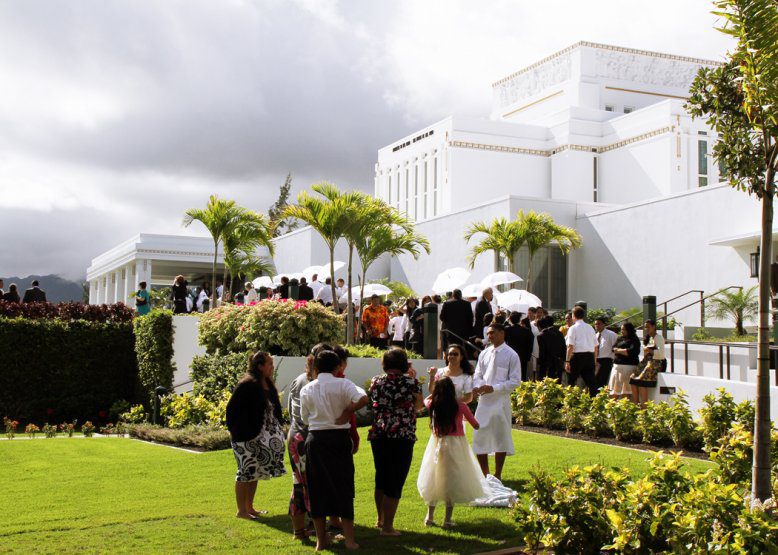
As a new line formed for the next of three dedicatory sessions inside the temple, others from the previous one mingled with family and friends outside the temple. Now that the Laie Hawaii Temple is rededicated, regular sessions and ordinance service will be by appointment.
-
Many of those who were fortunate enough to attend the dedicatory sessions inside the Laie Hawaii Temple, stayed to enjoy the annual display at the Visitors Center: Each stake on the island of Oahu provides a Christmas tree beautifully decorated with gospel motifs.







No Comments | Post or read comments