





I had a First Vision experience. I did not see what Joseph Smith saw nor did I hear what God our Heavenly Father or Jesus Christ said to him. And this was not the first time I had this experience, but it was the first time I made the connection to Joseph’s sacred grove.
I think my awareness came because my Institute lesson was on the First Vision. As part of the lesson, I showed the video, “Ask of God,” which is almost like watching the First Vision happen in real time.
Before showing the video, I reminded the students that Joseph dictated or wrote four different accounts of the First Vision and that six others wrote their remembrances of hearing Joseph talk about it. The fact that there are ten versions cause some to doubt the validity of Joseph’s experience, when in fact, each detail adds depth to what Joseph saw, heard, and felt. We all retell events in our lives and emphasize different aspects, according to whom we are speaking and our purpose in sharing.
In the transcript of the video, there are thirty-five footnotes that document the sources of the quotes. There are footnotes from eight of the ten First Vision accounts: thirteen are from the official 1838 account; eleven are from the 1832 account; two are from the 1842 account; two come from the 1835 account; one is from the Neibaur account; one quotes James 1:5; three are from the Hyde account; one is from the Pratt account; and one quotes History of the Church. (You can read about these accounts here.)
I also discussed with my students what Joseph’s religious beliefs were when he entered the grove. In 1820, the prevailing idea about God was that He, Jesus, and the Holy Spirit were one in substance—the doctrine of the Trinity. Joseph would have assumed that after Jesus’ apostles died, there was no more revelation and that the Bible contained all the truth there was. He would have believed in a wrathful God and that punishment in an endless hell awaited sinners.
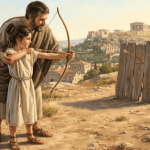
I suggested to the students that as they watch the video, they put themselves in the shoes of fourteen-year-old Joseph. I asked them to listen for the reason he went into the wooded area not far from his home to pray. (I said it was probably not the reason they were thinking.) I encouraged them to look for the axe in a stump, indicating that Joseph had pre-determined to pray there. I asked them to listen for two Christ-like virtues Joseph desired. I encouraged them to pay attention to their feelings.
After the video I asked my students what Heavenly Father said to Joseph. They answered: “Joseph, This is my beloved Son. Hear Him.” I asked them what Jesus Christ said to Joseph. They answered: “Joseph, my son, thy sins are forgiven thee. Behold I am the Lord of glory. I was crucified for the world that all those who believe on my name may have Eternal life. The world lieth in sin…. They have turned aside from the gospel and keep not my commandments. They draw near to me with their lips while their hearts are far from me. They teach for doctrines the commandments of men, having a form of Godliness, but they deny the power thereof. Go not after them. Wait patiently. At a future time, my true doctrine and the complete truth of the gospel will be revealed to you. Go thy way. Walk in my statutes and keep my commandments.”
Then I told my students about a new statue of the First Vision that is on Temple Square in Salt Lake City. I told them when I first saw this statue, I didn’t see that it was of the First Vision because I only saw our Father in Heaven and Jesus Christ. Then I showed a forty-seven-second video of the statue.
I asked the students for comments. One said it touched her heart that Joseph asked for mercy because he knew that only God could grant him mercy. Another student said: (These are his exact words that I transcribed later when I listened to the recording of the class.) “Growing up, and basically until now, I’ve had a really hard time relating to Joseph Smith. Especially him as a 14-year-old boy, because I think about myself as a 14-year-old boy. I was very, very different. Watching the video, and kind of seeing the perspective, especially showing the statue later, was kind of one of the first times where I was able to at least see things from a different perspective. When I saw Christ and the Father, both there, with their arms outstretched, kind of reaching towards Joseph, especially at the beginning of the video, when you don’t see Joseph, it almost kind of felt like, I don’t know, it felt like I was supposed to put myself in his shoes and imagine Christ saying the same things to me.”
I rejoiced in this teaching moment when the Holy Ghost had witnessed to students the truths being taught. That night when I knelt to pray, my desire was to fervently thank Heavenly Father for this blessing.
After I said, “Dear Father in Heaven,” a very negative memory of something that had happened fifty years ago entered my mind, followed by other thoughts of bad things that had happened in my life. A dark cloud had come over me. As I tried to pray, I was empty and unable to formulate thoughts into words. Then I remembered how Joseph said he overcame the evil that confronted him: “[I exerted] all my powers to call upon God to deliver me out of the power of this enemy which had seized upon me” (Joseph Smith-History 1:16).
It was then I recognized that the power of the adversary had derailed my prayer by diverting my thoughts. It took a while to recover, but as I persisted, I was able to say the words I desired. I know, of course, that I had felt only a tiny fraction of the adversary’s power compared to the evil that beset Joseph. He had learned for himself the contrasts of depravity and purity, base evil and glorious virtue.
The grove Joseph prayed in is called “sacred” not only because of whom he saw and what They said, but because there he overcame Satan. When you and I attempt to connect with the powers of heaven, we can challenge any thoughts that attempt to interfere with our prayers. When we prevail, feelings of love and mercy can overpower any evil influences, creating for us a sacred opportunity to commune with our Father.