









Photos courtesy of the Church Newsroom. You can visit their site here.
In March 2001, President Gordon B. Hinckley announced a “bold” education initiative that would go on to bless more than 130,000 lives worldwide: the Perpetual Education Fund (PEF).
“Where there is widespread poverty among our people, we must do all we can to help them to lift themselves, to establish their lives upon a foundation of self-reliance that can come of training. Education is the key to opportunity,” President Hinckley said.
Modeled after the 19th-century Perpetual Emigration Fund, PEF provides financial support for education that leads to better employment and long-term self-reliance for Latter-day Saints outside the United States and Canada.
“It was an amazing and beautiful idea that President Hinckley had,” said Elder John K. Carmack, emeritus General Authority Seventy, who led the program during its first 11 years. “He wanted the young people, especially out in the world who didn’t have opportunities, to get education. And he wanted the education to be practical. He wanted it to be the type of thing that would lead to jobs.”

Nahun Antonio Garcia Perez and family
That vision has been realized in the lives of participants like Nahun Antonio García Pérez of Honduras. With limited financial means, Pérez used PEF to complete his education, become an industrial engineer, and strengthen his family’s economic stability.
“Undertaking higher education has not been easy at all, but I feel the satisfaction of having achieved something I set out to do,” Pérez said. “PEF is inspired by God and can be of great benefit in our temporal and spiritual life.”
President Hinckley foresaw such outcomes.
“With good employment skills,” he said, “these young men and women can rise out of the poverty they and generations before them have known. They will better provide for their families. They will serve in the Church and grow in leadership and responsibility.”
Today, PEF has served participants in more than 80 countries, with 88% of graduates reporting improved employment. The revolving fund offers low- or no-interest loans, partial scholarships, and repayment incentives that help reduce the financial burden of education while opening doors to opportunity.
“Many who received education from the fund and the push that it gave them in life became our leaders — ward and stake leaders, stake presidents and others,” Elder Carmack said. “They were trained with the help of the Perpetual Education Fund. It was quite amazing.”
Trent Jacobson, manager of the Perpetual Education Fund, said the program’s focus remains unchanged.
“When members gain education and work, they are better able to provide for their families and serve in their communities,” Jacobson said. “The Perpetual Education Fund helps members gain market-ready skills that lead to meaningful employment. As we look forward, the focus of education for Church members will remain empowering members to become self-reliant and strengthening families around the world.”
Originally launched in Mexico, Brazil, Chile, and Peru, PEF is now available in many countries. Local and Church leaders are encouraged to identify individuals who may benefit, with eligibility details available on the PEF website.
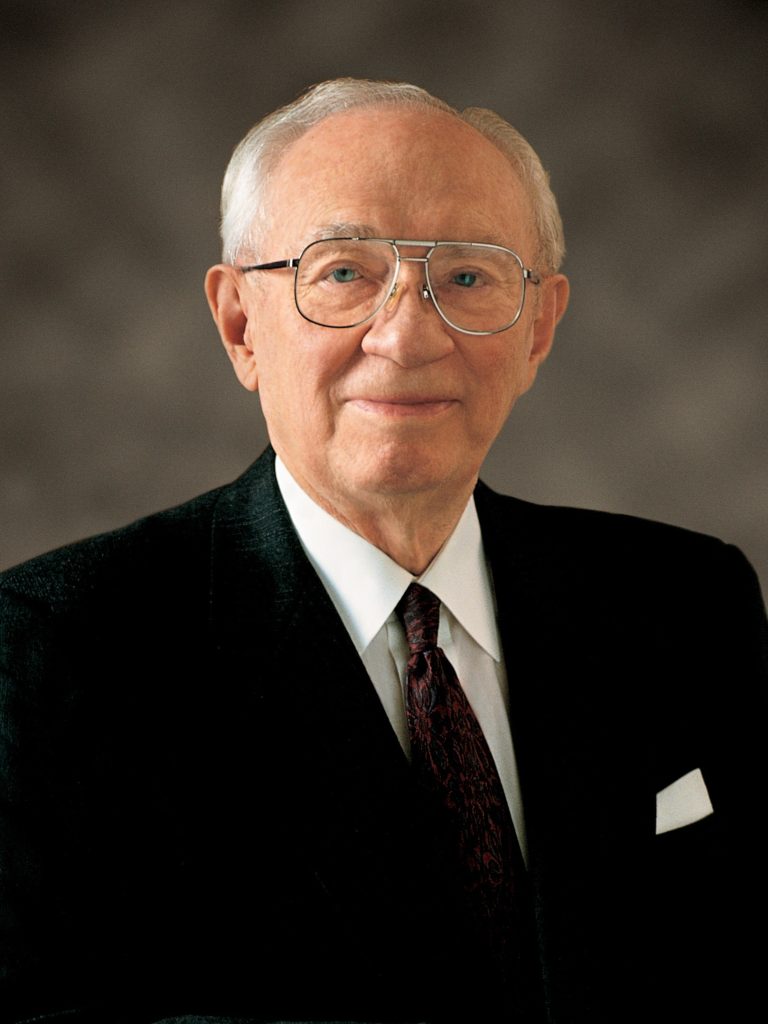
President Gordon B. Hinckley
Elder Carmack recalled President Hinckley’s urgency in the program’s early days.
“President Hinckley would call me every once in a while in the very beginning stages of PEF and say, ‘I’m not sleeping well at night. What are you doing? You’ve got to get this going,’” he said. “He was a pusher. He was pushing me.”
At one of his final meetings—a PEF committee gathering in January 2008—President Hinckley reflected on the program’s impact: “This program has been a miracle. It has really done what I hoped it would do.”
“He didn’t fool around with things that don’t matter,” Elder Carmack said. “He was entitled to and received constant revelation. I never questioned the inspired nature of the Perpetual Education Fund.”