




Genetic genealogist Debbie Weaver sat at a computer in her local family history center in late December 2019, working on her latest project. She had been integrating DNA techniques into her genealogy for several years, and the new technique was providing surprising avenues for research. She was so engrossed with her work that she continued past closing time. When the phone next to her buzzed hours later, she almost ignored it. However, something within her nudged her to pick up the phone.
On the other end of the line, a woman named Susan (name has been changed) began speaking with Debbie from her bed in an assisted living center. She wanted help with scanning and genealogy, but she couldn’t do it herself. Debbie agreed to meet with Susan, beginning a chain of events that would lead to the discovery of a child given up for adoption.
Debbie was no stranger to adoption. As a senior in high school, she was adopted by her foster family. She had first met her biological father when she was sixteen, desiring answers to her past from a young age. “I understand just how it feels to want [those] answers,” Debbie said.
Debbie was not the only one blessed by her foster family. Gary and Nancy Kehl, who had three children of their own, ended up adopting six children for a total of nine. As they raised their family, they also took in other foster children and unwed mothers. Debbie saw their example as they nurtured those under their wings, inspiring her to major in Social Work in college.
After her marriage, Debbie’s interest in genealogy found a new life. She had never been interested in science or history as a young girl, but she came to love it when she saw the impact that genealogy had on families. Her husband’s mother and grandmother were “avid genealogists” who managed to gather a multitude of different records about their family. Her interest “caught fire” as she worked in the Granite Family History Center (now the Granite FamilySearch Center) in her local area. She loved the challenge of a new problem to solve with every question posed to her.
As her skills developed and her passion grew, she decided to attend RootsTech in 2016. During that time, she learned about the new tools genealogists were using thanks to DNA. Debbie brought home several DNA kits and tested her husband and her children, sending their DNA samples to be processed.
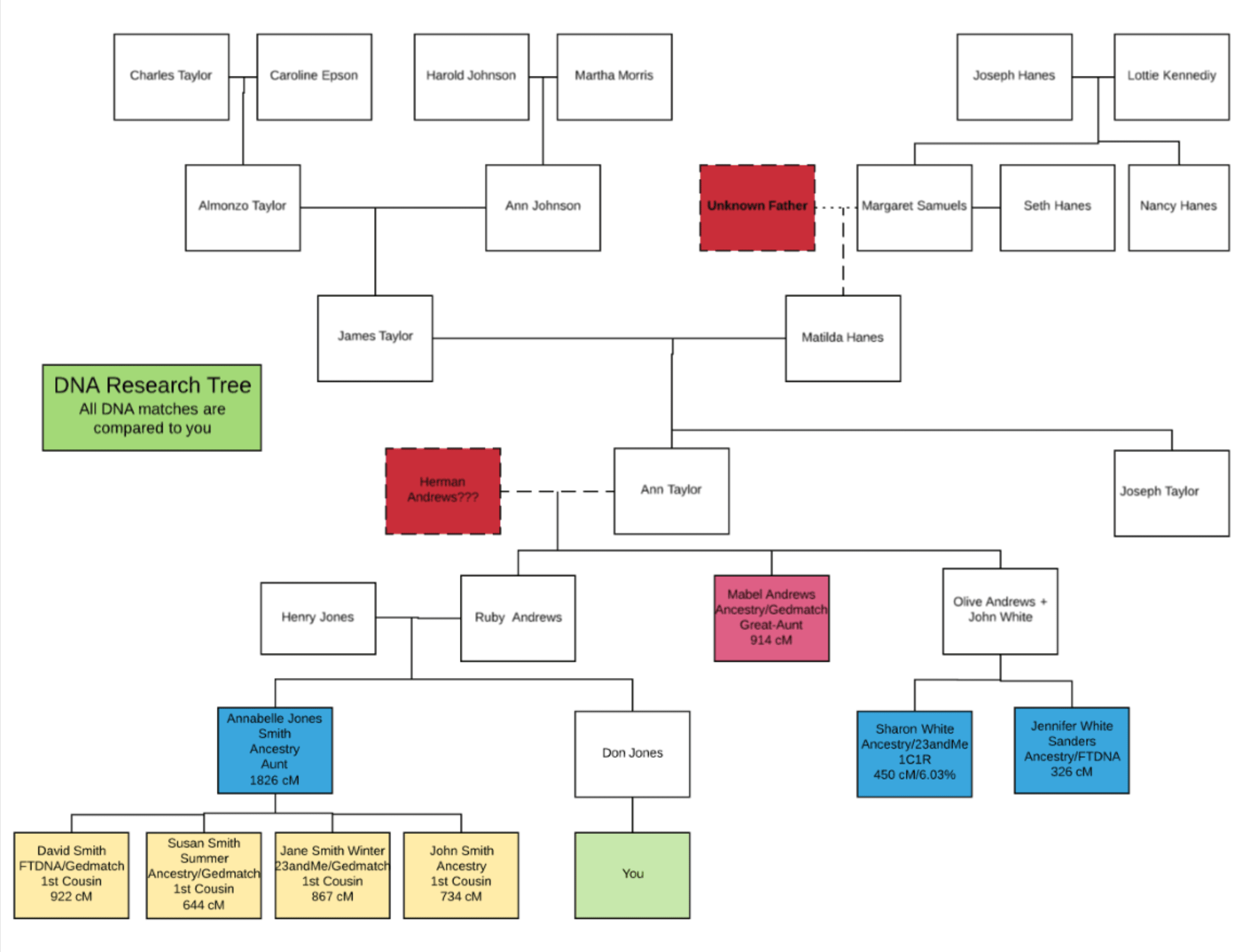
According to Debbie, DNA testing is another form of evidence that researchers and family historians can use to connect people that either confirm or disprove traditional paper research. Different types of DNA reveal different pieces of the genealogical puzzle.
“Y-DNA is carried down through sons,” Debbie explained. “Mitochondrial DNA is passed from every mother to every child. X-DNA has a unique pattern of inheritance. Autosomal DNA connects recent generations. Like a complex puzzle, everyone connects and has a place. Every single person carries their family history within them.”
After testing her immediate family members, her sister and a friend approached her, asking Debbie if she would be willing to help them find their birth parents. With DNA kits in hand, Debbie began the process of tracking down family members. “When I found them, I was really hooked,” Debbie said.
Debbie and Andie
Rather than focus on a specific time period, Debbie became an expert in using DNA and the tools surrounding it to solve family history mysteries. Multiple websites are available for those interested in working with DNA, including AncestryDNA, FamilyTree DNA, MyHeritage, and Gedmatch. Despite her expertise with these tools, she still connects with other researchers to continuously learn new techniques as the tools advance.
“Families often have stories that have been passed down,” Debbie explained, “and the use of DNA has helped to clarify or disprove them.” In one instance, she helped a family determine the truth behind a family story and pointed them to the records from their state archive that would allow them to support the DNA evidence.
In 2018, Debbie took several DNA test kits to her granduncle who was her oldest living relative. He died shortly after taking the test, leaving her the results. During the 2020 COVID-19 pandemic, Debbie used those results and others to tackle her own family history back to Ireland. She describes her family tree as a “brick wall” that she is trying to overcome with the help of her granduncle’s cousins and extended family.
“DNA has often helped me to see where previous research was incorrect and build a strong case for the truth,” Debbie said.
While DNA can bring seemingly unrelated people together, it can and often does expose family secrets. DNA cannot lie, and the results can sometimes become a “can of worms for some families.” Hidden affairs or scandals may be brought to light, sometimes requiring heavenly help to overcome the impact they have. “Forgiveness is often required,” Debbie said, “[but it] can set people free when they know the truth and can forgive.”
Members of The Church of Jesus Christ of Latter-day Saints have been called to keep records of their experiences since the early days of the Church on the earth. The passion that many have towards genealogy is, in part, a fulfilment of prophecy spoken by Malachi near the end of the Old Testament. “Behold, I will send you Elijah the prophet before the coming of the great and dreadful day of the Lord. And he shall turn the heart of the fathers to the children, and the heart of the children to their fathers, lest I come and smite the earth with a curse” (Malachi 4:5-6).

Debbie and Linda
“My testimony of Jesus Christ has grown immensely as I have felt His influence to guide me to find answers for those I have helped,” Debbie said. “I have no doubt that my abilities have been enhanced in order to serve. What might be considered coincidence by some, I see as divine inspiration. I have been able to witness true miracles.”
One such miracle occurred when Debbie was working with Samuel (names have been changed) in the search for Samuel’s mother. Samuel had bee
n conceived in one state by unknown parents, born in another state nine months later, then left behind in a third. As Debbie and Samuel worked together, they discovered that Samuel’s mother was still alive and living nearby. Debbie arranged for Samuel to meet his birth mother, surprising both with his original birth certificate obtained from a records office.
“My passion is for helping the ‘one,’” Debbie said. “I am grateful for those who are gifted at teaching and who continue to teach me. But I feel my gift or interest is to help and teach individuals or families to find their answers.”
Debbie has used her gift of teaching to help individuals as they searched for their family members. She taught both youth and adults at the Granite FamilySearch Center, helping them to use their records to find members of their family. Later, as technology improved, she began teaching others how to use DNA to find missing relatives.
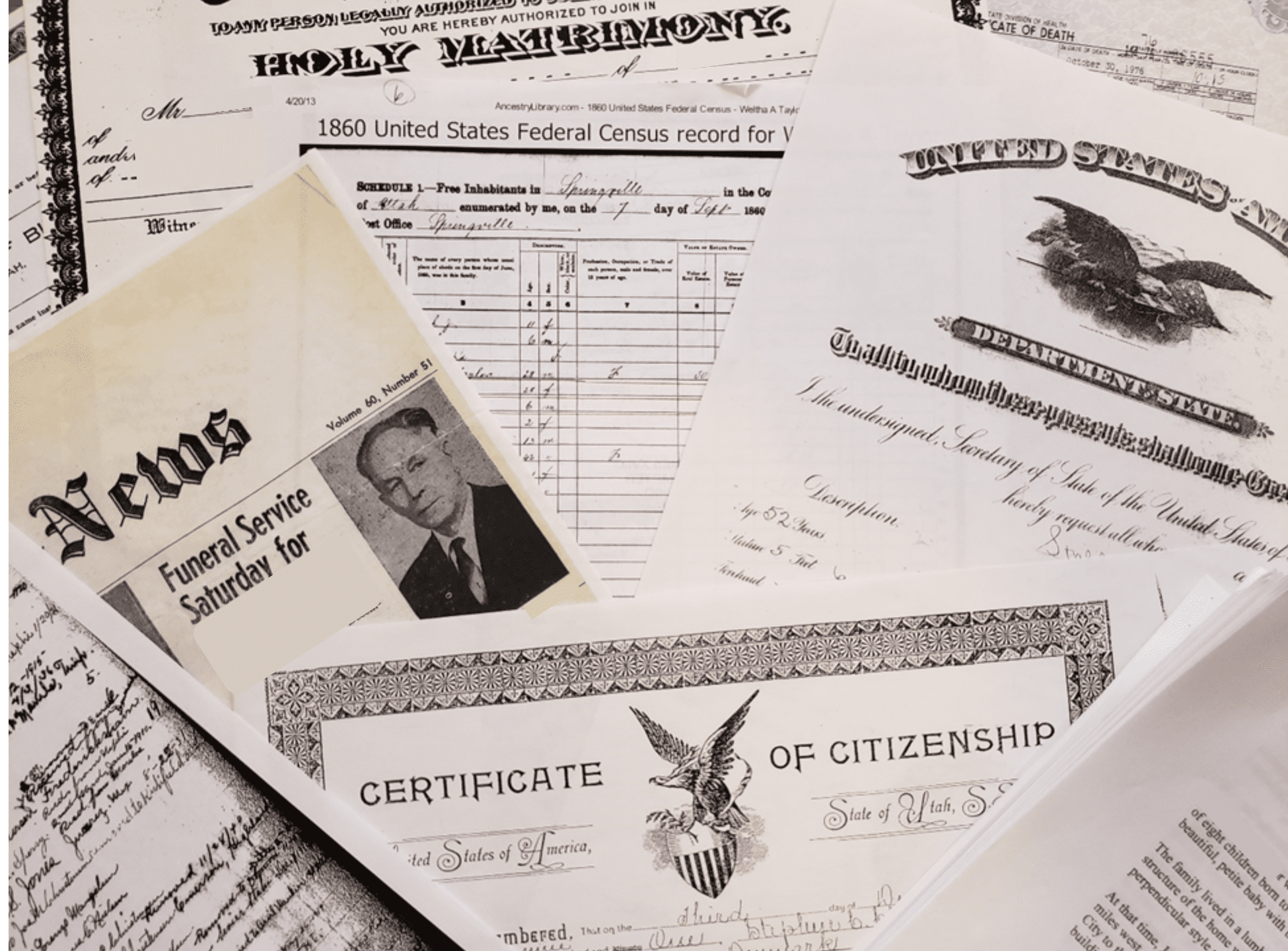
“DNA has often helped me to see where previous research was incorrect,” Debbie said, “and build a strong case for the truth.”
Debbie traveled to the care center where Susan was staying to meet with her in person shortly before Christmas. While she was there, Susan entrusted Debbie with a very fragile book containing Susan’s genealogy. Debbie promised to scan the information contained within the book as soon as she could. During their discussion, Susan confided that she had given up her only child for adoption. Debbie offered to help her locate her daughter, and Susan gave her as much information as she could. “Please,” Susan told her, “Find my daughter.”
“I will,” Debbie promised as she left. Debbie used the information she had been given to search for Susan’s daughter, and by the next day, Debbie found a match. “Of course, it took a lot more time to prove myself correct,” Debbie explained, “but I do like the challenge of seeing how quickly I can solve a case.”
Debbie shared the information with Susan, who contacted her daughter’s adoptive mother. With permission from the adoptive mother, Susan arranged to meet face to face for the first time in decades. They reconnected only a few weeks before Susan passed away, but Debbie’s husband was able to finish digitizing the records to give to Susan’s family.
“Navigating [family] issues is a challenge and makes me grateful for my degree in social work,” Debbie said. “But, if navigated well, it usually ends well and can bring families closer together.”