
Mention the Word of Wisdom and most people think immediately of its prohibitions against wine and
strong drink, its warnings that “tobacco is not for the body, neither for the belly.” Some members
of the church have emphasized various aspects of the positive injunctions about the use of fruits,
grains and the flesh of animals and birds. Yet, beyond these more obvious messages are spiritual
treasures hidden like nuggets of gold in the revelation.
The revelation came at an important time in the early development of the church. The “Olive Leaf,”
Section 88, with its beautiful doctrine and great promises, had been given just two months previously.
The Saints had been instructed to build the Kirtland temple (88:119-120), and the leaders had
participated in the ordinance of washing of feet. It was a time of preparation for, and eager
anticipation of, the great blessings and ordinances of the temple. Then as now, understanding the
teachings of the Word of Wisdom played a significant part in preparation for the temple.
It does so for us today, as well. It behooves each of us to fully understand the teachings in the Word
of Wisdom and the significance of this revelation to our own salvation.
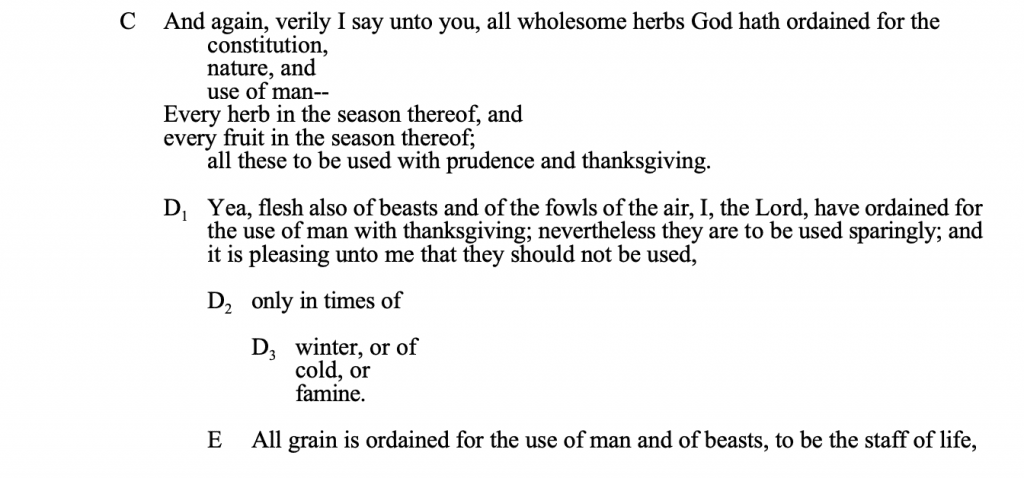
Although the revelation may be read and fully understood in the customary printed format,
rearranging the words on the page to reveal the thought patterns provides a vehicle for discovering
some of the deeper meanings imbedded within the words. The text, reformatted to show the patterns
of thought, is given in the Appendix. It is seen to possess an inverse parallel structure, characteristic
of what is known as “chiasmus”, with the concepts symmetrically placed about the statement, “All
grain is ordained for the use of man and of beasts, to be the staff of life”, located at the traditional
point of emphasis of the chiasm.
The newcomer to chiasmus will note labeling of related elements of the structure with capital letters
to guide the eye, with subscripts to show direct parallel relationships within matched major elements.
A label is placed at the beginning of the element, and the element extends to just before the next label.
Thus, the first B2 begins with “Behold, verily, thus saith the Lord…” and ends with “…hot drinks are
not for the body or belly.” Similar levels of indenting also are used to show parallelism.
The major elements of parallelism, as summarized in the table, are as follows. The first A1 mentions
“the order and will of God in the temporal salvation of all saints in the last days”, while the second
lists three pairs of blessings of that temporal salvation. The parallelism within the latter element is
shown by equal levels of indentation of related phrases. Similarly, the Lord alludes to a promise in
the first A2 which is specified in the second. The B1s taken together identify the saints as those who
remember “to keep and do these sayings”. The commandments spoken of in the second B2
include the prohibitions in the first but, of course, extend much broader. Both Cs have to do with fruits,
vegetables and grains, while the Ds, with their three parallel parts each, are concerned with the use
of the flesh of domestic and wild animals and birds.
It is well recognized that the Word of Wisdom provides wise counsel for healthy eating and drinking.
Modern medical science has corroborated all health aspects of the revelation pertaining to the
consumption of grains, fruits, and vegetables, and the wisdom of restricted consumption of animal
flesh and its associated fat and cholesterol. Indeed, the food pyramid issued recently by the US
government could have been based upon the Word of Wisdom. Moreover, the world has come to
realize the harmful effects of alcohol and tobacco, and is beginning to notice the harmful effects of
caffeine, as well. But the Word of Wisdom goes far beyond the effects of what we eat and drink on
our physical health. Interesting insights in this regard can be gained through consideration of the
structure.
It is intriguing to find the use of grain as the staff of life at the turning point, the traditional point of
emphasis of a chiasm. In contrast, how often our meals more typically are centered on some type of
meat. What is the significance of this emphasis on grain? Is it solely for health reasons, or are there
deeper symbolic meanings? We recall the statement in Doctrine and Covenants 29:34: “Wherefore,
verily I say unto you that all things unto me are spiritual, and not at any time have I given unto you
a law which was temporal…”. Taking this as a clue, we ask, What are the spiritual implications of
grain for the use of man?. Does grain signify the things of the spirit and meat the things of the flesh?
Grain, and bread made therefrom, appear prominently in both the New and Old Testaments. Christ
referred to both grain and bread in his parables. Bread was central to the miracles of feeding the
multitudes (Matt. 14:16-21, 15:32-38). Grain figured in his teachings about the Sabbath day (Matt.
12:1-8), and he taught us to pray for our daily bread (Matt. 6:11). Most of these, and perhaps all of
them, point to Christ as the bread of life. Christ so identified himself (John 6:35), and carried this to
the ultimate conclusion when he instituted bread as the symbol of his body at the Last Supper (Matt.
26:26). Thus a well-known symbol of Christ appears at the point of emphasis of the Word of
Wisdom, confirming our knowledge of him as the key to our temporal, as well as eternal, salvation.
The Word of Wisdom is not only a word for physical health, but for spiritual health as well.
Subtle but significant differences between the first and second Ds are apparent. The first seems to
have to do with domestic animals and birds, whose flesh is to be used sparingly, and preferably only
in times of winter, cold or famine, while the second says God made wild animals for the use of man
only in times of famine and excess of hunger. We recall the Lord’s injunction in D&C 49:21 about
wasting flesh when we have no need. Times of winter or cold would help minimize spoilage and
waste of flesh; modern refrigeration probably removes this aspect of this restriction. The Lord’s
reverence for living creatures is manifested clearly in these verses. Hunting for sport appears to be
contrary to the instructions given here, although he does permit consumption of meat from all sources
(D&C 49:18-19, 59:16-20).
The reference to saints in the two B1s almost provides a definition of the minimum requirements to
be a saint: “adapted to the capacity of the weak and the weakest of saints, who are or can be called
saints.” The statement in verse 2 about the revelation being given not by commandment or constraint,
but showing forth the order and will of God, can be considered in this regard. We recall a similar
statement in D&C 63:22: “As I said that I would make known my will unto you, behold I will make
it known unto you, not by way of commandment, for there are many who observe not to keep my
commandments.” He gives related counsel in D&C 58:26-33 in saying “It is not meet that I should
command in all things.” Thus, the saint is one who observes the will of the Lord, whether given by
commandment or otherwise.
As noted above, the first B2 contains the well-known prohibitions, while the second refers to walking
in obedience to the commandments, which is, of course, much broader in scope. The substances
named, as well as other commonly abused drugs, alter how the body feels, providing stimulation, or
feelings of comfort and pleasure. Keeping the commandments stimulates the spirit and yields feelings
of well being, confidence, and joy (see D&C 121:45-46). The drugs provide instant gratification of
bodily demands, while sometimes the joys of keeping the commandments are deferred. The effects
of the physical substances diminish in time, leaving the body depressed below normal levels and
demanding to be picked up again, which leads to addiction. The joys of keeping the commandments
are long-lasting and increase with time to the perfect day, which leads to devotion. Thus the chemical
substances provide counterfeit feelings of well being while displacing the true joy of doing well.
The greatest blessings of the Word of Wisdom are presaged in the first A1, temporal salvation, and
A2, a principle with promise, and elaborated upon in the second A1 and A2. It is instructive to
examine the scriptural origins of the phrases in the promises in the second A1. The phrase “health in
the navel and marrow in the bones” is found in Proverbs 3:5-8, which possesses a form of parallelism
in which the second set of phrases is related to the first set, but its elements are given in the same
order, rather than in the reverse order of chiasmus.
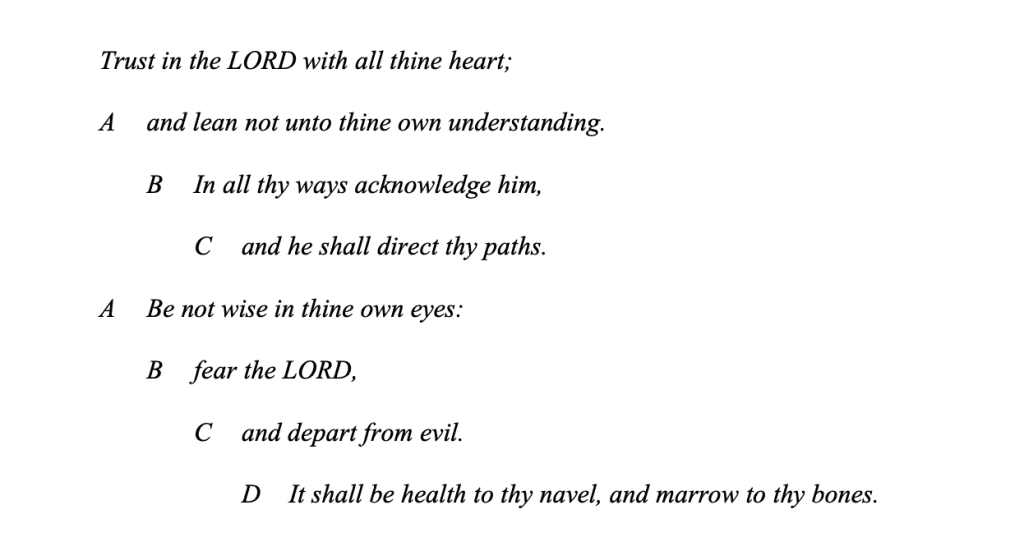
Here each of the elements in the two As, Bs and Cs are clearly related, and the D is the point of
emphasis to which they lead. The context indicates that the promise is spiritual in nature, and the
aspects of physical health mentioned are symbolic of spiritual health. The symbolism of the navel is
revealed in sacred places. Marrow is symbolic of one’s life-force, or vitality.1
Isaiah (40:28-31) uses the imagery of running and not being weary, walking and not fainting.
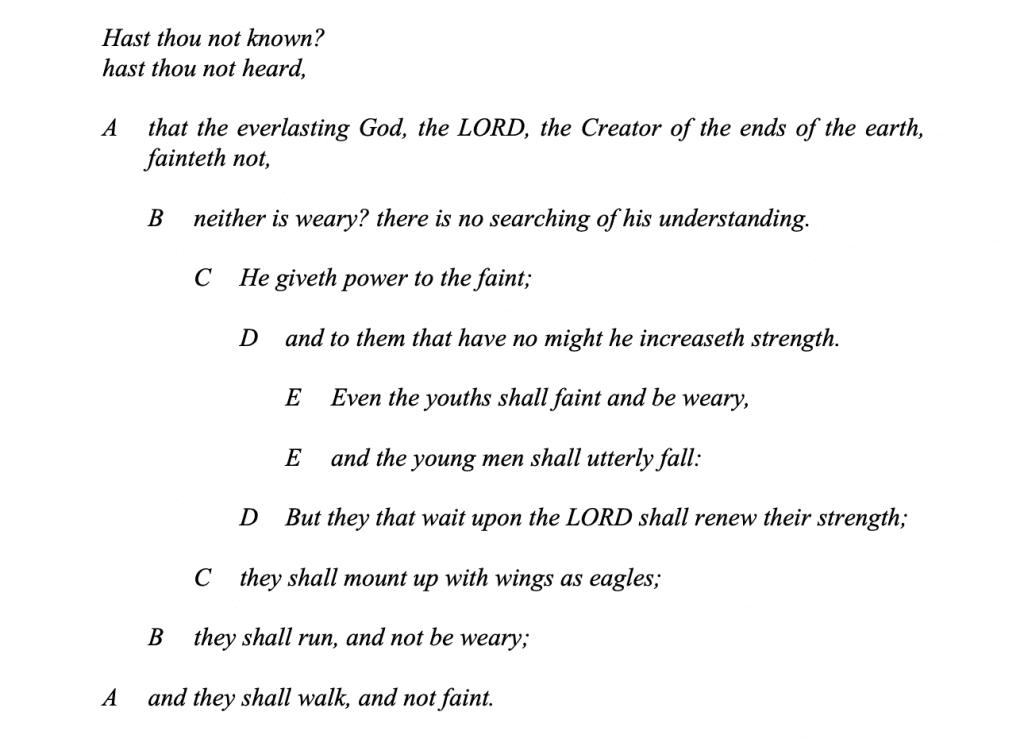
We see by examining the A and B elements of this chiasm that not being weary nor faint is a
characteristic of the Lord, and is also of a spiritual nature. Thus, keeping the Word of Wisdom, along
with the commandments, will tend to make people like the Lord, or godlike.
The images of running and walking are common in the scriptures in ways that pertain to our actions
with respect to the gospel. Thus, Paul says “I therefore so run, not as uncertain; so fight I, not as one
that beateth the air” (1 Cor. 9:26). He also uses the imagery of running with patience the race that
is set before us, along with not being weary and faint, tying the latter to looking to Jesus (Heb. 12:1-
3). Walking is used to represent our course of action in life in numerous places and contexts
throughout the scriptures, including the present verse 18. Paul’s statement “For we walk by faith, not
by sight” can help us understand that walking and not fainting is indicative of, among other things,
maintaining our faith. Without that faith, we are left to our physical selves, which, as Isaiah says,
“shall faint and be weary…and utterly fail”. The Cs have to do with power and wings, commensurate
with D&C 77:4. Although our youthful strength is transitory, both old and young alike who “wait
upon the Lord”, “shall mount up with wings as eagles…”, ie. have power and be godlike.
It probably is no accident that these two pairs of phrases bracket the promise of finding “wisdom and
great treasures of knowledge, even hidden treasures.” One might at first think only of receiving personal revelation, which is indeed to be expected. But in addition, we are told that things kept hid from before the foundation of the world are revealed in the temples, both ancient and modern (Doctrine & Covenants 124:38-41). Those who have received their endowment will recognize the language of the second A1. Thus, all three pairs of promises have deep spiritual connotations, closely associated with the temple, and living the Word of Wisdom will lead to strength in these spiritual matters. We can understand clearly the importance of living the Word of Wisdom as a prerequisite for entering the temple.
The second A2 gives a specific promise to those who keep and do these sayings. The wording of this
promise ties it directly to the Passover of the children of Israel in Egypt and, in a sense, the Word of
Wisdom is a modern Passover for the children of Israel in these days. This has reference not only to
the well documented health benefits of the principles taught in the Word of Wisdom but, perhaps
more significantly, it also refers to the spiritual destruction that is avoided by keeping oneself open
to reception of wisdom and hidden treasures of knowledge.
Thus, the Word of Wisdom may be understood on two levels. On the physical plane, it outlines what
has turned out to be the optimal food and drink regimen for human beings, both in the things against
which it warns explicitly and implicitly, and in the indicated balance of food obtained from grains,
vegetables, fruits, and animal flesh. On the spiritual plane, it teaches us about the central place of the
Savior, the bread of life, in our lives, and about both temporal and spiritual salvation, including the
hidden treasures of knowledge obtainable only in the temple and by personal revelation.
Notes:
- E.C. Cooper, An Illustrated Encyclopedia of Traditional Symbols, Thames and Hudson,
Ltd., London, 1978, p. 104.