









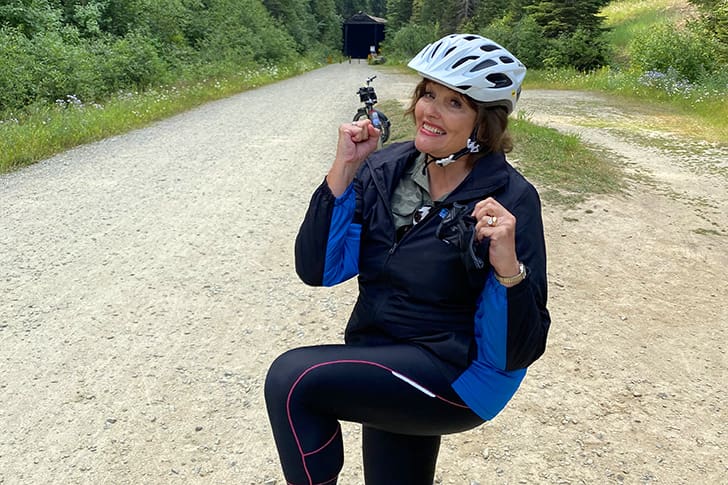


The above picture was just minutes before I started into the long tunnel where I broke my arm. I look so happy and unaware of what was about to strike.
Five years ago, I was riding my electric bike through the 1.66-mile, utterly dark tunnel on the route of the Hiawatha in Montana with only the light on my bicycle. The floor was damp and pitted, with two long concrete ditches that ran along each side. When I swerved to miss a hole, I could see my bike was headed for the ditch, and reflexively, I put my left arm up to stop the impact against the wall.
Of course, arms don’t stop impacts of a certain speed, so instead, my arm shattered into what one doctor helpfully described as kibbles and bits. Three surgeries later and a score of pins inserted, I was left with fingers that were just paralyzed in place. Stiff sticks attached to my hand, sticks that wouldn’t obey any command my brain sent their way. Dead things like winter trees scratching against your windows in the wind. They wouldn’t bend.
It was unnerving, and for help, I went to hand therapy twice a week for many months. I dutifully worked to turn over colored pegs, stacked colored rings, and squeezed a soft ball. Under the patient guidance of my honeyed-toned therapist who still spoke with the Georgian accent of her home state, I tried to pick up change and hold it in my fist. But I couldn’t close my fingers around the coins, and accusatory dimes fell to the floor, reminding me that I couldn’t even hold something effectively in my palm and shut my fingers around it.
I was picking out scripts for our podcast on my computer with a few fingers of my right hand and working on Meridian in the same plodding way.
One day after what had seemed to me like an eternity, I groaned out in sheer frustration and intense emotion to my hand therapist, “I just can’t move my fingers.”
Her answer was profound: “You just can’t do it…yet, Ladybug.” I might have remembered the moment alone because anyone who gives you such an endearing nickname on the spot is worth marking as a friend forever.
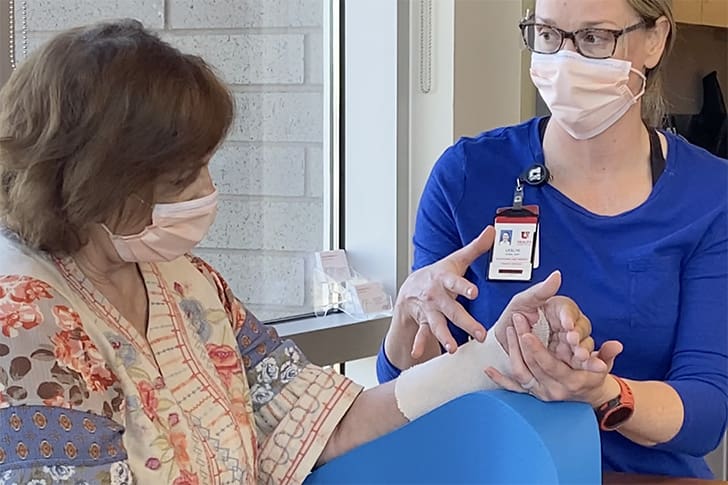
Yet, what really stood out to me was that important and really big word—”yet.” I may have believed with all my pained heart that my unmoving fingers was a life sentence and that I’d be forced to pace back and forth in this prison cell forever. She, with a much broader perspective and highly trained understanding, knew better. “You can’t move your fingers yet.”
We recently saw Lindsey Stirling perform with the Utah Symphony Orchestra, and she told a story with a similar theme. Years ago, she was on America’s Got Talent and heard an evaluation of her performance from the judges that seared her soul. Piers Morgan said to her, “to do what you do, you’ve got to be a world-class violinist, because if you aren’t, when you’re moving around and still trying to play, you end up doing what you did, and that’s missing lots of notes. There were times in there when it was okay, and there were times when it sounded to me like a bunch of rats being strangled.” And then to emphasize his comment, he added the word, ”Seriously.”
Lindsey, who had studied violin seriously since she was five years old, was devastated by his assessment, rocked to the core. Then, as she had time to think about it, she realized he was right. She wasn’t ready to play on the level she wanted while simultaneously dancing.
Yet a little voice inside her said, “You’re just not ready yet.”
Of course, the rest is history as she performs with power and grace, playing a perfect violin, on stages all over the world.
The “Not Yet” Principle
What is exciting about the “not yet” principle is that it holds innately in it the “someday, yes.” All the promise that is held inside of you is real. The world ahead gets better. “Not yet” means something really is coming.
The “not yet” principle is vital to learn for children of God who carry with them into this world these fleeting memories of light from our true home. They stir within us. Something tells us that we are so much more, but here we are stuck in the slums of Babylon, assaulted by a host of challenges that come rolling at us relentlessly.
Our yearnings call out for us to be more. Somehow, we know we are more, and that gap can cause tension.
There is so much potential and power within us, just ready to explode into beauty. We can feel it, but somehow we can’t let it out. Not yet.
So much reminds us of our inadequacy. We cannot always find the answers to the problems that confront us. How do I help that child of mine who is locked in despair? How do I navigate a course through a life that is often so hopelessly messy? How do I negotiate a day that has more challenges than hours?
The “not yet” principle is a way forward of peace and optimism. It relieves us of the heavy burden of having to be “all that” right now. I can accept that I am not yet whole. I am not yet complete. I am not yet as wise as I had hoped. That doesn’t have to be devastating news, nor do I have to evaluate my own history in terms of what I should have known and done before. Of all the various iterations of me, I do not need to disparage the old ones, nor believe my current self is all there is.
Acceptance of myself and my life is a powerful gift. I can work steadily toward a higher goal without gnawing discontent, because it will all happen. It just hasn’t happened yet.
The Pulitzer Prize-winning author, Wallace Stegner, wrote his mother:
Mom, listen. Except when I have to tie my shoelaces, I don’t feel 80 years old…But if I don’t feel decrepit, neither do I feel wise or confident. Age and experience have not made me a Nestor qualified to tell others how to live their lives…. Instead of being embittered, or stoical or calm, or resigned, or any of the standard things that a long life might have made me, I confess that I am often simply lost, as much in need of comfort, understanding, forgiveness, uncritical love–the things you used to give me–as I ever was at five, or ten, or fifteen.”
Like Stegner, I don’t know much. Still, the “not yet” principle allows me to accept myself and my days with calm and no self-disdain, while at the same time inviting me to move forward with courage, knowing that God has got this.
Stegner said, “You are at once a lasting presence and unhealed wound.” Because we are lasting presences, the Lord heals our wounds.
We want to be complete, whole, and the Lord promises us that if we trust Him and fall into the embrace of the atonement, we will be. That’s His work. Meanwhile, we can be confident and content on that journey.
Are we the whole, loving, wise presence we hope to be? Not yet, but that we can conceive of more and that we want to drink more deeply of the nectar of life, squeeze the juices out of it, and push ourselves into higher realms should tell us something. That yearning is a memory. It is planted in our souls to invite us forward. There is more. We are just not experiencing it yet.
The Lord tells us:
“Beloved, now are we the sons of God, and it doth not yet appear what we shall be: but we know that, when he shall appear, we shall be like him; for we shall see him as he is.” (1 John 3:2)
That’s such a promise. We do not yet see what we shall be—not yet.
Meanwhile, we have a friend who teaches:
Trust in Jesus Christ, not in the outcome.
To me, that means:
Trust in Jesus Christ, and don’t constantly measure today’s outcome, hoping to have already arrived.
We use up so much mindshare weighing and evaluating ourselves and our performance. We build up landfills of regret about what today should have looked like. We may even blame God because this life doesn’t look like the blueprint we designed.
At least, not yet. The promise is that “eye hath not seen, nor ear heard, neither have entered into the heart of man, the things which God hath prepared for them that love him” (1 Corinthians 2:9)
The Rest of My Story
With my unyielding fingers that refused to bend, I have a happy ending. My therapist was right all along. I couldn’t move my fingers yet, when I had cried out, but the time would come.
After months of working with only the slightest improvement in my left hand, she told me that I was sufficiently healed that my fingers should move now, but the war was in my mind. On some deeper level, my brain had decided to keep my fingers stiff as a sort of protection.
I remember so vividly when my stretched-out palm was on the table, willing my ring finger to tap the table on command. It wouldn’t. Send that message down those neurons I commanded from my silent nerve center? Nothing. No movement. Again and again. Why wouldn’t my fingers listen? It’s as if there was something broken between me and them.
Then my therapist had an idea to use a tool usually designed for stroke patients. She got a small A-frame with a mirror on the outside and placed it on the table, instructing me to put my left hand inside the A where I couldn’t see it. My right hand was also on the table, flat, palm down in front of the mirror. From my view, it appeared that I could see both hands, but in reality, the right hand was reflected in the mirror and looked like my left.
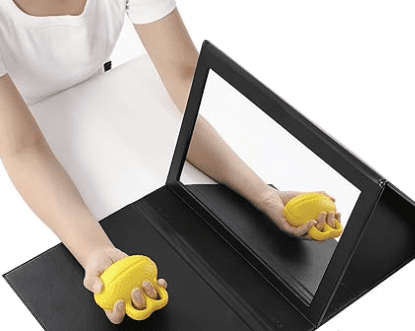
Then she gave me commands for my hands to do. Tap my pointer fingers on the table. From my vantage, I had the perfect illusion. It appeared that both my right and left hands were moving because the right was reflected in the mirror. Her commands continued, and it appeared to me that both my right and left hands were performing, thanks again to the mirror. Then suddenly something happened. She told me to tap a finger, and both my hands actually did respond. The left hand was a bare movement, but it was a movement, and we could all see it. It was a little tap of the ring finger on the table.
I looked up, and my husband, Scot, had tears in his eyes.
After that, my progress was steady, almost magical, and before I knew it, my fingers were gliding swiftly again over my keyboard as they are now.
For me, it was a miracle, and if ever I am feeling put upon by mortality and tired of the journey, I just look at my hand with gratitude and remember that “not yet” becomes now.
If I can accept “not yet,” then I am happier in the journey. I can be present and grateful. If most of us had the guarantee that we would be with God and like Him, we might allow the tensions and the inner demands that keep us anxious and tired float away. Yet, He has promised us that very thing if we will trust Him, turn to the atonement, and continue the journey with some heart. We are not what we will be—not yet, but mortality demands either an acceptance of that or a heartbreak.
Trust the Lord and accept the terms.







MaryannAugust 5, 2025
Such a beautiful, encouraging article that applies to all of our trials. I loved the idea that we can shake off the burden of believing that things must be all right "right now!" When we accept that recovery and also growth take time, we can feel more peace. I look forward to the day when we will stand as resurrected beings, perfect in health, and spirit. I am so glad that you're recovered!
MAugust 4, 2025
I am currently homebound with an illness subsequent to a traumatic injury, which doctors haven't been able to explain. I need stories like yours, because I have heard God whisper "Not yet." It helps so much to see the fruits of the hard work and perseverance of others. Thank you. Thank you.