








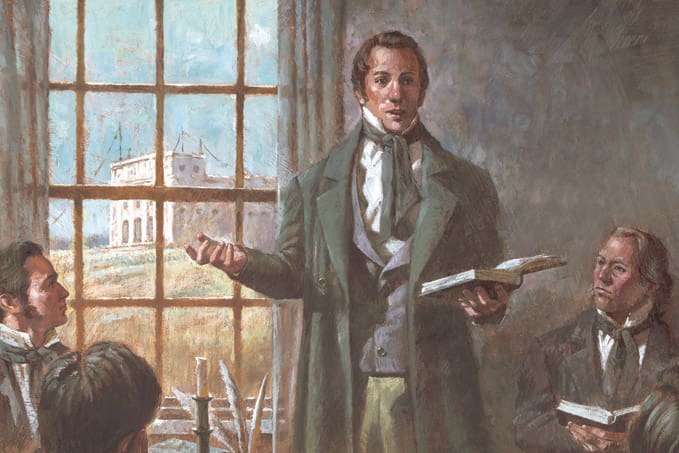


Among the many complexities of Latter-day Saint history, few subjects evoke as much unease, confusion, or silence as plural marriage. For modern members of the Church, it is often a topic easier to set aside than to engage with openly. The practice, central to early Church life yet wholly absent from our current experience, can seem at odds with our understanding of eternal marriage as a sacred covenant between one man and one woman. For some, the tension is deeply personal—how could something so contrary to our moral instincts have once been commanded by God?
That tension creates what psychologists might call cognitive dissonance—an uncomfortable clash between what we believe and what we know. Modern Saints are taught marriage reflects unity, fidelity, and equality before God, yet we also revere prophetic figures who practiced plural marriage under divine direction. Faced with this conflict, many members instinctively turn away, choosing to focus instead on other, more spiritually comfortable aspects of the gospel. It is easier, after all, to emphasize missionary work, charity, or the Atonement—uplifting and inspiring truths—than to dwell on unsettling history.
This pattern of avoidance is understandable, but it is also indicative of something deeper than discomfort—a cultural inheritance of secrecy reaching back to the 19th century. In its early days, plural marriage was practiced under conditions of misunderstanding and persecution. Those who entered it did so quietly, often in fear of external hostility or internal division. Even after the Manifesto of 1890 officially ended the practice, a reticence about discussing the subject remained. For generations, faithful Saints learned—often unconsciously—that silence was safer than transparency. This habit has persisted, passed quietly from teacher to student, parent to child. The result is that even today, many Latter-day Saints sense plural marriage is a sensitive or off-limits topic, best left to Church historians or avoided altogether.
Another reason for silence lies in our desire to protect faith, both our own and others’. Leaders and parents sometimes fear discussing plural marriage, especially its more troubling details, such as Joseph Smith’s plural wives or the secrecy of early practice, might damage trust in prophetic authority. Yet, ironically, this silence can make faith more fragile, not less. When members later discover these facts from secular or critical sources, they may feel blindsided or even betrayed, wondering why they were not trusted with the truth earlier. The real threat to testimony is not the history itself, but the sense that it was hidden.
To move forward, we must rediscover a truth central to the Restoration… all truth—spiritual, moral, or historical—belongs to God. Faith and inquiry are not enemies. If we believe in continuing revelation, we need not fear the weight of complexity. Honest study, approached prayerfully, can deepen rather than diminish testimony. As Elder Ballard has taught, There is no need to fear questions. The Church is not afraid of questions. Faith seeking understanding is itself an act of discipleship.
Part of our difficulty also stems from confusing eternal principles with historical practices. The everlasting covenant of marriage, central to God’s plan, endures as a doctrine of unity and exaltation. The command to practice plural marriage, however, was temporary—a specific directive for a specific time and purpose, much as other divine commands throughout scripture were adapted to their own eras. When we distinguish between the enduring principle and the historical commandment, we can sustain prophetic authority without feeling compelled to defend every historical circumstance. We can acknowledge Joseph Smith was a prophet of God and still wrestle with the human and cultural realities surrounding his prophetic calling. Faith does not require us to silence discomfort. It asks us to bring our discomforts honestly before God and trust Him to enlarge our understanding.
Seeing the Saints who lived plural marriage as real, complex human beings also transforms our perspective. Too often, we reduce them to symbols of controversy rather than disciples of Christ. Yet the journals and letters of early Saints reveal ordinary men and women—people of faith, doubt, and sacrifice—struggling to obey a commandment they often did not fully understand. Many resisted at first, some accepted reluctantly, and nearly all suffered deeply. And yet, in their suffering, they showed extraordinary devotion. Their lives remind us that discipleship sometimes means trusting God when His purposes remain obscure. Their obedience under uncertainty invites compassion rather than judgment from us, their spiritual descendants.
For the modern Church, creating faithful spaces for these conversations is crucial. Gospel classrooms, family councils, and youth discussions should be safe environments where hard questions can be explored openly, guided by the Spirit and grounded in official sources such as the Gospel Topics essays and Saints history volumes. Leaders and teachers need not fear that openness will erode belief. On the contrary, honesty builds trust, while silence breeds suspicion. When we model curiosity and faith side by side, we teach the rising generation that difficult history is not a threat to testimony, but a natural part of a living, growing faith.
Plural marriage also shows us a humbling truth about divine revelation. God works through imperfect people in imperfect contexts. His commandments unfold according to time, culture, and need. The Restoration has always been a process, not an event—a continuing dialogue between heaven and earth. As President Uchtdorf has candidly observed, To be perfectly frank, there have been things said and done that were not in harmony with our values, principles, or doctrine. That honesty does not diminish prophetic authority; it reinforces our belief that revelation is ongoing, and the Lord’s Church is capable of correction and refinement as His purposes unfold. Just as plural marriage served a divine but temporary role in the 19th century, so too did its end reflect continuing revelation and divine mercy. God’s moral arc bends toward perfect justice, even if we perceive it only gradually.
Plural marriage will always remain one of the most perplexing chapters in our history, but its difficulty need not make it shameful. To face it faithfully is to live the very principle Joseph Smith taught—by proving contraries, truth is made manifest. Wrestling with the past can strengthen, not weaken, our discipleship. When we stop fearing our history, we find it holds not scandal but soul—stories of obedience, sacrifice, and the unfolding of divine will among fallible people striving to do right.
For too long, we have inherited silence as our coping mechanism. The time has come to replace silence with understanding. When we confront our history with both faith and humility, we honor the spirit of the Restoration itself—a movement born from the courage to ask, to seek, and to believe truth, however complex, will ultimately lead us closer to God. In doing so, we find not a threat to our faith, but an invitation to deepen it—to let our testimonies grow from simple conviction to mature trust in the God who reveals truth line upon line, here a little and there a little, until the whole light of eternity unfolds.






Lenet ReadNovember 14, 2025
The Lord used animal sacrifice for centuries to teach of Christ's sacrifice It is possible He used polygamy as a similitude of Eternal Lives. How else could He teach of that. By having a few men take multiple wives He could bear witness of the great posterity available to those who keep His covenants, but through many generations of time.
MaryannNovember 14, 2025
I feel sure that plural marriage was a true doctrine given to the Prophet, Joseph Smith, for the temporary need to build up the church, and to bring Spirits being born into the Kingdom of God. I am grateful to know scripturally, and also from modern day Apostles (Elder Bruce R. McConkie) that entering into plural marriage is NOT a requirement for exaltation in the Celestial Kingdom. I don't believe that it is possible for a man to understand the depth of pain and fear experienced by women who mistakenly believe they will be forced to live the law of plural marriage. There could be nothing more destructive to a woman's heart or soul.