






Editor’s Note: Meridian is pleased to offer some sneak peeks into Richard Eyre’s new grandparenting book which will be released in March. This is the second article of four that give us advance samples from the book. (See article 1 here) Today’s excerpts are aimed at giving us more accurate perspectives of grandparenting.
The Perspectives of Grandparenting
The best place to start is with perspective. Thinking about what grandparenting is and developing an awareness of what it can become allows us to pull back and see it from above before we dive in with our new plan.
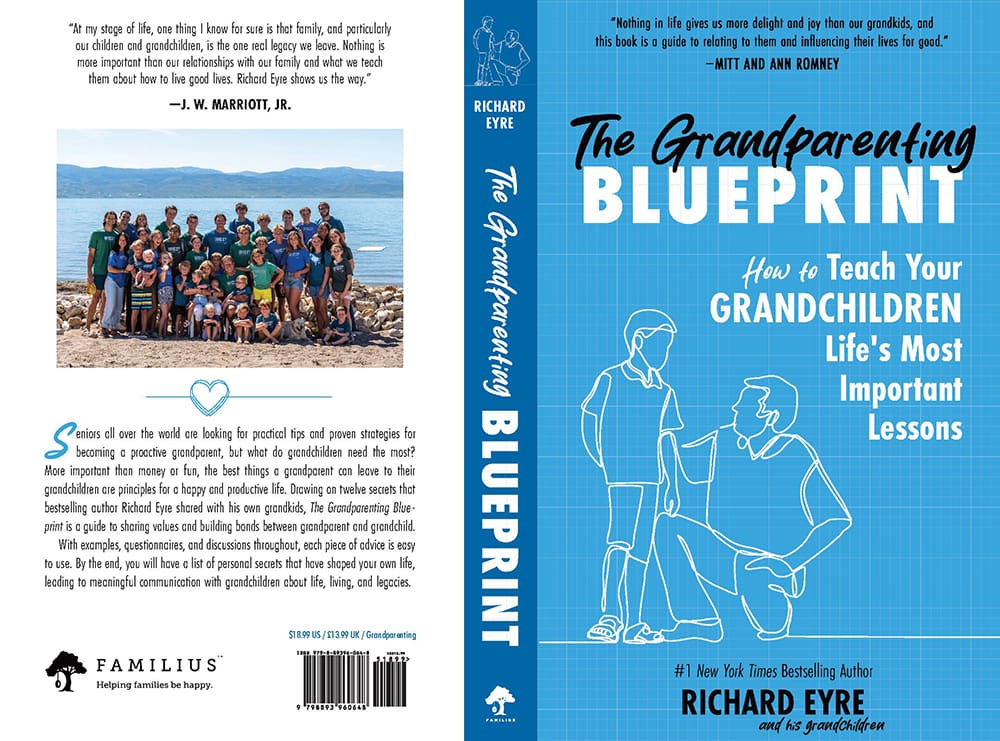
In The Grandparenting Blueprint, Grandparent author Richard Eyre shares practical grandparenting principles to help grandparents strengthen relationships, teach life lessons, and create a meaningful family legacy with their grandchildren.
Here are five important things to think about:
1.Facts, Questions, And “Turning our Hearts”
Consider the following:
- Many of us will be grandparents for 40 years, more than twice as long as the time we had to parent a child in our home.
- A majority of grandparents say that their grandchildren are the best part of their lives.
- Yet most feel inadequate and unprepared for the role—not quite sure how to approach it, and a bit worried about stepping on the toes of their kids, the parents.
- There is no guidebook or owner’s manual for grandkids—unlike parenting there aren’t many resources or reliable things being written or podcasted to help grandparents.
- In other words, grandparenting is not really a thing yet. It’s like parenting was 50 or 60 years ago—we just try to figure it out as we go along.
- Many of us wonder if grandparenting should be more proactive—setting goals for our grandkids and for our relationship with them; or whether it should be reactive—trying to step in only when there is a serious issue or when parents ask for help.
- Most grandparents want to be useful and relevant to their grandkids, to be effective, and to make a difference. But there are a million questions—is financial help a good thing? If we have several grandkids, should we treat them all the same or help the ones that need help the most? How do we get to know them individually and as independent persons from their parents? If parents are the real managers and stewards, how can we be good supplements and consultants? How can we work in synergistic partnership with our children (the parents) to give grandchildren what they need? Who should take the initiative in this partnership, the grandparent or the parent? How much should we try to help our grandchildren spiritually and with their values and their faith? What are some of the “best practices” or grandparenting strategies and proven ideas that really work?
- Lots of parents form parenting groups to learn from and help each other. Might that also work for Grandparents?
Heart-Turning
In a world where the norm is both parents working full time, and a world where grandparents are young and capable for more years than ever before, opportunities for “teamwork families” abound. As grandparents, we often have more time, more resources, more experience, and are better positioned to turn the hearts, to be the trunk that connects branches and roots—in both directions.
Let’s focus for a moment on that phrase “turn the hearts.” It is the final verse of the Old Testament in the Bible, and it is in the form of a powerful admonition. “Turn the hearts of the children to the fathers (parents, grandparents) and the hearts of the fathers to the children.” And then follows a dire warning: “Lest the whole earth be wasted,”
The same admonition to turn the hearts appears again elsewhere in scripture, this time with an even more ominous warning: “Lest the whole earth be cursed.”
Notice three things:
- Hearts have to turn in both directions. Some interpret this scripture as being about turning our hearts to our departed ancestors and doing our genealogy, and indeed, it can mean that. But the more immediate and intimate meaning is turning our hearts within our three-generation families— turning our hearts to our children and grandchildren—prioritizing them and doing all we can to love them.
- Without this turning, our lives become “cursed” or “wasted,” since the highest purpose of this life is to form our own committed, loving families as parts of God’s family. If we fail to do this, the Bible tells us that God’s plan is unfulfilled, and this mortal purpose is cursed and wasted.
- Turning hearts not only means loving, it means prioritizing and trying hard to become the best help and support we can be to our children and grandchildren.
2.Saving the World, one Grandchild at a time
Good grandparenting may have the power to save the world. As parents are more and more busy, it really takes a team effort to raise children, and grandparents and parents who form that kind of a team can change everything.
Done well, grandparenting helps everyone—It helps the parents by giving them back-up, support, and a little more time for themselves. It helps the kids by giving them a kind of nonjudgmental, unconditional love and acceptance that is easier for grandparents—and may teach them values and give them a level of security that parents can’t give all by themselves. And it helps us, the grandparents, by giving us a kind of joy and fulfillment that is available nowhere else in the world.
But good grandparenting isn’t easy. There are a lot of mistakes that can be made, and some of them can damage our relationship with our children. Instead of trial and error, we need to learn from other grandparents who have more experience than we do. We need to learn from each other and get serious about being the best we can be at this important and long-term role.
Freed from the mandatory duties of parenthood—the educating, the disciplining, the feeding and clothing and taxi-ing and supervising, we are free to pull back, to see the bigger picture, to focus on the macro of who this child is, and who he can become. We have the joy and luxury of helping this child, this being who is one-fourth us, to figure out who he or she is, to have the confidence our pride and praise can give, and to perceive and practice principles that can both protect and perfect. Therein lies our greatest legacy!
When someone asks, “Who is going to teach this generation of children the values, the character, the family narrative, even the street smarts that they will need?” most would answer “the parents.” But in today’s world, where most parents work full time, and where life and all its demands seem to increase exponentially, who is to say that parents will find the time or the means to give their kids all that they need?
So, who else can possibly do it? Only one answer—Grandparents!
And who will give kids the confidence, the identity, and maybe even the resources they need to become all they can be? Same ideal answer, it should be the parents, but same problem, too much to do and too little time to do it.
So, who else can? Only one answer—Grandparents!
3. My Four Fondest Wishes
By: Every Senior
Hello, my name is Every Senior, and I have lived about 70-75% of my life.
Here are my Four Fondest Wishes for the last quarter of my life
ONE: In terms of how I feel and how I think, I wish to stay as young as I can for as long as I can.
TWO: I wish to leave some kind of lasting legacy.
THREE: I wish to be Surrounded by Loved Ones as I live the final chapters of my life
FOUR: I wish for each of my Grandchildren a safe and successful life.
Let me elaborate a little on each of those wishes:
- Since I am Every Senior, I can be candid and tell you that at this stage, I am starting to feel my age. Little things mostly, but I’m aware that I can’t do everything I once could, and realistically, my physical and mental peaks may have passed. I may be, as they say, a little bit “over the hill,” but it’s not always such a bad place to be—when you crest a hill, you can coast a little. My first wish is just that the downslope will be gradual, and long. Ageing is inevitable, but my wish is that I can control its pace—slow it down as much as possible. Because I still feel like I have a lot to do, a lot to enjoy, and a lot to give. That’s my first wish.
- Not to dwell on it, but I want to leave something behind when I go—some kind of legacy—something that makes the world a little better place, so that is the second wish.
- I want to be independent and able to care for myself as long as possible, but my third wish is that I can avoid the loneliness that creeps up on so many as they move into the “winter” of their lives. I feel that I can handle everything that comes at me a little bit better if those I care about and love most still care about and love me back. That is my wish number three.
- My grandchildren, on the opposite end of life from me, will live in a world I can’t even imagine, and my fourth wish is not for me but for them—that they will have the strength and the values and the faith to find their own joy and reach their potential.
Now let me tell you a little secret—a small but extremely valuable discovery:
THE BEST WAY TO WORK ON THE FIRST THREE WISHES IS TO WORK ON THE FOURTH ONE.
It is our grandkids, and our frequent contact with them and our individual relationships with them that will keep us young!
Whether we are outgoing or quiet, famous or common, rich or poor, our only real legacy will be our grandchildren!
And the older we get, the more it will be our grandkids that we want to have around us, either physically or virtually!
So, by focusing on the fourth wish, we will also create favorable results on wishes one, two, and three.
Statistics suggest that if you have just become a grandparent, you likely have another 20 to 40 good years ahead of you; and public opinion polls show that you probably consider your grandkids to be the best part of this “Autumn of life.” (They don’t call it GRANDparenting for nothing!)
The question is, how much time and mental energy will you expend on these living legacies? How much will you prioritize them and how proactive and deliberate will you be as a grandparent? And where do you go to learn the art of effective but unobtrusive grandparenting?
4. Four Kinds of Grandparenting: Your Choice
How much of our time and our mental energy are we devoting to those precious and perfect little kids who carry on our name and our genetics and our view of the world? And how deliberate and thoughtful are we about the time we spend with them, about what we can do for them, about the relationship we want with them now and for the rest of our lives?
We don’t get a lot of training about how to be grandparents. It’s different than parenting, and there is no owner’s guide or instruction manual.
When your kids have kids, you have a decision to make: What kind of grandparent will you be?
There are four general alternatives, and each comes with a different attitude:
1.Disengaged Grandparenting.
Attitude: I raised my kids and now it’s their turn to raise their kids; I’m done.
This attitude might lead you to downsize into an adults-only condo in sun city by a golf course where your days will be quiet but boring.
2.Limited Grandparenting.
Attitude: I love to see them but in limited doses and on my terms.
In this model, grandkids are like amusement parks; you go there once in a while to have fun. Or like dinner guests; you have them over now and then when it’s convenient.
3.Supportive Grandparenting.
Attitude: My kids need all the help they can get with their kids and I want to be there for them.
With this approach you become part helper, part martyr, sacrificing your own life to be at the beck and call of your adult children whenever they “need” you to help with kids.
4.Proactive Grandparenting.
Attitude: My children are the stewards for their children, but I can teach these grandkids things their parents can’t and be an essential part of an organized three generation family. And by thinking about it—hard—and coming up with a strategy and a plan, I can make a real difference in my grandkids’ lives, even as I add joy to my own life and keep myself young.
Only at this 4th level does Grandparenting become effective, consequential, and truly fun. At this level you deliberately ponder the needs you can uniquely fulfill and you set goals and plans to enhance your grandchildren’s lives; and you do so in concert and in teamwork with the goals and stewardship of their parents. This approach will stretch and test you but it will also reward you with levels of fulfillment and well-being and love and peace otherwise unobtainable.
The fact that you are reading this book probably means that you are willing to accept the challenge of more Proactive Grandparenting, so I can begin by speaking candidly and unapologetically about accepting the role with gusto and making a difference.
The fact is that we can and should play a powerful role in teaching our grandchildren to live for responsibility and reputation rather than ease and entitlement….and in most cases doing so will be the most welcome gift you can give to your own children-the-parents.
5. Champions
The champion stands alone on the podium—triumphant, a winner. Years of training have paid off: the sacrifices, the dedication and the unrelenting commitment to excellence. Now comes the reward — being the best. Being a champion in this sense is an ultimate — an endpoint.
But there is another kind of champion — where the word is a verb as well as a noun, and where you become the person who elevates others as an advocate, encourager, supporter, defender, protector and opportunity-maker. This is the type of championing where you stand behind the podium, invisible, and cheer on the person you have mentored. It is wonderful to champion the people you love, particularly your grandchildren.
In fact, the first step in becoming a Proactive Grandparent is to be a champion for your grandkids.
We should be their biggest cheerleaders, the ones they know are always there for them, and the resource they can fall back on when they need help. We should take our grandchildren out for regular grandma and grandpa “dates,” attend as many of their performances and games as we can, talk and—more importantly—listen to them, perhaps contribute to their college fund and interact frequently with them in person or on line.
I love to think of “champion” as a verb. How can we champion them? How can we empower them? How can we make them feel in themselves the confidence we feel in them.
Championing them means believing in them, recognizing and praising them for specific things that you notice in them, giving them opportunities, opening doors for them, representing them. When we champion (v) them, we become their champions (n) who are their biggest cheerleaders and biggest supporters and encouragers!
Start by thinking about “who you want to be to them”. What kind of a champion do they need at different ages? Here are some suggestions to consider:
Babies to eight years old: Be their ringmasters
Eight to sixteen: Be their buddies
Sixteen and up: Be their consultants
With the little guys, just show them a good time. Take them places, show them things, spoil them a little (but always in concert and communication with their parents.) Enjoy them, and let them enjoy you! Be their ringmasters in the circus of life.
With the middle ones, be their buddies, and first of all, you’ve got to be tech savvy and on line. And email won’t cut it. Just be, electronically, whatever they are. And as they evolve from Facebook and X to Instagram or Snapchat or AI or whatever comes next, you evolve with them.
With the upper teens, be their trusted, non-judging consultants; establish a relationship in which they will ask for your advice, or at least listen to it. Explain that a consultant is not a manager or someone who tells you what to do or pushes you around. A consultant is someone with a lot of experience who can help you with your goals and help you get what you want and become what you want.
And remember, most of this ringmastering, buddying, and consulting is not done in groups, but one-on-one, whether it is in person, looking in the eye, or online back and forth—just the two of you—the magic connection of generations 1 and 3.
(End of excerpt)
Thanks for reviewing and renewing your grandparenting perspective with me today. Join me again this Friday on Meridian when we will excerpt a bit more from the book about the T.E.A.M. approach to more proactive and effective grandparenting. – RE
Richard Eyre is a New York Times #1 Bestselling Author and a former Mission President in London