










This article includes excerpts from The Heart of Our Covenants: Temple Principles that Draw Us unto Christ by Valiant K. Jones. Used by permission. See www.valiantjones.com or www.cedarfort.com.
While addressing the conflict between same-sex marriage concerns and Church doctrine in August of 2021, President Jeffrey R. Holland admonished the BYU community to do better in teaching our doctrine, encouraging them to find “better ways to move toward crucially important goals in these very difficult matters—ways that show empathy and understanding for everyone while maintaining loyalty to prophetic leadership and devotion to revealed doctrine.” He then spoke of a “need to define, document, and defend the faith.”[i]
This series of articles is intended as a faithful response to that request. The first three articles in this series focus primarily on “loyalty to prophetic leadership and devotion to revealed doctrine,” and the final two articles focus primarily on “ways that show empathy and understanding for everyone.”
See the previous article in this series here.
Support for Sexual Minorities through the Doctrine of Christ
The preceding articles in this series presented the doctrine of the Church regarding eternal families and showed that it is based on eternal principles. Only a husband and wife, sealed for eternity and resurrected with celestial bodies, will be able to enjoy the continuation of seed eternally. This doctrine resonates warmly with many Latter-day Saints; however, for those who experience same-sex attraction (SSA) or related sexual minority challenges,[ii] it may seem inaccessible.
What can we do to help these faithful Latter-day Saints reconcile their real-life experiences with our doctrinal beliefs regarding eternal family arrangements? The Church agrees that “Individuals do not choose to have such attractions.”[iii] What can be done to help them live the gospel while experiencing their unsought-for challenges? The final two articles of this series will address these questions. The experiences and testimonies of several faithful Latter-day Saints and other Christians who experience same-sex attraction will be presented, showing that help can be found by applying the doctrine of Christ.
The Two Dimensions of the Doctrine of Christ
One of the covenants of the temple endowment is called the law of the gospel of Jesus Christ. The gospel of Jesus Christ is also called the doctrine of Christ (see Jacob 7:6). It focuses on the Resurrection of Jesus Christ and the redeeming power of His Atonement that will not only justify His faithful followers at the Final Judgment but will also strengthen them through the challenges of mortality. It also specifies a path for engaging Christ’s redeeming power in our lives. This path requires us to come unto Christ and exercise faith in Him, repent of our sins, make or renew with God our covenant of baptism, and receive and follow the guidance of the Holy Ghost. We should then endure to the end by regularly repeating this cycle with the help of prayer and scripture study. This doctrine is taught in the temple endowment and in many passages of scripture.[iv]
The doctrine of Christ proclaims, in the words of the apostle Paul, “I can do all things through Christ who strengthens me” (Philippians 4:13, NKJV). Those who follow this doctrine develop a personal relationship with the Father and the Son by learning to tap into the power that comes from the Atonement of Jesus Christ—His Grace.
There is, however, another dimension to the law of the gospel or doctrine of Christ from which we can draw power. God does not expect us to receive support, help, and strength exclusively from our relationship with Him and His Son, as powerful as Their help is. God invites us to also tap into the power that comes from our relationships with one another as fellow disciples in His church and kingdom. The Apostle Paul explained that the followers of Christ are the body of Christ—His hands, ears, eyes, and feet (see 1 Corinthians 12:12-27). As such, we need to assist in His work.
Dr. Christopher Yuan was once a gay drug addict who discarded those identities after finding wholeness in Jesus Christ and strength through fraternal relationships in his evangelical Christian community. He summarized the two dimensions in which the doctrine of Christ functions by saying, “The answer is Christ. And if Christ is the answer, then that also means that the body of Christ is part of that answer.”[v] As disciples of Jesus Christ, we are His body, and we are not fully living the doctrine of Christ unless we are supporting one another in the community of believers.
In the spring of 1834, the fledgling new Church of Christ in the Kirtland area was inundated with many new members whose needs were greater than their personal resources. During this time, the Lord revealed: “And it is my purpose to provide for my saints, for all things are mine. But it must needs be done in mine own way . . . . Therefore, if any man shall take of the abundance which I have made, and impart not his portion, according to the law of my gospel, unto the poor and the needy, he shall, with the wicked, lift up his eyes in hell, being in torment” (D&C 104:15–18; emphasis added).
This passage describes how the Lord provides for the needs of His Saints: It is usually through each other! This approach is “according to the law of my gospel,” and thus, according to the doctrine of Christ. And it applies not only to meeting physical needs, but also to meeting social and emotional needs. As members of Christ’s kingdom, each of us should “take of the abundance” of emotional strength which God has placed within us “and impart… his portion… unto the needy.” When we do so, we are living “according to the law of my gospel,” which is according to the doctrine of Christ.
Alma understood both dimensions of the law of the gospel. His description of our baptismal covenant includes a call “to come into the fold of God, and to be called his people, … and to stand as witnesses of God at all times and in all things, and in all places that ye may be in, even until death, that ye may be redeemed of God” (Mosiah 18:8–9). That connection with God describes the first dimension. In addition, Alma said the baptismal covenant includes being “willing to bear one another’s burdens, that they may be light; yea, and … willing to mourn with those that mourn; yea, and comfort those that stand in need of comfort” (Mosiah 18:8–9). That connection with fellow saints describes the second dimension.
Paul also taught both aspects of the law of the gospel of Jesus Christ. For example, he taught the Romans that “the gospel of Christ . . . is the power of God unto salvation to every one that believeth [in Christ]” (Roman 1:16). This focus on Christ as the source of salvation is balanced by the following instructions that Paul wrote to the Galatians: “Bear ye one another’s burdens, and so fulfil the law of Christ” (Galatians 6:2). The gospel of Jesus Christ, the law of Christ, and the doctrine of Christ are different titles for the same doctrine, and this doctrine has two dimensions—one vertical and one horizontal.
Just as the gospel or doctrine of Christ requires that we engage with Christ in the steps of faith, repentance, covenants, and the Holy Ghost, so also this doctrine requires that we engage with the body of Christ in these same steps. We lean on the example of other faithful saints to increase our own faith, and it is usually through missteps and occasional messy interactions with fellow Church members and family members that we learn repentance. We also join with other saints in weekly sacrament meetings to renew our baptismal covenants so we can receive a rejuvenation of the Holy Ghost.
Sometimes, when I partake of the sacrament, I not only think about the Savior, but I also look around the chapel at the other saints I am worshipping with and think about the times so many of them have shown me love and helped me grow in the gospel. They truly are the body of Christ. There is a reason that we partake of the sacrament communally. In fact, some Christian denominations call their version of this ordinance the communion.
The two dimensions of the doctrine of Christ or law of the gospel of Jesus Christ are seen in the revealed name of the Church: The Church (1) of Jesus Christ (2) of Latter-day Saints. These two dimensions can also be summarized by the two great commandments: (1) Love God, and (2) love your neighbor. However, the doctrine of Christ expands these to say that we should not only extend love to God and to our neighbors, but we should also receive love from God and receive love from our neighbors so we can be fortified by them.
It is through the giving and receiving of love in our interactions with Deity and with others in our church community that the doctrine of Christ has the power to change us. As Elder Gary E. Stevenson taught, “There is an important interdependency between loving the Lord and loving one another. . . . Our ability to follow Jesus Christ depends upon our strength and power to live the first and second commandments with balance and equal devotion to both.”[vi]
It is not possible to fully live the gospel of Jesus Christ in isolation. The doctrine of Christ requires engagement with the Atonement of Jesus Christ and engagement with the body of Christ—the members of His church. Both aspects of the doctrine of Christ focus on relationships. The doctrine of Christ is experienced through connections in both directions, providing two-dimensional support for any struggle.
Connections Strengthen SSA Saints
We can strengthen those who experience same-sex attraction and want to remain faithful by helping them engage the doctrine of Christ in both of its dimensions: a vertical connection with Jesus Christ and a horizontal connection with fellow saints who are the body of Christ. These provide connections upward and outward.
Consider first the need for connections outward. We can all help anyone with any challenge, including individuals with same-sex attraction, by befriending them personally. We can invite others into our lives, engaging with them in authentic conversations and shared activities. We can show love to others, putting our arms around them and encouraging them to join us at our family and social events. We can ask them about their lives and tell them about our own. We need to validate others as children of God and listen to their stories with empathy and compassion. We should be open and vulnerable in sharing our own struggles, even if our challenges are quite different from those of our new friends. The connection that comes from opening a window to our own soul in a personal way will help fill a need for emotional intimacy in others and in ourselves. In short, we can bless others by being their friend. For those who experience same-sex attraction, same-gender connections can be especially helpful (as will be seen in coming examples). Even if our struggling friends leave the Church, we should still love them, for that is what Christ would have us do.
Consider also the need for connections upward. We can help anyone, including those with same-sex attraction, connect to Jesus Christ and the power of His Atonement by talking about our own personal experiences with the Savior. We can pray with and for anyone who faces complex challenges in their unique lives. We can encourage them as they seek personal revelation for how to best navigate those challenges. We can share our own stories about receiving guidance through the Holy Ghost and how that guidance has formed a conduit to Jesus Christ. Under divine inspiration, we can encourage our friends to reconsider any views that are not aligned with the teachings and doctrine of the Church, but continue to love them even if they embrace those views.
I believe that stronger peer relationships and stronger divine relationships are the keys to strengthening our sexual minority brothers and sisters who desire to live within the boundaries of their covenants. These relationships will provide engagement with the doctrine of Christ in both of its dimensions—the horizontal and the vertical.
In my research on this topic, I have found many examples of faithful Latter-day Saints with same-sex attraction who bear testimony of the value of connections outward and upward. Following are stories from two men who are managing their lives in mixed-orientation marriages and a third who is single. All three are members of North Star International, an organization whose mission is “To be a faith-affirming resource for Latter-day Saints addressing sexual orientation and gender identity who desire to live in harmony with the teachings of Jesus Christ and the doctrine and values of The Church of Jesus Christ of Latter-day Saints.”[vii]
In the first example, Garrett Ferguson, alongside his wife, Sallie, described in a video interview the strength he gained from emotional connections with other men in a support group and at a weekend retreat: “I started attending this group, and it felt so life-changing. I remember walking taller after the first meeting—walking out, and I didn’t feel alone anymore. There were all these other great guys that experienced the exact same things I did, some married, some not. I felt like it was life-changing. I started working on it—talking about it and trying to understand it. And then three months later, I went to this weekend retreat with other men who experience SSA, and I came back so much better—more confident. I could be who I am, and I like who I am. I wasn’t afraid anymore. I wasn’t afraid to talk about it.
“I still attend the men’s group, and it still feels life-changing often, where I just feel more whole than I ever have before. I just feel more put together—I feel better. . . . I come home, and immediately I feel more masculine than I had before the meeting. And I feel stronger, and intimacy becomes so much easier. We can tell when I haven’t been to Group [for a while]. . . . Sallie will say, ‘You need to go spend some time with your group. You need some guy time.’ . . .
“It took me a long time, but I finally figured out a way that I could accept [my SSA] and still live in harmony with the principles of the gospel that are so important to me. . . . I know I’m a worthy church member, and I have a strong testimony of the gospel, and it makes me so happy and brings me so much joy every day. And I still have SSA.”[viii]
Garrett’s efforts to emotionally connect with other men lifted him and made him feel more masculine. Clearly, some fundamental need is being met through intimate, non-sexual connections with same-gender friends.
Garrett has also found help through the grace of Jesus Christ. In his written profile, he stated the following about his connection to the Lord: “I’ve often wondered why I experience same-sex attraction. Why would God give me such a difficult thing to deal with? While I don’t know all the answers, I can tell you that I have learned to remain close to Him in order to stay strong. My weakness has become strength through the grace of Jesus Christ. I strive to remain close to Him by reading my scriptures every day and maintaining an eternal perspective, and I know that one day, if I remain faithful, I will be able to stand before God and tell Him that I am worthy and that I gave Him all I have. This struggle has actually brought me closer to God and helped me remain humble in His presence. I love the Lord, and while I don’t understand this struggle completely, I do know that He loves me and that I am closer to Him because of it.”[ix]
In another North Star video, Spencer Thompson described how a connection to the Savior carried him through his struggles with same-sex attraction. He said the following.
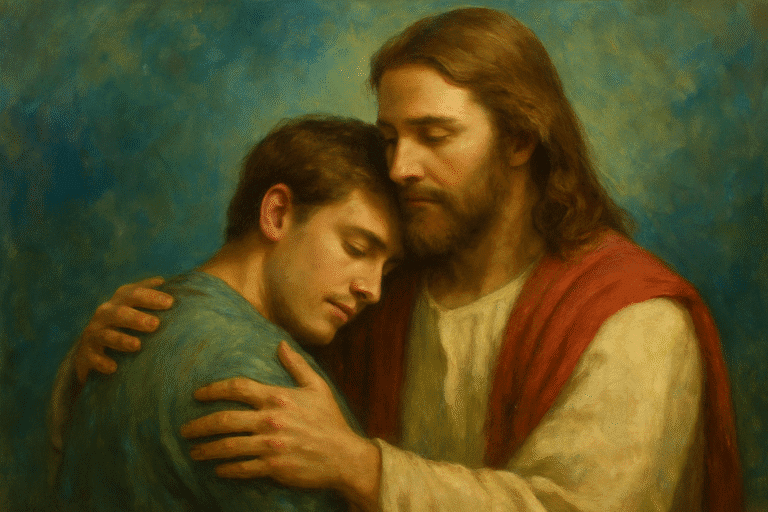
“One of the most spiritual experiences I’ve had in dealing with [my SSA], where I felt that the Savior was so aware of me, was in a counseling session. My therapist works on a lot of visualization techniques, and one of [the sessions] was working through some of my… deepest pains on this issue… surrendering it all over to God, to Jesus—letting Him take it all from me. [I visualized this.] And then I’ve never felt so close to the Savior when I imagined Him. It was palpable. It was real to me. I felt Him embracing me, kissing me on my head, wiping the tears off my cheeks, and saying, ‘Spencer, let me have it. I love you. It’s all worth it. And you’re okay just as you are. You are loved.’
“Feeling that embrace of the Savior,… it’s real. When I say I’ve experienced the Atonement, . . . to me it’s feeling the love of the Savior. And to me the love of the Savior can carry us through anything. I’ve experienced that. It took me a while to get there—to really realize what it was—but I’m here to say that the Savior is not just there cheering us on from the sidelines. He gets down there in the dirt and the grit with us and carries us through it. And to me, that’s the biggest thing that I’m experiencing and that I’m gaining through all of this is: that the Savior is real; that I know that He died for me, and that I’m worth it.”[x]
Mitchell Clark, the third North Star member I will highlight, concluded his personal story with this testimony: “I started to turn to God, and I really began to understand . . . that my relationship with God was more important to me than anything a sexual or romantic relationship with a man could bring me. This was a big turning point for me, to be able to finally realize that I could get my needs met in healthy ways—in platonic relationships with other males and through God—and that I did not have to turn from God. I didn’t have to turn from the Church.”[xi]
I consider Garrett Ferguson, Spencer Thompson, and Mitchell Clark to be giants, along with the many other valiant men and women whose personal stories are documented at NorthStarSaints.org. In researching this issue, I have been amazed at these faithful saints who are striving to keep their covenants while living with same-sex attraction or related experiences. Each is an inspiration. They find strength from supportive friends and from Jesus Christ.
I personally know a faithful Latter-day Saint who experiences same-sex attraction. He told me that the more same-gender, emotional connections he gets, the better he is able to deal with his unwanted attractions. He said, “I do okay as long as I stay close to the Lord and have regular interactions with other men who respect me and are good to me. I call it my man vitamins or vitamin M, and I need regular doses of it. I have been able to develop close friendships with a few good men at work and at church, and their inclusion has been very helpful for me—not curing me but strengthening me by filling a void. These heterosexual friends have no idea how much good their friendship does for me.”[xii]
These men with same-sex attraction have been strengthened by connections with other men and by connections with Jesus Christ. However, it is important to clarify that these stories do not show that a focus on connections outward and upward will cure anyone from their challenges, but rather these connections will support a person through their challenges. Elder Jose L. Alonso taught, “When we encounter difficulties, we naturally tend to concentrate on the obstacles we face. . . . By placing Christ at the core of our thoughts and deeds, we align ourselves with His outlook and strength. This adjustment does not discount our struggles; instead, it helps us to navigate through them under divine guidance. . . . With the Savior, what seems like a major problem can become a pathway to greater spiritual progress.”[xiii]
Our same-sex attracted brothers and sisters must be patient and not expect instant miracles. In my observations of a multitude of people facing a variety of challenges, I have seen that God would rather develop a person through a lifelong process of growth in adversity than to provide a miraculous instant change. Quick miracles do not give a person the same depth of spiritual maturity that comes when a person struggles through difficulties over a lifetime. God has never been One to avoid putting His children on a path of suffering in order to stimulate growth. As the book of Job declares, “Man is born unto trouble” (Job 5:7); however, if we, like Job, will stay connected to the Lord and find friends who will sit with us, then over time God will help heal what needs to be healed and help endure what needs to be endured as we move forward through those troubles.
This earth-life was never meant to be easy. As President Henry B. Eyring has said, “Our mortal life is designed by a loving God to be a test and source of growth for each of us.”[xiv] Nevertheless, by keeping our covenants, we are promised divine blessings to help us with our challenges. Sister Terry Christensen shared an experience she had after her husband passed away. He came to her in spirit and said, “It is very important to be good; keep the commandments and keep your covenants. When you do, you’ll be able to handle hard things.” He then added, “Don’t worry about the kids. I’ll take care of them.” A few days later, their son-in-law was killed in a car accident.[xv]
Sister Christensen’s husband did not tell her that if she kept her covenants, God would remove hard things from her life. He told her that by keeping her covenants, she would be able to handle the hard things when they came. This is true for everyone, whether those hard things include living as a widow, or living with same-sex attraction, or any of a multitude of challenges in today’s world. We should not try to make life easier by campaigning for changes in church policy and doctrine. Instead, we should keep our covenants in order to arm ourselves with the power of God that we will need to better deal with the challenges we face. It is in the fire of adversity that personal growth is forged, and as Alma the Younger taught, “Whosoever shall put their trust in God shall be supported in their trials, and their troubles, and their afflictions, and shall be lifted up at the last day” (Alma 36:3).
We all need emotionally intimate connections with friends, regardless of the nature of our struggles. Elder Joseph B. Wirthlin said, “When we work together in a bond of brotherhood, when we love each other and are loyal and faithful to the great cause to which we have been called, the impossible becomes possible.”[xvi] Everyone also needs the divine help that comes from a connection with God and Jesus Christ. These two dimensions of the strengthening power of the doctrine of Christ are universal. Community psychologist and author Dr. Jacob Hess has written some articles discussing common themes he has found in the stories of people who have overcome struggles with pornography[xvii] and depression.[xviii] With both struggles, he found repeated references to the value of connections with supportive friends and connections with God or Jesus Christ. We all need these connections regardless of our challenges. The difference for those who experience same-sex attraction or other sexual minority experiences is that they are often either shunned or avoided, making their need for friendship and community sometimes greater.
I believe that Christ cannot return until those who claim to be His followers learn to embrace all people with love and compassion, while living our own lives within the standards He has established. We all need to become more Christlike if we are going to live with Him after His Second Coming, and the rise of this challenge in recent years may be one of the ways God is trying to teach us charity in order to prepare us for His Son’s return. No change in Church policy or doctrine is needed for us to show love to others. We just need to engage the doctrine of Christ more fully in both of its dimensions.
Remembering these two dimensions of the doctrine of Christ, which is also called the gospel of Jesus Christ, can bless us when we participate in temple ordinances. Whenever we covenant to live the law of the gospel of Jesus Christ, either for ourselves or as proxies for others, we commit to live it in both of its dimensions: We commit to nourish our connection upward to God and Jesus Christ and our connection outward to our neighbors. These connections will bless ourselves and our fellow saints, no matter what our individual challenges may be.
To be continued…
Valiant K. Jones is the author of The Heart of Our Covenants: Temple Principles that Draw Us unto Christ. For more information, see www.valiantjones.com or www.cedarfort.com.
[i] Jeffrey R. Holland, “The Second Half of the Second Century of Brigham Young University,” ibid.
[ii] This discussion focuses primarily on supporting Latter-day Saints who experience same-sex attraction. Some aspects may be extrapolated to those who identify as transgender or other challenges in the LGBT+ constellation of experiences; however, those additional challenges will not be addressed directly.
[iii] “Is same-sex attraction a sin?,” Library/Life Help/Same-Sex Attraction, accessed October 20, 2024, churchofjesuschrist.org/study/manual/same-sex-attraction-church-leaders/is-same-sex-attraction-a-sin?lang=eng; see also M Russell Ballard, “The Lord Needs You Now!,” Ensign, Sept. 2015, churchofjesuschrist.org/study/ensign/2015/09/the-lord-needs-you-now?lang=eng .
[iv] For a full discussion of the doctrine or gospel of Jesus Christ, including citations of many defining scriptures, see chapter 3 of Valiant K. Jones, The Covenant Path: Finding the Temple in the Book of Mormon, Cedar Fort, 2020.
[v] Drew Boa and Christopher Yuan, “Holy Sexuality and Singleness (with Dr. Christopher Yuan),” Husband Material with Drew Boa, YouTube, February 22, 2021, timestamp 39:25, youtube.com/watch?v=-GdyNBKsrNA.
[vi] Elder Gary E. Stevenson, “Bridging the Two Great Commandments,” Liahona, May 2024, churchofjesuschrist.org/study/liahona/2024/05/53stevenson?lang=eng.
[vii] “Welcome to North Star,” northstarsaints.org, accessed October 20, 2024, northstarsaints.org/north-star-intro.
[viii] Garrett & Sallie Ferguson, “Voice(s) of Hope • Garrett & Sallie Ferguson (Full Interview),” North Star International, YouTube, November 4, 2013, timestamp 49:15-55:07, youtube.com/watch?v=s36K2ilFsnY; some editing liberties were taken to consolidate and to incorporate comments by Sallie that Garrett confirmed.
[ix] Garrett Ferguson, “All That I Have,” Voices of Hope: Garrett & Sallie, North Star, static1.squarespace.com/static/6329059c2789477a2e256088/t/63af4ca55f6d412cfac642f9/1672432805941/All+That+I+Have+garrett+sallie.pdf, accessed October 20, 2024.
[x] Spencer Thompson, “Same-Sex Attraction and My Journey from Shame to Joy,” October 2021, Church of Latter-day Saints, Liahona. https://www.
[xi] Mitchell Clark, “Life with SSA,” Personal Blog, July 9, 2021, https://ldswithssa-mylife.
[xii] Anonymous, Personal discussion with the author.
[xiii] Jose L. Alonso, “Jesus Christ at the Center of Our Lives,” Liahona, May 2024, churchofjesuschrist.org/study/liahona/2024/05/24alonso?lang=eng; emphasis added.
[xiv] Henry B. Eyring, “Try, Try, Try,” Ensign, November 2018, churchofjesuschrist.org/study/ensign/2018/11/sunday-afternoon-session/try-try-try?lang=eng.
[xv] Anne Hinton Pratt, “The Other Side and Back,” Meridian Magazine, February 23, 2022, latterdaysaintmag.com/the-other-side-and-back/.
[xvi] Joseph B. Wirthlin, “Band of Brothers,” Ensign, February 2008, churchofjesuschrist.org/study/ensign/2008/02/band-of-brothers?lang=eng.
[xvii] Jacob Z. Hess, “How People Get Better from Porn Addiction,” Publish Peace, January 2, 2024, publishpeace.net/p/how-people-get-better-from-porn-addiction.
[xviii] Jacob Z. Hess, “How People Get Better from Depression,” Publish Peace, January 3, 2024, publishpeace.net/p/how-people-get-better-from-depression






Boanerges RubalcavaJuly 3, 2025
If you love me, keep my commandments. One of the important one is thou shall NOT commit adultery, therefore, having sexual relations out of marriage, is not accepted by the Lord either by married or not married people. And the greatest commandment is to love the Lord and to love our fellowman. So, it is very simple, on one hand we should love one another and for sure we should not judge others, and if you are married it should be the way the Lord commanded us (one man with one woman). If you have been unable to have a companion, pray to the Lord and He would help you. If you have the "orientation" to same sex" (homosexual) or the opposite sex (heterosexual) it is the same: FOLLOW THE LORD AND KEEP HIS COMMANDMENTS. That's all.
RozyJuly 2, 2025
These essays are wonderful. I have never understood how SSA is any different from opposite sex attraction for the many women in the church who want to marry and never have the opportunity. These valiant women struggle with keeping the Law of Chastity, and making those horizontal connections too. Feelings of attraction are powerful, but can and must be controlled by everyone. Married men, married women, single men, and single women, and teens of every persuasion must obey the Law of Chastity if we want the blessings of eternity. I wish we could talk more openly about temptation and sin in our adult quorums and RS. Perhaps if we were more open about it we wouldn't feel so alone and "different".