








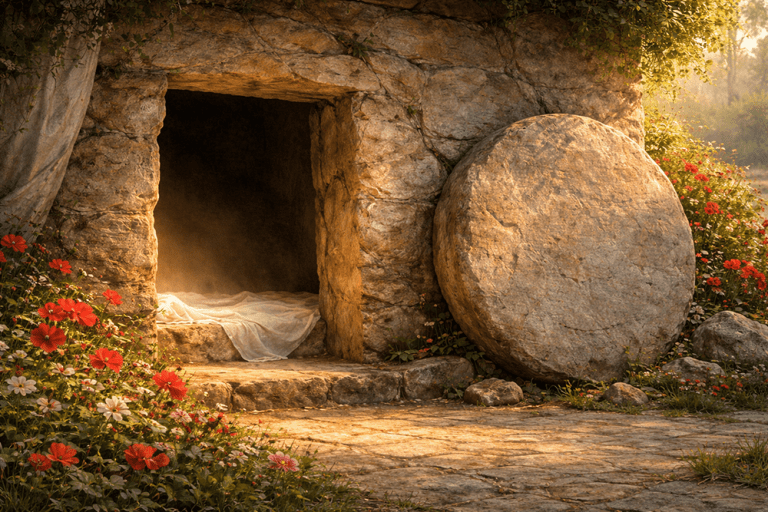


There is a powerful image at the center of the Easter story, an image of stone and silence, of darkness and waiting, of a sealed tomb that seemed to mark the end of hope. Christ was laid in a borrowed tomb, a great stone rolled into place, the entrance sealed by the weight of the world’s sorrow and sin. Yet on the third day the stone stood rolled away and the tomb was empty. The moment was not only a sign of His resurrection, it was a sign of His power to open every tomb, including the ones we seal ourselves inside.
As members of the Church of Jesus Christ of Latter-day Saints, we see the Resurrection of Jesus Christ as the final step in the Atonement, the glorious victory over death and sin making it possible for all of us to rise again. Because He rose, we will rise. Because He broke the bands of death, we will live again. This truth is central to everything we believe. Yet there is another layer to the image of the stone being rolled away. It speaks not only of the tomb He left behind, but of the tombs we carry with us every day.
Each of us knows what it feels like to be trapped. Not in a tomb of stone, but in a tomb of our own making. Some are sealed in by fear—fear of failure, fear of rejection, fear of the future. Others sit in the darkness of anger, unable to let go of an old wound. Some are buried in pride, unwilling to bend, unwilling to admit fault. Others struggle inside tombs of jealousy, deceit, addiction, or lust. Sin and weakness can entomb us behind a stone too heavy to move—a barrier too large to push aside—through our own strength.
One of the great truths of the gospel is we are not expected to move the stones entombing alone—simply because we cannot move them alone. The message of the Atonement is not that we must save ourselves, it is that we cannot save ourselves, and that Christ has already done what we could never do. He suffered for our sins, He took upon Himself our pain, our guilt, our shame, and He rose again so none of those things would have the final word.
In the New Testament account, the stone was not rolled away so Christ could get out. He had already risen. The stone was rolled away so others could see in. So they could witness the tomb was empty, death had been conquered, and the impossible had already happened. In much the same way, Christ does not wait for us to free ourselves before He helps us. He asks us to come to Him as we are, still trapped, still struggling, still surrounded by stone. Through faith in Him, through true repentance, through humility and a broken heart and a contrite spirit, He begins to move the stones we cannot move.
Repentance in LDS doctrine is not about punishment, it is about change. It is about turning toward Christ and allowing His grace to work in us. Grace is not only what cleans us, it is what strengthens us. It is the power which helps us become more than we are now. When we repent sincerely, we are not just forgiven, we are freed—the stone begins to shift…light begins to enter the tomb…air begins to flow again. Hope returns.
There is something deeply personal about this process. Every person’s tomb is different. Every stone is shaped by different choices, different wounds, different burdens. Yet the Savior knows the weight of every one of them. He knows where we are sealed in the darkness. He knows how long we have been there. And He knows how to reach us.
The story of the Resurrection is not only about what happened to Him, it is about what can happen to us. We can walk out of our tombs. We can leave behind the darkness of old sins. We can step into a new life, forgiven, changed, and free. This does not mean the process is instant or easy. Stones are heavy for a reason. Some take time to move. Some require us to return again and again in prayer, in repentance, in faith. But the promise remains the same. The stone can be rolled away.
The Atonement of Jesus Christ is both infinite and intimate. Infinite because it covers all mankind. Intimate because it applies one by one, heart by heart, soul by soul. He did not suffer for a crowd, He suffered for individuals. This means He suffered for every person trapped in fear; for every person trapped in anger; for every person trapped in addiction, pride, jealousy, or shame. He suffered for each of us, and because He did, no tomb is permanent.
The image of the empty tomb stands as a promise. Stones can be moved. Darkness can be left behind. Through Christ, we are not meant to remain sealed in the places which hold us down. We are meant to rise, to walk forward, to live again in a better way than before.
The stone was rolled away once in a garden long ago. Because of Him, it can be rolled away again and again, in every life that turns toward Him to step out of the tomb into the light.






LisaApril 6, 2026
Love the analogies in this article.
Haze K.April 2, 2026
I loved this. What a new, unique thought about why the stone was rolled away and how we all have made our own tombs by not letting go of something. The most important sentence for me was the last one: "every life that turns toward Him to step out of the tomb into the light. Thank you