

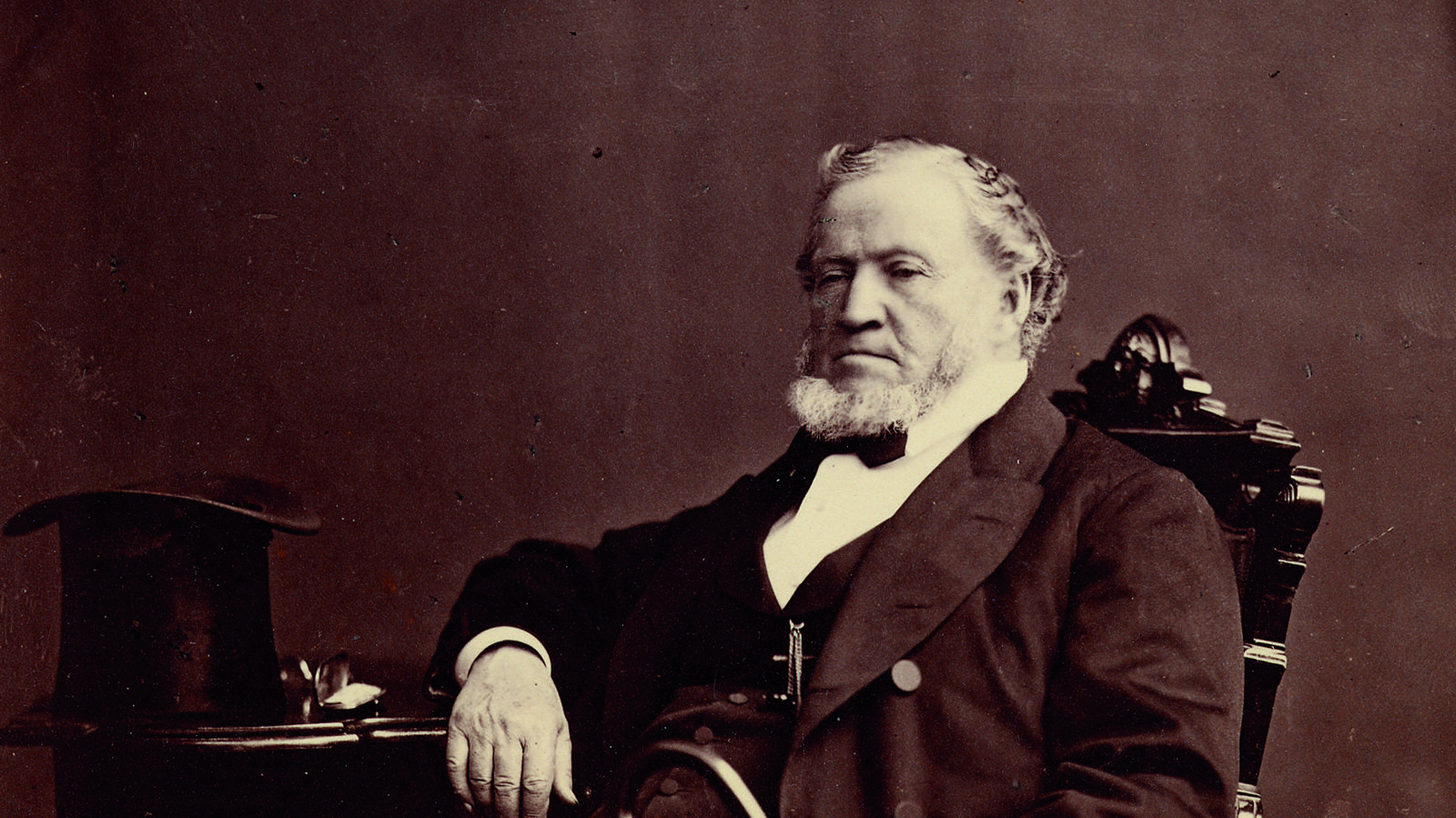

Brigham Young once asked: “Can a prophet or an apostle be mistaken?” Then he offered his own answer: “Do not ask me any such question, for I will acknowledge that all the time.”[i] He later said, “I do not pretend to be infallible.”[ii]
This is consistent with what others have said. President J. Reuben Clark, for instance, said about the First Presidency that “we are not infallible in our judgment, and we err,”[iii] and George Albert Smith, then of the Twelve, said of the Presidency that they are still “men with human frailties” and that “they will make mistakes.”[iv]
What can sometimes seem confusing are declarations that seem to contradict these sentiments. After issuing the Manifesto, for example, Wilford Woodruff famously declared:
I say to Israel, the Lord will never permit me or any other man who stands as president of the Church to lead you astray. It is not in the program. It is not the mind of God. If I were to attempt that the Lord would remove me out of my place, and so he will any other man who attempts to lead the children of men astray from the Oracles of God and from their duty.[v]
More recently, Russell M. Nelson noted that “the Lord has promised us that He will never allow the prophet to lead us astray”[vi] and President Gordon B. Hinckley also declared: “I want to make you a promise. I know it’s true. The Lord will never let the General Authorities of this Church lead it astray. It won’t happen.”[vii]
Two Essential Truths in Understanding Prophetic Leaders and Mistakes
On the surface, this collection of statements seems to present a contradiction. After all, Brigham Young (and others) say one thing, and Russell M. Nelson (and others) say another. What gives?
Well, what gives is that the appearance of contradiction in these statements is actually an illusion. There are actually two essential truths to keep in mind in thinking about prophetic leadership and the decision-making errors they might commit.[viii] When we keep these in mind, we see that there is no contradiction at all.
Errors Vary Widely in Importance
The first thing to recognize is that possible errors come in a wide range of sizes. There is a scale, with matters of low importance at one end and matters of great importance at the other. Some errors, therefore, are tiny, while others would be huge if they were made. Wilford Woodruff, for instance, was speaking of the “huge” end of the scale—specifically in the context of ending polygamy. That had been a revealed practice, and he wanted to assure the Saints that the Lord would not have permitted such a change unless He Himself were behind it. Such an action, if it were done in the absence of the Lord’s direction or approval, would clearly seem to qualify as leading the Church astray, and President Woodruff was saying that the Lord would not permit that.
But we can imagine errors on a smaller scale that the Lord would permit. We see this with regard to the Book of Mormon, for example. After all, Moroni speaks of the book as containing “the mistakes of men” (Title Page), and he also speaks of its “imperfections” (Mormon 8:12). But this does not prevent the Lord Himself from saying that “as your Lord and your God liveth it is true” (D&C 17:6). The Book of Mormon is true despite its mistakes, because what is divine in it is far, far more significant than what is mortal in it.
The same thing is apparent in the naming of the Church. Although the Lord formally established His Church in 1830, he did not reveal its name until 1838 (D&C 115:3–4). In a technical sense, therefore, every reference to the name of the Church prior to 1838 was a mistake; it did not actually capture what the Lord had in mind.
There are two things to notice about this, however.
First, even in April 1830 the Church did have a prophet, the authority of the priesthood, and ongoing revelation. And soon would come the Book of Mormon as a witness to the world of Jesus Christ as Savior of the world and of the restoration of His Church to the earth. What the Church was missing was far less significant than what it had.
Second, since the Lord provided a massive amount of revelation between 1830 and 1838, He obviously could have revealed the Church’s name during that time if He had wanted to. Apparently, He didn’t want to—which simply reflects the Lord’s statement to Joseph and other early brethren. He told them to “ask the Father in my name in faith, believing that you shall receive, and you shall have the Holy Ghost, which manifesteth all things which are expedient unto the children of men” (D&C 18:18). His promise was not that He would reveal everything to them, but only what He deemed wise and prudent at the time. Evidently, for whatever divine reason, a revelation naming the Church was expedient in 1838, but not in 1830.[ix] Thus, while references to the Church during those years were technically inaccurate, that did not seem to matter to the Lord. Technical accuracy on this point was just not a priority for Him, and those mistakes, such as they were, were thus completely insignificant.
This is exactly what we see with the Book of Mormon. If it had been important to Him, the Lord could have found a way to prevent whatever mistakes appear in that record. But He didn’t. Apparently, He was satisfied with the reality that what is mortal in the book is completely dwarfed by what is divine in it. And just so with the name of the Church. Mortal mistakes in referring to the Church were completely dwarfed by the divine approval, priesthood power, and overflowing revelation that infused it.
Thus, while it would certainly be accurate to speak of errors, both in the Book of Mormon and in references to the Church’s name, it would just as certainly be trivial. Any number of actions might be mistakes, and yet, in the scheme of things—according to the Lord’s judgment—be insignificant.
We are Poor Judges of What Is an Error and What Is Not
A second essential truth to keep in mind, however, is this: even though leaders can make errors of a certain kind, it does not follow that we, as members, are any good at telling what those errors are. The truth is, on our own we just aren’t very good at telling the difference between something that is a mistake and something that is directed by the Lord for reasons our mortal eyes can’t see.
To some, for example, settling in the uninviting valley of Salt Lake had all the earmarks of a mistake at first. It took a long time for the benefits of that instruction to become clear to everyone.[x] The same was true of the children of Israel and their delivery from Egyptian bondage: from their perspective, the Lord’s guidance away from Egypt looked like just one big human mistake after another.[xi] Indeed, at one point, “Moses cried unto the Lord, saying, What shall I do unto this people? They be almost ready to stone me” (Exodus 17:4). In both cases, however, these prophets were not making mistakes in their leadership, but, instead, were doing exactly what the Lord was directing.
Eliza R. Snow once paraphrased what Joseph Smith said about those who thought they could identify mistakes he had made (or was making) and therefore criticize him. In response, he asked: “Who knows the mind of God? Does He not reveal things differently from what we expect?”[xii] Exactly.
So, again: just knowing, in principle, that mistakes can be made does not mean we are any good at identifying them. We really aren’t smart enough to know. What we are smart enough to know is that whatever the mistakes are, they must not matter too much to the Lord. If they did, He either wouldn’t have permitted them in the first place, or . . . according to His desires, He can quickly correct them. We can thus proceed out of complete loyalty. We can fully recognize that some decisions will be less than ideal, but also recognize that we don’t know which ones those are—which puts us in a poor position to go about trying to correct them! Instead, we can leave the matter completely in the hands of the Lord, faithfully follow the Brethren, and be free of worry.
Has anyone put the point better than Brigham Young?
“Where you find a man who wishes to steady the ark of God, without being called to do so, you will find a dark spot in him. The man full of light and intelligence discerns that God steadies his own ark.”[xiii]
*****
Duane Boyce and Kimberly White are father and daughter. Learn more about modern prophets in their new book, The Last Safe Place: Seven Principles for Standing with the Prophets in Troubled Times.

Notes:
[i] Brigham Young, cited in Saints—No Unhallowed Hand: 1846–1893 (Salt Lake City, Utah: The Church of Jesus Christ of Latter-day Saints, 2020), 279.
[ii] Brigham Young, ibid., 364.
[iii] J. Reuben Clark, cited in D. Michael Quinn, The Mormon Hierarchy: Extensions of Power (Salt Lake City, Utah: Signature, 1997), 7, 368.
[iv] George Albert Smith, “Sustaining Those Whom the Lord Sustains,” in Teachings of Presidents of the Church: George Albert Smith, https://www.lds.org/manual/teachings-george-albert-smith/chapter-6?lang=eng.
[v] Wilford Woodruff, in G. Homer Durham, ed., The Discourses of Wilford Woodruff, in Teachings of the Latter-day Prophets (Salt Lake City, Utah: Bookcraft, 1998), 212–13.
[vi] Russell M. Nelson, “Becoming True Millennials,” January 10, 2016, Young Adult Broadcast, https://www. lds.org/broadcasts/article/worldwide-devotionals/2016/01/becoming-true-millennials?lang=eng.
[vii] Gordon B. Hinckley, quoted in “‘Strengthen Belief in God and Self,’ Prophet Counsels,” Church News, March 30, 1996, p.3; http://www.ldschurchnewsarchive.com/articles/27977/Strengthen-belief-in-Godand-self-prophet-counsels.html.
[viii] The matter of doctrinal mistakes is a related but separate topic. Including a discussion of Brigham Young, we cover it fully in The Last Safe Place, 88–96.
[ix] It is true that Joseph’s revelations often came in answer to specific questions, but that does not explain the time lag in naming the Church: apparently, that naming occurred in the absence of any inquiry by Joseph. This matter is discussed in The Last Safe Place, n23, pp. 212–13.
[x] Wilford Woodruff reported that some thought the westward migration itself was “a wild speculation” and that it was a “dangerous” stand. See Journal of Discourses, vol. 4:95, https://contentdm.lib.byu.edu/digital/collection/JournalOfDiscourses3/id/664.
[xi] See, for example, Exodus 5:6–21; 14:12; 16:1–3; 17:1–4; Num. 14:1–4
[xii] Eliza R. Snow, citing Joseph Smith, in “Revelation and the Living Prophet,” in Teachings of Presidents of the Church: Joseph Smith, 200, https://www.lds.org/manual/teachings-joseph-smith/chapter-16?lang=eng.
[xiii] Brigham Young, Journal of Discourses, vol. 8:66, https://contentdm.lib.byu.edu/digital/collection/JournalOfDiscourses3/id/3462/rec/9.