







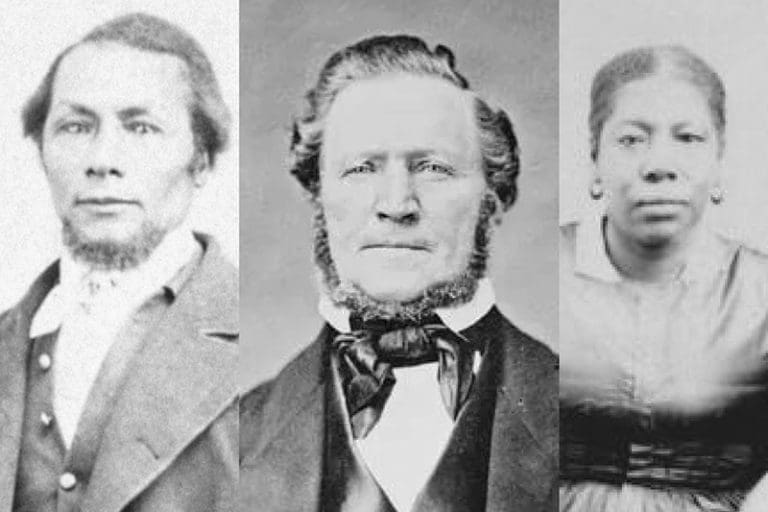


We can’t escape the fact that Brigham Young said some things about racial issues that make us cringe in the twenty-first century. In fact, to make matters worse, as governor of Utah Territory, he presided in 1852 over the passage of a law that actually legalized slavery in the territory.
Or did he? I addressed this topic briefly during the recent 2025 FAIR Conference that was held at Thanksgiving Point in Lehi, Utah. In my presentation, I summarized portions of a much longer paper that I’d been working on—which is, in its turn, a summary of elements of two books that I’ve recently read. (See below.) In this column, I’ll briefly summarize that brief summary.
Very recent scholarship—some of it possible only because of the trailblazing efforts of LaJean Purcell Carruth in deciphering Pitman shorthand records of the associated legislative debates—has carefully examined Utah’s 1852 “Act in Relation to Service.” It has overturned much of what I, at least, had assumed about that law.
Part of our modern problem in understanding the 1852 law is our failure to understand how labor and employment were categorized in antebellum America. Whereas we today tend to see a stark binary distinction between free, contracted labor, on the one hand, and slave labor on the other, Americans in the early nineteenth century recognized gradations between the two, such as apprenticeships and indentured servitude. Indeed, some of the early leaders of the Church of Jesus Christ of Latter-day Saints and of Utah Territory—the two were pretty much the same group during those first decades of the settlement of the Great Basin—and some of the other early pioneers had been indentured servants or apprentices themselves. This should be kept in mind.
At FAIR, I shared results of this recent scholarship that, I believe, reduce (although they don’t altogether eliminate) the challenges posed to contemporary Latter-day Saints by Brigham Young’s racial attitudes. This is important not merely for better understanding Brother Brigham but because some of his statements have been deployed as weapons by contemporary critics to attack both him and the church that he led for more than three decades.
The scholarship to which I refer wasn’t created with the intent of defending Brigham and the Church, but I turned it in that direction—and I believe that my argument is consistent with the evidence that has been discovered. For me, this new scholarship has been very helpful, and I think that some of its results need to reach a general audience.
The question of slavery arose for Utah from the very beginning: Three enslaved men arrived in the Valley of the Great Salt Lake with the first vanguard pioneer company in July 1847. And, thereafter, converted slaveholders from the American South began to immigrate to the Saints’ “Great Basin Kingdom,” bringing people with them whom they had enslaved under Southern law. The numbers were never large—perhaps thirty or forty enslaved people within the whole territory—but their presence and their legal status posed a major challenge.
Brigham and other leaders sought at first to avoid the issue by simply refusing to recognize slavery. If there was no law establishing slavery in the territory, they reasoned—and they could cite more than a century of Anglo-American law in support of their position —slavery could not gain a foothold in Utah.
Eventually, though, the slavery question was impossible to evade. Until Abraham Lincoln’s 1863 “Emancipation Proclamation” and 1865’s Thirteenth Amendment to the Constitution of the United States altogether banned slavery in the states and the territories, the issue threatened to divide the Church and its settlements in the Great Basin West. And this was no small danger: The Southern Baptist Convention had already split off from the national Baptists in 1845 and, of course, the American Civil War would begin in 1861. That war killed perhaps as many as three-quarters of a million people in a country with a far smaller population than today’s. It injured a similar number, and it caused untold damage, destruction, and economic loss.
What emerged from Utah’s legislature in 1852 under the leadership of Brigham Young was a law that, while it didn’t include an outright prohibition of slavery, also failed to recognize or protect it. It was definitely not a “slave law”: Rather than being modeled on the slave codes of the South, it seems to have been patterned after the “gradual emancipation” laws of such places as Indiana and Illinois. Significantly, Brigham Young insisted that the name of the bill’s original draft be changed from “An Act in Relation to African Slavery” to “An Act in Relation to Manual Service.” He had several important reasons for this. Most significantly, he sincerely believed that the statute did not legalize chattel slavery, of which he had long and often expressed his strong disapproval. He often took pains to distinguish “servitude” from “slavery.” Furthermore, the law applied not only to African-American enslaved people but to unfree European-immigrant labor, as well.
The law created a system of quasi-indentured servitude for enslaved African Americans, intending to shift chattel slavery into a system of contracted labor. At Brigham’s insistence, it referred to people in such conditions as servants rather than slaves, and it unambiguously recognized servants as human beings who possessed personal agency. They were, for example, permitted to testify in court (even potentially against their masters), they could not be removed from the territory without their own approval and that of a judge, and their labor obligations could not be sold without their consent. Servants were not commodities to be purchased or traded away at will.
The Service Act severely limited a master’s authority over his servant. For example, it forbade breaking up families—something that seems to have especially horrified Brigham Young. (The destruction of enslaved families was also a central element in the plot of Harriet Beecher Stowe’s famous novel “Uncle Tom’s Cabin.” Coincidentally, her novel was published in 1852; it helped mightily to galvanize anti-slavery sentiments in the years just prior to the Civil War.)
Utah’s legislature also prohibited cruelty, physical and sexual abuse, and rape, which were relatively common under Southern chattel slavery. Any punishment imposed should be “reasonable” and “guided by prudence and humanity.” If not, a probate judge could remove a servant from a household—which didn’t entail transferring the servant to another master: It meant that the servant was thereafter free. The Act limited the length of terms of service and stipulated that masters could require only “reasonable hours” of work and must provide “comfortable habitations, clothing, bedding, sufficient food, and recreation” to those who labored for them.
Significantly, while the slave codes in many Southern states made it a crime to teach a slave to read and write, under Utah’s law a master was required to provide servants with at least eighteen months of education between the ages of six and twenty years—a level of education that was probably not very different from what most other people attained in those days on the American frontier. (Brigham Young himself had received only eleven days of formal schooling.)
The 1852 Act proposed no restrictions on a servant’s ownership of personal property, didn’t require servants to travel with a pass, and didn’t authorize private citizens to apprehend “runaways.” Nor did it contain any of the other meddlesome or even oppressive restrictions that American legislatures had traditionally imposed upon slaves, unfree laborers, and even free Black people. Of most fundamental importance was this provision: In stark distinction to Southern slavery, the children of “servants” in Utah would not inherit the servitude of their parents. This seems to have been designed to ensure the eventual disappearance of unfree labor in the territory.
Although in practice, the daily lives and labors of African-American servants in Utah probably weren’t dramatically different from their experience as slaves, the 1852 law plainly afforded them new rights and greater personal security. Ultimately, the Service Act was designed to raise enslaved Black people from the status of property to that of contract servants and to phase out compulsory servitude. It seems clearly to have intended a form of gradual emancipation—and perhaps also to discourage Southern enslavers from bringing their slaves to Utah, since Utah law would not recognize their “property rights.”
Recent scholarship furnishes several examples not only of Brigham Young’s denunciations of chattel slavery but of his acts of kindness to individual Black people—including buying their freedom. Here, though, I’ll share a couple of illustrations that the historian Mark Ashurst-McGee kindly called to my attention just before my presentation at FAIR:
Col. Thomas Kane is still fondly remembered by many today for his friendship to the persecuted nineteenth-century Latter-day Saints and for his advocacy on their behalf. Apparently, though, his wife, Elizabeth, never fully accepted his involvement with the Saints. Likewise, although her husband had been a vocal abolitionist, she seems to have remained rather conventional in her racial views.
In 1872, Thomas was in ill health, so Brigham Young invited him and his wife to spend the winter in the warmth and clean air of St. George, in southern Utah. Accordingly, Thomas and Elizabeth traveled from their home in Pennsylvania to Salt Lake City and then southward from there. Elizabeth wrote about her experiences.
One member of the company was a “colored man” to whom Elizabeth gave the pseudonym “John.” He was actually Isaac James, a Black Latter-day Saint pioneer of 1847 who had married the well-known Jane Manning (James), another Black convert who had been a member of Joseph and Emma Smith’s household in Nauvoo. In Salt Lake City, Isaac became a member of Brigham Young’s household, working as President Young’s carriage driver. Brigham thought highly of Isaac James, describing him at one point as a man whom he had employed for many years and who deserved any blessing that could be conferred upon him.
Isaac or “John” normally rode with the teamsters in the supply wagons, but one of the members of the company with whom the Kanes were traveling noticed that he was suffering from rheumatism. So the man took Isaac into his own carriage, with the idea that the ride would be more comfortable for the Black coachman in that vehicle. Elizabeth Kane, though, was shocked to see Isaac James riding and conversing with a “kind-hearted elder.”
Thereafter, she came into the kitchen of the Gates Hotel at what is today known as Pintura, in southern Utah, and was surprised to see Brigham Young himself helping Isaac James to put on his coat. “It was amusing,” she wrote, “to see John accepting every Civil Right ‘these yer Mormons’ admitted him to . . . . Never a word of those profuse apologies which the natural politeness of colored people under ordinary circumstances would have prompted, on receiving such a courtesy from a white man seventy years of age, passed from his lips.” She was astonished to see Isaac “let the Mormon pontiff help him dress.”
I’ve often heard Brigham Young denounced as a racist and a supporter of slavery. In fact, I’ve encountered accusations that his racial attitudes were little different from those of the Nazis. It should be obvious, I think, that such claims are false. And Utah’s 1852 “Act in Relation to Service” certainly can’t be used to support them.
**
A video of my 2025 FAIR presentation on “Brigham Young and Slavery” is now up online at https://www.youtube.com/watch?v=ADEajUFCVCk, and a rough transcript is available at https://www.fairlatterdaysaints.org/conference/august-2025-fair-conference/brigham-young-and-slavery.
My remarks at FAIR were inspired by, and heavily dependent upon, Amy Tanner Thiriot, “Slavery in Zion: A Documentary and Genealogical History of Black Lives and Black Servitude in Utah Territory, 1847-1862” (University of Utah, 2022) and W. Paul Reeve, Christopher B. Rich Jr., and LaJean Purcell Carruth, “This Abominable Slavery: Race, Religion, and the Battle Over Human Bondage in Antebellum Utah” (Oxford, 2024).
The two stories about Isaac James come from Amy Tanner Thiriot, “Guest Post: “Every Civil Right”: Eastern Visitor Scandalized by Racial Relations in Utah Territory”






John C. GreeneSeptember 1, 2025
In the temple we are twice admonished to avoid all evil speaking of the Lord’s anointed. But it seems that a significant contingent of Latter-day Saints think there is an exception to that warning that goes: avoid all evil speaking of the Lord’s anointed, unless they deserve it. Hurling the charge of racism at anyone you don’t understand, or don’t like, or disagree with has become de rigueur today. I think it’s an ugly sign of the times and unbecoming of a disciple of Jesus Christ. “Cursed are all those that shall lift up the heel against mine anointed, saith the Lord, and cry they have sinned when they have not sinned before me, saith the Lord, but have done that which was meet in mine eyes, and which I commanded them” (D&C 121:16). Did the Lord command Brigham Young in the matter of the priesthood ban? President Kimball thought so. And so do I. I appreciate Daniel C. Peterson’s defense of Brigham Young.
Blayne SouleAugust 29, 2025
Thanks for posting! Very informative.