







Carrying on our theme from the last column, here are two more books that tell of strong, engaging, brave, and generous women from the earliest years of this dispensation up to today.
“Join with us in celebrating the many Latter-day Saint women whose lives should be an inspiration to readers in the present generation and in generations to come.”
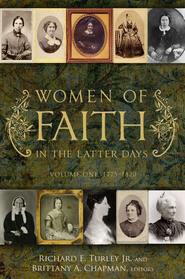 Women of Faith in the Latter Days: Volume One, 1775-1820
By Richard E. Turley, Jr., and Brittany A. Chapman, editors
We currently seem to be in a Church history renaissance with the advent of the amazing Joseph Smith Papers Project (josephsmithpapers.org), the growing popularity of various websites focused on Mormon history (check out keepapitchinin.org and juvenileinstructor.org for a start), and the Church’s publication and wide distribution of the new Daughters in My Kingdom book. The Women of Faith in the Latter Days series is an important and valuable addition to this drive to flesh out a fuller history of the Church in this dispensation.
I grew up in the Church, graduated from four years of seminary, took college-level courses on Church history and attended Institute classes, and unfortunately came away with an impression of the history of the Church that was mostly male-centric. Aside from Emma Smith, Eliza R. Snow’s music, or a few oft-repeated, faith-promoting stories (you know the ones: Mary Fielding Smith crossing the plains shortly after Hyrum’s death, Amanda Smith acting on revelation to know how to heal her son’s hip which had been destroyed at the Haun’s Mill Massacre, young Caroline and Mary Elizabeth Rollins risking their lives to save some of the printed pages for the Book of Commandments from the mob) I didn’t have a strong picture of the faithful women who made up approximately half of the members of the Church in its early days, and to my shame, I didn’t even notice how much was missing. This book, the first in a projected series of seven, opened my eyes to many strong, faithful women from the early 1800s, and I can’t wait to learn more.
Each chapter is devoted to an individual woman who was born between 1775 and 1820 and begins with a brief biographical sketch covering the basic outline of her life. The bulk of each chapter describes that woman’s “life experiences,” often in her own words from letters or journals. I was struck over and over by the heart-wrenching devastation of children’s deaths. Elizabeth Harrison Goddard, for example, saw eight of her thirteen children die before they reached adulthood. While crossing the plains, she recorded: “In July the Cholera broke out in our Camp when our daughter Eliza was seised [sic] with it afterwards our eldest son George was attacked and then our little Henry about 3 years old who did not live many hours. The others lingered, George seemed to improve and would be dressed to go and see some children baptized, but I think he took cold and had a relapse and we had to part with him…” Describing the death of a daughter, Elizabeth said, “My dear little girl Betsy took sick and died. She was about 4 years old. She wanted to live and said Mama make me well I want to go to the Valley, but she went into convulsions and died. Thus I had to lay another of my dear ones away. My husband would not allow me to go and see her consigned to Mother Earth, For I was not well and the weather very cold.” Similar sad stories are told by many of these women.
I was intrigued by the women’s reactions to plural marriage. Many of them talked of “giving [their] husband” another wife and were frank about the difficulties of living a polygamous life. Polygamy was described as “the great test of Mary Isabella Horne’s spiritual persistence.” She wrote of this trial in the third-person: “Plural marriage destroys the oneness [of marriage] of course. Mrs. Horne had lived for 28 years with her husband, before he entered into polygamy; she said and re-iterated; no one can ever feel the full weight of the curse till she enters into polygamy; it is a great trial of feelings, but not of faith.’ It is a great trial, no one would deny that; but she was willing because it was a duty her religion demanded.” Patty Bartlett Sessions chronicles the difficulties a second wife, Rosilla, caused in her family, turning her husband against Patty and refusing to contribute to the household work until finally leaving the Saints, obtaining a divorce and marrying outside the Church. Eliza Roxcy Snow was sealed as a plural wife to both Joseph Smith and Brigham Young.
While I enjoyed learning more about women whose names I knew, like Eliza Roxcy Snow and Lucy Mack Smith, I was thrilled to learn about women I’d never heard of before. Maria Jackson Normington Parker was a survivor of the Martin Handcart Company. Belinda Marden Pratt was Parley P. Pratt’s sixth wife. Sarah Melissa Granger Kimball was a staunch suffragist acquainted with Susan B. Anthony and other women’s rights activists of the time. Mercy Rachel Fielding Thompson was sister to Mary Fielding Smith and was also sealed to Hyrum Smith as a plural wife becoming her sister’s sister-wife as well. At the age of sixty-six, Desideria Quintanar de Yanez was the first Mexican woman baptized into the Church and maintained her faith until her death with only minimal contact with other members of the Church.
The women I met in these pages are inspiring. They suffered trials and persecution and adversity that is all but beyond my imagination and maintained their faith with grace and strength. I look forward to meeting more women like them in the subsequent volumes, which can’t be published fast enough for me!
Don’t miss the 17 bonus chapters that are available with the ebook version or online here . And make sure you check out the website for the series: www.ldswomenoffaith.com. You can even submit proposals for women you’d like to see covered in upcoming editions. The deadline for Volume Two (1821-1845) has already passed, but you have until June to submit a chapter for Volume Three (1846-1870)!
“Kids have no clue about the sacrifices their parents make on their behalf.”
 Life Lessons from Mothers of Faith
Compiled by Gary W. Toyn
In one of the over seventy personal essays in Life Lessons from Mothers of Faith, Mark Allred, currently the chief trial judge of the United States Air Force, offers a caution about Mothers’ Day and specifically the “eulogies” given in honor of mothers. His deliberately over-the-top description of “a strange, angelic caricature” of mothers contains glowing terms such as “a soft spiritual blossom who floats through her world insulated in an aura of the divine” who “may shed a sweet tear at the pain and faltering of her fellow beings” or “may even encounter what for others might be terrible adversity” yet “she herself never stumbles” and rings true to some of the many tributes I’ve heard on Sundays in previous Mays .
Piling it on thickly, he continues: “Anger and depression are as foreign to her as the urge to speak a harsh word. Always her home has the hush and serenity of a temple. Always the gentle harmonies of lovely children at play.”
Anyone need insulin yet?
Col. Allred warns that “Often the effect of our eulogies is not what we desire.” Describing his mother’s “despair and conviction of inadequacy” at these annual praises, he offers a loving and realistic portrait of his mother as “a woman of character.” Sharon Richards Wallace Allred is a woman I would love to meet and swap stories with. “Much of her nobiility lies in the war she wages with her own shortcomings. Tenacity. Guts. And bloody knuckles. Tears sneaking out through clenched eyelids. Not a perfect person but a very righteous one. A person who’s trying, who’s progressing. One, by the way, whom I respect infinitely more than the caricature.”
Count me as one of those women who doesn’t really look forward to Mothers’ Day. Yes, I’m a mother of three unique, energetic, challenging, delightful young boys whom I love dearly. And yes, I have a brilliant, strong, faithful mother whom I admire and love. But so often the Mothers’ Day “eulogies” we hear over the pulpit or read in rhyming verse on a Hallmark card bear so little resemblance to my daily mothering experience. I’ll admit to a bit of trepidation as I opened this book, bracing myself against the onslaught of praise of perfection I thought I’d read. But Life Lessons from Mothers of Faith finds the delicate balance between paying tribute to those whose behind-the-scenes contributions are so often taken for granted and idolizing the “strange, angelic caricature” placed on the impossibly high pedestal. While some of the individual entries may veer more in one direction or the other, the overall impression is that of real women doing their personal best for their families despite – or sometimes because of – their imperfections.
Drawn from many different walks of life, each author pays tribute to the woman who raised him or her and the most valuable lessons she imparted. Silvia Allred tells of growing up in El Salvador with her mother, Hilda Alvarenga de Henriquez, who showed determination and resourcefulness as she started over again and again after tragedy and setbacks stole their family’s financial security. Susan Easton Black describes her feisty mother’s reaction to being called as Young Women President in her ward at the age of 78 and the subsequent devotion Ethelyn “Dolly” Lindsay Ward showed the young women in her care who “never questioned her love for them.” Neylan McGain’s mother, Ariel Bybee, was a single working woman – and glamorous opera diva – with enormous talents who Neylan calls “the most productive woman I know.”
Harry Reid pays tribute to his mother, Inez Jaynes Reid, who was “confident and optimistic when she had no reason to be.” He outlines her difficult childhood and rough family life and also her devoted commitment to her children. “We may not have had religion in our home,” he states, “but my mother most definitely had it in her heart.”
Maren Rosemarie Slover Mazzeo honors her mother, Robin Baker Slover, a practicing anesthesiologist, in a touching essay that emphasizes that “we need to recognize…that the process will be different for each mother, and for each mother, the process will probably not be what she expected. Though both were built under the direct guidance of the Lord, the boat of Nephi wasn’t the same design as the boat of the brother of Jared.” The wide variety of women profiled in his book is certainly a testament to that!
As Heather Willoughby says of her mother, Zella Irene Smith Willoughby, “my mother has not become disillusioned by the quest to be a perfect woman; rather, she has mastered the art of being perfectly herself.” I can think of no higher praise for the real, imperfect, wonderful women I know.
* Please note that I received review copies of both of these books from the publishers.
**************************
On My Bedside Table…
Just finished: Butterfly’s Child: A Novel by Angela Davis-Gardner
Now reading: If I Only Knew Then…: Learning from Our Mistakes by Charles Grodin
On deck: Midnight in Austenland by Shannon Hale
**************************
New topic next time: we’ll be reading about all kinds of mistakes! Come find me on goodreads.com or email suggestions, comments, and feedback to egeddesbooks (at) gmail (dot) com.