





In honor of Women’s History Month (March), International Women’s Day (March 8), and the anniversary of the creation of Relief Society (March 17), I present two books which highlight and celebrate the contributions of some of the inestimable women of the Church of Jesus Christ of Latter-day Saints.
“Every Latter-day Saint woman is a woman of covenant.”
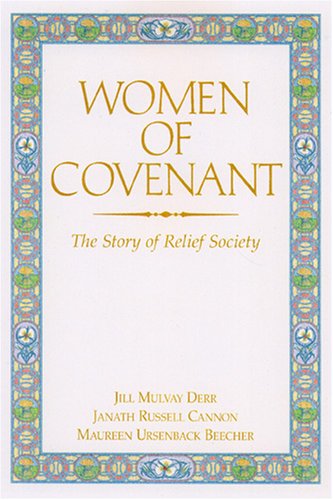 Women of Covenant: The Story of Relief Society
By Jill Mulvay Derr, Janath Russell Cannon, and Maureen Ursenbach Beecher
With the recent emphasis on learning about the history of Relief Society, each sister in the Church has (hopefully by now) received a copy of Daughters in My Kingdom. While Daughters in My Kingdom provides a good basic outline, Women of Covenant really fills in the gaps and fleshes out individual characters beautifully. I loved reading more in-depth information about the history of Relief Society!
Written by three women (self-described in the preface as a former counselor in the Relief Society general presidency, a “published historian”, and an affiliate with the Joseph Fielding Smith Institute for Church History–descriptions which grossly understate their education and credentials), this book chronicles in great detail the history of Relief Society, starting just before the official beginning on March 17, 1842, up through the time of the 12th Relief Society general president, Elaine L. Jack, who was released in 1997.
In addition to gaining appreciation for the grand arc of the history of Relief Society, I learned so many little nuggets along the way. About women laying on hands for healing blessings; how Young Women, Primary, nursery, the welfare program, LDS Family Services, and so many other Church programs originated under the umbrella of the Relief Society; that Sr. Belle Spafford, the 9th general president of Relief Society, was invited to speak in the general priesthood session of General Conference one year to instruct the brethren regarding “partnership opportunities” with their ward Relief Society presidents; that membership in Relief Society wasn’t automatic for women in the Church until 1971; and all the changes in the visiting teaching program. Wow! There’s also a chart in the back of the book that lists not only the Relief Society presidencies, but also the members of the Relief Society General Board from its creation in 1880 up to about 1990, which I’ve never seen before – I don’t know that those callings are even openly announced to the membership of the Church, but it’s wonderful to know the names of these dedicated women who work tirelessly behind the scenes.
Many, if not most, of the stories included in Daughters in My Kingdom are told in Women of Covenant as well, but generally in much more detail. One example is the story of Sr. Gertrude Zippro, the Netherlands Mission Relief Society president during World War II. Her faith and courage take on almost mythical proportions as the perilous situations she braved after the German invasion, which are barely touched on in Daughters in My Kingdom, are more fully explained in Women of Covenant.
Occasionally, the prose is a bit dry, but only occasionally, which really isn’t bad for a 433-page history book. The final chapter in the updated 2000 edition, written by a different author to cover Sr. Elaine Jack’s presidency, stands out by virtue of its more “inspirational” tone, which contrasts the more “historical” voice of the preceding chapters. Anyone, female or male, wanting to satiate the appetite whetted by Daughters in My Kingdom should definitely start with Women of Covenant.
“Differences between people always exist, but differences should be respected and prized.”
 Women of Character: Profiles of 100 Prominent LDS Women
By Susan Easton Black and Mary Jane Woodger
A thoroughly enjoyable compilation of short biographies of 100 LDS women, I appreciated the wide variety displayed in Women of Character. The women profiled cover the entire time span of this dispensation. There are widows, divorcees, women who never married, married women who had no children and women who had 13 kids. Their accomplishments were in the fields of education, athletics, politics, the arts, medicine, law, and the home, just to name a few. Some found and joined the Church later in life and some were born in the Church. Several had multiple graduate degrees, while others had little formal schooling. All are admirable in their own right and convincing evidence that there is no one single right way to be a good LDS woman.
I especially appreciate the inclusion of women that some would consider slightly unorthodox including Claudia Bushman (a professional historian who co-founded the modern LDS women’s magazine Exponent II), Laurel Thatcher Ulrich (an author who self-identifies as a feminist and a Mormon), and Juanita Brooks (another historian whose research and publications on the Mountain Meadows Massacre led some to question her faithfulness). One minor quibble – for each of the women, the authors/editors identified a quality or virtue as a subtitle for her biography. Sr. Brooks’s primary quality was listed as a “disputatious temperament,” which I think could have been better and more positively described as integrity or, as she put it herself, “intellectual honesty.”
Some of my favorite stories were of women I’d never heard of before. Martha Hughes Cannon, for example, ran for political office in 1896. As a Democrat. Against her husband (a Republican). And beat him by 3000 votes! There was a profile of Lucy Jane Brimhall Knight, one of the first two sister missionaries called in this dispensation. Mary Ellen Edmunds coined the “14th Article of Faith” that begins “We believe in meetings–all that have been scheduled, all that are now scheduled, and we believe that there will yet be scheduled many great and important meetings…” I loved learning more about Vienna Jacques, the only woman besides Emma Smith mentioned by name in the Doctrine & Covenants. While there were a few difficult historical points that were glossed over in some of the biographies, on the whole I was impressed with the amount of information condensed into these three-page sketches.
I would have liked to see more women from other cultures profiled. The vast majority (96 out of 100!) were from the United States and Great Britain (and those from the British Isles were mostly from the 1830s and 1840s). One was born in the LDS colonies of Mexico, one was from Canada, one was from Hawaii (before it was a state), and – the most far-flung – one from Brazil. It would have been nice to have the worldwide membership of the Church better represented.
Women of Character is best summed up by a quote from Ardeth Greene Kapp’s bio: “I have…learned that the best mission in life is the one the Lord has prepared for me.” As varied as the life paths of these women were, I have no doubt that they were each fulfilling the missions the Lord had for them.
*Disclosure: I received a review copy of this book from the publisher.
**************************
On My Bedside Table…
Just finished: Mighty Be Our Powers: How Sisterhood, Prayer, and Sex Changed a Nation at War by Leymah Gbowee
Now reading: Bringing Up BeBe: One American Mother Discovers the Wisdom of French Parenting by Pamela Druckerman
On deck: Winter’s Bone by Daniel Woodrell
**************************
We’ll have more on some amazing and accomplished women next time. Come find me on goodreads.com or email suggestions, comments, and feedback to egeddesbooks (at) gmail (dot) com.