











This is chapter one from Women of the Book of Mormon: Insights and Inspirations, originally published by Covenant Communications, Inc., 2010.
And he did travel in the wilderness with his family, which consisted of my mother, Sariah, and my elder brothers, who were Laman, Lemuel, and Sam.
1 Nephi 2:5

Humble. Resourceful. Faithful.
All are words that describe Sariah, mother of Nephi, whose name is the only woman’s to appear in Nephi’s writings. Her devotion planted the seeds of faith that were harvested centuries later in women such as Abish and her queen (see Alma 19:16-17), yet Sariah’s trials were almost inconceivable, almost impossible to overcome. As the matriarch of the family, Sariah was primarily responsible for the care and nurturing of her children and eventually her grandchildren. This included feeding and clothing them and providing basic shelter.
Starvation was a terrible reality Sariah faced on numerous occasions (see 1 Nephi 16:19, 35; 18:19). Like all mothers, Sariah surely would have preferred to go without than see her loved ones suffer. For Sariah, this harsh burden was only the beginning.
Sariah’s Husband
Lehi was a wealthy man, having “gold and silver, and all manner of riches” (1 Nephi 3:16). This will later lead us to a greater understanding of the sacrifices that Sariah made when she left her beautiful home. The family lived on a large estate outside of Jerusalem in a nice home[1] surrounding a central courtyard. Sariah likely had servants to help with the daily chores. Food, clothing, and luxuries were at her disposal with the international market of Jerusalem just a short distance away. Furnishings in her home may have included beds, low tables, and oil lamps made of clay. Decorations consisted of pictorial and metal art, vases, carved ivory plaques, glass beads, and decorated pottery.[2] With a wealthy, educated family, including four fine sons, Sariah seems to have had it all.
Although surrounded by convenience and a measure of luxury, Sariah sadly didn’t read or write.[3] Scholars believe Lehi was a merchant who had an Egyptian education and taught his sons the language,[4] but for Sariah and her daughters, their lives revolved around the home without receiving any education themselves.
Marriage
The average age for a woman to be betrothed in Sariah’s time was twelve or thirteen-almost incomprehensible by today’s standards. Fortunately, the betrothal typically lasted one year. Although a woman might marry at the young age of thirteen, she didn’t reach her fertility until later due to poor nutrition and common illnesses.[5] In Lehi and Sariah’s case, we don’t know the relationship between their families, but we can assume that Sariah was from the same lineage (Manasseh) and of the same class, or social status, as Lehi.
When a woman married in Ancient Israel, she moved into her in-laws’ home and lived under her mother-in-law’s direction. It’s possible Sariah lived with her in-laws until the time of their passing, when Lehi would have taken over the family homestead.
Sariah is thought to have been about seventeen or eighteen when she had her first child.[6] This would place her around thirty-eight when she left Jerusalem-with sons of marriageable age. Bearing two sons, Jacob and Joseph, in the wilderness indicates that Sariah was still young enough to beget children (see 1 Nephi 18:7).
Although marriage was arranged by fathers in Sariah’s culture, we can be sure that mothers had their say behind closed doors-or tent flaps.
In Jerusalem, Sariah’s wedding festivities would have lasted about a week. Perhaps due to circumstances in the desert, her sons and Ishmael’s daughters may have had a shorter betrothal period and marriage festivity. Imagine four betrothed couples living in a secluded camp-they would be around each other most of the time. It was best for them all to marry as quickly as possible.
Custom dictated that a gift, or bride price (mohar), be brought to the bride’s father. Gifts of mohar included silver and gold jewelry for the bride, such as necklaces, anklets, earrings, bracelets, and a nose ring-all to be worn on the wedding day. Even today we find Middle Eastern women wearing large amounts of jewelry-proudly showing their husband’s wealth and generosity.
When Ishmael brought his family of mostly daughters to the camp of Lehi, Sariah faced an interesting challenge. Which of her sons would marry which of Ishmael’s daughters? The only indication the scriptures relate is that Zoram (the former servant of Laban) married the eldest daughter of Ishmael (see 1 Nephi 16:7).
This left the remaining four to be matched.
One can only hope that the marriage partners were settled agreeably. There would be enough tension to come in religious matters, and the families would be living in very close quarters for the next twelve years.
Daughters-in-law
When we read of Nephi and his brothers traveling to Jerusalem for a second time to retrieve Ishmael and his family, we discover a couple of things. First, we learn that Ishmael had five daughters who were of marriageable age (see 1 Nephi 7:6). Second, there was no murmuring like there was on the first journey to retrieve the brass plates. Apparently, bringing back a family full of eligible maidens was much more appealing to the sons of Lehi than imploring Laban for the brass plates (see 1 Nephi 7:1-4).
But on the return trip, tensions were stirred up when the sons of Ishmael and Laman and Lemuel desired to return to Jerusalem (see 1 Nephi 7:16-20). Of course, Nephi pled for them to stay and reminded them of the Lord’s commandment and their father’s wishes.
Laman and Lemuel resisted Nephi’s pleadings, and the punishment this time was more serious than the previous beating that was only stopped by the appearance of an angel (see 1 Nephi 3:29).
At first glance we might assume that Nephi’s older brothers just wanted to teach their pesky younger brother a good, hard lesson. They bound Nephi and left him “in the wilderness to be devoured by wild beasts” (1 Nephi 7:16). Leaving an enemy lying in the desert to be devoured by wild beasts was a common occurrence among the Arabs during this time and “no mere figure of speech.
“[7] This was an act of premeditated murder, a serious charge indeed.In Lehi’s family, Lehi was the patriarch, similar to a sheikh, and his sons were rivals. Nephi experienced a narrow escape since rivalries between sons of a sheikh commonly led to loss of life.
Nephi’s brothers did not plan to retrieve him, so when he appeared before them-bands loosed by the Lord-they became angry again. The second time they tried to “lay hands upon” Nephi, one of the daughters of Ishmael, as well as the wife and a son of Ishmael, pled with Laman and Lemuel to spare Nephi’s life (1 Nephi 7:19).
At this point, the incident took a turn for the better. In various mid-east and eastern cultures, a man’s word of honor was something he can never undo. If a man went back on his word, he lost all respect. Yet there was one loophole. If a woman entreated, or begged, then a man could yield to a woman’s entreaties without losing face. This shows that the voices of women certainly carried weight in the family. And, perhaps the daughter of Ishmael who bravely stepped forward to plead for Nephi’s life was the one whom he chose to marry.
A New Land, A New Culture
If you or I were to move to another country or even another state, we would gradually adapt to the customs and the food choices of that locale. This was likely true for Sariah and her family as well. Adapting the nomadic lifestyle was full of responsibilities for women, such as setting up tents and taking them down, loading and unloading supplies onto camels, preparing meals (which included gathering firewood, churning butter, and collecting water), spinning and weaving to make clothing, and guarding any flocks.[8] Whatever luxuries Sariah might have enjoyed in Jerusalem all but disappeared when she followed her husband into the desert. Everything changed-even her clothing.
Throughout the modern villages and cities of the Middle East many women cover their hair in public-from the Orthodox Jew to the devout Muslim. Ancient Hebrew women most likely covered their hair in public, but not necessarily their faces. The only artist rendering of women from this time period shows a woman with a veil over her head, but not her face.[9] This carried over into the Bedu culture as well-Sariah and her daughters likely covered their hair to protect it from sun, wind, and sand just as the Bedu people did throughout Arabia.
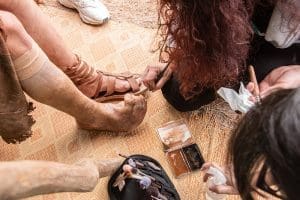
Lehi left all of his valuables behind in Jerusalem as the family embarked on their long journey (see 1 Nephi 2:4), but Sariah had her own valuables-various pieces of jewelry that she’d inherited or had been given to her by her husband. She may well have taken her jewelry with her, and just as the Bedu women, kept most of it in a locked box. Women typically possessed one locked box in which to hold medicines, combs, mirrors, and valuables.[10]
Ancient Hebrews did not keep their valuables in their house. Instead, they buried the jewelry or valuables they weren’t using in their yards. If Sariah brought along her inherited jewelry she could have used it to barter or trade for food or goods along the trail, or even passed it down to her daughters-something with great meaning, since the gifts from a woman’s family she received upon her marriage remained her own property.[11]
Food Preparation
Similar to women’s lives today, the role of a homemaker often revolved around preparing or providing meals. Since ancient times, men and women in Sariah’s culture ate their meals separately. The men were served by the women, then the women disappeared into the cooking room and later ate the leftovers. It was considered a privilege for the women to serve supper to male guests.
Providing meals in the desert would have proved a great challenge to Sariah as she functioned as the matriarch of the family. She somehow had to make very lean pickings in the desert stretch across the growing family. Learning to live off the land, much as the Bedu people, was an urgent priority, and additional restrictions came because Sariah lived the law of Moses.
Due to the law of Moses, Sariah’s family wouldn’t have been able to eat certain animals in the wilderness. A list of suitable animals can be found in Leviticus 11, but generally, they wouldn’t have been able to eat camel meat (padded hoof), or any animals they happened upon that were already dead.
In the wilderness, the Liahona led the family to “the more fertile parts of the wilderness” (1 Nephi 16:16), possibly meaning that they were led from oasis to oasis, or well to well. Wells have been in existence since antiquity, but many of these ancient wells contained bitter water, which was undrinkable-even to animals. The water was bitter because of centuries of camel urine filtering down through the layers of soil and rock. One method of salvaging the water Sariah may have learned from the indigenous Bedu people was to mix the bitter water with camel’s milk so that it became possible to drink.[12]
The men of course hunted for meat, but everything else was part of the women’s domain. A typical breakfast in the wilderness would have consisted of leban, dates with sour milk, or if a guest was present, dates in buttermilk with sweet butter. Butter and sour milk were made and stored in goatskins.[13]
Honey was the most common sweetener, but juice from grapes or dates could also be used. A special treat among desert dwellers was a meal of locusts. When boiled in salted water they taste somewhat like shrimp. If dried in the sun they could be kept for use at some other time of the year, when they would be ground into a powder and mixed with wheat flour for biscuits or simply moistened with honey or vinegar.
Childbirth
Throughout the ancient world, women were considered unclean during childbirth and menses. The birthing mother “was not only impure herself; she also contaminated others, even those in her proximity.” In ancient Persia, the baby and mother were quarantined.[14]
We can assume that most of the women of Lehi and Ishmael’s families gave birth at least once during their eight-year journey through the wilderness (see 1 Nephi 17:1; 18:7). Sariah herself had two sons in the desert, Jacob and Joseph. The older women would likely assist the mother, taking her away from camp, “apart in the wilderness,” to give birth.The birthing place would consist of “a mantle or tent-cloth spread upon the earth.” If a birthing chair was not available, the laboring mother would kneel or sit on her heels.
If a daughter was born, the days of the mother’s purification were doubled from what they would be if she had born a son.[15]
Because blood was considered unclean, whether it was associated with childbirth or preparing meat, washing or cleansing rituals may have been a part of the afterbirth process and later in the purification sacrifice. “Both mother and child had to be purified from the pollution of birth” and “both underwent a ritual bath.” It is also important to understand that the birthing mother only suffered a “physical impurity” and had “committed no moral wrong that require[d] divine forgiveness.”[16]
Under the law, Sariah would have made a burnt offering and a sin (purification) offering, with two birds. The priest would benefit “from the meat of the purification offering,” whereas the burnt offering was for the altar alone, i.e. God.[17] This act of atonement “purified [the woman and child] from the pollution of birth,”[18] which meant to “cleanse” the woman and child from the impurity of blood (see Leviticus 12:6-8).
Murmuring
Having children was, of course, the ultimate aim of all the women in Ancient Israel. Everyone felt very sorry for any wife who failed to deliver at least one son, if not several. Boys were preferred for the simple reason that girls left home when they married; sons were permanent assets while daughters were temporary. Even mothers, then, would prefer to have a son who would remain part of her family forever than a daughter who would eventually have to leave and become part of another household.
It is understandable when Sariah complained as she faced the potential loss of all four of her sons (see 1 Nephi 5:1-3). She had just traveled the distance between Jerusalem and the Valley of Lemuel and knew exactly when her sons should be returning. Her husband was a wanted man in Jerusalem-which might possibly lead to danger for her sons as well. Considering these coupled with the fact that losing her sons would cause others to think she was cursed by the Lord, and she’d have no one to care for her in her old age or defend the family name, we begin to understand her desperation. She loved her sons, and her grief for their potential demise was valid.
The delay of her sons’ return tested Sariah as never before. Yet, the Lord knew that this was an important trial of faith for her to go through. She would need to face even harder trials in the years to come.
Journey of a Lifetime
Lehi and possibly his sons would have been experienced at traveling and living in a tent, but not Sariah or her daughters.[19] Coming from a wealthy home with servants, they would have been ill-prepared to take on the demands of desert living.
Ishmael’s wife and daughters would have no experience either, but they wouldn’t have had to give up as many luxuries as Sariah. Ishmael wouldn’t have been wealthy enough to afford camels for all the supplies and everyone to ride. The baggage was loaded onto the camels, and after baggage, the men and the children would have taken precedence on any remaining camels. In a society where women’s social status was just above that of a slave, healthy women would be the least likely to ride.
Yet, we know that living out of a tent would have been Sariah’s least concern. Living in the Arabian wilderness offered many challenges: intense climate, endless rolling sands with scarcity of water, and peril from wild animals. Her children and grandchildren suffered from lack of food and water. Hostile Arabian tribes who thought nothing of murdering for gain would have threatened at every turn. But even more unsettling, the lack of love between her sons would have been devastating for Sariah.
She was also faced with a difficult choice after her husband passed away. Her son, Nephi, was commanded to flee from Laman in order to preserve his life (see 2 Nephi 5:5). Nephi took all those who believed in the “warnings and the revelations of God” (2 Nephi 5:6). Sariah was in this category. It would have been a difficult experience for her to say goodbye, permanently, to her two oldest sons, their wives, and all of those grandchildren.
We don’t know how long Sariah lived or whether she witnessed the conflicts between the people of Laman and the followers of Nephi that seemed unending. But we do know that Sariah followed a prophet into the wilderness and spent many long years living in harsh, difficult, and deplorable conditions.
Yet from the shores of the Red Sea to the hills of Mesoamerica, her testimony remained firm as she did indeed testify, “Now I know of a surety that the Lord hath commanded my husband to flee into the wilderness” (1 Nephi 5:8).
Heather B. Moore is the Best of State in Fiction award-winning author of Abinadi and Alma the Younger. Her most recent novel, Ammon, was released in 2011. Non-fiction works include Women of the Book of Mormon and Christ’s Gifts to Women, co-authored with Angela Eschler (March 2012). Visit Heather’s website for more titles: www.hbmoore.com
Link to purchase Women of the Book of Mormon
__________________________________________________________
[2] See Camille Fronk, “Desert Epiphany: Sariah & the Women in 1 Nephi” in Journal of Book of Mormon Studies 9, no. 2 (2000): 7-8.
[3] Charles Doughty reveals that “most of the men are lettered, but not all; children learn only from their fathers” (see Travels in Arabia Deserta 1:186).
[5] See John L. Sorenson’s essay, “The Composition of Lehi’s Family,” edited by Stephen D. Ricks and John M. Lundquist, By Study and Also by Faith, 2:179 (Salt Lake City: Deseret Book, and Provo: F.A.R.M.S., 1990).
[9] Head coverings worn by men and women are depicted in Sennacherib’s stone panel, which is based on the Assyrian attack on the Judahite city of Lachish, a century before Nephi’s time period.
The panel is on display in the British Museum, and is published in David Ussishkin’s book, The Conquest of Lachish by Sennacherib [Tel Aviv: Sonia and Marco Nadler Institute of Archaeology of Tel Aviv University, 1982], 86-87.
[11] E. (Ephraim) Neufeld clarifies that the gifts from a woman’s family she receives upon her marriage remain her own property (see Ancient Hebrew Marriage Laws, London, New York, Toronto: Longmans, Green and Co., 1944, 239).
[14] Jacob Milgrom, Leviticus 1–16, A New Translation with Introduction and Commentary, The Anchor Bible, 763.







Rebecca Holmstrom Murrieta, CaliforniaJanuary 17, 2020
Thank you for this wonderful information on Sariah! It was fascinating to read and very helpful for my Stake Primary presentation.